
Deertongue (Dichanthelium clandestinum)
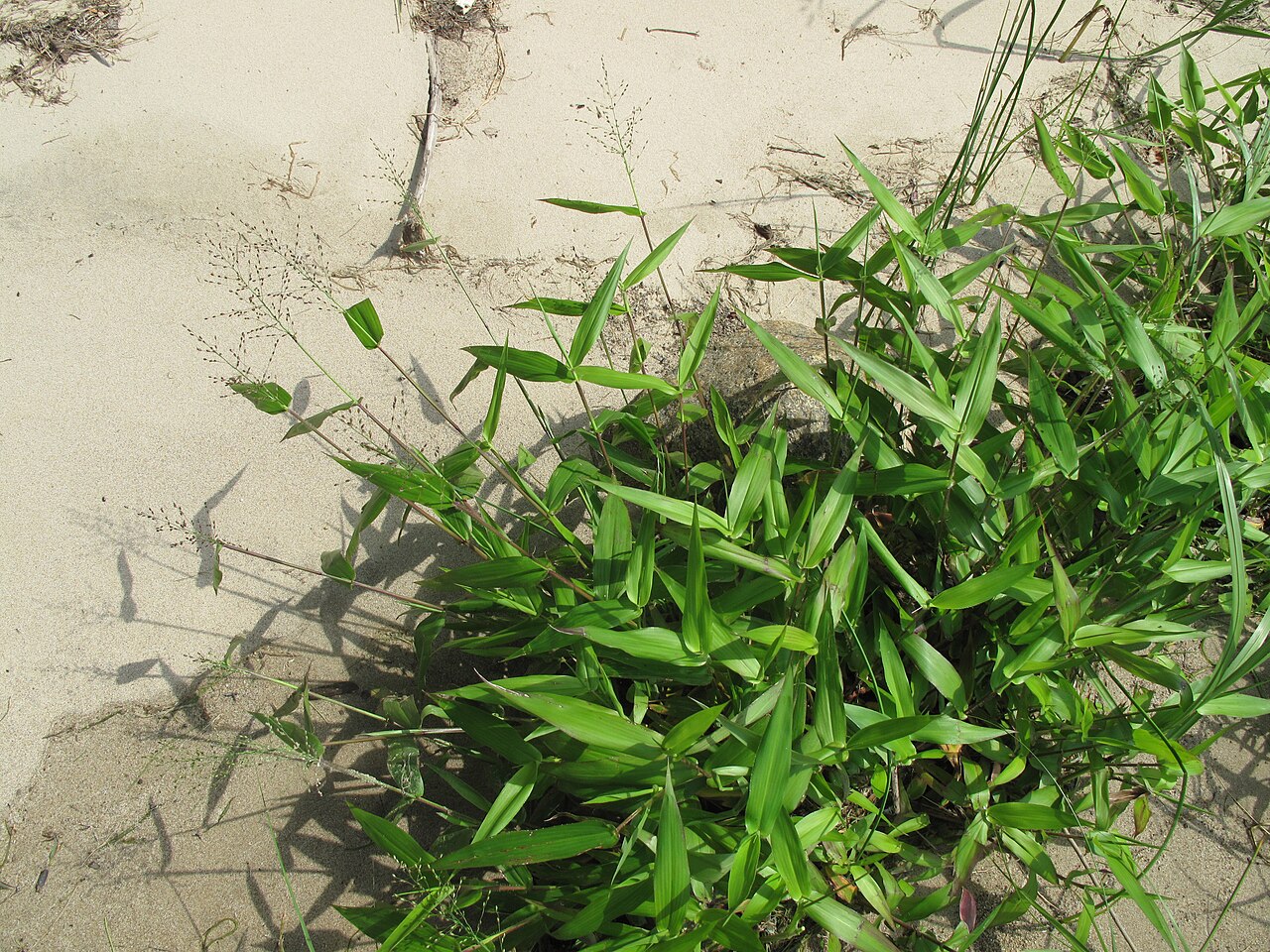
Dichanthelium clandestinum, known as Deertongue or deer-tongue rosette grass (and long known by the older name Panicum clandestinum), is a native perennial grass of eastern North America. It grows 2 to 4 feet tall in leafy clumps that spread by rhizomes into colonies. What sets it apart from almost every other grass is its leaves: short, broad and lance-shaped, up to about an inch wide, clasping the stem at the base. A patch of deertongue looks more like small bamboo than a typical grass.
Deertongue grows in moist, open or lightly shaded places: woodland edges and clearings, stream banks, wet meadows, old fields, ditches and roadsides. It tolerates a remarkable range of conditions, from wet clay to dry sand and from rich soil to very acidic, infertile ground. That toughness has made it one of the most important native grasses for stabilizing eroding slopes and reclaiming acidic mine spoils in the Appalachians.
The species name clandestinum means “hidden” or “secret.” It refers to the small, self-pollinating flowers the plant produces later in the season, tucked away inside the leaf sheaths where they are barely visible. For gardeners, deertongue is an easy, adaptable grass for naturalistic plantings, rain gardens, shady edges and difficult banks, with good value for birds and grass-feeding butterflies.
Identification
Deertongue is one of the easiest native grasses to recognize, thanks to its broad, short leaves. Like other rosette grasses (Dichanthelium), it has a distinctive seasonal cycle, so it looks different in winter, early summer and fall.
Growth Habit
Each plant forms a clump of stiff, leafy stems 2 to 4 feet tall, and the clumps are connected by short, thick rhizomes into colonies that can cover large patches. In fall and winter the plant produces a low basal rosette of short, broad leaves that stays green or purplish through much of the winter. New stems grow from this rosette in spring.
Leaves & Sheaths
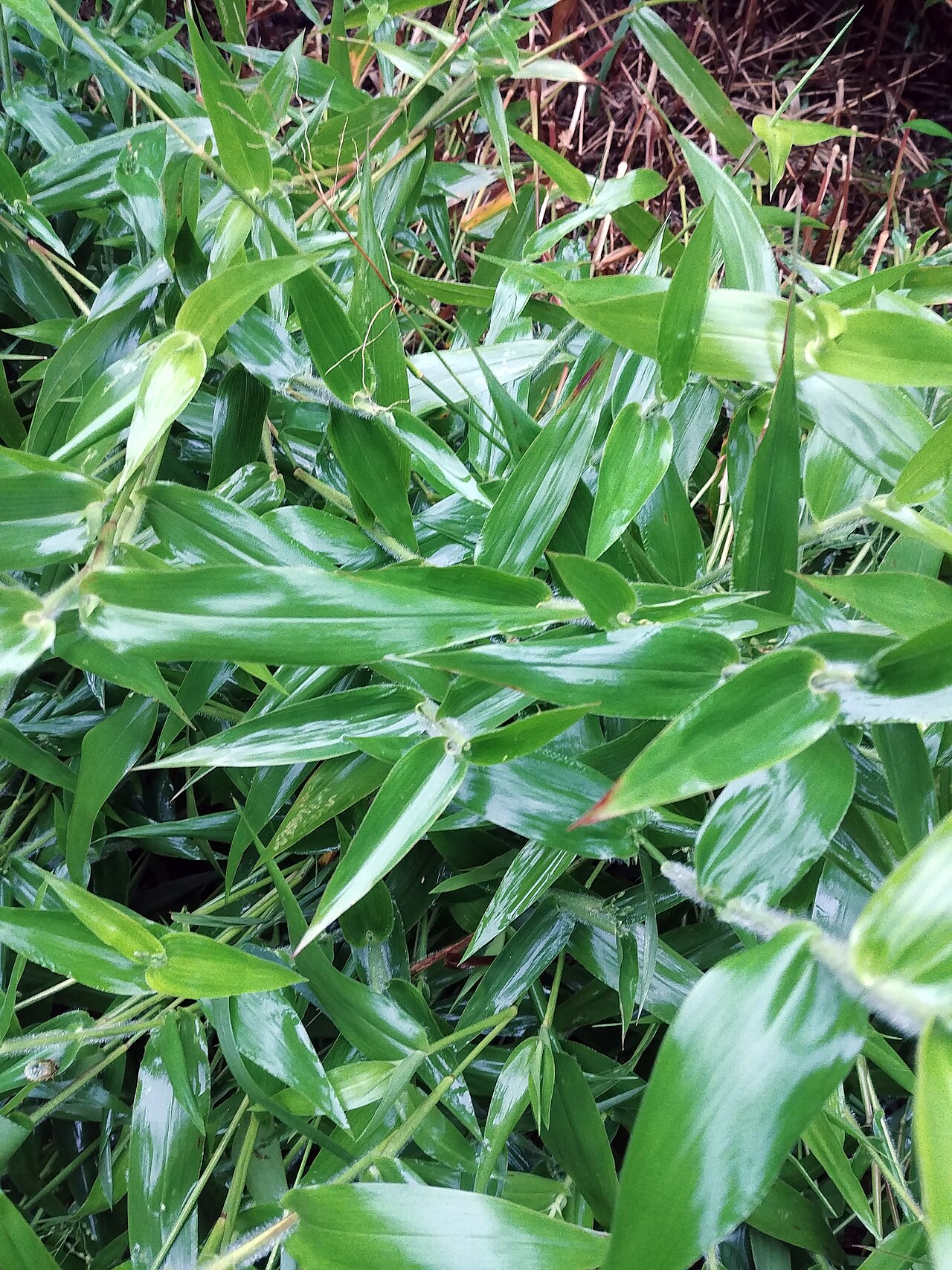
The leaf blades are lance-shaped, 4 to 8 inches long and about ½ to 1¼ inches wide, with a heart-shaped base that clasps the stem. They are green and smooth on top, often fringed with hairs near the base. The leaf sheaths are distinctive: they are usually covered in stiff hairs that grow from tiny bumps (papillae), making them rough or bristly to the touch, though this varies between plants. The overall look, with leaves spaced along an upright stem, is very much like a small bamboo. The foliage often turns purplish or tan in fall.
Flowers & Seed Heads
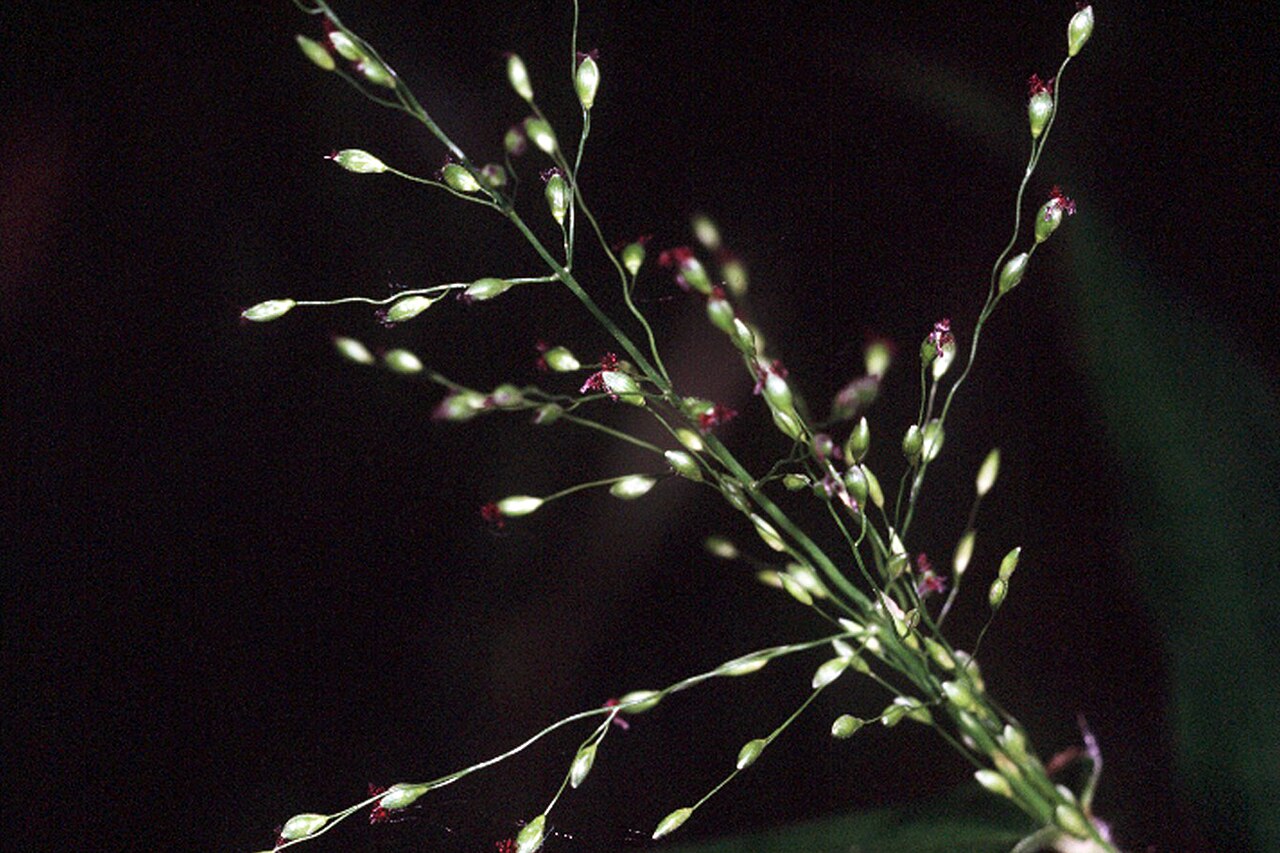
Deertongue flowers twice. In late spring or early summer, each main stem ends in an open, branching panicle 4 to 6 inches long with small, rounded, purplish-green spikelets. These flowers open and are wind-pollinated. Later in summer, the stems branch, and smaller panicles develop partly hidden inside the leaf sheaths. Many of these later flowers never open and pollinate themselves (cleistogamy), which is the “clandestine” behavior behind the species name.
Seeds
Each spikelet holds a single small, hard, oval grain about 3 mm long. Seeds ripen through summer and fall and drop near the parent plant or are eaten and spread by birds.
Quick Facts
| Scientific Name | Dichanthelium clandestinum (syn. Panicum clandestinum) |
| Family | Poaceae (grass family) |
| Plant Type | Perennial rhizomatous rosette grass |
| Mature Height | 2–4 ft |
| Mature Spread | 2–3 ft clumps; spreads by rhizomes into colonies |
| Growth Rate | Moderate to fast |
| Sun Exposure | Full sun to partial shade |
| Water Needs | Moderate to high; tolerates periodic flooding and some drought once established |
| Soil Type | Adaptable: clay, loam or sand; tolerates very acidic, infertile soils |
| Soil pH | About 4.0–7.5 |
| Bloom Time | June–September (open flowers in early summer, hidden flowers later) |
| Flower Color | Inconspicuous; green to purplish spikelets |
| Fall Color | Purplish to tan; winter rosettes often stay green or purple |
| Fruit | Small, hard, oval grain about ⅛ in long |
| Deer Resistant | Low to moderate; young leaves are browsed |
| USDA Hardiness Zones | 4–9 |
Native Range
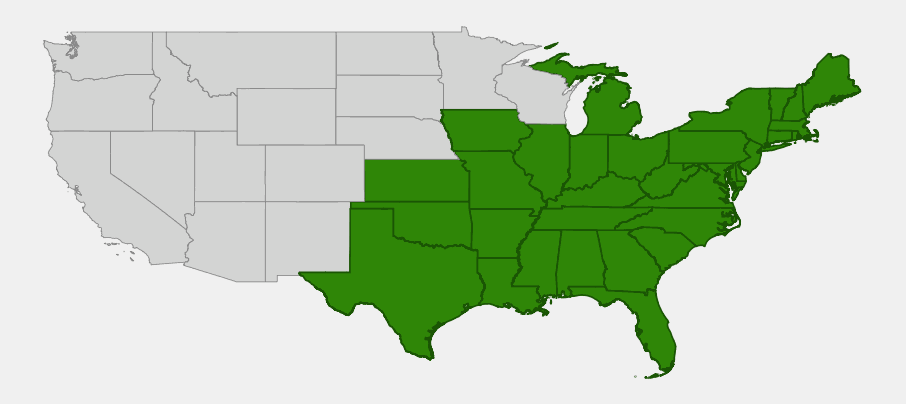
Deertongue is native across most of eastern North America. USDA PLANTS records it in 32 states and the District of Columbia, from Maine and Vermont south to northern Florida and west to Michigan, Iowa, Kansas, Oklahoma and eastern Texas. In Canada it grows in southern Ontario, southern Quebec and Nova Scotia.
It is most common in the Appalachian region, the Piedmont, the Ohio Valley and the Mid-Atlantic, where it is a familiar grass of roadsides, stream banks, power-line corridors and moist woodland clearings. On the southern Coastal Plain it is less common and grows mostly in moist woods and along streams. At the western edge of its range in Kansas, Oklahoma and Texas it is limited to the wetter, wooded eastern parts of those states.
Deertongue is an early colonizer of disturbed sites. It often appears after logging, along newly cut roads and on abandoned fields, and it is one of the few grasses that will grow naturally on the extremely acidic soil and rock left by coal mining.
📋 Regional plant lists featuring Deertongue: New York, Pennsylvania & Northern New Jersey · Ohio & Indiana · Michigan, Wisconsin & Eastern Minnesota · Kentucky & Tennessee · Nebraska, Kansas & Eastern Colorado · Connecticut, Massachusetts & Rhode Island · New Hampshire, Maine & Vermont · Maryland, Virginia & West Virginia · Delaware, Southern New Jersey & Long Island · Illinois, Iowa & Missouri · Alabama, Georgia & Mississippi · North & South Florida · North & South Carolina · Arkansas, Louisiana, Eastern Oklahoma & Eastern Texas
Growing & Care Guide
Deertongue is a very adaptable, low-maintenance native grass. It grows quickly from seed or plugs, spreads to fill space, and has an unusual bamboo-like texture that adds interest to naturalistic plantings. It is not a formal ornamental grass, so give it room where spreading is an advantage.
Light
Deertongue grows well in full sun and in partial shade. It is one of the better native grasses for woodland edges, light shade under open trees and the north side of buildings. In deep shade it becomes sparse and flowers poorly.
Soil & Water
It prefers moist soil but tolerates a wide range, from seasonally wet clay to sandy, fairly dry ground. It is especially valued for its tolerance of very acidic, low-fertility soils where few other grasses grow. No fertilizer is needed. In a rain garden it can handle short periods of standing water.
Planting Tips
Plant plugs or divisions in spring or fall about 18 to 24 inches apart. It can also be seeded in spring or fall into a firm, weed-free seedbed, covering the seed lightly. It mixes well with other native grasses and wildflowers for erosion control or meadow plantings. Expect it to spread by rhizomes, and plant it where that is welcome.
Pruning & Maintenance
Cut back the old stems in late winter or early spring before new growth starts, leaving the low winter rosettes. If it spreads beyond where you want it, dig out the edges of the colony in spring. Otherwise it needs little attention, and established plants are seldom troubled by pests or disease.
Propagation
Deertongue is easy to propagate by dividing clumps in spring or by seed. Seed germinates more evenly after a period of cold, moist stratification, so fall or winter sowing outdoors works well. Seed of the cultivar ‘Tioga’, selected by the USDA NRCS for mine reclamation, is sometimes available from conservation seed suppliers.
Landscape Uses
- Erosion control: banks, slopes, ditches and stream edges, where its rhizomes bind the soil
- Mine and disturbed-land reclamation: one of the most acid-tolerant native grasses for revegetating mine spoils and other degraded soils
- Rain gardens and swales: tolerates both short flooding and dry spells
- Woodland edges and shade gardens: a native grass for light shade, with a bamboo-like texture
- Wildlife plantings: seeds for birds and foliage for grass-feeding caterpillars
Wildlife & Ecological Value
Deertongue is a quietly valuable plant for wildlife, offering seeds, cover and caterpillar food across a long season.
For Pollinators
Like all grasses, deertongue is wind-pollinated and offers little to nectar-feeding insects. It is, however, a larval host plant for grass-feeding skippers, including the northern broken-dash (Wallengrenia egeremet), whose caterpillars feed on rosette grasses. Its leaves and dense clumps also shelter many other insects through the year.
For Birds
The seeds are eaten by wild turkeys, northern bobwhite and many songbirds, including sparrows and juncos, which pick fallen seeds from the ground. Dense colonies provide cover for ground-nesting birds and small game.
For Mammals
White-tailed deer eat the young leaves and winter rosettes, and small mammals use the dense clumps for cover. The common name is generally explained by the leaf shape, which suggests a deer’s tongue.
Ecosystem Role
As a fast-spreading early colonizer, deertongue helps stabilize bare and disturbed soil, reduces erosion along streams and roadsides, and creates conditions for other plants to establish. Its ability to grow on very acidic mine spoils makes it a key species in restoring Appalachian landscapes damaged by mining.
Cultural & Historical Uses
Carl Linnaeus described this grass in 1753 as Panicum clandestinum, and it kept that name in most American manuals for more than two centuries. Botanists later placed the rosette panicgrasses in their own genus, Dichanthelium, based on their winter rosettes and two-phase flowering, and Frank Gould made the combination Dichanthelium clandestinum in 1974. Both names are still widely used.
Deertongue has found an important modern role in land reclamation. In the 1970s, the USDA Soil Conservation Service (now the Natural Resources Conservation Service) released the cultivar ‘Tioga’ from its Big Flats Plant Materials Center in New York for stabilizing acidic, infertile mine spoils, eroding banks and other critical areas. It is still used in conservation seed mixes for these purposes.
For gardeners interested in native plants, deertongue is a reminder that useful native grasses are not limited to prairie species. Its broad, bamboo-like leaves and tolerance of shade make it suitable for woodland edges and other places where typical prairie grasses struggle.
Frequently Asked Questions
Why is it called deertongue?
The name is usually explained by the broad, smooth, tongue-shaped leaves, and deer also graze the young leaves. It is unrelated to the heirloom lettuce sold as deer tongue.
Is deertongue invasive?
It is native across eastern North America and not invasive there, but it does spread by rhizomes and can form large colonies. Give it room, or plant it where spreading is useful, such as on banks and in naturalized areas.
Will deertongue grow in shade?
Yes, it grows well in partial shade and is one of the more shade-tolerant native grasses. It needs at least a few hours of sun or bright dappled light to stay dense and flower well.
What is the difference between Dichanthelium and Panicum?
Both are panicgrasses, and deertongue was long called Panicum clandestinum. Rosette grasses (Dichanthelium) form low winter rosettes and flower twice, first with open flowers in early summer and then with hidden, self-pollinating flowers later. Species of Panicum in the strict sense, such as switchgrass, do not.
Is deertongue good for erosion control?
Yes. Its rhizomes and fibrous roots bind soil, it establishes quickly, and it tolerates acidic, infertile and disturbed soils. It is widely used on slopes, stream banks, roadsides and reclaimed mine land.

Looking for a nursery that carries Deertongue?
Browse our native plant nursery directory: Alabama & Arkansas · Connecticut, Delaware, Florida & Georgia · Illinois, Indiana, Iowa & Kansas · Kentucky, Louisiana, Maine, Maryland, Massachusetts, Michigan, Mississippi & Missouri · New Hampshire, New Jersey, New York, North Carolina, Ohio & Oklahoma · Pennsylvania, Rhode Island, South Carolina, Tennessee, Texas, Vermont & Virginia · West Virginia