
Texas Stork’s Bill (Erodium texanum)
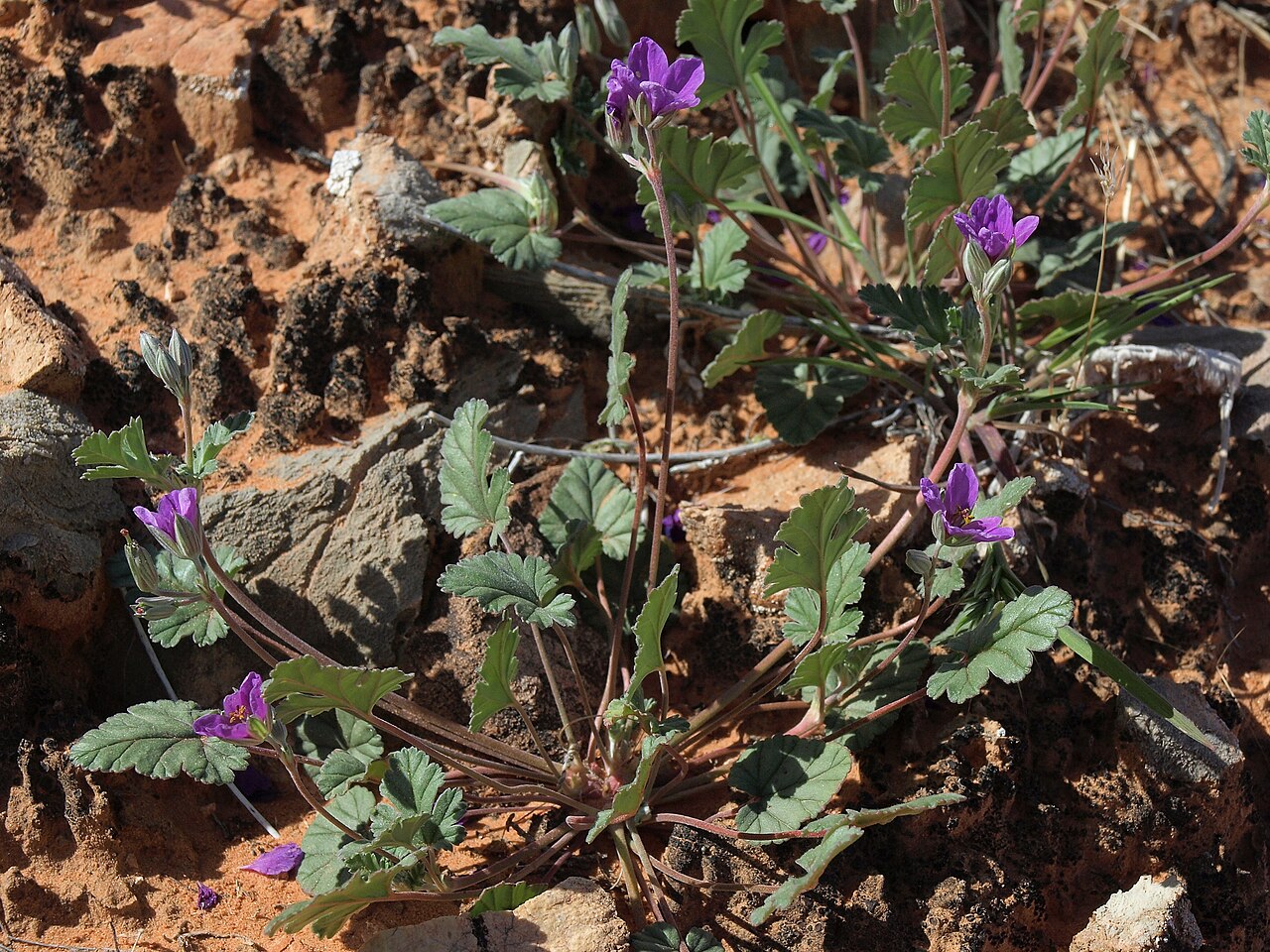
Erodium texanum, known as Texas Stork’s Bill, Texas storksbill or Texas filaree, is a native wildflower of the geranium family (Geraniaceae) found from central and western Texas and southwestern Oklahoma west through New Mexico and Arizona to southern Nevada, southwestern Utah and southeastern California. It is a low winter annual or short-lived biennial with gray-green, scalloped, three-lobed leaves and showy magenta to purple flowers about an inch across in late winter and spring.
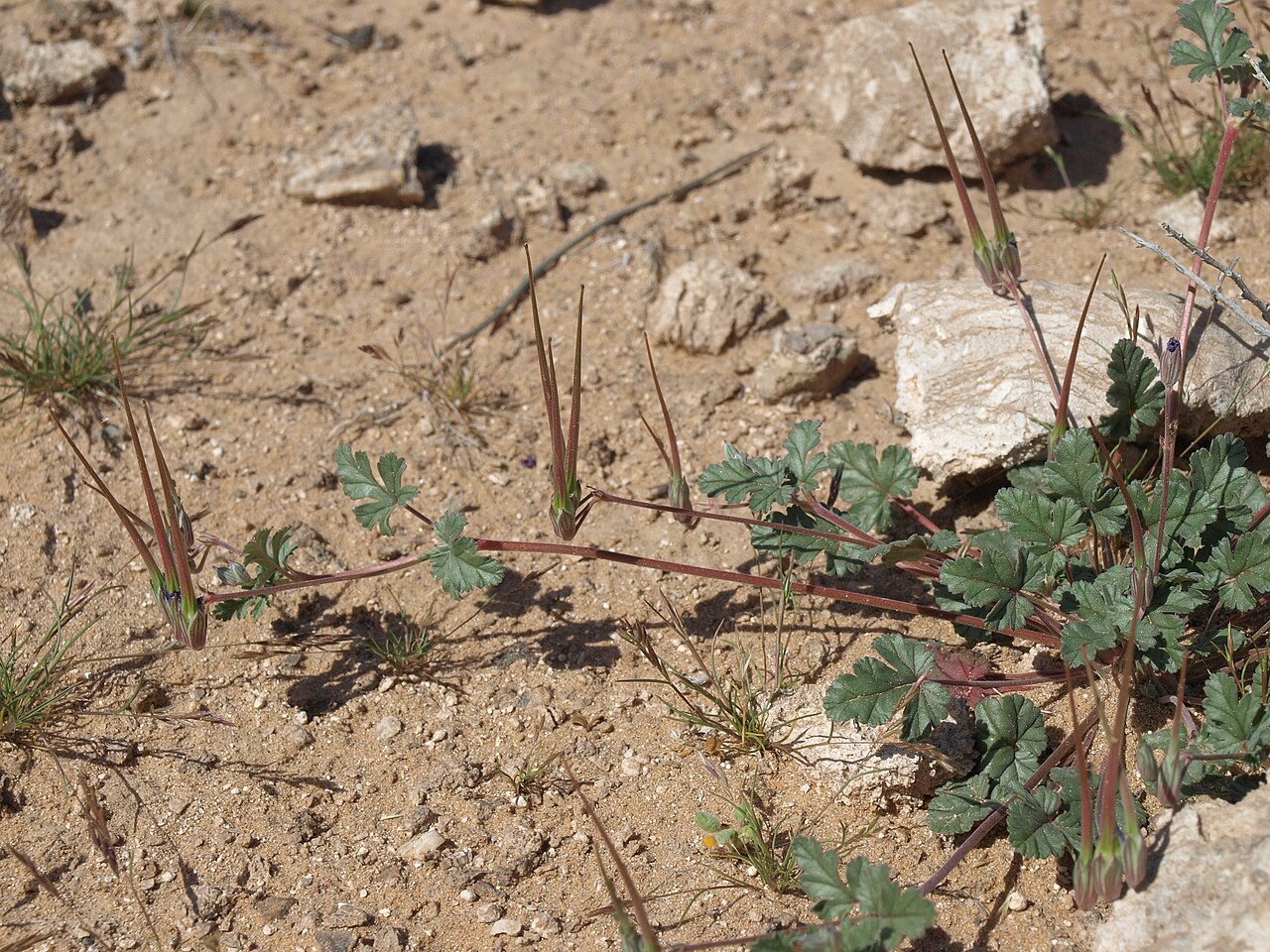
The common name comes from its fruit. After flowering, each flower develops a slender beak 1½ to 3 inches long, shaped like a stork’s bill. When ripe, the beak splits into five sections, each with a seed at the base and a long tail (awn) that twists into a spiral as it dries. Changes in humidity make the awn coil and uncoil, which drives the seed into the soil like a tiny drill.
Texas stork’s bill is often confused with the common filaree or redstem stork’s bill (Erodium cicutarium), a Mediterranean species that has spread across much of North America. Unlike that introduced weed, Texas stork’s bill is a true native of the Southwest. It has broad, lobed leaves rather than finely divided ones, and much larger flowers. It is a charming plant for desert and rock gardens and an early food source for pollinators.
Identification
Texas stork’s bill is easy to recognize in spring by its large purple flowers, broad scalloped leaves and long beaked fruits. The key is to separate it from the introduced filaree, which often grows in the same places.
Leaves & Stems
The plant begins as a flat rosette of long-stalked leaves. The leaf blades are oval to heart-shaped, ¾ to 2 inches long, with three shallow, rounded lobes and scalloped edges. They are gray-green and covered with fine hairs, and they often turn reddish in cold or dry weather. Later, the plant sends out reddish stems that sprawl along the ground or curve upward, up to about 20 inches long.
Flowers
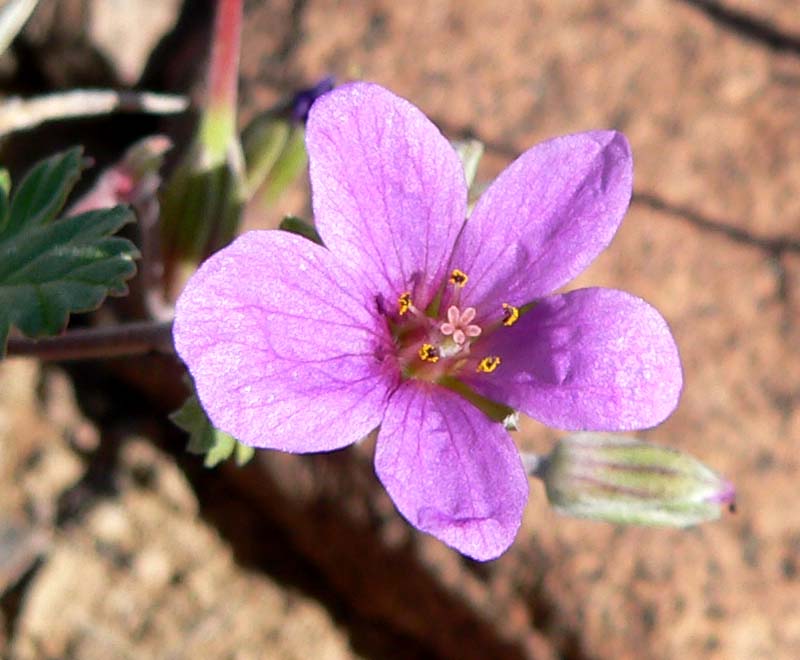
Flowers come in clusters of two or three on long stalks from the leaf axils. Each flower has five rounded petals, ½ to ¾ inch long, magenta to purple or pinkish purple, with darker veins, around a ring of stamens with bright yellow pollen. The flowers often open in the late afternoon and close by the following morning, except in cloudy weather, so a plant may look flowerless at midday. Bloom time is mainly February through May, depending on winter rains.
Fruit & Seeds
Pollinated flowers form a long, needle-like beak, 1½ to 3 inches long, which is longer and stouter than the beak of common filaree. At maturity the fruit splits into five mericarps. Each holds one seed and has a long awn that coils into a tight spiral as it dries and unwinds when wet. This movement twists the pointed, bristly seed into the soil.
Native vs. Introduced Filaree
Common filaree (Erodium cicutarium), introduced from the Mediterranean, has fern-like leaves that are divided all the way to the midrib into many small leaflets, and small pink flowers about ½ inch wide. Texas stork’s bill has undivided, three-lobed, scalloped leaves and larger flowers. Another introduced species, broadleaf filaree (E. botrys), has deeply lobed leaves and grows mostly in California.
Quick Facts
| Scientific Name | Erodium texanum |
| Family | Geraniaceae (geranium family) |
| Plant Type | Winter annual or short-lived biennial wildflower |
| Mature Height | 2–6 in tall; stems spread to 20 in |
| Mature Spread | 6–20 in |
| Growth Rate | Fast |
| Sun Exposure | Full sun |
| Water Needs | Low; winter and spring moisture only |
| Soil Type | Dry, rocky, gravelly or sandy soil; often limestone or caliche |
| Soil pH | About 7.0–8.5 (neutral to alkaline) |
| Bloom Time | February–May |
| Flower Color | Magenta, purple or pinkish purple |
| Fall Color | None; leaves often redden in cold or drought |
| Fruit | Long, beak-like fruit (1½–3 in) splitting into five coiling segments |
| Deer Resistant | Moderate |
| USDA Hardiness Zones | Grown as an annual; suited to zones 7–10 |
Native Range
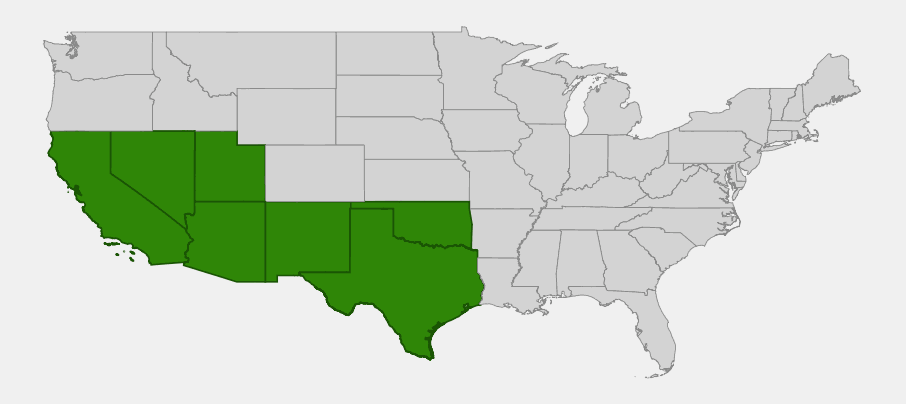
Texas stork’s bill is native to the southwestern United States and northern Mexico. USDA PLANTS records it in Texas, Oklahoma, New Mexico, Arizona, Nevada, Utah and California. In Texas it is widespread through the Edwards Plateau, central Texas, the Trans-Pecos and South Texas, and in Oklahoma it is limited to the southwestern corner. Westward it grows across southern New Mexico and Arizona, in the Mojave Desert of southern Nevada and southwestern Utah, and in the deserts of southeastern California.
USDA PLANTS also lists Missouri and South Carolina. The only herbarium specimens we found from those states were collected around a railroad freight yard in St. Louis and a wool-processing mill in South Carolina in the 1950s and 1960s. These were short-lived introductions (waifs) carried by freight and wool, not native populations, so we have left those states off the range map.
Throughout its range it grows on open, dry, sunny ground, especially rocky or gravelly limestone soils, caliche flats, desert pavements and bajadas, grassland openings and roadsides. Like other desert annuals, it may be scarce in dry years and abundant after good winter rains.
📋 Regional plant lists featuring Texas Stork’s Bill: Idaho, Eastern Oregon & Eastern Washington · Utah & Western Colorado · Arizona & New Mexico · South & West Texas · California & Nevada
Growing & Care Guide
Texas stork’s bill is an easy annual for dry, sunny gardens in the Southwest. It grows quickly from seed sown in fall, blooms in late winter and spring, and reseeds itself. Its low, spreading habit makes it a good choice for rock gardens, gravel gardens and the edges of desert plantings.
Light
Plant it in full sun. It flowers best and stays compact in bright, open sites.
Soil & Water
It needs well-drained soil and does especially well in rocky, gravelly or sandy soil, including alkaline limestone and caliche. Winter rains are usually enough. Water occasionally during a dry winter to help seedlings establish, but avoid watering in summer, when the plant naturally dies back.
Planting Tips
Sow seed in fall on bare, well-drained soil, scattering it thinly and raking it in lightly. The seeds bury themselves as their awns twist, so they need little covering. Plant it where its low rosettes are not hidden by taller plants.
Pruning & Maintenance
No pruning is needed. Let the plants set seed and dry out naturally. If filaree or other weedy annuals are present, pull them early so they don’t crowd out the native species.
Propagation
Grow it from seed. Collect the ripe fruit segments in late spring as they turn brown and separate, then store them dry until fall. Once established in a garden, it often reseeds on its own.
Landscape Uses
- Rock and gravel gardens: a low, spreading annual with bright spring color
- Desert and xeriscape plantings: needs only winter rain
- Native wildflower meadows: mixes with bluebonnets, Indian blanket and other spring annuals
- Pollinator gardens: early-season nectar and pollen for native bees
- Restoration of dry grasslands and desert flats: a native alternative to introduced filaree
Wildlife & Ecological Value
Texas stork’s bill is a small but valuable member of the spring flora in Southwestern grasslands and deserts.
For Pollinators
The flowers offer nectar and pollen early in the season, and they are visited by native bees, including small solitary bees, as well as flies and butterflies.
For Birds
Seed-eating birds such as quail, doves and sparrows forage among spring annuals and eat their seeds, including those of stork’s bills.
For Mammals
Desert tortoises, rodents, rabbits and other herbivores browse the leaves of spring annuals, and rodents collect and store the seeds.
Ecosystem Role
As a native winter annual, Texas stork’s bill is part of the flush of growth after winter rains that supports food webs in deserts and dry grasslands. Its self-burying seeds help it persist in harsh, open soils. In many places it competes with the introduced common filaree, and it is a native alternative for restoration plantings.
Cultural & Historical Uses
Asa Gray described Erodium texanum in the mid-nineteenth century from specimens collected in Texas, where much of the botanical exploration of the Southwest began. The genus name comes from the Greek erodios, heron, another reference to the long, beak-like fruit. In English, the related names “stork’s bill” and “crane’s bill” are used for Erodium and Geranium, respectively.
The twisting awns of Erodium seeds have long fascinated scientists and naturalists. Because they coil and uncoil with changes in humidity, they have been used as simple hygrometers, and recent studies of their drilling motion have inspired designs for self-burying seed carriers and small robots.
Today Texas stork’s bill is mostly appreciated as a spring wildflower of the Texas Hill Country and Southwestern deserts. Because the introduced common filaree is so widespread, learning to recognize the native species helps gardeners and land managers protect native wildflower communities.
Frequently Asked Questions
How can I tell Texas stork’s bill from common filaree?
Look at the leaves and flowers. Texas stork’s bill has broad, three-lobed, scalloped leaves and flowers about an inch wide. Common filaree (Erodium cicutarium), introduced from the Mediterranean, has fern-like, finely divided leaves and small pink flowers about half an inch wide.
Is Texas stork’s bill native?
Yes. It is native to Texas, Oklahoma and the desert Southwest. Most other stork’s bills found in North America were introduced from Europe and the Mediterranean.
Why are the flowers closed when I see the plant?
The flowers usually open in the late afternoon and close the next morning, except on cloudy days. Check in the late afternoon or evening to see them in full bloom.
How do the seeds plant themselves?
Each seed is attached to a long awn that coils as it dries and uncoils when it gets wet. These movements twist the sharp, bristly seed into the soil, burying it.
When should I sow Texas stork’s bill seeds?
Sow in fall, ideally just before the winter rains. The seeds germinate in the cool season and bloom from late winter into spring.

Looking for a nursery that carries Texas Stork’s Bill?
Browse our native plant nursery directory: Arizona · California · Nevada, New Mexico & Oklahoma · Texas & Utah