
Bride’s Bonnet (Clintonia uniflora)
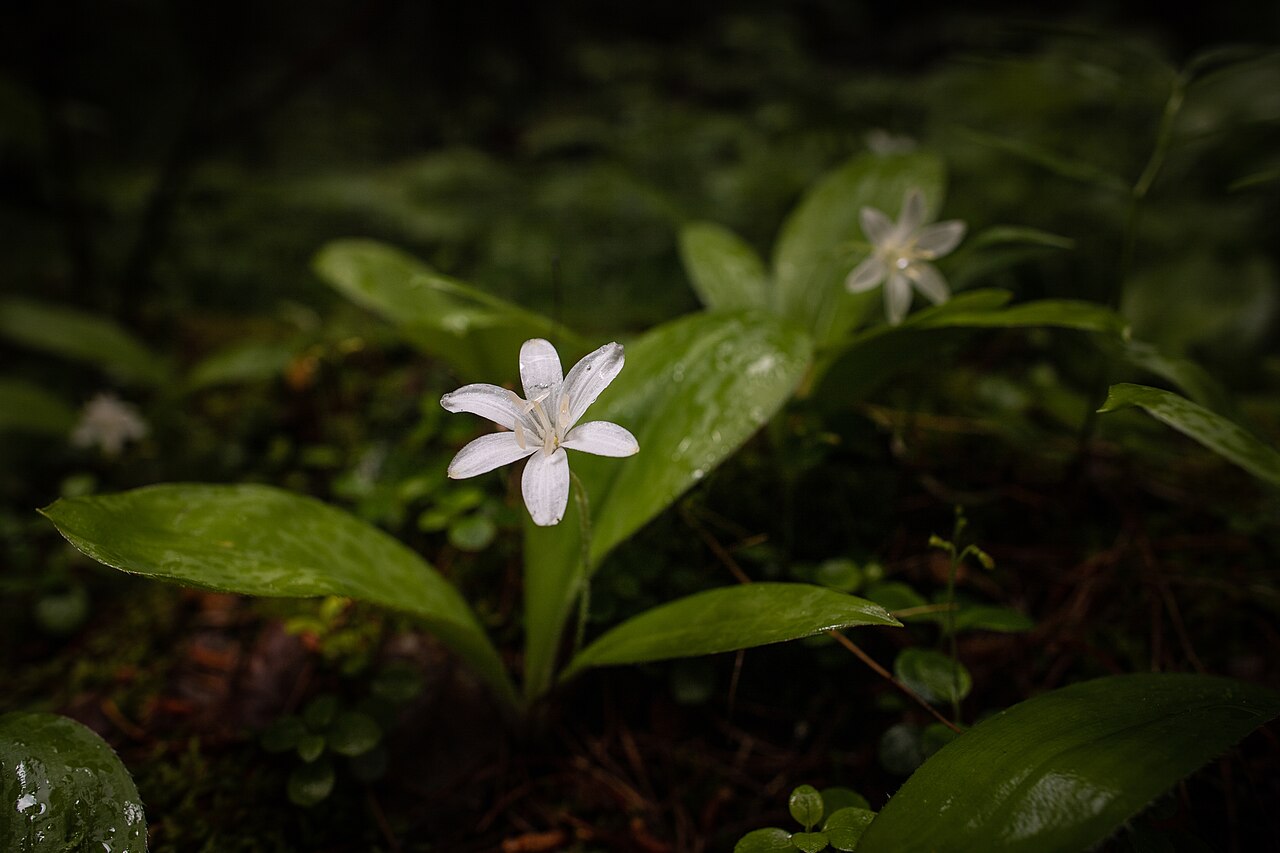
Clintonia uniflora, known as Bride’s Bonnet (also queen’s cup or bead lily), is a small woodland lily of the moist conifer forests of the Pacific Northwest and northern Rocky Mountains. In late spring and early summer it lifts a single pure-white, star-shaped flower just above a pair or trio of broad, glossy leaves, lighting up the shaded forest floor beneath hemlock, fir and cedar.
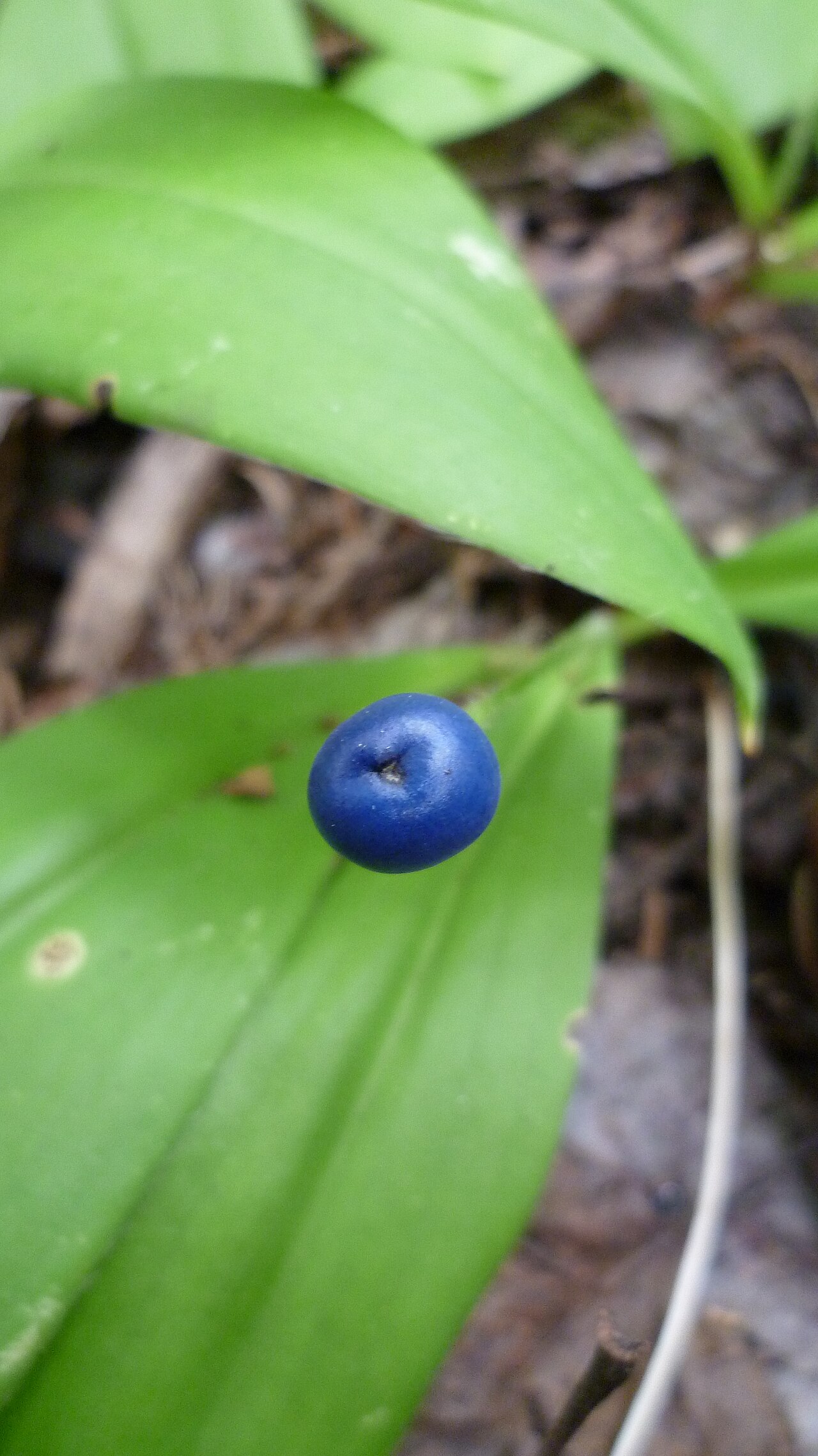
It is a low perennial, usually 3 to 8 inches tall, that spreads slowly by thin underground rhizomes into loose colonies. After the flower fades it produces one round, porcelain-blue berry, which gives it the name bead lily. It belongs to the lily family (Liliaceae) and is the western cousin of the eastern Bluebead Lily (Clintonia borealis).
Bride’s bonnet is a plant of cool, humid, shaded forests with deep leaf litter. It can be grown in a shade or woodland garden in a cool climate, but it is slow to establish and dislikes heat and drought. Buy nursery-grown plants or grow it from seed; never dig it from the wild.
Identification
Look for two or three shiny, oblong basal leaves and a short leafless stalk topped by one (rarely two) upward-facing white flowers with six tepals, in moist, shady conifer forest in late spring and summer. In late summer, look for a single deep-blue berry on the stalk.
Leaves
The leaves all grow from the base. There are usually two or three per plant, oblong to oblanceolate, 3 to 6 inches (8 to 15 cm) long and 1 to 2 1/2 inches wide. They are bright green, glossy and somewhat fleshy, with fine hairs along the edges. Non-flowering plants in a colony often have just one or two leaves.
Flowers
A slender, hairy, leafless stalk 2 to 6 inches tall rises from between the leaves and bears a single flower, rarely two. The flower is white, about 1 to 1 1/2 inches (2.5 to 4 cm) across, open and star-shaped to shallowly cupped, with six spreading tepals and six stamens with yellow anthers. It faces upward or outward. Bloom is from May to July, later at higher elevations.
Fruit
Each flower ripens a single round berry about 1/3 to 1/2 inch across. It is a vivid, glossy blue, sometimes described as porcelain or amethyst blue, and holds several seeds. Berries ripen from July to September. They are not considered edible for people.
Roots & Growth
Bride’s bonnet spreads by slender, creeping rhizomes just under the leaf litter. Over many years a single plant can form a patch of dozens of leaf pairs, though only some of them flower in any given year.
Look-alikes
Bluebead Lily (C. borealis), of the northeastern U.S. and Canada, has several nodding, greenish-yellow flowers per stalk. White Clintonia (C. umbellulata) of the Appalachians has a dense cluster of small white flowers and black berries. Andrews’ clintonia (C. andrewsiana) of coastal northern California has many deep pink-red flowers on a tall stalk. In the same forests, False Lily of the Valley (Maianthemum dilatatum) has heart-shaped leaves on its stem and a spike of tiny white flowers.
Quick Facts
| Scientific Name | Clintonia uniflora |
| Family | Liliaceae (lily family) |
| Plant Type | Rhizomatous herbaceous perennial |
| Mature Height | 3–8 in |
| Mature Spread | 6–12 in; slowly spreads into colonies |
| Growth Rate | Slow |
| Sun Exposure | Part shade to full shade |
| Water Needs | Moderate; evenly moist soil |
| Soil Type | Rich, humusy, well-drained forest soil |
| Soil pH | About 5.0–6.5 (acidic) |
| Bloom Time | May–July |
| Flower Color | White |
| Fall Color | None notable; leaves yellow and die back |
| Fruit | Single glossy blue berry, July–September |
| Deer Resistant | Moderate; occasionally browsed |
| USDA Hardiness Zones | 4–8 |
Native Range
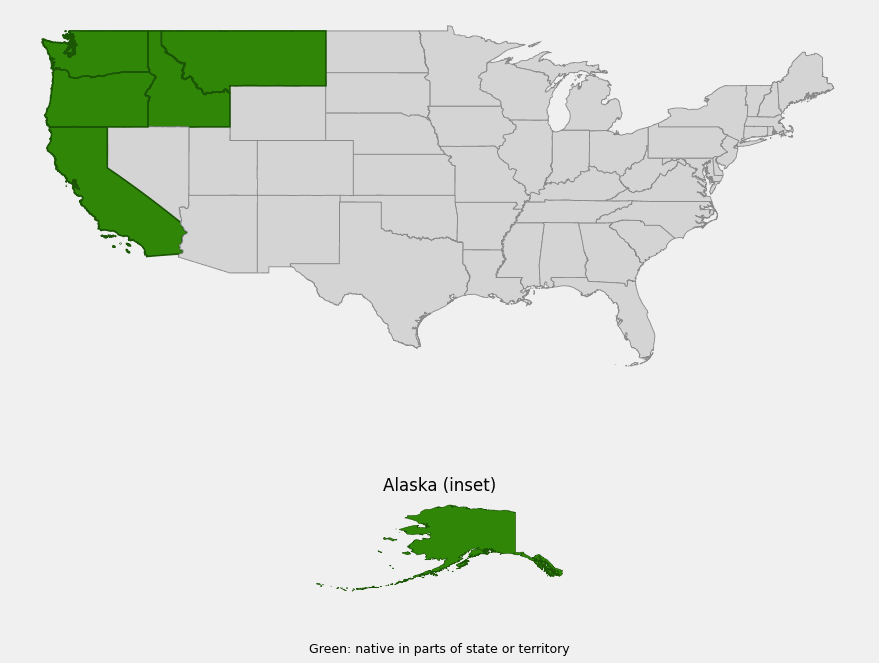
Bride’s bonnet is native to western North America. USDA PLANTS lists it as native in Alaska, California, Idaho, Montana, Oregon and Washington, and in British Columbia and Alberta in Canada. In Alaska it reaches only the far southeastern panhandle, and in California it runs south through the North Coast Ranges and the Sierra Nevada to about Tulare County.
Its heartland is the moist forest belt from southern British Columbia through western Washington and Oregon, including the Cascades and Olympic Mountains, and east through the wetter forests of northeastern Washington, northern Idaho and western Montana, such as Glacier National Park. It also grows in the Blue Mountains of eastern Oregon and southeastern Washington.
It grows in moist, shady coniferous and mixed forests from low elevations to the subalpine zone, typically under western hemlock, western redcedar, Douglas-fir, grand fir and subalpine fir, in deep duff and leaf litter. It often grows with other shade-loving wildflowers such as twinflower, vanilla leaf, foamflower and false lily of the valley.
📋 Regional plant lists featuring Bride’s Bonnet: Idaho, Eastern Oregon & Eastern Washington · Montana & Wyoming · Alaska · Western Oregon & Western Washington · California & Nevada
Growing & Care Guide
Bride’s bonnet is a choice plant for cool, shaded woodland gardens in the Pacific Northwest and similar climates. It needs patience: plants grow slowly and seedlings take several years to bloom, but an established patch is long-lived.
Light
Part shade to full shade. Bright, dappled shade under conifers or deciduous trees is ideal. Direct afternoon sun scorches the leaves.
Soil & Water
Plant it in rich, acidic, humusy soil that stays evenly moist but drains well, like a forest floor. Mulch with leaf litter or conifer needles. Water during dry spells in summer; it does not tolerate drought or hot, dry sites, and it struggles in hot-summer climates.
Planting Tips
Plant rhizome divisions or potted plants in early spring or fall, with the rhizome about 1 inch deep. Space them 6 to 12 inches apart and let them slowly fill in. It pairs well with ferns, foamflower, wild ginger and vanilla leaf. Protect young plants from slugs, which feed on the leaves.
Pruning & Maintenance
No pruning is needed. Leave fallen leaves in place as natural mulch. Avoid disturbing the shallow rhizomes with digging or heavy foot traffic.
Propagation
Divide established clumps in early spring or fall. It can also be grown from seed cleaned from ripe berries and sown outdoors in fall for natural cold stratification; germination is slow, and seedlings may take three to four years or more to flower. Buy nursery-propagated plants rather than collecting from the wild.
Landscape Uses
- Woodland gardens: a fine groundcover accent under conifers
- Shade gardens: glossy leaves, white flowers and blue berries in deep shade
- Native fern gardens: pairs well with sword fern and deer fern
- Naturalizing: slowly forms colonies in moist forest soil
- Forest restoration: native understory plant for moist conifer sites
Wildlife & Ecological Value
Bride’s bonnet is a small but steady part of the western forest understory, offering early-summer nectar and late-summer berries.
For Pollinators
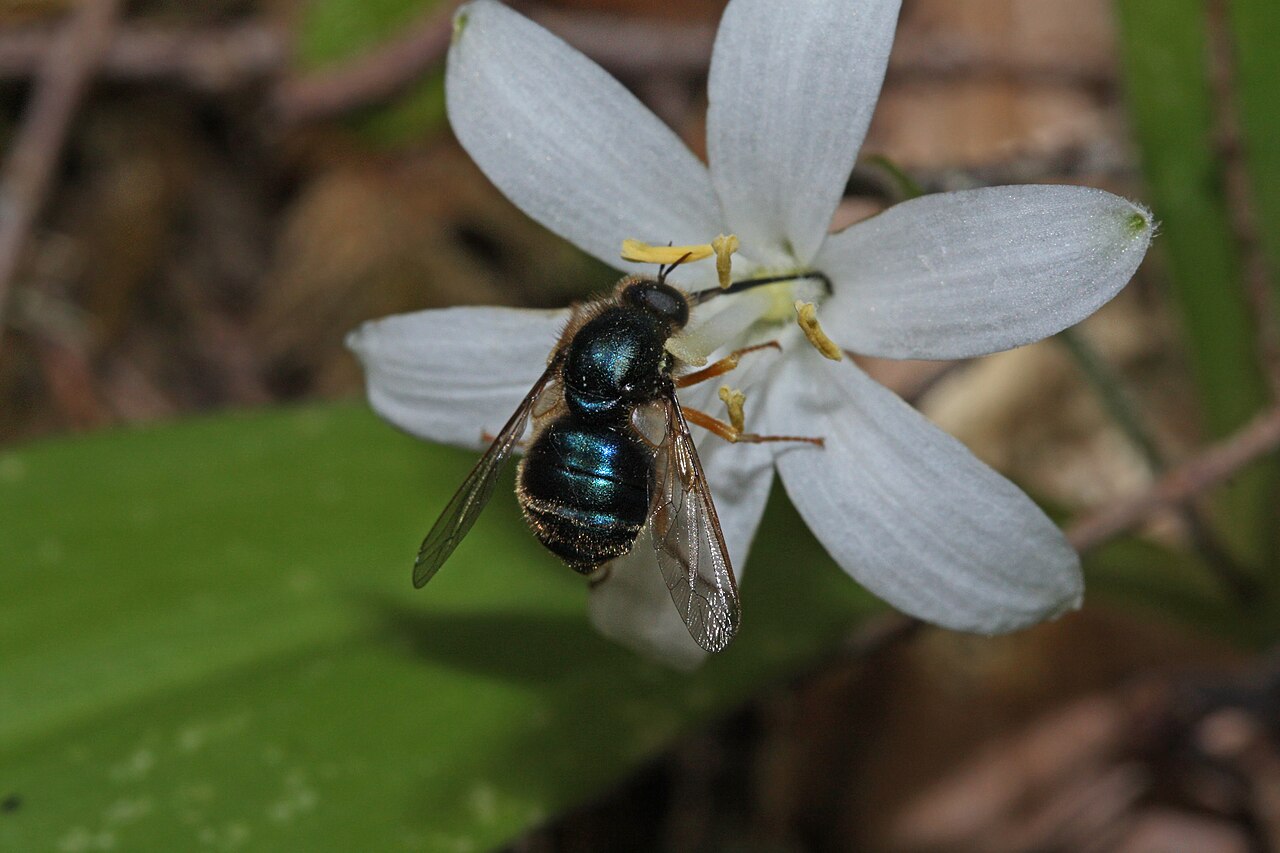
The open white flowers are visited by bumblebees, small native bees and flies, including spectacular metallic small-headed flies (Eulonchus), whose larvae are parasites of spiders.
For Birds
Ruffed grouse and other forest grouse eat the blue berries, and some songbirds may take them as well. Birds help spread the seeds through the forest.
For Mammals
Small mammals may eat fallen berries. Deer occasionally browse the leaves, but it is not a preferred food.
Ecosystem Role
As a slow-growing, long-lived understory plant, bride’s bonnet is an indicator of moist, relatively undisturbed forest. Its colonies help hold the duff layer and contribute to the diverse herb layer of old conifer forests.
Cultural & Historical Uses
The genus Clintonia is named for DeWitt Clinton (1769–1828), a governor of New York and an amateur naturalist. The species name uniflora means “one-flowered,” describing the single bloom on each stalk. The names bride’s bonnet and queen’s cup refer to the pure-white, cup-shaped flower, and bead lily to the blue berry.
Ethnobotanical records note that some Indigenous peoples of British Columbia and the Pacific Northwest used the leaves externally, for example as a poultice on cuts and sores or in eye washes. The berries were generally not eaten.
Clintonia has an interesting distribution: two species grow in western North America, two in eastern North America, and the remainder in eastern Asia, a pattern shared by many forest plants. On this site, related species include Bluebead Lily and White Clintonia.
Frequently Asked Questions
Why is it called bride’s bonnet?
The name refers to the pure-white, cupped flower held above the leaves. It is also called queen’s cup for the same reason, and bead lily for its single blue berry.
Are bride’s bonnet berries edible?
They are not considered edible. The berries were generally not eaten by Indigenous peoples and are best left for grouse and other wildlife.
Can I grow bride’s bonnet in my garden?
Yes, in a cool, shady woodland garden with rich, moist, acidic soil. It is slow to establish and struggles in hot, dry climates. Buy nursery-propagated plants or grow it from seed; never dig it from the wild.
How is it different from bluebead lily?
Bride’s bonnet grows in the West and has one (rarely two) white, upward-facing flowers. Bluebead lily (Clintonia borealis) grows in the Northeast and has several nodding, greenish-yellow flowers per stalk.
When does bride’s bonnet bloom?
From May to July, depending on elevation and latitude. The blue berries ripen from July to September.

Looking for a nursery that carries Bride’s Bonnet?
Browse our native plant nursery directory: Alaska · California · Idaho · Montana · Oregon · Washington