
Bigpod Sesbania (Sesbania herbacea)
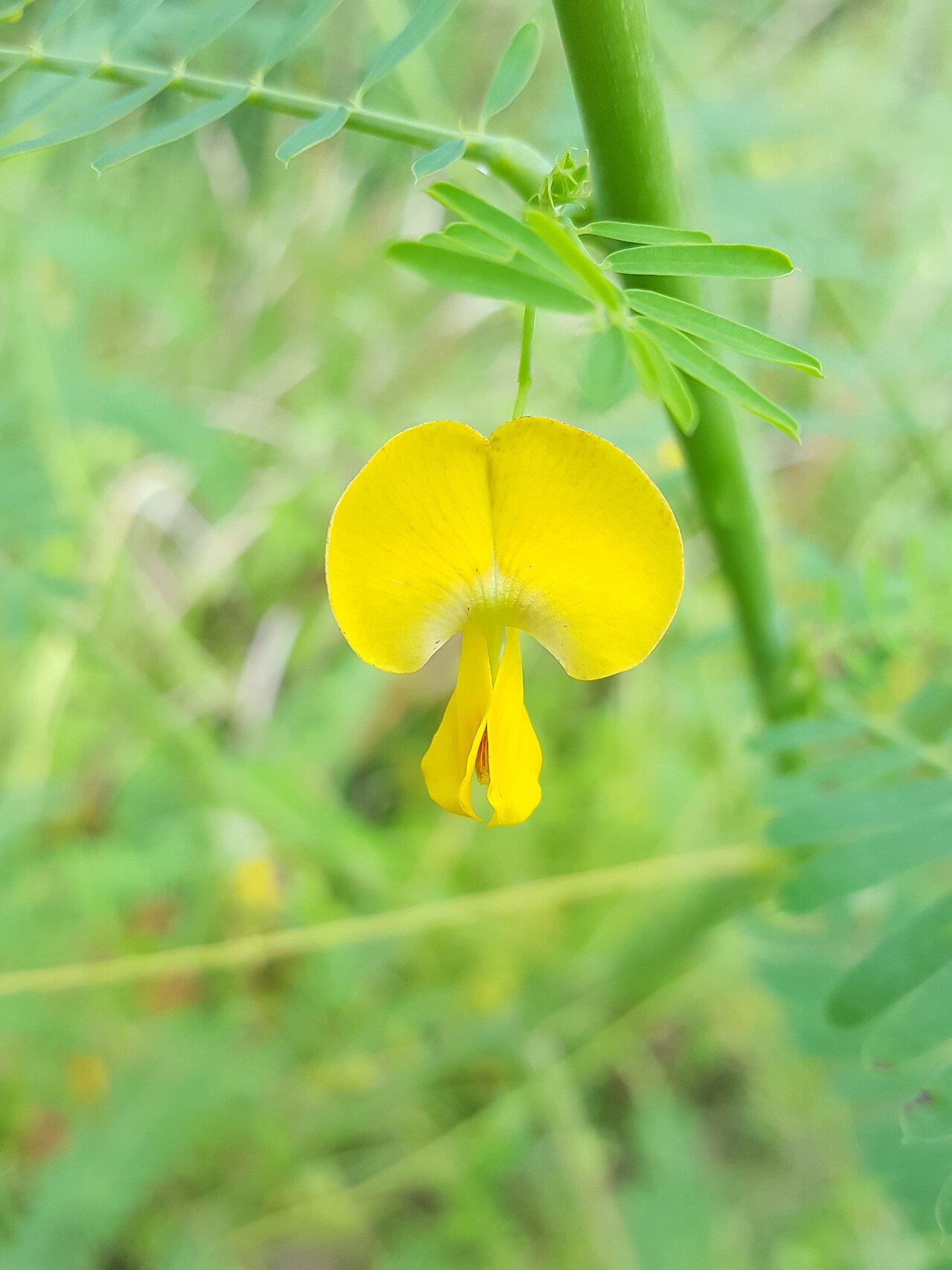
Sesbania herbacea, known as Bigpod Sesbania (USDA: bigpod sesbania), is a tall, fast-growing annual of the pea family (Fabaceae). It is also called hemp sesbania, tall river-hemp, coffeeweed and Colorado River hemp, and older books list it as Sesbania exaltata or S. macrocarpa. In a single summer it shoots up from seed to 4 to 10 feet tall, with a slender, mostly unbranched stem and long, feathery leaves made of dozens of small leaflets.
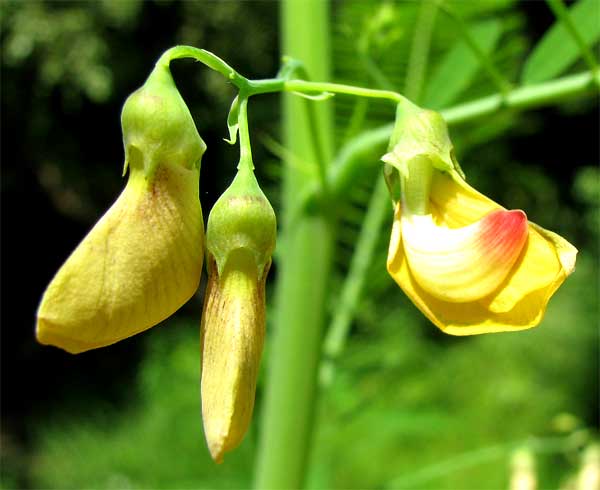
From midsummer to fall it bears small clusters of yellow, pea-like flowers, often streaked or spotted with red or purple. These are followed by its signature feature: remarkably long, very slender, four-angled pods, 4 to 8 inches long, which give the plant its common name. It grows on wet, open, disturbed ground: riverbanks, sandbars, pond shores, ditches, wet fields and the edges of rice and soybean fields, where it is a well-known agricultural weed.
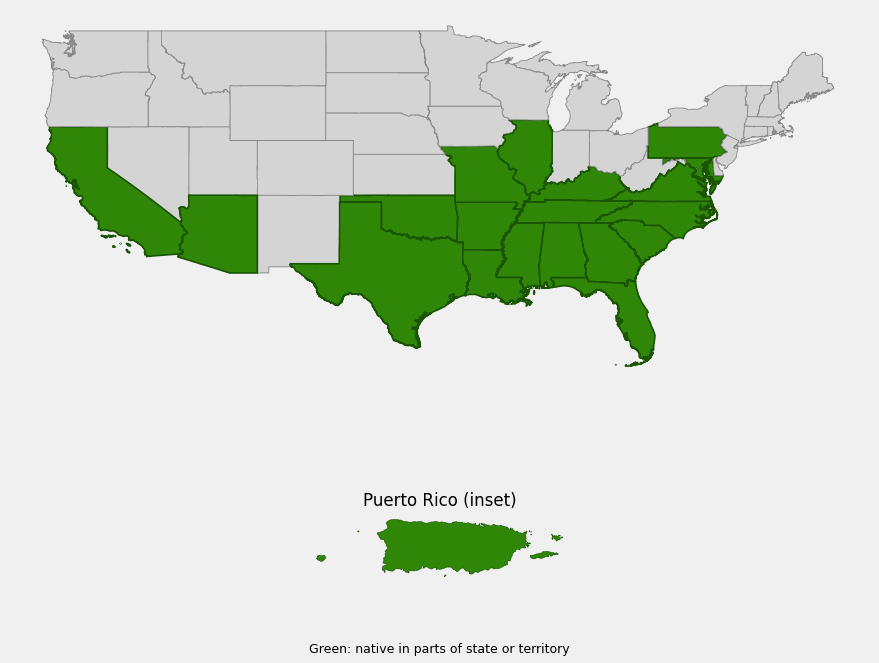
Bigpod sesbania is native across the southern United States from California and Arizona to Texas, the Mississippi Valley and the Southeast, and in Puerto Rico. Like many legumes, it hosts nitrogen-fixing bacteria in its roots. Safety note: the seeds contain toxic saponins and have poisoned livestock and poultry. Do not eat any part of the plant, and keep children, pets and livestock away from the pods and seeds.
Identification
Bigpod sesbania is easiest to recognize in late summer, when a tall, lanky plant with feathery leaves carries both yellow pea flowers and long, thin pods that look like stiff green strings hanging from the stem.
Stems & Growth Habit
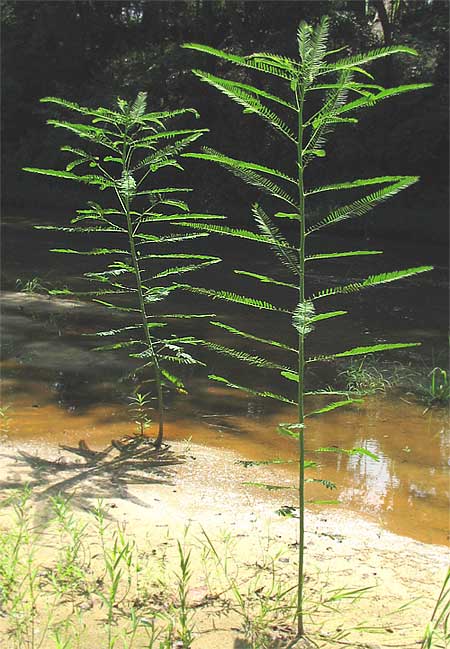
The plant is an annual with a single, smooth, green stem that can reach 10 to 12 feet in rich, wet soil. The stem becomes woody at the base by late summer, so the plant looks like a slender shrub or small tree, but it dies after setting seed. Upper branches are short and spread outward.
Leaves
The leaves are alternate and evenly pinnately compound, 4 to 12 inches long, with 20 to 70 narrow, oblong leaflets, each about 1/2 to 1 1/4 inches long with a tiny bristle at the tip. The foliage gives the plant a soft, feathery, almost fern-like look. The leaflets fold together at night.
Flowers
From about June to the first frost, short clusters of two to six flowers grow from the leaf axils. Each flower is about 1/2 to 3/4 inch long, with a broad, rounded banner petal, two wings and a keel, typical of the pea family. The petals are yellow, and the banner is often streaked or dotted with red, orange or purple.
Fruit & Seeds
The pods are the best field mark: very long and slender, 4 to 8 inches long but only about 1/8 inch wide, four-angled, slightly curved and ending in a short beak. They are divided inside into compartments, each with one oblong, olive-brown seed, and hold up to about 40 seeds. The pods often stay on the dry stems into winter.
Look-alikes
Rattlebox (Sesbania punicea) and bladderpod sesbania (Sesbania vesicaria) have short, winged or inflated pods. Coffee senna and sicklepod (Senna species) have fewer, wider leaflets and different flowers. Partridge Pea is much shorter and has flat, short pods and large yellow flowers with red centers.
Safety Note
The seeds of bigpod sesbania contain saponins and are considered poisonous. Livestock and poultry have been sickened or killed by eating the seeds, for example where seeds contaminate grain or where animals graze stands in fall, and related sesbanias are even more toxic. Do not eat the seeds or pods, do not use the plant for food or medicine, and keep children and pets away from the pods. Wash your hands after handling seeds.
Quick Facts
| Scientific Name | Sesbania herbacea |
| Family | Fabaceae (pea family) |
| Plant Type | Tall warm-season annual legume |
| Mature Height | 4–10 ft (up to 12 ft) |
| Mature Spread | 1–3 ft |
| Growth Rate | Very fast |
| Sun Exposure | Full sun |
| Water Needs | High; moist to wet soil |
| Soil Type | Sand, silt, clay and mud; tolerates poor soils |
| Soil pH | About 5.5–8.0 |
| Bloom Time | June–November |
| Flower Color | Yellow, often streaked red or purple |
| Fall Color | None; dies after seeding |
| Fruit | Very slender pods 4–8 in long; seeds toxic |
| Deer Resistant | Moderately; foliage is seldom heavily browsed |
| USDA Hardiness Zones | Annual; grows where zones 6–11 occur |
Native Range
Bigpod sesbania is native to the warmer parts of North America, the Caribbean and Mexico. USDA PLANTS records it in 22 states and Puerto Rico. Its core range is the southern tier of states: southern California and Arizona (especially along the lower Colorado River), Texas and Oklahoma, the lower Mississippi Valley in Louisiana, Arkansas, Mississippi, Tennessee, Kentucky, Missouri and southern Illinois, and the Southeast from Alabama and Georgia to Florida, the Carolinas and Virginia. It is also native in Puerto Rico.
Farther north it shows up as an outlying record in Maryland and Pennsylvania. In some northern states it has clearly arrived with people. Go Botany treats it as introduced in Massachusetts, and NatureServe lists it as exotic in New York and Kansas, so those states are not shown on the map. It has also been found as a rare introduction in Ontario.
It grows on moist, open, often freshly disturbed soil: sandbars and muddy riverbanks, pond and lake shores, drying marsh edges, ditches, wet fields, levees and roadsides. It is common in the rice, soybean and cotton fields of the Mississippi Delta and the Gulf Coast, where it is managed as a weed.
📋 Regional plant lists featuring Bigpod Sesbania: New York, Pennsylvania & Northern New Jersey · Kentucky & Tennessee · Maryland, Virginia & West Virginia · Arizona & New Mexico · Illinois, Iowa & Missouri · Alabama, Georgia & Mississippi · North & South Florida · Puerto Rico · North & South Carolina · Arkansas, Louisiana, Eastern Oklahoma & Eastern Texas · South & West Texas · California & Nevada
Growing & Care Guide
Bigpod sesbania is rarely sold or planted in gardens. It is a weedy, short-lived annual with toxic seeds that can reseed heavily, and it is considered a problem weed in crop fields. It can still have a place in large, wet restoration sites, wildlife areas and natural shorelines within its native range, where it gives quick summer cover. Grow it from locally collected or purchased native seed only where it will not spread into farm fields or pastures.
Light
It needs full sun and does not tolerate shade. In the wild it grows on bare, open ground where taller plants have not yet taken over.
Soil & Water
It thrives in moist to wet soil of almost any texture, from sand to heavy clay and mud, and tolerates temporary flooding. It grows poorly on dry upland soils. Because it fixes nitrogen with root bacteria, it does not need fertile soil or fertilizer.
Planting Tips
Sow seed directly in late spring after the soil has warmed, on bare, moist soil. Scarify the hard seeds first (nick or sand the seed coat, or soak in hot water) to speed germination. Seedlings grow quickly in summer heat. Do not plant it next to grazing pastures, poultry yards, crop fields or play areas, because of the toxic seeds and its weedy habit.
Pruning & Maintenance
No pruning is needed. If you do not want it to reseed, cut or pull plants before the pods mature in late summer. Dispose of seed-bearing pods away from animals. Dead stems can be left standing over winter for cover, then cut in spring.
Propagation
It reproduces only by seed. Each plant makes hundreds of seeds, which can stay dormant in the soil for years and germinate when the ground is disturbed and wet. Collect pods as they dry and turn brown, and store seed cool and dry.
Landscape Uses
- Wetland and riparian restoration: quick temporary cover on bare, wet soil within its native range
- Wildlife areas: tall summer cover along ponds, sloughs and moist-soil units
- Natural shorelines: fast cover on sandbars and pond edges until perennials take over
- Soil improvement: a nitrogen-fixing legume on poor, wet ground
- Nature education: a striking example of a legume with extremely long pods
Wildlife & Ecological Value
Bigpod sesbania is a short-lived pioneer plant of wet, disturbed ground. It supports insects with its flowers and quickly covers bare soil, though its toxic seeds limit its food value for many animals.
For Pollinators
The yellow pea flowers are visited by bees, including bumblebees and other medium to large bees that are strong enough to open the keel petals and reach the nectar and pollen. Flowers keep coming from midsummer to frost, when other nectar sources along wet ditches may be scarce.
For Birds
Tall stands give cover to birds along ponds, sloughs and wet fields. The seeds are toxic to poultry and are not considered a good food for wild birds.
For Mammals
Mammals seldom browse it heavily. The seeds and pods are toxic to cattle, goats and other livestock, so it should not be allowed to grow thickly in pastures.
Ecosystem Role
As a pioneer annual, it quickly stabilizes freshly exposed mud and sand after floods or drawdowns. Its root nodules fix atmospheric nitrogen, adding nitrogen to the soil when the plants die and decompose. Dense stands shade the soil and provide temporary habitat for insects and small animals until longer-lived wetland plants become established.
Cultural & Historical Uses
The name Colorado River hemp comes from its use by Indigenous peoples of the lower Colorado River, who used the strong stem fibers for cordage and fishing nets. The fibers of several sesbanias were used for similar purposes in other parts of the world, and the species has been studied as a fiber and green manure crop.
In the southern United States, bigpod sesbania is better known to farmers as hemp sesbania or coffeeweed, one of the most troublesome annual weeds of rice, soybean and cotton fields in the Mississippi Delta and along the Gulf Coast. Its tall stems compete with crops for light, and its seeds can contaminate harvested grain.
The plant has had a few scientific names, including Sesbania exaltata and S. macrocarpa, which still appear in older floras and agricultural literature. The species name herbacea refers to its herbaceous, annual nature, despite its shrub-like size by fall.
Frequently Asked Questions
Is bigpod sesbania poisonous?
Yes. The seeds contain saponins and are toxic. Livestock and poultry have been poisoned by them. Do not eat any part of the plant, and keep children, pets and animals away from the pods and seeds.
Is it a shrub or an annual?
It is an annual. It grows from seed to as much as 10 feet tall in one summer, becomes woody at the base, then dies after setting seed in the fall.
Why is it called bigpod sesbania?
For its pods, which are extremely long and slender, often 4 to 8 inches long and only about 1/8 inch wide.
Is it native or a weed?
Both. It is native across the southern United States and Puerto Rico, but it is also a serious weed in rice, soybean and cotton fields. In a few northern states it is introduced.
Should I plant bigpod sesbania in my yard?
It is not a typical garden plant. It is best kept to large wet restoration areas and wildlife sites within its native range, away from livestock, crop fields and children.

Looking for a nursery that carries Bigpod Sesbania?
Browse our native plant nursery directory: Alabama, Arizona & Arkansas · California · Florida & Georgia · Illinois · Kentucky, Louisiana, Maryland, Mississippi & Missouri · North Carolina & Oklahoma · Pennsylvania, South Carolina, Tennessee, Texas & Virginia