
Halberd-Leaved Violet (Viola hastata)
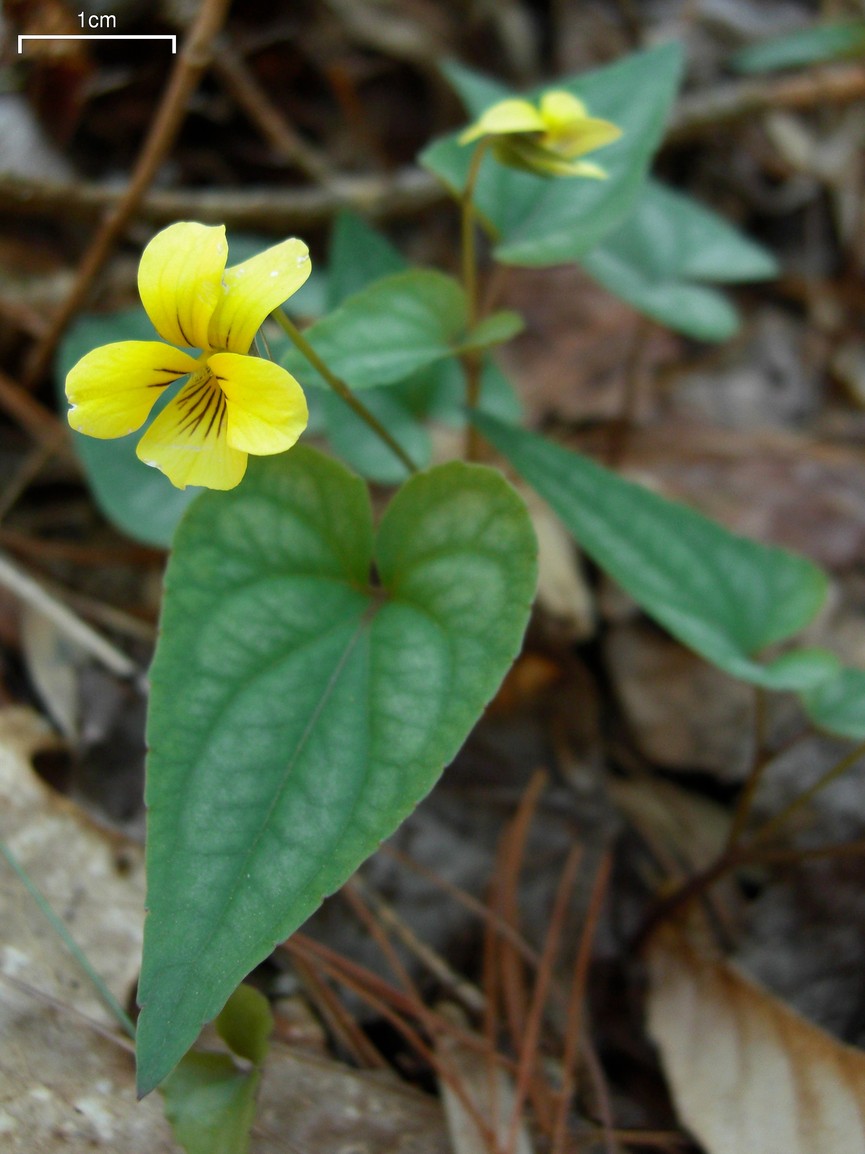
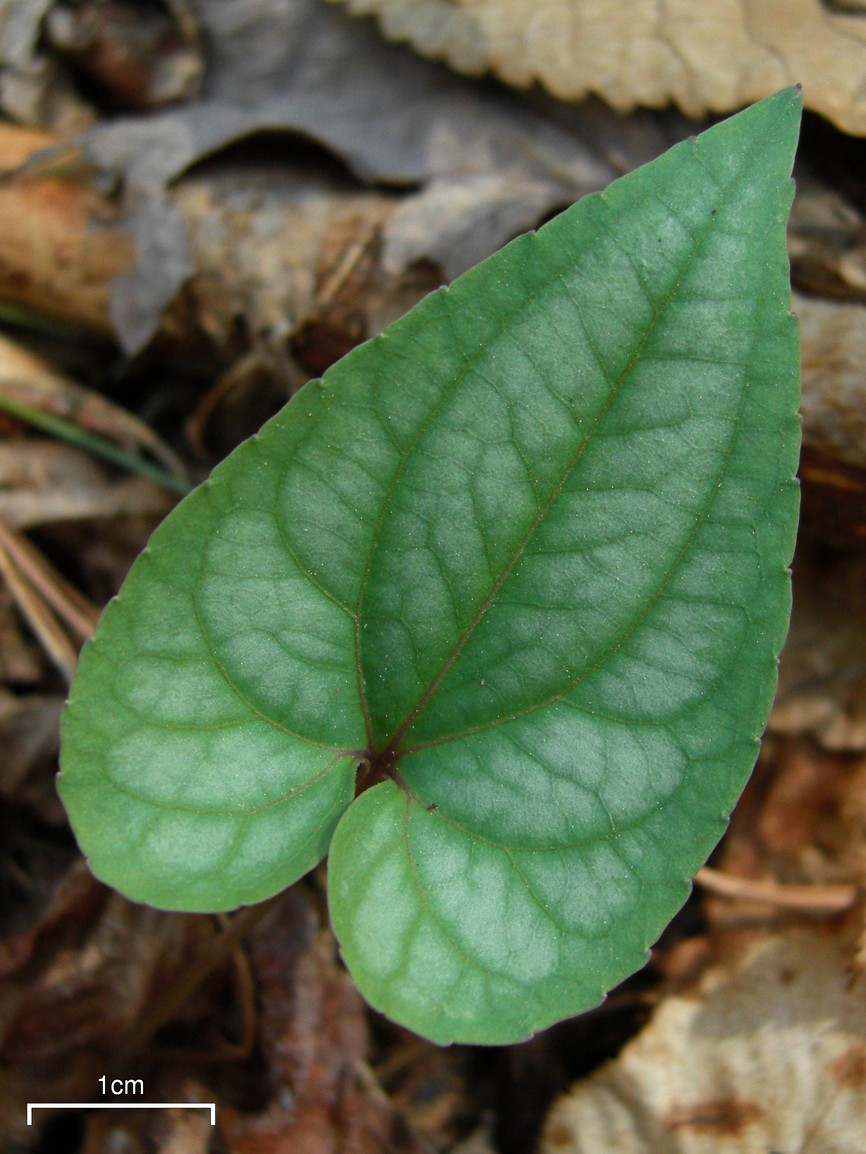
Viola hastata, known as Halberd-Leaved Violet or halberdleaf yellow violet, is a small spring wildflower of rich deciduous woods in the Appalachians and the Southeast. Unlike most violets, which have heart-shaped or rounded leaves, it carries just a few long, narrow, triangular leaves near the top of a short stem. Their two flaring basal lobes recall the blade of a halberd, a medieval spear-and-axe weapon, and give the plant its name.
In April and May, slender stalks rise from the leaf axils with bright yellow flowers about half an inch across, marked with purple-brown lines on the lower petals. Many plants also have silvery mottling between the leaf veins, which makes this one of the prettiest woodland violets in leaf as well as in flower. It grows from a slender, creeping rhizome and forms loose, scattered colonies on the forest floor.
This guide covers how to identify halberd-leaved violet and tell it from other yellow violets, where it grows, how to grow it in a shady woodland garden, and its value to fritillary butterflies, bees and ants. Buy nursery-propagated plants, and never dig violets from the wild.
Identification
Halberd-leaved violet is a “stemmed” yellow violet: its flowers and leaves come from an upright stem rather than directly from the ground. Look for one to four narrow, triangular leaves near the top of a short stem and yellow flowers in spring.
Stems & Growth Habit
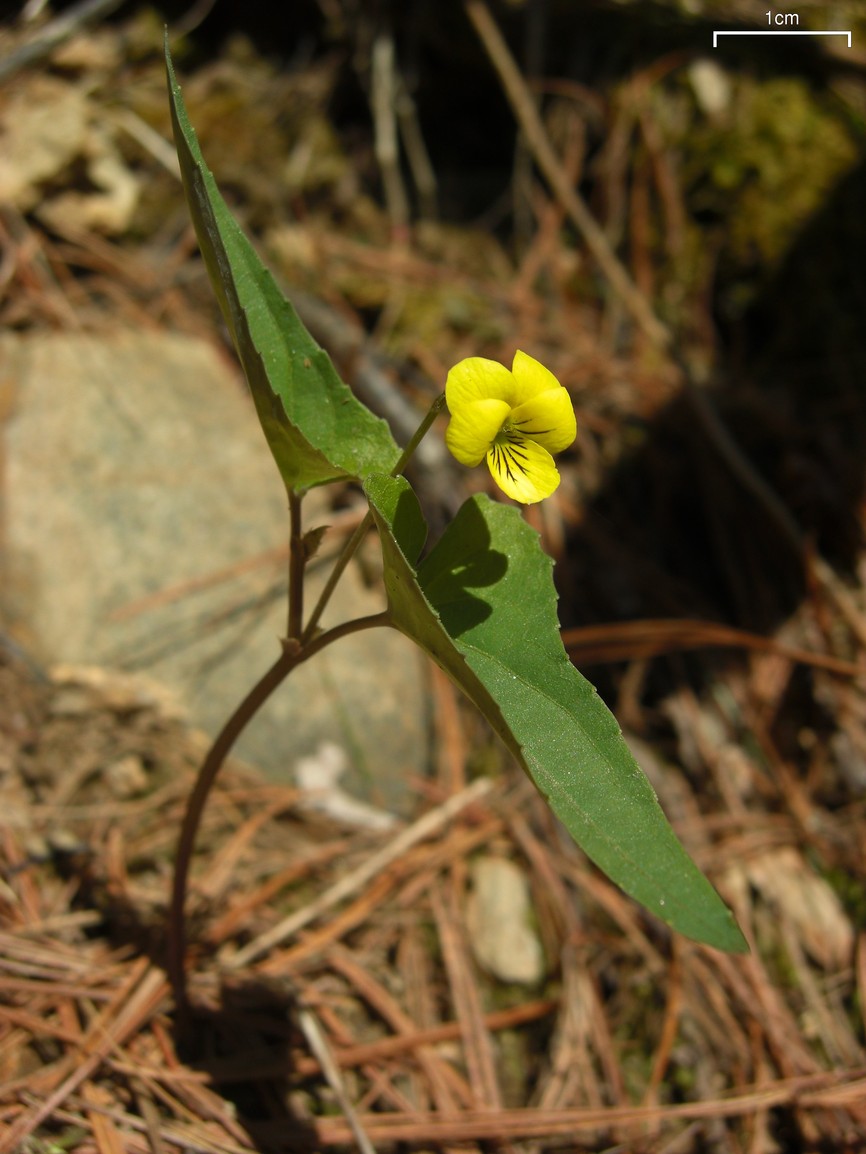
Each plant has one or a few slender, upright stems 4 to 10 inches tall (occasionally to about a foot) rising from a thin, brittle, horizontal rhizome. The stems are smooth or finely hairy and bare along the lower half, with the leaves clustered near the top. Plants often grow in loose patches, connected by their rhizomes. The upright parts die back in summer.
Leaves
The stem leaves, usually two to four, are long-stalked and narrowly triangular to arrow-shaped (hastate), 2 to 4 inches long, with two spreading, rounded basal lobes and a long, tapering tip. The edges have shallow, rounded teeth. Many plants have attractive silvery or grayish mottling between the veins, especially in spring, though some plants are plain green. Basal leaves, when present, are similar but appear later and are often broader.
Flowers
The flowers are about 1/2 to 3/4 inch across, on slender stalks from the axils of the upper leaves. They have five bright yellow petals: the lower three have fine purple-brown veins that guide insects to the nectar spur, and the two lateral petals are bearded with short hairs near the center. The backs of the upper petals are often tinged purple. Bloom is mostly in April and May. Later in the season, the plant produces small, closed (cleistogamous) flowers that pollinate themselves without opening.
Fruit & Seeds
The fruit is a small, smooth, oval capsule about 1/3 inch long that splits into three boat-shaped valves. As the valves dry, they squeeze the seeds and shoot them a few feet away. Each seed has a small oily appendage (elaiosome) that attracts ants, which carry the seeds to their nests and help spread the plant.
Look-alikes
Downy yellow violet (Viola pubescens) is also a stemmed yellow violet but has broad, heart-shaped leaves. Round-leaved yellow violet (Viola rotundifolia) has no leafy stem and round basal leaves that lie flat on the ground. Three-parted yellow violet (Viola tripartita), a close relative in the same region, has leaves that are deeply cut into three lobes or sometimes unlobed; plants with intermediate leaf shapes occur where the two grow together.
Quick Facts
| Scientific Name | Viola hastata |
| Family | Violaceae (violet family) |
| Plant Type | Herbaceous perennial wildflower (stemmed violet) |
| Mature Height | 4–10 in |
| Mature Spread | 4–8 in; forms loose colonies |
| Growth Rate | Slow |
| Sun Exposure | Part shade to full shade |
| Water Needs | Medium |
| Soil Type | Moist to medium, well-drained, humus-rich woodland soil |
| Soil pH | About 4.5–6.5 (acidic) |
| Bloom Time | April–May |
| Flower Color | Yellow with purple-brown veins |
| Fall Color | None; foliage dies back in summer |
| Fruit | Small three-valved capsule with ant-dispersed seeds |
| Deer Resistant | Low to moderate |
| USDA Hardiness Zones | 5–8 |
Native Range
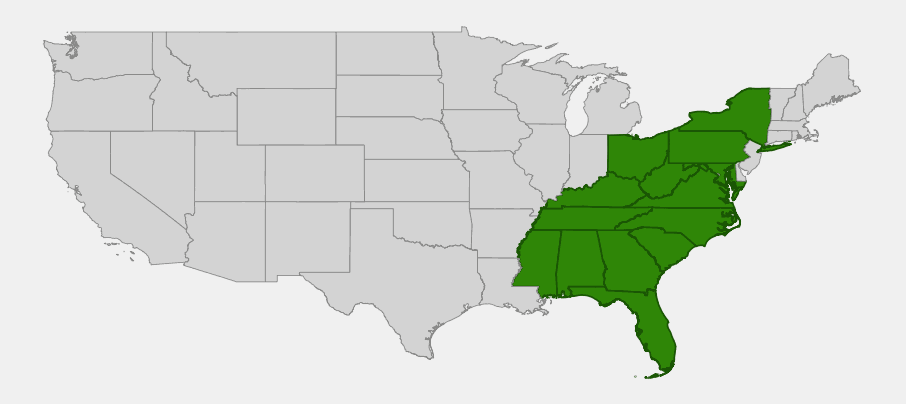
Halberd-leaved violet is native to the eastern United States, with its center in the Appalachian Mountains and the adjacent Piedmont and Allegheny Plateau. USDA PLANTS lists it from southwestern New York, Pennsylvania and Ohio south through Maryland, West Virginia, Virginia, Kentucky, Tennessee and the Carolinas to Georgia, Alabama and Mississippi, with an outlying population in the Florida Panhandle. It does not occur in Canada.
It is most common in the southern and central Appalachians, from West Virginia and western Virginia to the Great Smoky Mountains and the Blue Ridge of North Carolina and Georgia. Toward the edges of its range it becomes scattered: NatureServe ranks it as critically imperiled (S1) in Florida, where it grows in a few rich ravines in the Panhandle, and the Mississippi records are few.
Its habitat is rich, moist to fairly dry deciduous and mixed forests, especially on slopes and in ravines with deep leaf litter and acidic soils. It is often found under oaks, beech, tulip tree, maples and hemlock, sometimes with rhododendron and mountain laurel nearby, from the foothills well up into the mountains.
📋 Regional plant lists featuring Halberd-Leaved Violet: New York, Pennsylvania & Northern New Jersey · Ohio & Indiana · Kentucky & Tennessee · Maryland, Virginia & West Virginia · Delaware, Southern New Jersey & Long Island · Alabama, Georgia & Mississippi · North & South Florida · North & South Carolina
Growing & Care Guide
Halberd-leaved violet is a charming plant for a shady woodland garden, especially in the Appalachian region and the Southeast. It is less vigorous than common blue violets and will not take over a bed. It is seldom sold, so look for it at native plant nurseries that specialize in woodland wildflowers. Always buy nursery-propagated plants; never dig them from the wild, since the brittle rhizomes rarely survive transplanting and wild populations are slow to recover.
Light
Part shade to full shade. It does best under deciduous trees, where it gets spring sun before the canopy leafs out and shade in summer. Avoid hot afternoon sun.
Soil & Water
Give it moist but well-drained, humus-rich, acidic soil, like the leafy loam of a mature hardwood forest. Mix in leaf mold or compost when planting in poor soil. Water during dry spells in spring and its first summer. Established plants tolerate some dryness in summer, when the foliage dies back.
Planting Tips
Plant container plants in early spring or fall, 6 to 8 inches apart, in small groups so they can merge into a colony. Set the rhizome just below the surface. Combine it with spring ephemerals and ferns that will fill the space after it goes dormant. Mark the location so you do not dig into it in summer.
Pruning & Maintenance
No pruning is needed. Leave a light layer of shredded leaves over the bed in fall to mimic the forest floor; avoid thick wood-chip mulch, which can smother small woodland plants. Keep aggressive groundcovers and invasive plants such as garlic mustard away from it.
Propagation
Propagate it by seed or by carefully dividing established patches in early spring or fall. Seed should be sown fresh, as soon as the capsules ripen in late spring or early summer, in pots or a shady seedbed left outdoors over winter; dried seed usually needs a cold, moist period before it germinates. Seedlings grow slowly and may take two or three years to flower.
Landscape Uses
- Woodland and shade gardens: a delicate yellow accent with patterned leaves under deciduous trees
- Native wildflower collections: an unusual stemmed violet with distinctive arrow-shaped leaves
- Butterfly gardens in shade: a larval host for fritillary butterflies
- Naturalized woodland plantings: with trilliums, bellworts, hepaticas and ferns
- Forest restoration: spring understory layer in Appalachian hardwood forests
Wildlife & Ecological Value
Like other native violets, halberd-leaved violet is small but supports a surprising range of wildlife, from early spring bees to fritillary caterpillars and seed-carrying ants.
For Pollinators
The spring flowers are visited by small bees, including mason bees and small sweat bees, and by bee flies and early butterflies seeking nectar from the short spur. Later, closed self-pollinating flowers ensure that the plant still sets seed in years with few pollinators.
For Birds
Some ground-feeding birds, such as wild turkeys and ruffed grouse, eat violet seeds, leaves and rhizomes, but halberd-leaved violet is too scattered to be an important food source.
For Mammals
Deer, rabbits and small rodents occasionally browse violet leaves and seeds.
Ecosystem Role
Violets (Viola) are the only larval host plants for many fritillary butterflies, including the great spangled fritillary and other Speyeria species, whose caterpillars feed on violet leaves at night in spring. Ants collect the seeds for their oily elaiosomes and discard them in their nests, where they can germinate, a seed-dispersal system shared with many spring woodland wildflowers.
Cultural & Historical Uses
The species name hastata is Latin for “spear-shaped,” from hasta, “spear.” The French botanist André Michaux, who explored the southern Appalachians in the 1780s and 1790s, published the name in his Flora Boreali-Americana of 1803.
Violets have long been used as food and medicine in many cultures; the young leaves and flowers of several species are eaten in salads. Halberd-leaved violet, however, is a scattered woodland plant that is far too uncommon to harvest. Enjoy it in the woods and in the garden, not on the plate.
For wildflower enthusiasts, halberd-leaved violet is one of the signature plants of a spring walk in the Great Smoky Mountains and the Blue Ridge, where its silver-patterned leaves and yellow flowers brighten the forest floor in April.
Frequently Asked Questions
Why is it called halberd-leaved violet?
Its leaves are narrowly triangular with two flaring lobes at the base, like the blade of a halberd, a medieval spear-and-axe weapon. The species name hastata also means “spear-shaped.”
Where does halberd-leaved violet grow?
It grows in rich deciduous woods of the eastern United States, mainly in the Appalachians and Piedmont from New York and Ohio south to Georgia and Alabama, with outlying populations in Mississippi and the Florida Panhandle.
Can I grow halberd-leaved violet in my garden?
Yes, in part to full shade with moist, humus-rich, acidic soil. Buy nursery-propagated plants from a native plant nursery and never dig it from the wild.
Is halberd-leaved violet a host plant for butterflies?
Yes. Like other violets, it is a larval host for fritillary butterflies such as the great spangled fritillary.
How do I tell it from other yellow violets?
Look at the leaves. Halberd-leaved violet has long, narrow, triangular leaves with flaring basal lobes, often mottled with silver. Downy yellow violet has broad heart-shaped leaves, and round-leaved yellow violet has round leaves lying flat on the ground.

Looking for a nursery that carries Halberd-Leaved Violet?
Browse our native plant nursery directory: Alabama · Florida & Georgia · Kentucky, Maryland & Mississippi · New York, North Carolina & Ohio · Pennsylvania, South Carolina, Tennessee & Virginia · West Virginia