
Scarlet Pea (Indigofera miniata)
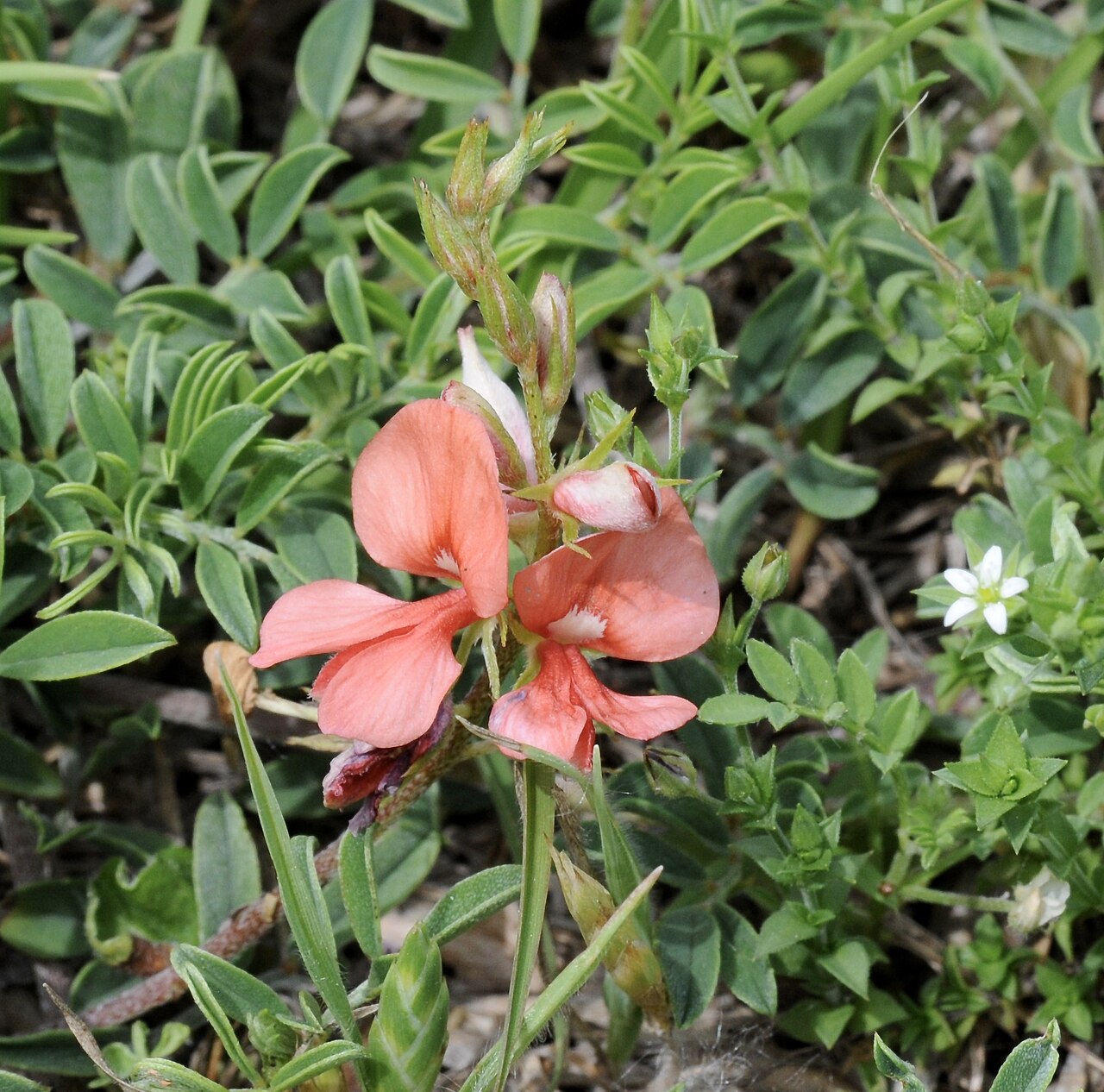
Indigofera miniata, known as Scarlet Pea and also as coastal indigo or Texas indigo, is a low, trailing perennial in the pea family (Fabaceae). Its stems spread flat along the ground for up to about 2 feet from a deep, woody taproot, and from spring into fall they carry short spikes of eye-catching salmon-pink to brick-red pea flowers. The whole plant has a silvery cast from fine, flat-lying hairs.
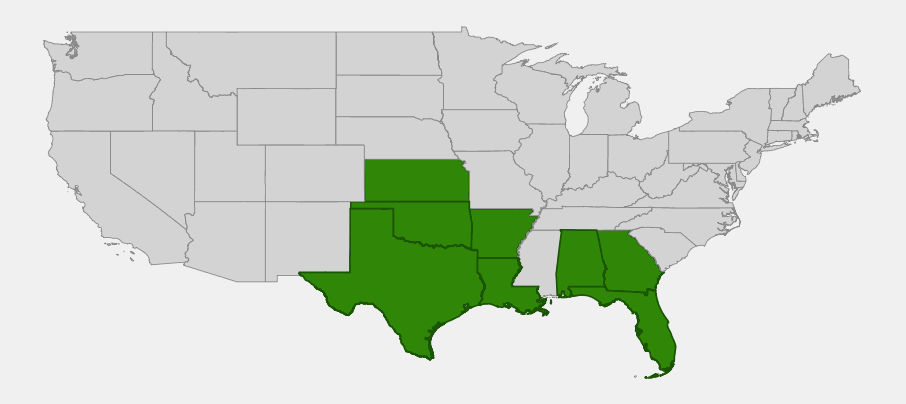
Scarlet pea is most common in Texas and Oklahoma, where it grows in open prairies, pastures, roadsides, coastal dunes and sandy or rocky ground across much of the state. It reaches north into the Red Hills of south-central Kansas and east through scattered sites in Arkansas, Louisiana, Alabama and Georgia to the sandhills, coastal strand and pine rocklands of Florida. It also grows in Mexico and parts of Central America and the Caribbean.
For gardeners, scarlet pea is a tough, drought-tolerant groundcover for sunny, well-drained spots. It does not bloom constantly, but its flushes of coral flowers are striking, and it is a host plant for several small butterflies. Like other legumes, it adds nitrogen to poor soils.
Identification
Look for a flat, silvery-green mat of small compound leaves with spikes of bright salmon-pink to scarlet pea flowers on stalks that rise from the leaf joints.
Growth Habit
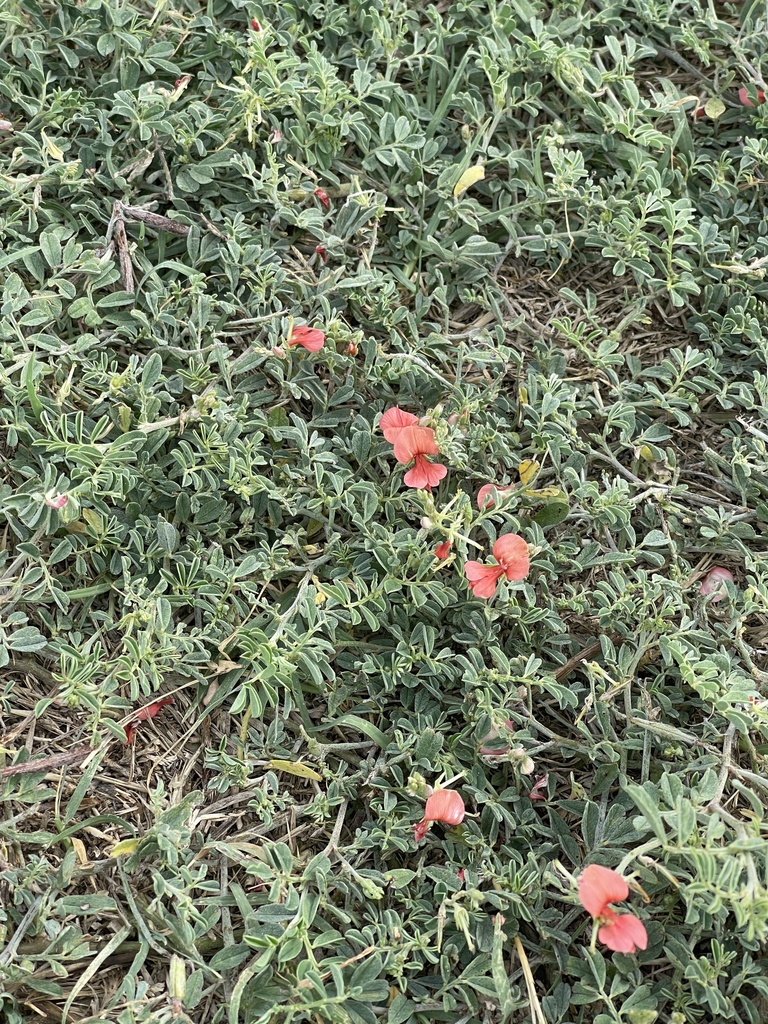
Scarlet pea is a herbaceous perennial with prostrate or low, sprawling stems that grow from a thick, woody taproot. The stems are usually 1 to 2 feet long and often form a loose mat only a few inches tall. In mowed or grazed areas it hugs the ground; among taller grasses the stems may lean upward.
Leaves
The leaves are alternate and pinnately compound, usually with 5 to 9 narrow, oblong to wedge-shaped leaflets, each about 1/4 to 1 inch long. Leaves and stems are covered in short, flat-lying hairs attached at the middle (a feature of the indigo genus), which give the plant a grayish or silvery look.
Flowers
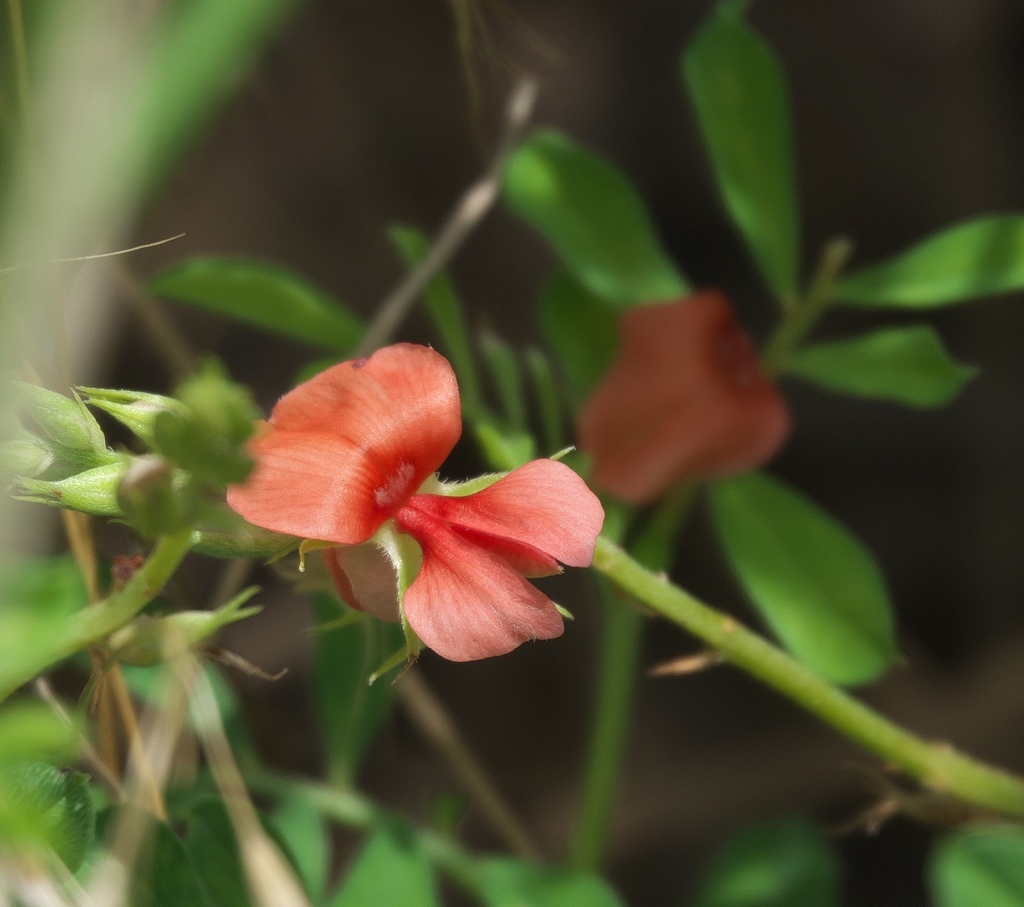
Flowers are borne in short spikes (racemes) of a few to a dozen or more on long stalks from the leaf axils, mostly from April to October. Each flower is about 1/2 inch long, with a broad, rounded banner petal, two wing petals and a small keel. The color ranges from salmon-pink and coral to brick-red, which is where the species name miniata (meaning “cinnabar-red”) comes from.
Fruit
The fruit is a slender, nearly cylindrical, straight pod about 1 to 1 1/2 inches long, hairy and pointed at the tip. It turns brown in late summer and fall and splits to release several small seeds.
Varieties
Older treatments divided scarlet pea into several varieties, including var. leptosepala (often called western scarlet pea), var. texana and var. florida, based on hairiness and the shape of the leaflets and sepals. Many botanists now treat it as one variable species, and USDA PLANTS lists those names as synonyms.
Look-alikes
Few other low plants in its range have such large, salmon-red pea flowers. Hairy indigo (Indigofera hirsuta), a non-native species in the Southeast, is upright and bristly with small pink flowers in dense spikes. Native trailing indigo bush (Dalea greggii) also has silvery foliage but is a shrub with tiny purple flowers in round heads.
Quick Facts
| Scientific Name | Indigofera miniata |
| Family | Fabaceae (pea family) |
| Plant Type | Trailing herbaceous perennial |
| Mature Height | 4–12 in |
| Mature Spread | 1–2 ft |
| Growth Rate | Moderate |
| Sun Exposure | Full sun to part shade |
| Water Needs | Low; drought tolerant |
| Soil Type | Well-drained sand, loam, clay or caliche |
| Soil pH | Slightly acidic to alkaline (about 6.0–8.5) |
| Bloom Time | April–October, in flushes |
| Flower Color | Salmon-pink to brick-red |
| Fall Color | None |
| Fruit | Slender hairy pods, 1–1 1/2 in |
| Deer Resistant | No; browsed by deer |
| USDA Hardiness Zones | 6–10 |
Native Range
USDA PLANTS lists scarlet pea as native in eight states: Alabama, Arkansas, Florida, Georgia, Kansas, Louisiana, Oklahoma and Texas. Beyond the United States it grows in Mexico, Guatemala and Cuba.
It is abundant in Texas, where it grows in open areas across the eastern two-thirds of the state, from the Blackland Prairie and Cross Timbers through the Hill Country to the South Texas plains and the barrier islands of the Gulf Coast. It is also widespread in Oklahoma. In Kansas it reaches its northern limit in the Red Hills (Gypsum Hills) of the south-central part of the state, and in Arkansas it is known from the southwestern corner. Records from Louisiana, Alabama and Georgia are few and scattered, and those states are best treated as outlying parts of the range. In Florida it grows in dry sandhills, coastal dunes and pine rocklands, mainly on the peninsula.
Habitats include prairies, pastures, open woodlands, roadsides, coastal dunes and sandy flats, and rocky or gravelly slopes. It grows in well-drained sand, loam, clay and caliche, usually in full sun.
📋 Regional plant lists featuring Scarlet Pea: Nebraska, Kansas & Eastern Colorado · Alabama, Georgia & Mississippi · North & South Florida · Arkansas, Louisiana, Eastern Oklahoma & Eastern Texas · South & West Texas
Growing & Care Guide
Scarlet pea is an easy plant for hot, dry, sunny gardens in the southern Plains and Gulf states. Its deep taproot makes it very drought tolerant once established, but it also makes older plants hard to move, so place it where it can stay.
Light
Full sun gives the most flowers and the tightest growth. It tolerates part shade, but blooms less and sprawls more.
Soil & Water
Any well-drained soil works, including sand, loam, clay and caliche. It does not need fertilizer; as a legume it hosts nitrogen-fixing bacteria in its roots. Water new plants until they are established, then only during long droughts. Soggy soil can rot the crown.
Planting Tips
Plant small container plants in spring or fall, or sow seed in fall. Use it at the front of a bed, along a path, between stepping stones or tucked among short grasses such as buffalograss and hairy tridens, where its trailing stems can weave through.
Pruning & Maintenance
Little care is needed. The plant blooms in flushes from spring to fall; cutting it back lightly after a flush can encourage a new round of flowers. It dies back to the root in cold winters and regrows in spring.
Propagation
Grow it from seed collected in late summer and fall when the pods turn brown. Like many legumes, the hard seeds germinate better after scarification (lightly nicking or sanding the seed coat) or a soak in warm water.
Landscape Uses
- Groundcover: a low, trailing plant for dry, sunny spots
- Rock and gravel gardens: thrives in lean, fast-draining soil
- Prairie and meadow plantings: weaves among short grasses and wildflowers
- Butterfly gardens: larval host for several small butterflies
- Coastal gardens: tolerates sand, wind and heat near the Gulf
Wildlife & Ecological Value
Scarlet pea is a small plant, but it supports a range of insects and grazing animals in prairie and coastal habitats.
For Pollinators
Bees visit the flowers for nectar and pollen. The Lady Bird Johnson Wildflower Center lists scarlet pea as a larval host for the gray hairstreak, southern dogface and Reakirt's blue butterflies.
For Birds
Ground-feeding birds such as quail and doves may eat the seeds that fall from the split pods.
For Mammals
White-tailed deer relish the foliage, and livestock graze it, so in deer country it may need protection while it establishes.
Ecosystem Role
As a legume, scarlet pea forms root nodules with nitrogen-fixing bacteria that enrich poor, sandy soils. Its spreading stems help hold sand in place on dunes and open ground.
Cultural & Historical Uses
The genus name Indigofera means “indigo-bearing.” Several Old World species, especially Indigofera tinctoria, are the traditional source of indigo dye. Scarlet pea is not a significant dye plant, but it shares the genus's distinctive flat, two-armed hairs.
The species name miniata comes from the Latin for “colored with cinnabar” (red lead or minium), a reference to its red-orange flowers. The species was described in the late 1700s by the Spanish botanist Casimiro Gómez Ortega.
In Texas, scarlet pea is a familiar roadside and prairie wildflower, and native plant groups recommend it as a durable groundcover for water-wise gardens.
Frequently Asked Questions
Is scarlet pea the same as coastal indigo?
Yes. Coastal indigo is the USDA common name for Indigofera miniata. It is also called scarlet pea, Texas indigo and western indigo.
Does scarlet pea bloom all summer?
It blooms in flushes from spring into fall rather than continuously. A light trim after a flush can encourage more flowers.
Is scarlet pea a good groundcover?
Yes, for dry, sunny places. It forms a low, trailing mat, but it is not dense enough for heavy foot traffic and goes dormant in cold winters.
Will deer eat scarlet pea?
Yes. Deer find it tasty, so protect young plants where deer are common.
Is scarlet pea native to Kansas?
Yes. It reaches its northern limit in the Red Hills of south-central Kansas, where it grows on rocky slopes and prairies.

Looking for a nursery that carries Scarlet Pea?
Browse our native plant nursery directory: Alabama & Arkansas · Florida & Georgia · Kansas · Louisiana · Oklahoma · Texas