
Sea Plantain (Plantago maritima)
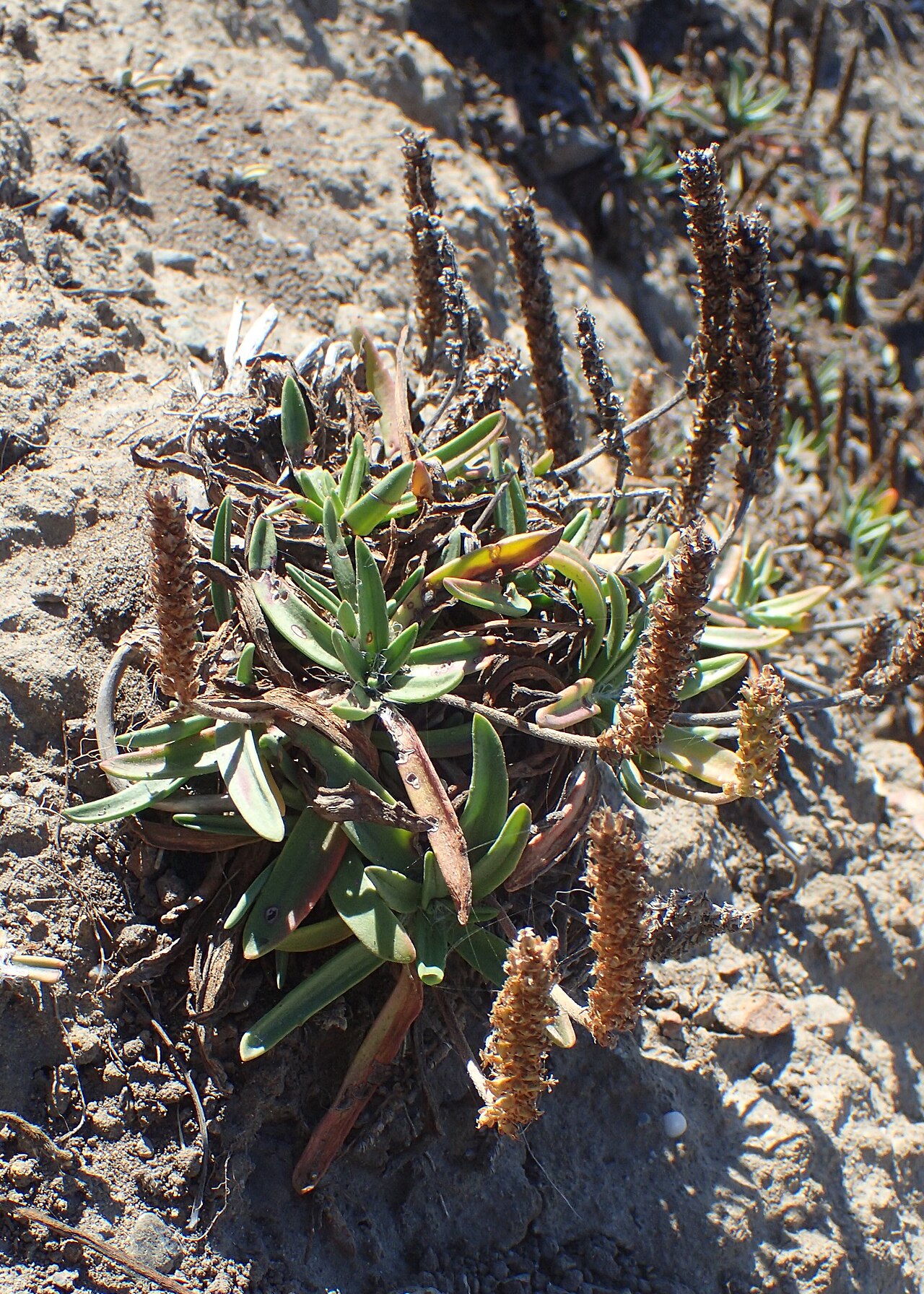
Plantago maritima, known as Sea Plantain or goose tongue (its USDA common name), is a low perennial of salt marshes and rocky seashores. It forms tufts or rosettes of narrow, fleshy, grass-like leaves, and from early summer to fall it sends up slender stalks topped with dense, cylindrical spikes of tiny brownish flowers with pale, dangling stamens. It belongs to the plantain family (Plantaginaceae).
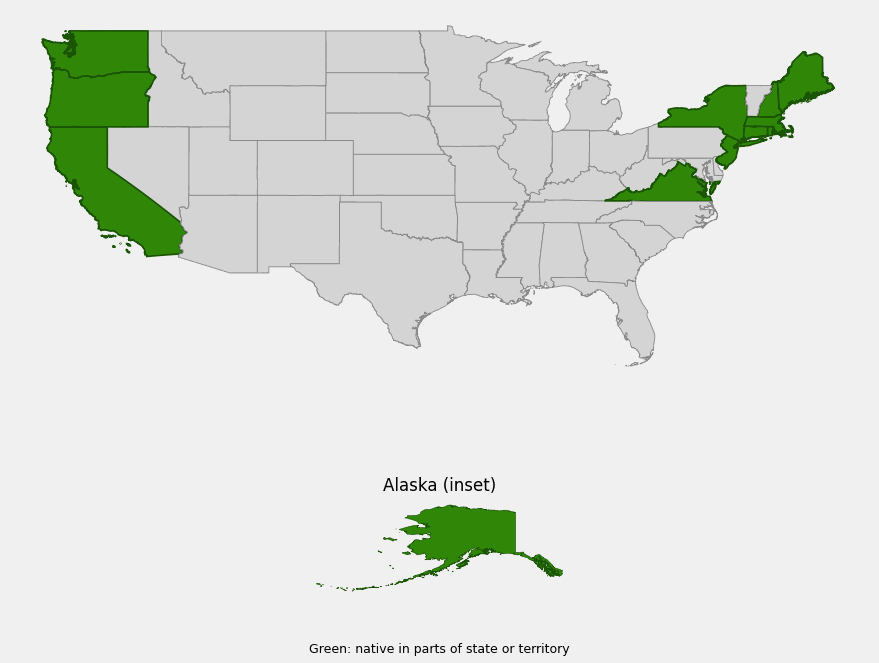
Sea plantain grows around the coasts of the Northern Hemisphere and in southern South America. In North America it is found along the Atlantic coast from Labrador and Newfoundland to New England, New York and New Jersey, with Virginia at its southern edge; along the Pacific coast from Alaska to California; and around Hudson Bay and inland salt flats on the Canadian prairies. It thrives where salt spray, tides and wind keep most other plants out.
In Maine and Atlantic Canada, the young leaves have long been gathered as “goose tongue greens,” a salty wild vegetable. If you forage it, do so sparingly and carefully: it shares its salt-marsh habitat with seaside arrowgrass, a poisonous look-alike. For coastal gardeners, it is a tough, salt-tolerant plant for rock crevices and seaside plantings.
Identification
Look for tufts of narrow, thick, fleshy leaves on salt marshes or rocky shores, with leafless stalks ending in dense, pencil-like spikes of tiny flowers.
Growth Habit
Sea plantain is a perennial with a stout taproot, often branched at the top so that several rosettes form a small clump. The leaves lie flat or stand upright, and the whole plant is usually 2 to 10 inches tall in flower, sometimes taller in sheltered marshes.
Leaves
The leaves are linear, 2 to 8 inches long and up to about 1/2 inch wide, thick and fleshy, and often slightly channeled on the upper side. The edges are smooth or have a few small teeth, and there are often woolly hairs at the base of the rosette. Unlike broadleaf plantains, the leaves have no stalk and are almost grass-like.
Flowers
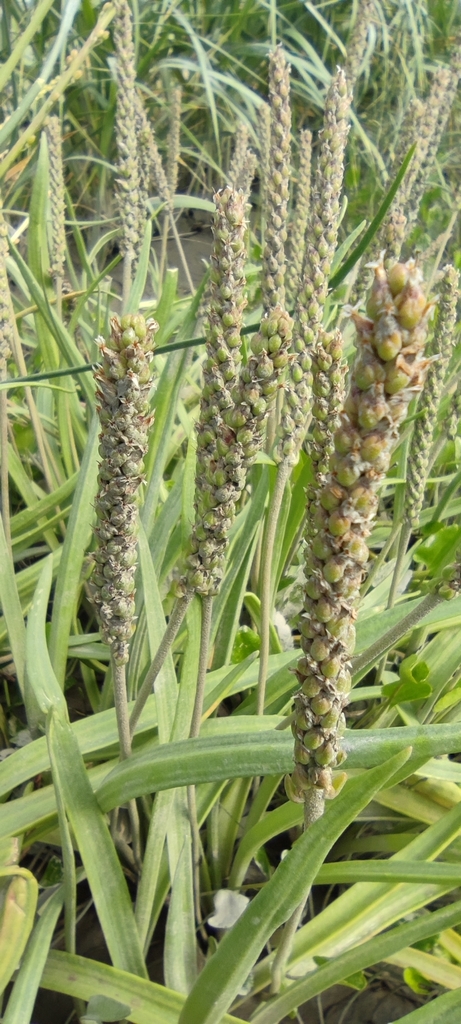
Leafless flower stalks (scapes) rise slightly above the leaves, each ending in a dense, cylindrical spike 1 to 4 inches long. The individual flowers are tiny, with four papery, brownish petals and four stamens on long, pale filaments that hang out of the flower. They are wind-pollinated. Bloom time is mainly June to September, beginning earlier on the Pacific coast.
Fruit
Each flower produces a small capsule that splits around the middle (like a lid) to release two to four small brown seeds. The seeds become sticky when wet, which helps them stick to birds' feet and feathers.
Varieties
North American plants are usually placed in subspecies juncoides, and Pacific Coast plants are sometimes called var. californica. They differ from European plants only in small details.
Look-alikes
Seaside arrowgrass (Triglochin maritima) grows in the same marshes and also has narrow, fleshy leaves. It is poisonous, containing compounds that release cyanide. Arrowgrass leaves are half-round in cross section and sheath each other at the base, and its tall flower stalk carries a long, loose spike of tiny greenish flowers rather than a dense, brown spike. Seaside goldenrod and young saltmeadow cordgrass can also grow among it, but their leaves are not fleshy.
Quick Facts
| Scientific Name | Plantago maritima |
| Family | Plantaginaceae (plantain family) |
| Plant Type | Low, salt-tolerant herbaceous perennial |
| Mature Height | 2–10 in (in flower) |
| Mature Spread | 4–12 in |
| Growth Rate | Slow to moderate |
| Sun Exposure | Full sun |
| Water Needs | Medium to high; tolerates salt water |
| Soil Type | Salt marsh mud, sand, gravel, rock crevices |
| Soil pH | Neutral to alkaline (about 6.5–8.5); salt tolerant |
| Bloom Time | June–September |
| Flower Color | Brownish-green spikes with pale yellow stamens |
| Fall Color | None |
| Fruit | Small capsules with 2–4 seeds |
| Deer Resistant | Rarely browsed; grows where deer seldom feed |
| USDA Hardiness Zones | 3–8 |
Native Range
USDA PLANTS lists sea plantain as native in Alaska, 11 coastal states of the lower 48 and most of Canada. On the Atlantic coast it grows in Maine, New Hampshire, Massachusetts, Rhode Island, Connecticut, New York and New Jersey, with an outlying record from Virginia at the southern edge of its Atlantic range. On the Pacific coast it grows in Washington, Oregon and California, and it is widespread on the coasts of Alaska.
In Canada it grows along the coasts of all the Atlantic provinces, Quebec, Hudson Bay and the Arctic, and British Columbia. It also grows inland on saline and alkaline flats and lake shores in Alberta, Saskatchewan and Manitoba, and it is native around the coasts of Europe, North Africa, Asia and southern South America.
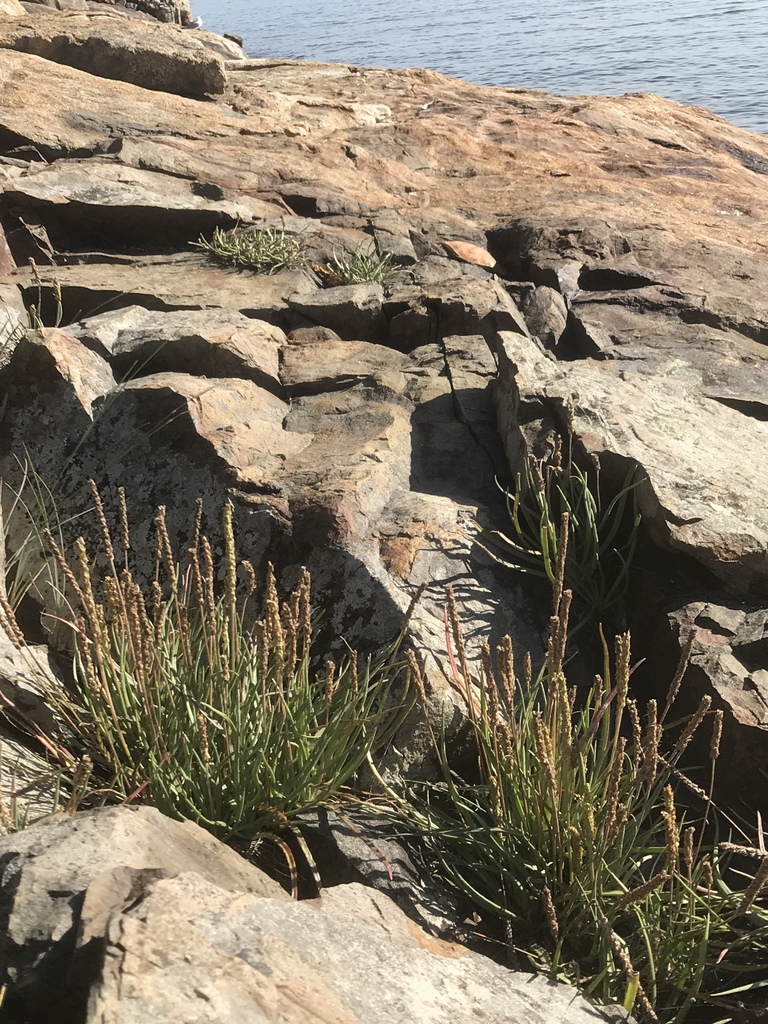
It is a plant of salt marshes, salt meadows, tidal flats, rocky shores and sea cliffs, beaches and dune hollows, usually just above the reach of daily tides, where it receives salt spray and occasional flooding with sea water. It is most common in the North; south of Cape Cod it becomes uncommon to rare.
📋 Regional plant lists featuring Sea Plantain: New York, Pennsylvania & Northern New Jersey · Connecticut, Massachusetts & Rhode Island · New Hampshire, Maine & Vermont · Maryland, Virginia & West Virginia · Delaware, Southern New Jersey & Long Island · Alaska · Western Oregon & Western Washington · California & Nevada
Growing & Care Guide
Sea plantain is a specialist of salty, sunny coastal sites. It is rarely sold, but it can be grown from seed for seaside rock gardens, living shorelines and salt-marsh restoration within its native range.
Light
Full sun. In the wild it grows in open, windswept places with little competition.
Soil & Water
It grows in sand, gravel, rock crevices or marsh mud, and it tolerates salt spray and occasional flooding with sea water. Keep the soil moist while plants establish. In ordinary garden soil it can survive, but it is easily crowded out by larger plants.
Planting Tips
Sow seed in fall or spring on the surface of a sandy or gritty mix, or plant small plugs into crevices of seaside rock walls and among stones near the high-tide line. In restoration, use it in the upper salt marsh and on rocky shores rather than in regularly flooded mud.
Pruning & Maintenance
Very little care is needed. Remove spent flower stalks if you want a tidier look, and keep taller plants and weeds from shading it.
Propagation
Grow it from seed collected in late summer and fall when the spikes turn brown. Mature clumps with several rosettes can be divided carefully in spring.
Landscape Uses
- Seaside gardens: a salt-tolerant tuft for rocky crevices and sandy spots
- Salt-marsh restoration: a native plant for the upper marsh edge
- Rock gardens: a small, grass-like accent near the coast
- Wild edible: young leaves gathered sparingly as “goose tongue greens”
- Living shorelines: helps hold sediment along rocky and marshy edges
Wildlife & Ecological Value
Sea plantain is a small but common member of northern salt-marsh and rocky-shore communities.
For Pollinators
The flowers are wind-pollinated and offer no nectar, but small bees and flies sometimes collect pollen from them.
For Birds
Geese, ducks and shorebirds graze the leaves and eat the seeds in salt marshes, which may be how it earned the name “goose tongue.” The sticky seeds can be carried on birds' feet and feathers.
For Mammals
Hares, voles and other small mammals may nibble the leaves where they can reach them.
Ecosystem Role
Its deep taproot and tufted rosettes help stabilize sediment in salt marshes and crevices. It is one of the plants that can grow in salt-stressed zones where few others survive.
Cultural & Historical Uses
The name “goose tongue” refers to the shape of the leaves, and perhaps to their popularity with geese. In Maine, Nova Scotia, New Brunswick and Newfoundland, the young leaves are a traditional wild food, eaten raw in salads, briefly blanched like green beans or pickled. They have a salty, slightly sweet flavor.
Foraging note: Harvest only young leaves, cut a few from each plant and leave the roots in place so the plant can regrow. Never harvest where it is uncommon (as it is south of Cape Cod), in protected areas where gathering is not allowed, or on shores that may be polluted. Be absolutely certain of your identification, because the poisonous seaside arrowgrass grows in the same places and looks similar.
The genus name Plantago comes from the Latin planta, “sole of the foot,” referring to the broad, flat leaves of common plantains. The species name maritima means “of the sea.” It is one of the most salt-tolerant flowering plants of northern coasts, and scientists have studied how it copes with salt.
Frequently Asked Questions
Is sea plantain edible?
Yes. The young leaves, known as goose tongue greens, are eaten raw, blanched or pickled in Maine and Atlantic Canada. Harvest lightly, and only if you can tell it apart from poisonous seaside arrowgrass.
How can I tell sea plantain from seaside arrowgrass?
Sea plantain has dense, brown, cylindrical flower spikes on short stalks and flat to slightly channeled leaves. Seaside arrowgrass has half-round leaves that sheath at the base and a tall, loose spike of tiny green flowers. When in doubt, do not eat it.
Where does sea plantain grow?
In salt marshes, salt meadows, rocky shores and sea cliffs along the northern Atlantic and Pacific coasts, in Alaska, and on inland salt flats in the Canadian prairies.
Can I grow sea plantain in my garden?
Yes, in a sunny, gritty or sandy spot near the coast, especially in rock crevices. It is slow and small and is easily crowded out in rich garden soil.
Is sea plantain related to the common lawn plantain?
Yes. Both are in the genus Plantago, but sea plantain has narrow, fleshy leaves adapted to salty habitats, while broadleaf plantain, a common lawn weed that is mostly non-native in North America, has broad leaves.

Looking for a nursery that carries Sea Plantain?
Browse our native plant nursery directory: Alaska · California · Connecticut · Maine & Massachusetts · New Hampshire, New Jersey & New York · Oregon · Rhode Island & Virginia · Washington