
American Senna (Senna hebecarpa)
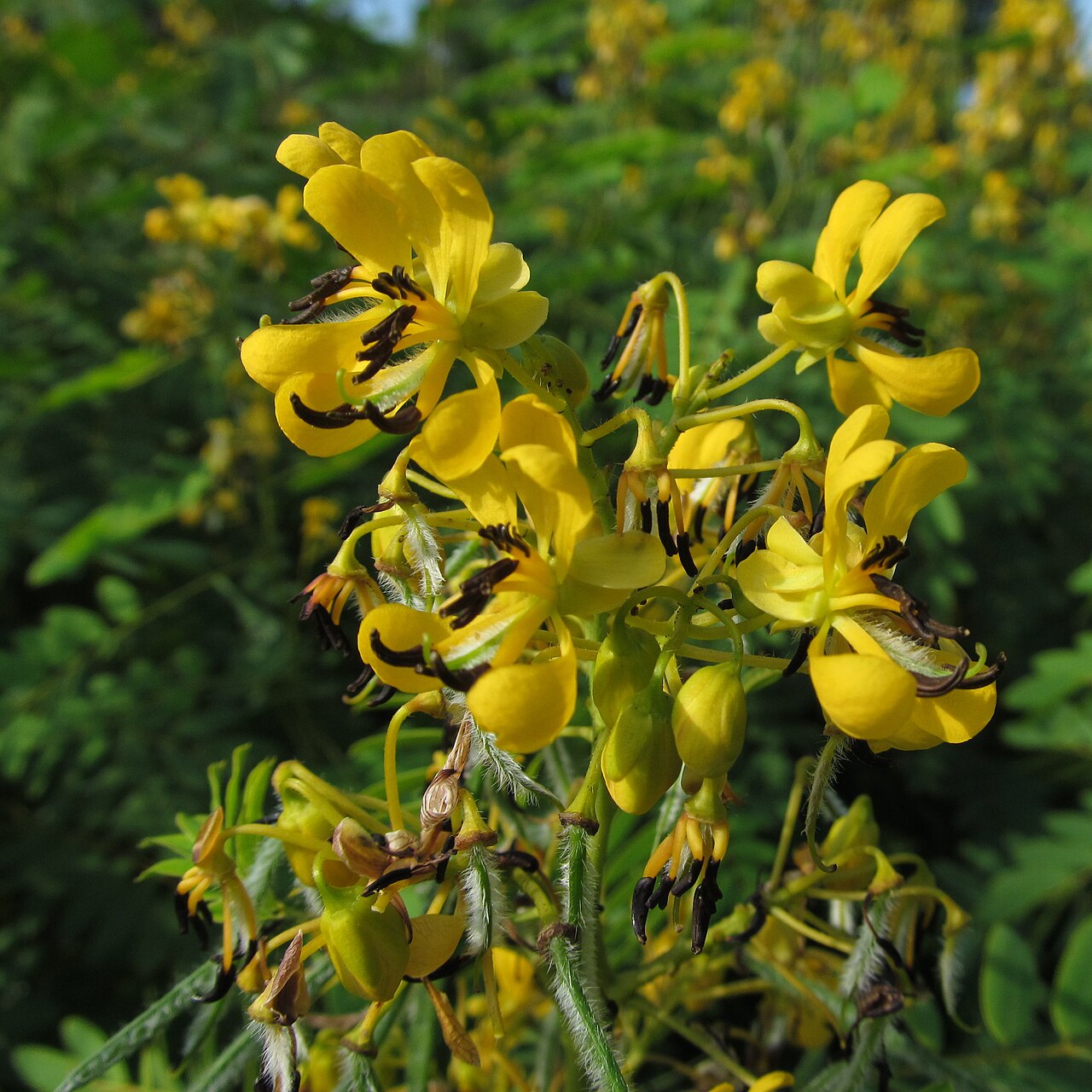
Senna hebecarpa, known as American Senna or northern wild senna, is a tall, bushy perennial of the pea family (Fabaceae) native to the eastern United States and southern Ontario. It grows 3 to 6 feet tall, with feathery compound leaves and, in mid to late summer, dense clusters of bright yellow flowers at the tops of the stems. The flowers have striking chocolate-brown anthers, and they are followed by flat, segmented, hairy pods.
This is a plant for moist, sunny meadows, stream banks, open woods and roadsides, and it adapts easily to garden beds and rain gardens. Bumble bees are its main pollinators, and its leaves feed the caterpillars of sulphur butterflies. Older books list it as Cassia hebecarpa, and it is often confused with the closely related southern wild senna (Senna marilandica).
Like other sennas, its leaves, pods and seeds contain anthraquinone compounds that act as strong laxatives. Do not eat any part of the plant, keep children from chewing the pods and seeds, and do not let livestock graze it heavily. In the garden it is easy to grow, long-lived and rarely bothered by deer.
Identification
American senna forms a clump of upright, unbranched or sparsely branched stems topped by yellow flower clusters. The combination of even-pinnate leaves, a small club-shaped gland on the leaf stalk and dark anthers identifies it.
Growth Habit
A clump-forming perennial from a woody crown and deep roots, 3 to 6 feet tall and 2 to 3 feet wide. The stems are green and somewhat hairy, and die back to the ground each winter. Established plants become shrub-like in size by midsummer.
Leaves
The leaves are alternate and even-pinnately compound, 6 to 8 inches long, with about 5 to 10 pairs of oblong leaflets 1 to 2 inches long and no terminal leaflet. Near the base of each leaf stalk is a small, stalked, club-shaped gland (an extrafloral nectary) that secretes nectar and attracts ants. The leaflets fold together at night.
Flowers
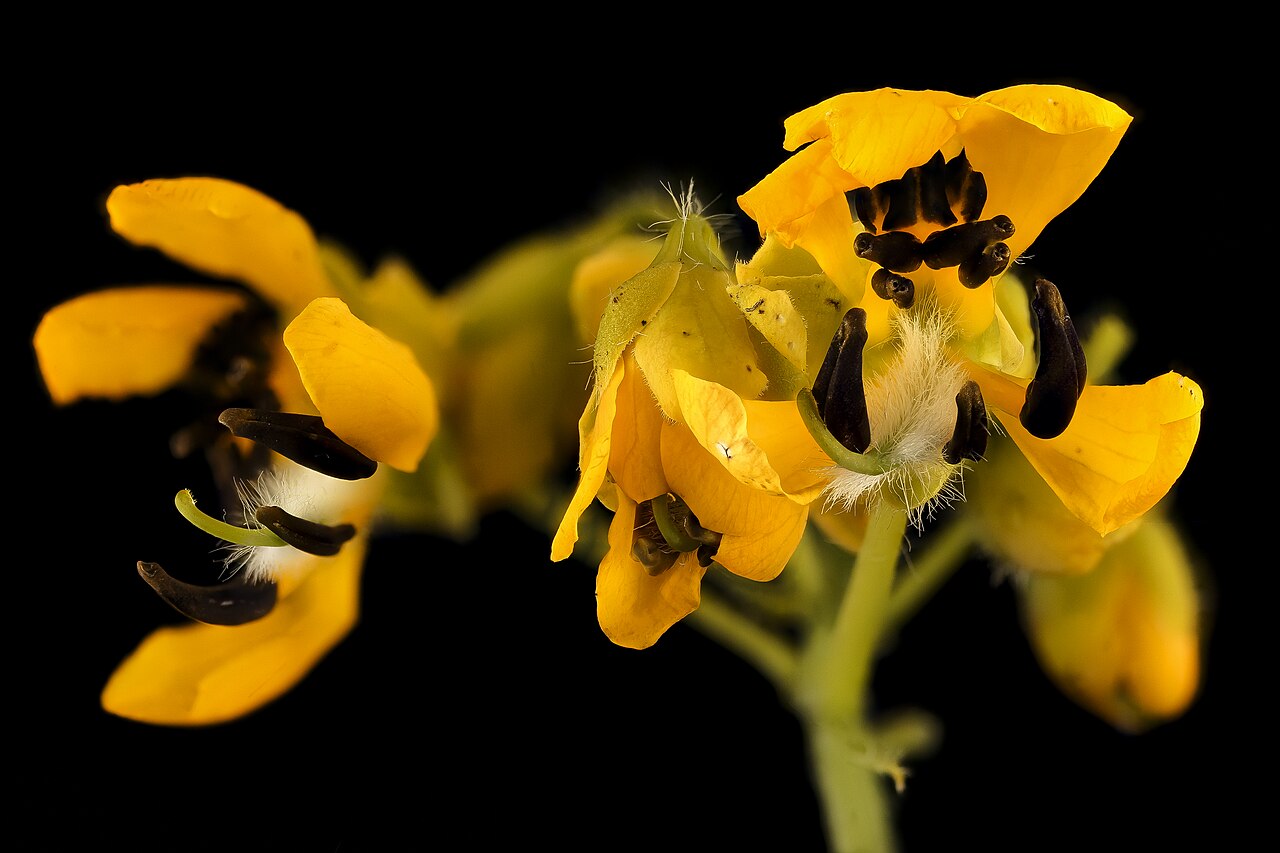
From July to August, short clusters of flowers form in the upper leaf axils and at the stem tips, creating a dense crown of yellow. Each flower is about 3/4 inch across with five slightly unequal, bright yellow petals. Unlike a typical pea flower, it is open and nearly radial. Seven of the ten stamens have large, dark brown to nearly black anthers; the upper three are reduced. The petals fade toward white as they age.
Fruit & Seeds
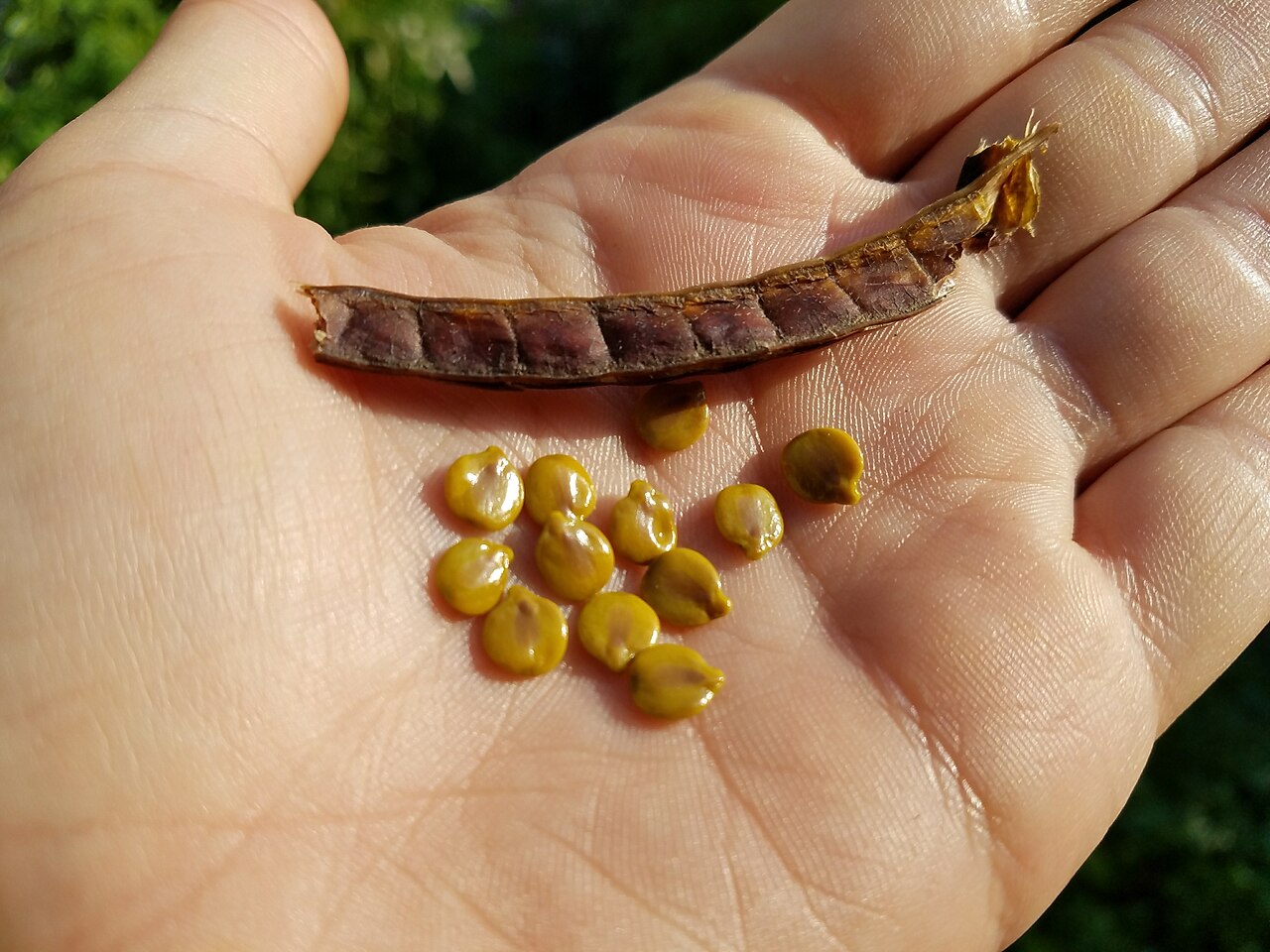
The pods are flat, 3 to 4 inches long, covered with short hairs and visibly divided into segments, each holding one flat seed. They turn dark brown to black in fall and split slowly, often staying on the stems into winter.
Look-alikes
Southern wild senna (Senna marilandica) is very similar but has fewer flowers per cluster, a dome-shaped rather than club-shaped leaf-stalk gland, and pods that are hairless or nearly so with less obvious segments. It grows farther south and west. Partridge pea (Chamaecrista fasciculata) is a much smaller annual with finer leaflets. Introduced sicklepod (Senna obtusifolia) and coffee senna (S. occidentalis) are weedy annuals with fewer, broader leaflets.
Safety
All parts, especially the seeds, pods and leaves, contain anthraquinone glycosides (sennosides) with a strong purgative effect. Eating them can cause severe diarrhea, cramping and dehydration in people and pets, and large amounts can poison livestock. Do not use the plant as a home remedy, and plant it away from areas where small children play unsupervised.
Quick Facts
| Scientific Name | Senna hebecarpa |
| Family | Fabaceae (pea family) |
| Plant Type | Herbaceous perennial |
| Mature Height | 3–6 ft |
| Mature Spread | 2–3 ft |
| Growth Rate | Moderate to fast |
| Sun Exposure | Full sun to part shade |
| Water Needs | Medium to moist; tolerates brief dry spells |
| Soil Type | Loam, sandy loam, clay loam |
| Soil pH | About 5.5–7.5 |
| Bloom Time | July–August |
| Flower Color | Bright yellow with dark brown anthers |
| Fall Color | Leaves yellow; dark pods persist |
| Fruit | Flat, hairy, segmented pod, 3–4 in |
| Deer Resistant | Yes; rarely browsed |
| USDA Hardiness Zones | 4–8 |
Native Range
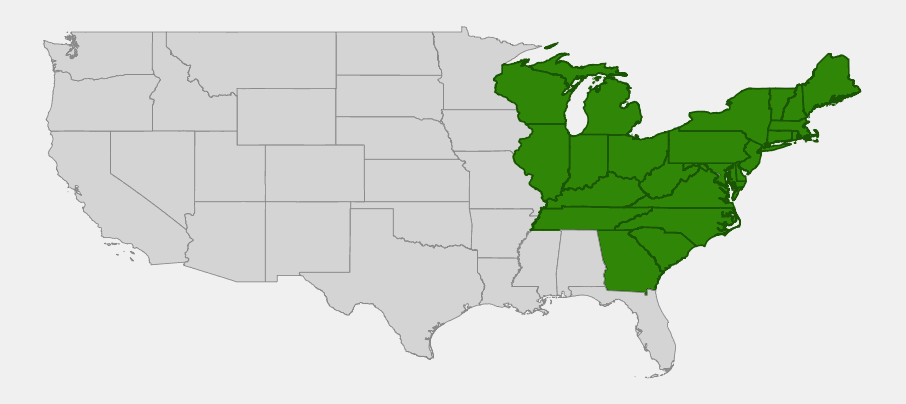
American senna is native to eastern North America. USDA PLANTS records it as native in southern Ontario and in 23 eastern states plus the District of Columbia. The Lady Bird Johnson Wildflower Center summarizes the range as Ontario and Maine south to Georgia and northwest to Tennessee and Wisconsin.
It is most frequent in the Appalachian and Ohio Valley states, the Mid-Atlantic and southern New England, and it reaches west through Ohio, Indiana and Illinois to Michigan and Wisconsin. In Georgia and South Carolina it is known only from scattered outlying stations in the mountains, at the southern tip of its range. In parts of northern New England and the Midwest it is uncommon, and the more southern and western sennas are often mistaken for it.
Typical habitats are moist meadows, stream and river banks, floodplain openings, edges of moist open woods, wet thickets and roadsides. It does best in sunny openings on fertile, moist soil, and it often turns up where a disturbance such as flooding or mowing keeps trees from taking over.
📋 Regional plant lists featuring American Senna: New York, Pennsylvania & Northern New Jersey · Ohio & Indiana · Michigan, Wisconsin & Eastern Minnesota · Kentucky & Tennessee · Connecticut, Massachusetts & Rhode Island · New Hampshire, Maine & Vermont · Maryland, Virginia & West Virginia · Delaware, Southern New Jersey & Long Island · Illinois, Iowa & Missouri · Alabama, Georgia & Mississippi · North & South Carolina
Growing & Care Guide
American senna is an easy, long-lived perennial for sunny, moist sites. It is slow to start from seed but almost trouble-free once established, and a single plant fills a space like a small shrub each summer.
Light
Full sun gives the strongest stems and heaviest bloom. It tolerates part shade, especially afternoon shade in the South, but plants in shade grow lanky and may flop.
Soil & Water
Grow it in average to rich, moist loam. It tolerates clay and sandy loam, and brief flooding along streams. Once established, its deep roots carry it through ordinary summer dry spells, though it looks best with steady moisture. As a legume it needs no fertilizer.
Planting Tips
Plant container plants in spring or fall, 2 to 3 feet apart. It has a deep, woody root and resents moving once settled, so choose a permanent spot. Use it at the back of a border, in a rain garden, a meadow or along a pond or stream edge.
Pruning & Maintenance
Cut the stems down in late winter or early spring, after birds and winter interest are over. Plants emerge late in spring, so mark their spot. Self-sown seedlings can appear nearby; pull extras or let them fill in a naturalized area. Wear gloves when handling large quantities of seed.
Propagation
Seeds have hard coats. Nick or sand them, or soak them in hot water overnight, then sow outdoors in fall or in spring after a few weeks of cold, moist stratification. Seedlings take two or three years to flower. Mature clumps can also be divided carefully in early spring or fall.
Landscape Uses
- Pollinator gardens: a magnet for bumble bees from July to August
- Butterfly gardens: larval host for sulphur butterflies
- Rain gardens and swales: tolerates wet soil and brief flooding
- Back of the border: a tall, shrub-like perennial with fine foliage
- Meadow and stream-bank restoration: a sturdy, deep-rooted native legume
Wildlife & Ecological Value
American senna supports a surprising number of insects for its flowers alone, and its leaves, nectar glands and seeds add further value.
For Pollinators
The flowers produce no nectar. Instead, bumble bees grip the anthers and vibrate their flight muscles to shake out pollen, a process called buzz pollination. The Xerces Society lists it as having special value to bumble bees. Small bees gather fallen pollen. The leaf-stalk glands secrete nectar that attracts ants, small wasps and other insects that may help protect the plant from herbivores.
For Birds
The hard seeds are eaten only occasionally by seed-eating birds and are not a major food. The tall stems give cover in meadows.
For Mammals
Deer and rabbits usually avoid the foliage, likely because of its purgative compounds. Grazing livestock should not be allowed to eat large amounts.
Ecosystem Role
It is a larval host plant for the cloudless sulphur butterfly (Phoebis sennae), and other sulphur butterflies such as the sleepy orange use sennas too. Like many legumes, its roots host nitrogen-fixing bacteria, adding nitrogen to the soil in meadows and stream banks.
Cultural & Historical Uses
Sennas have been used as laxatives for centuries, and American senna was used in the same way as the imported Alexandrian senna of the Old World. Native American peoples in the East used wild sennas as a purgative and for fevers and other complaints, and early American physicians used the leaves as a domestic substitute for imported senna. Because doses are hard to control and the effects can be severe, it should not be used at home.
Botanically, American senna was long classified in the genus Cassia, and many field guides still call it Cassia hebecarpa. In 1982 Irwin and Barneby moved it to Senna, It was first described by Merritt Lyndon Fernald in 1937, who separated it from the southern Senna marilandica, with which it had long been lumped. The species name comes from Greek words meaning “hairy fruit,” referring to its hairy pods.
Today it is valued by native plant gardeners and restoration ecologists as a showy, bumble-bee-friendly perennial for moist meadows. Its tropical-looking foliage and brown-eyed flowers make it a conversation piece in the garden.
Frequently Asked Questions
Is American senna poisonous?
Yes, in the sense that its leaves, pods and seeds are strongly laxative. Eating them can cause severe diarrhea and cramping in people and pets, and large amounts can harm livestock. Do not eat it or use it as a remedy.
How tall does American senna get?
Usually 3 to 6 feet tall and 2 to 3 feet wide, like a small shrub by midsummer. It dies back to the ground each winter.
What is the difference between American senna and Maryland senna?
They are close relatives. American senna (S. hebecarpa) has more flowers per cluster, a club-shaped leaf-stalk gland and hairy pods. Maryland or southern wild senna (S. marilandica) has a dome-shaped gland and smoother pods and grows farther south and west.
Which butterflies use American senna?
It is a larval host for the cloudless sulphur, and other sulphurs such as the sleepy orange also use sennas. Its flowers mainly feed bumble bees.
Is it hard to grow from seed?
Not hard, but slow. Scarify the hard seeds and give them cold, moist stratification. Seedlings usually flower in their second or third year.

Looking for a nursery that carries American Senna?
Browse our native plant nursery directory: Connecticut, Delaware & Georgia · Illinois & Indiana · Kentucky, Maine, Maryland, Massachusetts & Michigan · New Hampshire, New Jersey, New York, North Carolina & Ohio · Pennsylvania, Rhode Island, South Carolina, Tennessee, Vermont & Virginia · West Virginia & Wisconsin