
Dwarf Sundew (Drosera brevifolia)
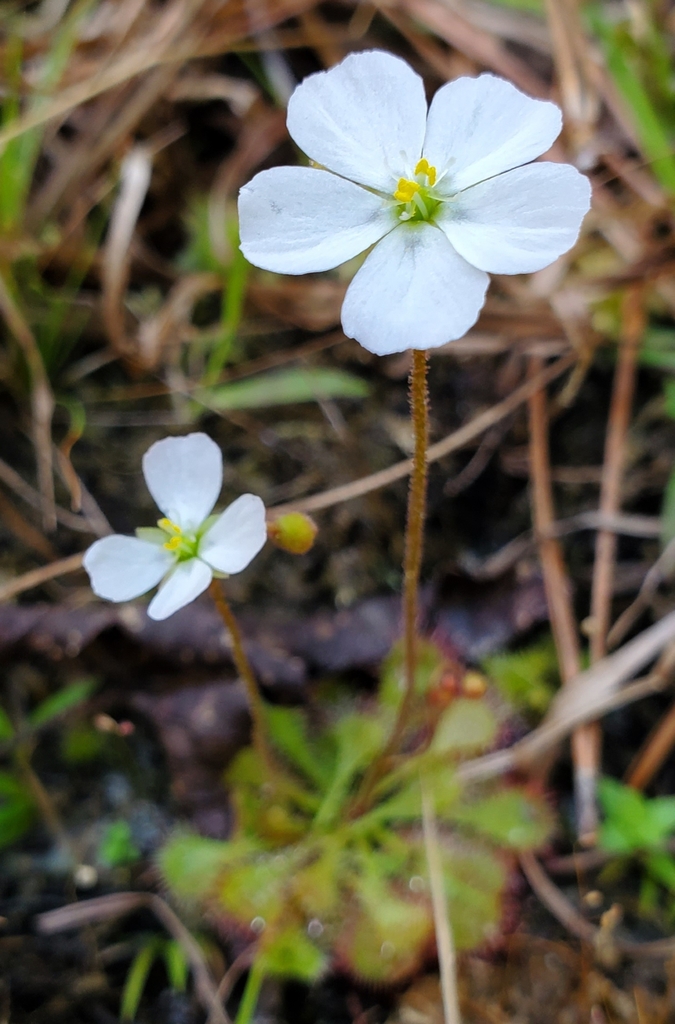
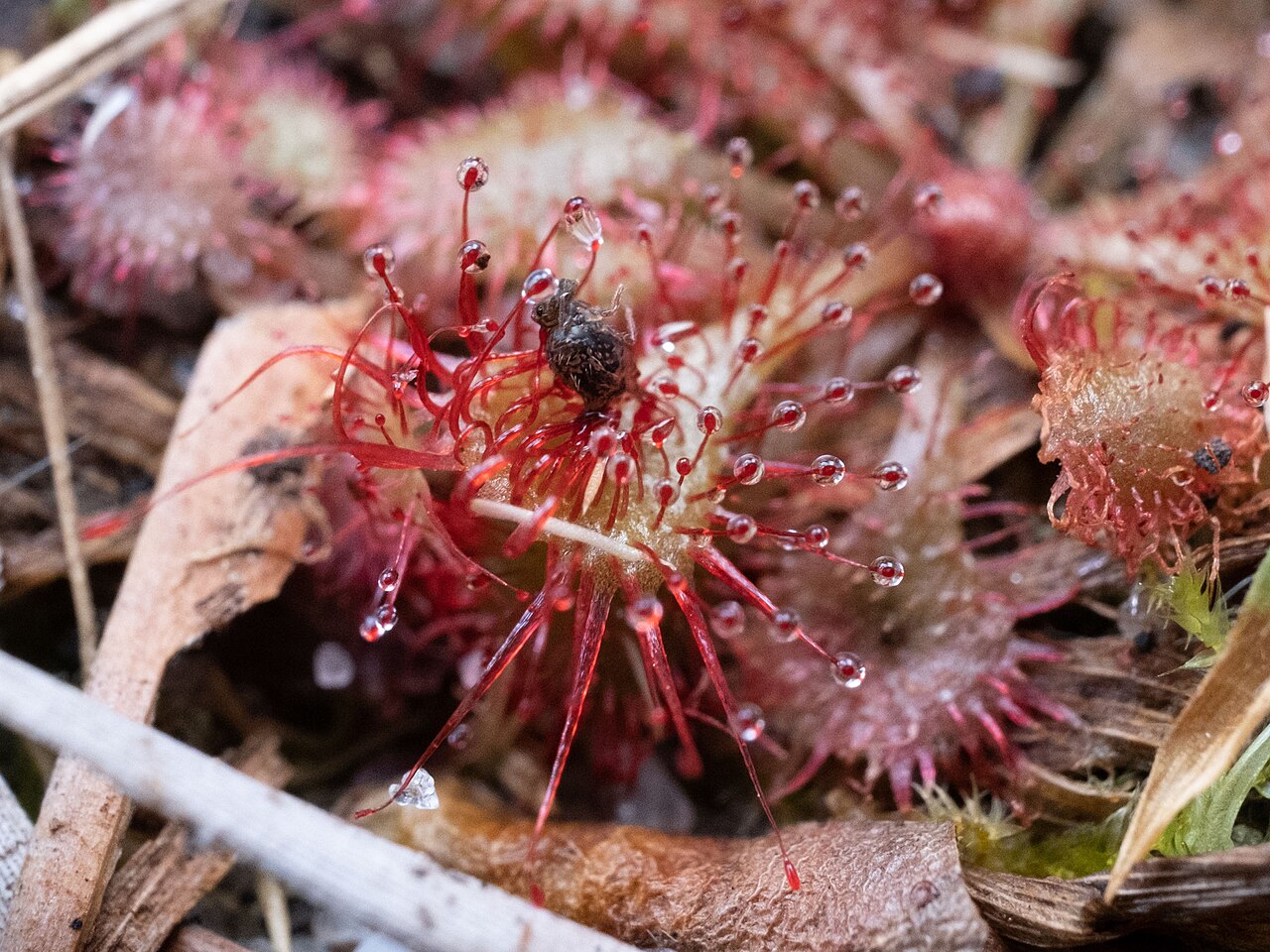
Drosera brevifolia, known as Dwarf Sundew, is the smallest sundew in the eastern United States, a carnivorous plant whose flat, reddish rosette is often less than an inch across. It belongs to the sundew family (Droseraceae). Its short, wedge-shaped leaves are covered with red, gland-tipped tentacles that hold drops of sticky “dew,” which trap gnats, springtails and other tiny insects.
Dwarf sundew is a plant of late winter and spring. Rosettes appear in damp, sandy or peaty openings, flower from about March to May with surprisingly large white to pink blossoms, set seed, and often die as soils dry out and heat arrives in summer. Many populations behave as annuals and return from seed each year, which is why it was once also named Drosera annua.
It grows across the Coastal Plain and interior lowlands of the Southeast, west to eastern Oklahoma and Texas and north to Kansas, Kentucky and Virginia, and it also occurs in Latin America. Its seepy, open habitats are easily lost to drainage and fire suppression. Never dig sundews from the wild. Grow only nursery-propagated plants or seed from cultivated plants.
Identification
Dwarf sundew is easy to overlook until it blooms. Look for small red rosettes pressed flat against bare, damp sand or moss in early spring, with flowers that seem far too big for the plant.
Rosette
The rosette is usually 1/2 to 1 1/4 inches across and lies flat on the ground. Plants growing in full sun are deep red; those in partial shade are greener. Each plant has a small, weak root system and often grows in loose colonies of dozens to hundreds of rosettes.
Leaves
The leaves are short, about 1/4 to 1/2 inch long, and wedge- or spoon-shaped, widening gradually from the base with no distinct stalk. The upper surface and edges carry red tentacles, each tipped with a drop of clear, sticky mucilage. The tentacles bend slowly toward trapped prey.
Flowers
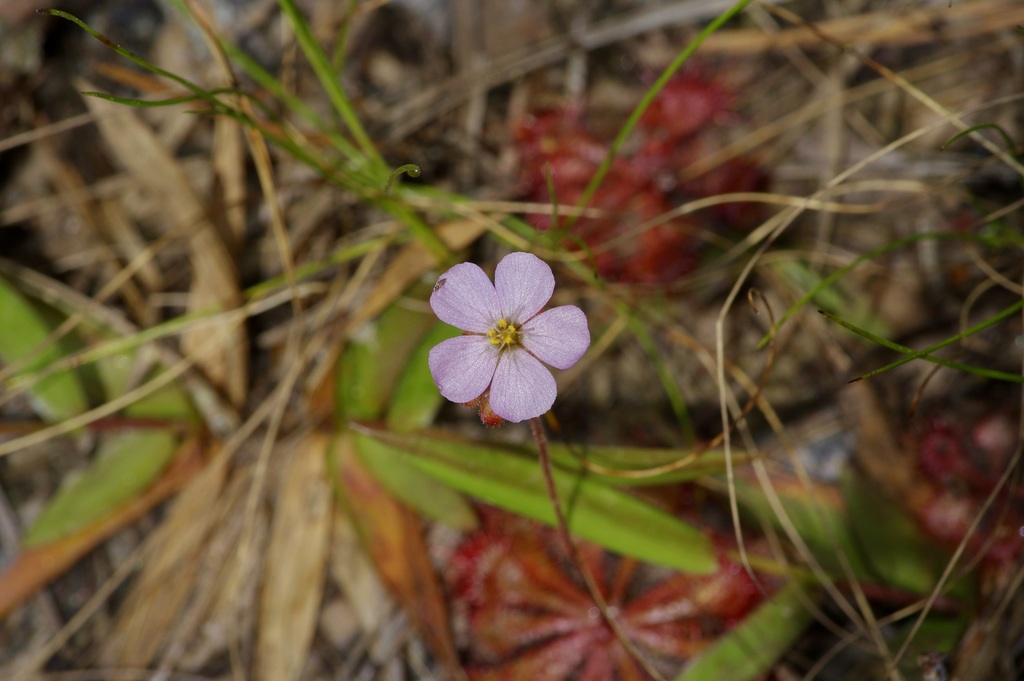
From late winter to late spring, each rosette sends up one or a few flower stalks 1 1/2 to 4 inches tall. The stalks are covered with tiny glandular hairs, an important identification feature. Each stalk carries one to several flowers about 1/2 inch or more across, with five white to rose-pink petals. They open in sunshine, usually one at a time.
Fruit & Seeds
A small capsule follows each flower and splits to release many tiny black seeds. In seasonally dry habitats the rosettes then wither, and the seed bank carries the population to the next wet season.
Look-alikes
Pink sundew (Drosera capillaris) has longer leaves with distinct stalks, smooth (not glandular) flower stalks and pink flowers; it often grows in the same places. Spoon-leaved sundew (D. intermedia) is larger, with leaves on long, erect stalks, and grows in wetter spots. Round-leaved sundew (D. rotundifolia) has round leaf blades on long stalks and is a northern and mountain species.
Safety & Conservation
Dwarf sundew is harmless to people and pets; its traps hold only tiny insects. The concern is for the plant. It depends on open, wet, sandy ground kept open by fire or other disturbance, and it is uncommon to rare near the edges of its range. Never collect wild plants; buy nursery-grown plants or seed from cultivated stock.
Quick Facts
| Scientific Name | Drosera brevifolia |
| Family | Droseraceae (sundew family) |
| Plant Type | Carnivorous herb; annual or short-lived perennial |
| Mature Height | Rosette under 1/2 in tall; flower stalks 1 1/2–4 in |
| Mature Spread | 1/2–1 1/4 in per rosette |
| Growth Rate | Fast; completes its cycle in one season |
| Sun Exposure | Full sun |
| Water Needs | High; wet in winter and spring |
| Soil Type | Wet sand, sandy peat, moss |
| Soil pH | About 4.5–6.0 (acidic) |
| Bloom Time | March–May (sometimes into June) |
| Flower Color | White to rose pink |
| Fall Color | Not applicable; rosettes usually die back by summer |
| Fruit | Small capsule with many tiny black seeds |
| Deer Resistant | Yes; too small and sticky to be browsed |
| USDA Hardiness Zones | 7–10 |
Native Range
USDA PLANTS lists dwarf sundew as native in 14 states: Alabama, Arkansas, Florida, Georgia, Kansas, Kentucky, Louisiana, Mississippi, North Carolina, Oklahoma, South Carolina, Tennessee, Texas and Virginia. Beyond the United States it ranges into Latin America, including Mexico, the Caribbean and parts of South America.
It is most common on the Gulf and southern Atlantic Coastal Plain, from Florida and Georgia west through the Florida Panhandle, Alabama, Mississippi and Louisiana to eastern Texas, where it is frequent in the Pineywoods and Post Oak Savannah. In Texas it also extends down the coast into South Texas, with many records from wet sandy prairies and swales around Rockport, Port Lavaca, Corpus Christi and Padre Island National Seashore. Northward it reaches the Ozarks and Ouachitas, southeastern Kansas, Tennessee, Kentucky and southern Virginia, where it is scattered and often rare.
Typical habitats are seasonally wet, open places with acidic, sandy or peaty soil: pine flatwoods and savannas, seepage slopes, sandy roadside ditches, wet prairies, coastal swales, and thin soils over sandstone or granite where water seeps in spring. It needs bare ground and full sun, and it often appears after fire, mowing or light disturbance clears competing plants.
📋 Regional plant lists featuring Dwarf Sundew: Kentucky & Tennessee · Nebraska, Kansas & Eastern Colorado · Maryland, Virginia & West Virginia · Alabama, Georgia & Mississippi · North & South Florida · North & South Carolina · Arkansas, Louisiana, Eastern Oklahoma & Eastern Texas · South & West Texas
Growing & Care Guide
Dwarf sundew is a delightful but short-lived plant for carnivorous plant enthusiasts. Grow it from seed or nursery plants in a sunny bog container. Never take plants from the wild: digging damages fragile seepage habitats, and collected plants rarely survive.
Light
Give it full sun or very bright light. Strong light keeps the rosettes compact and red; in shade they become green and weak.
Soil & Water
Use a mix of sphagnum peat and lime-free sand or perlite, or live sphagnum moss. Keep it wet during the growing season by standing the pot in a shallow tray of water. Use only rainwater, distilled or reverse-osmosis water, since minerals in tap water slowly kill sundews. Never fertilize the soil.
Planting Tips
Sow seed on the surface of the moist mix in fall or late winter and do not cover it. Grow plants in small pots or as a ground layer in a bog container with taller pitcher plants kept to the side so they do not shade it. Do not feed it meat; outdoors it catches enough prey.
Pruning & Maintenance
Expect many plants to set seed and die in early summer. Leave the flower stalks to ripen, then let seed fall onto the soil or collect it and resow. Keep the surface free of fast-growing moss, algae and weeds that would smother the tiny rosettes. Protect pots from hard freezes.
Propagation
Seed is the main method. Fresh seed germinates readily on moist peat in cool, bright conditions, often without cold treatment. Leaf cuttings laid on wet sphagnum can also produce plantlets. Plants are mostly self-pollinating and set abundant seed.
Landscape Uses
- Bog containers: a tiny, colorful ground layer for a sunny carnivorous plant pot
- Seepage and bog gardens: reseeds on bare wet sand where competition is low
- Nature education: shows insect trapping on a very small scale
- Savanna and flatwoods restoration: an indicator of open, fire-maintained wet ground
- Wet ditch and swale plantings: on bare acidic sand that stays wet in spring
Wildlife & Ecological Value
Dwarf sundew is a tiny predator and a small but telling member of the wet, fire-maintained plant communities of the Southeast.
For Pollinators
The flowers are visited by small bees and flies, but they can also self-pollinate, and many set seed without insect visits. The flower stalks lift the blooms above the sticky rosette, so visitors are rarely trapped.
For Birds
It has no real food value for birds, but it shares its open, wet savannas and flatwoods with birds such as Bachman’s sparrows and red-cockaded woodpeckers in longleaf pine country.
For Mammals
Mammals do not eat it. Trampling, rooting by feral hogs and heavy vehicle use in wet areas can damage populations.
Ecosystem Role
Dwarf sundew captures springtails, gnats, midges, ants and other tiny arthropods, recycling scarce nitrogen and phosphorus on nutrient-poor sands. Its presence shows that a site is open, wet and acidic. Fire suppression lets shrubs and taller plants shade it out, and drainage removes the seasonal wetness it needs.
Cultural & Historical Uses
Dwarf sundew was first described by the American botanist Frederick Pursh in 1814. Later botanists described the same plant as Drosera annua and D. leucantha, names now treated as synonyms. Its name means “short-leaved sundew.”
Charles Darwin’s experiments on sundews in Insectivorous Plants (1875) showed that their tentacles move and that the leaves digest prey. Dwarf sundew works the same way on a miniature scale, and carnivorous plant growers value it for its large flowers and rich red color.
In the Southeast, dwarf sundew is often one of the first wildflowers of the year in wet pine savannas, blooming in late winter alongside the earliest violets. Botanists and naturalists use it, along with pitcher plants and other sundews, as a sign of high-quality, fire-maintained wet savanna and seepage habitat.
Frequently Asked Questions
Is dwarf sundew an annual?
Often, yes. Many populations sprout in fall or winter, bloom in spring and die in early summer, returning from seed. In wetter sites some plants survive longer as short-lived perennials.
How can I tell dwarf sundew from pink sundew?
Dwarf sundew has very short, wedge-shaped leaves without distinct stalks and glandular-hairy flower stalks. Pink sundew has longer, stalked, spoon-shaped leaves and smooth flower stalks.
Is dwarf sundew dangerous to people or pets?
No. It is harmless to touch and too small to trap anything larger than tiny insects.
Can I collect dwarf sundew from a ditch?
No. Wild populations depend on their local seed bank, and collected plants seldom survive. Buy nursery-propagated plants or seed from cultivated plants.
What water should I use for dwarf sundew?
Rainwater, distilled water or reverse-osmosis water. Keep the soil wet while it is growing, and never fertilize the soil.

Looking for a nursery that carries Dwarf Sundew?
Browse our native plant nursery directory: Alabama & Arkansas · Florida & Georgia · Kansas · Kentucky, Louisiana & Mississippi · North Carolina & Oklahoma · South Carolina, Tennessee, Texas & Virginia