
Nuttall’s Toothwort (Cardamine nuttallii)
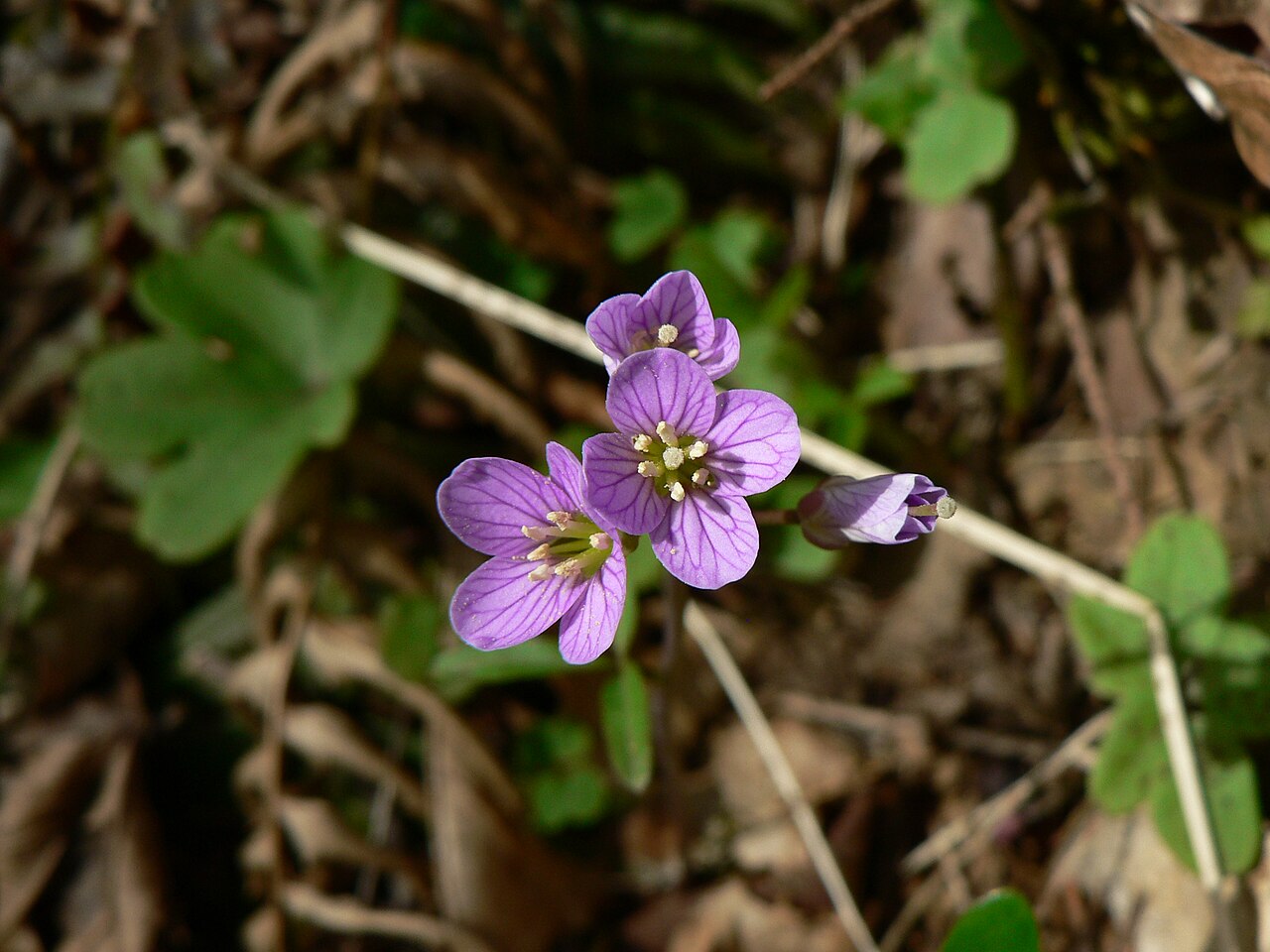
Cardamine nuttallii, known as Nuttall’s Toothwort, slender toothwort or beautiful bittercress, is a small spring wildflower of the forests of the Pacific Northwest and northern California. In late winter and early spring it sends up a slender stem, usually less than 8 inches tall, with a few divided leaves and a short cluster of four-petaled flowers in pale pink, lavender or rose-purple. By early summer the plant has set seed and vanished back underground, making it one of the region’s classic spring ephemerals.
Nuttall’s toothwort is a member of the mustard family (Brassicaceae). Older Northwest floras, including Hitchcock and Cronquist, call it Cardamine pulcherrima, and it has also been treated as Dentaria tenella, a name from the time when toothworts were kept in their own genus, Dentaria. All of these refer to the same plant. The species is named for the naturalist Thomas Nuttall, who collected in the Oregon Country in the 1830s.
It grows from British Columbia south through western Washington and Oregon to northern California, mostly in moist forests and woodland openings west of the Cascades, with populations on the eastern slopes and in the Columbia River Gorge. This guide covers how to identify it, where it grows, how to give it a home in a shady native garden, and its role as an early food source for pollinators.
Identification
Nuttall’s toothwort is easy to recognize in bloom by its combination of small size, four-petaled pink or lavender flowers and leaves of two different shapes: rounded basal leaves and divided stem leaves.
Roots & Stems
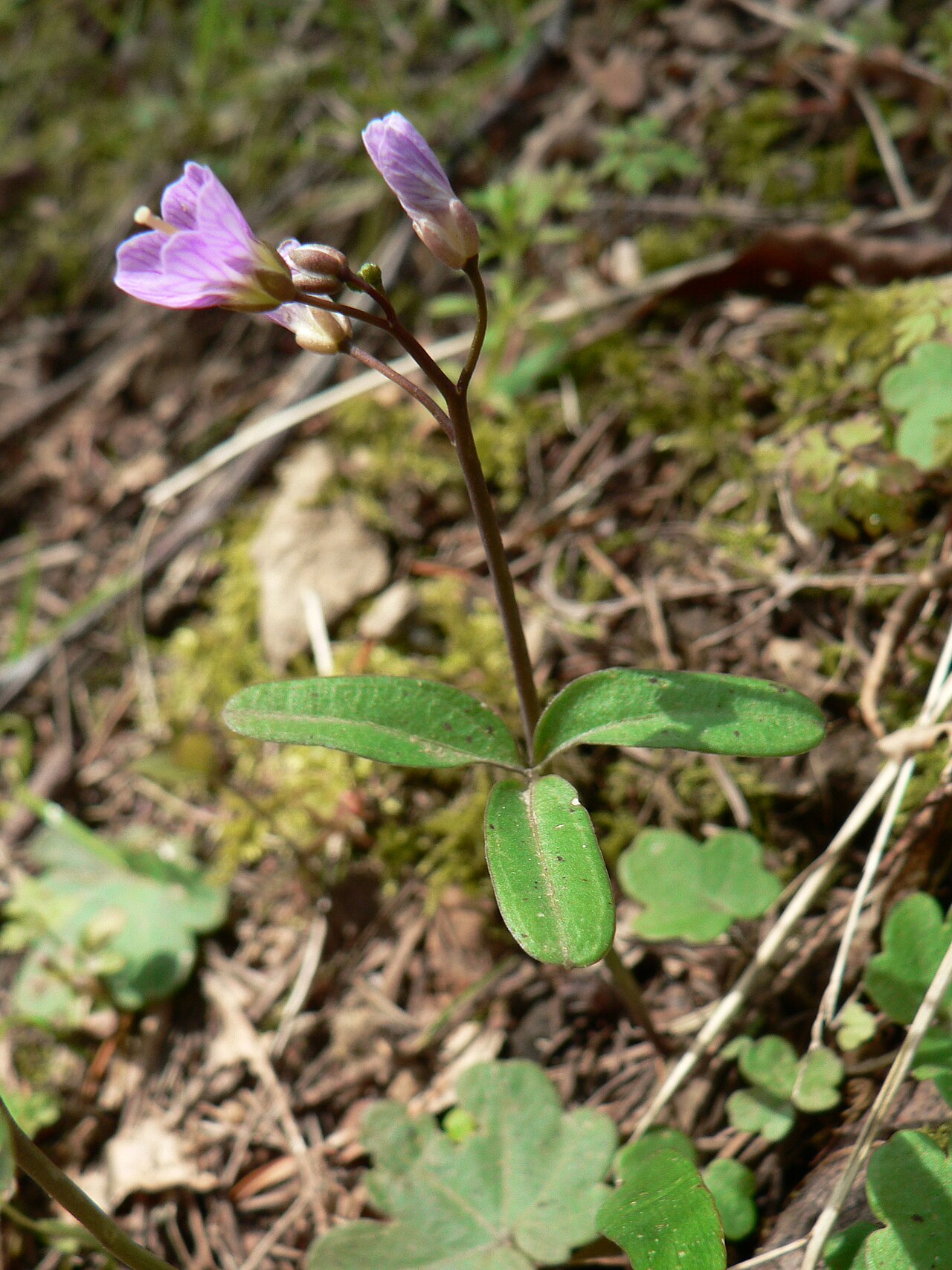
Each plant grows from a short, slender, fleshy white rhizome. Like other toothworts, the rhizome can have small tooth-like bumps, which gave the group its common name. A single unbranched stem rises 4 to 8 inches (10 to 20 cm), occasionally a bit taller. The stems are smooth or only sparsely hairy.
Leaves
The basal leaves are long-stalked, with rounded to heart-shaped blades that usually have scalloped edges. They are often separate from the flowering stem and may appear before it. Higher up, the stem carries one to three leaves grouped above the middle. These are usually divided into three to five narrow, lance-shaped leaflets 1/2 to 1 1/2 inches long, with smooth edges. The contrast between the round basal leaves and the narrow-fingered stem leaves is a good field mark.
Flowers
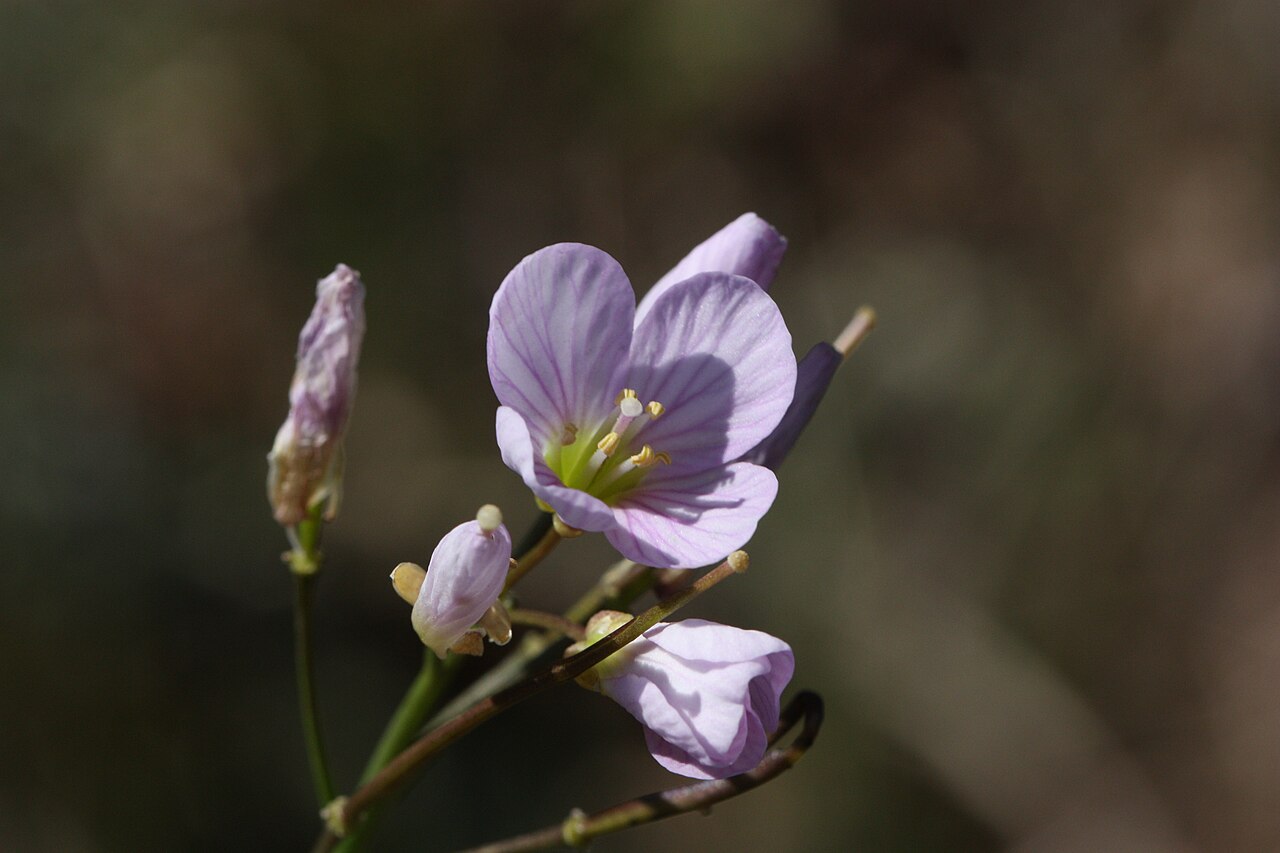
The flowers are carried in a short, few-flowered raceme at the top of the stem, on ascending stalks about 1/2 inch long. Each flower has four petals about 3/8 to 1/2 inch (9 to 14 mm) long, in pale pink, lavender, rose or purple, rarely white, often with darker veins. The four small sepals are purplish, and there are six stamens. In the Northwest it flowers mainly from March to May, earlier at low elevations and in mild winters.
Fruit & Seeds
After flowering, each blossom forms a slender, upright seed pod (a silique) about 1/2 to 2 inches long and very narrow. When ripe, the pod walls coil back suddenly and fling the seeds a short distance. By late spring or early summer the above-ground parts wither and the plant is dormant until the next winter.
Look-alikes
Milkmaids (Cardamine californica) is larger, usually has white or pale pink flowers and has stem leaves divided into broader, toothed leaflets; it overlaps with Nuttall’s toothwort in Oregon and California. In eastern North America, the related cut-leaved toothwort and two-leaved toothwort fill the same spring-ephemeral role in deciduous woods.
Quick Facts
| Scientific Name | Cardamine nuttallii Greene (syn. C. pulcherrima, Dentaria tenella) |
| Family | Brassicaceae (mustard family) |
| Plant Type | Herbaceous perennial spring ephemeral from a slender rhizome |
| Mature Height | 4–8 in (occasionally to about 1 ft) |
| Mature Spread | 3–6 in; slowly forms small colonies |
| Growth Rate | Slow |
| Sun Exposure | Part shade to shade |
| Water Needs | Moderate; moist in winter and spring, drier in summer dormancy |
| Soil Type | Humus-rich forest soil, leaf litter, mossy slopes |
| Soil pH | Slightly acidic to neutral (about 5.5–7.0) |
| Bloom Time | March–May |
| Flower Color | Pale pink, lavender, rose or purple; rarely white |
| Fall Color | None; dormant by early summer |
| Fruit | Slender, upright siliques that coil open to fling seeds |
| Deer Resistant | Not well documented; above ground only briefly in spring |
| USDA Hardiness Zones | 6–9 |
Native Range
Nuttall’s toothwort is a Pacific Coast species. USDA PLANTS lists it as native to California, Oregon and Washington, and to British Columbia in Canada. In British Columbia it grows in the southwest, including Vancouver Island and the lower Fraser Valley. In Washington and Oregon it is common in the lowland and foothill forests west of the Cascades, from the Puget Trough and Willamette Valley to the Coast Range. In California it occurs mainly in the northern part of the state, in the Coast Ranges and Klamath region, where several varieties have been described.
It is not strictly a west-side plant. The Burke Herbarium notes that in Washington it occurs on both sides of the Cascade crest, and it grows in the transition zone of the Columbia River Gorge, for example at Tom McCall Preserve in Oregon, and on the lower eastern slopes of the Cascades in places such as the Leavenworth area. Its stronghold, though, is the moist, mild forest country west of the mountains.
Typical habitats are seasonally moist soils in forest openings and forest understory at low to moderate elevations: Douglas-fir and mixed conifer forests, oak woodlands, shaded bottomlands, mossy slopes and streamsides. Four varieties are often recognized. The rare var. gemmata is restricted to redwood and related forests of northwestern California and southwestern Oregon.
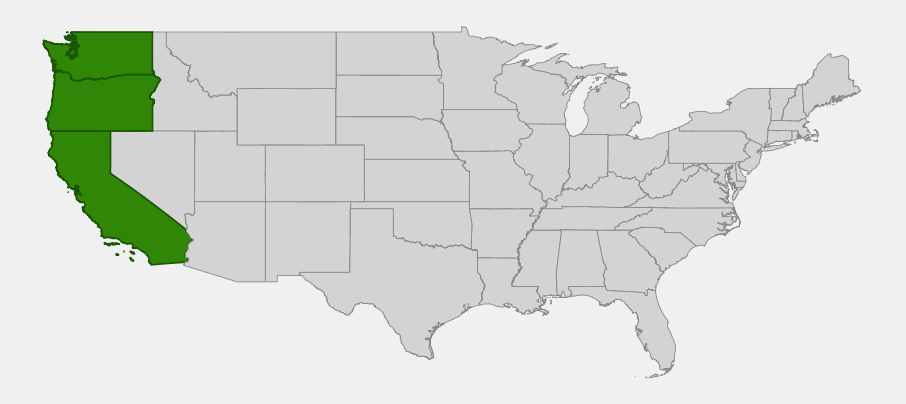
📋 Regional plant lists featuring Nuttall’s Toothwort: Western Oregon & Western Washington · Idaho, Eastern Oregon & Eastern Washington · California & Nevada
Growing & Care Guide
Nuttall’s toothwort is a delicate plant for a naturalistic woodland garden in the Pacific Northwest or northern California. It is rarely sold, and it is easiest to enjoy where it already grows or where it can be introduced from nursery-grown stock or responsibly gathered seed. Plan for its short season: it shines from late winter to spring and then disappears for the rest of the year.
Light
Give it part shade to light shade, ideally under deciduous trees or at the edge of conifers, where it gets winter and spring light and summer shade. Deep, year-round shade under dense evergreens reduces flowering.
Soil & Water
Plant in loose, humus-rich soil with plenty of leaf litter. It needs moisture from fall through spring, when it is growing, but it tolerates the dry summers of the region well because it is dormant then. Avoid planting where summer irrigation keeps the soil constantly wet, since the small rhizomes can rot.
Planting Tips
Plant rhizomes or potted plants in fall so they can root over winter. Set them in small drifts among ferns, trilliums and other woodland plants that will fill the space after the toothwort goes dormant. Mark the location so the dormant rhizomes are not dug up by accident.
Pruning & Maintenance
Little maintenance is needed. Let the foliage wither naturally, which allows the rhizome to store energy for next year, and leave fallen leaves in place as a natural mulch. Keep vigorous groundcovers and weeds from smothering the small plants in spring.
Propagation
Propagate by sowing fresh seed in fall in a shaded outdoor seedbed or pot, where it gets the cool, moist winter conditions it needs to germinate. Seedlings take a few years to reach flowering size. Established clumps can also be divided carefully when dormant in summer or early fall. Never dig plants from wild populations.
Landscape Uses
- Woodland gardens: early pink and lavender flowers among ferns and trilliums
- Spring ephemeral plantings: blooms in late winter and spring, then goes dormant
- Shade under deciduous trees: uses the spring light before the canopy leafs out
- Pollinator gardens: an early nectar and pollen source for bees and flies
- Native restoration: part of the herb layer of west-side forests and oak woodlands
Wildlife & Ecological Value
Nuttall’s toothwort is one of the first wildflowers to bloom in many Pacific Northwest forests, so its small flowers matter to insects that are active early in the year.
For Pollinators
The Burke Herbarium lists bees and flies as its pollinators. Early-flying native bees and hover flies visit the flowers for nectar and pollen on mild days in March and April, when few other flowers are open in the forest. Plants of the mustard family, including several Cardamine species, are also larval food plants for white and orangetip butterflies.
For Birds
It is too small to provide much food or cover for birds, but the insects it supports in early spring are food for insect-eating birds that are beginning to nest.
For Mammals
Deer, elk and small mammals may nibble the young growth, but the plant’s short season above ground limits browsing. The fleshy rhizomes may be dug up by rodents.
Ecosystem Role
As a spring ephemeral, Nuttall’s toothwort completes most of its yearly growth before the forest canopy closes and the summer drought sets in. It takes up nutrients from the soil in early spring and returns them as its leaves decay, part of the seasonal cycle of the forest floor herb layer.
Cultural & Historical Uses
The species was named by the botanist Edward Lee Greene in 1887 in honor of Thomas Nuttall, the English-born naturalist who traveled to the Pacific Northwest with Nathaniel Wyeth’s expedition in 1834 and collected many plants new to science. Greene also published the name Cardamine pulcherrima, “most beautiful”, which was widely used in the Northwest for this plant.
The name toothwort comes from the tooth-like projections on the rhizomes of some species, which by the old “doctrine of signatures” was thought to show the plant’s use for toothache. The genus name Cardamine comes from an ancient Greek name for a cress. Like other bittercresses and toothworts, the plant has a peppery, mustard-like taste, but it is too small and slow-growing to harvest, and it should be left in place.
For many Northwest hikers, the pink flowers of slender toothwort among the moss and leaf litter are one of the first true signs of spring in the lowland forests, appearing along trails in parks around Puget Sound and Portland while snow is still on the mountains.
Frequently Asked Questions
Is Nuttall’s toothwort the same as Cardamine pulcherrima?
Yes. Cardamine pulcherrima and Dentaria tenella are older names for the same plant. Current floras and USDA PLANTS use Cardamine nuttallii.
When does Nuttall’s toothwort bloom?
Mainly from March to May, depending on elevation and the weather. At low elevations in mild winters it may start blooming in late February.
Why does my toothwort disappear in summer?
It is a spring ephemeral. After flowering and setting seed, the leaves and stems wither and the rhizome stays dormant underground until the next winter. This is normal, not a sign that the plant has died.
Does Nuttall’s toothwort grow east of the Cascades?
It is mainly a west-side forest plant, but it also grows on the lower eastern slopes of the Cascades in Washington and in the Columbia River Gorge.
How is it different from milkmaids?
Milkmaids (Cardamine californica) is a larger plant with mostly white flowers and broader, toothed leaflets. Nuttall’s toothwort is smaller, usually pink to lavender, and has narrow, smooth-edged leaflets on the stem.

Looking for a nursery that carries Nuttall’s Toothwort?
Browse our native plant nursery directory: California · Oregon · Washington
