
Sugarstick (Allotropa virgata)
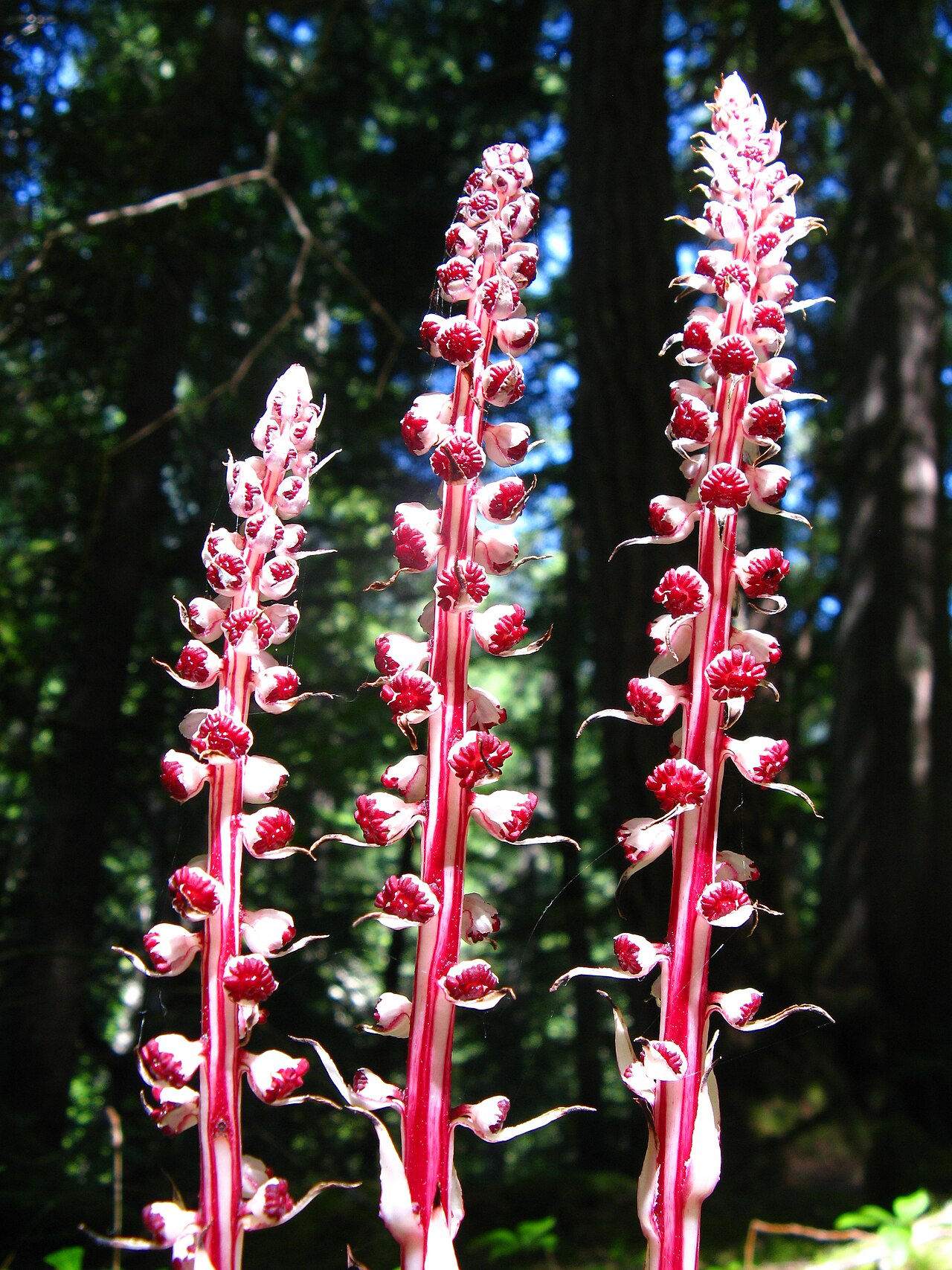
Allotropa virgata, known as Sugarstick (also candystick or barber’s pole), is one of the most striking wildflowers of western conifer forests. It has no green leaves and no chlorophyll. In summer it sends up stiff, unbranched stems 4 to 16 inches tall, white with bold red or maroon vertical stripes like a candy cane, lined with small, petal-less flowers with dark red stamens. It belongs to the heath family (Ericaceae), in the same group as indian pipe and snowplant, and it is the only species in its genus.
Sugarstick is a mycoheterotroph: instead of making its own food, it gets all its sugars from soil fungi that are connected to the roots of nearby conifers. Its main fungal partner is the matsutake mushroom (Tricholoma magnivelare in the broad sense), a prized edible mushroom of the same forests. It grows from southern British Columbia south through Washington, Oregon, Idaho and western Montana to the Sierra Nevada of California and the Lake Tahoe area of Nevada.
Because it depends completely on this partnership with fungi and trees, sugarstick cannot be grown in gardens, and it should never be dug up or picked. This page is a guide to identifying it, understanding its unusual life and finding it in the wild.
Identification
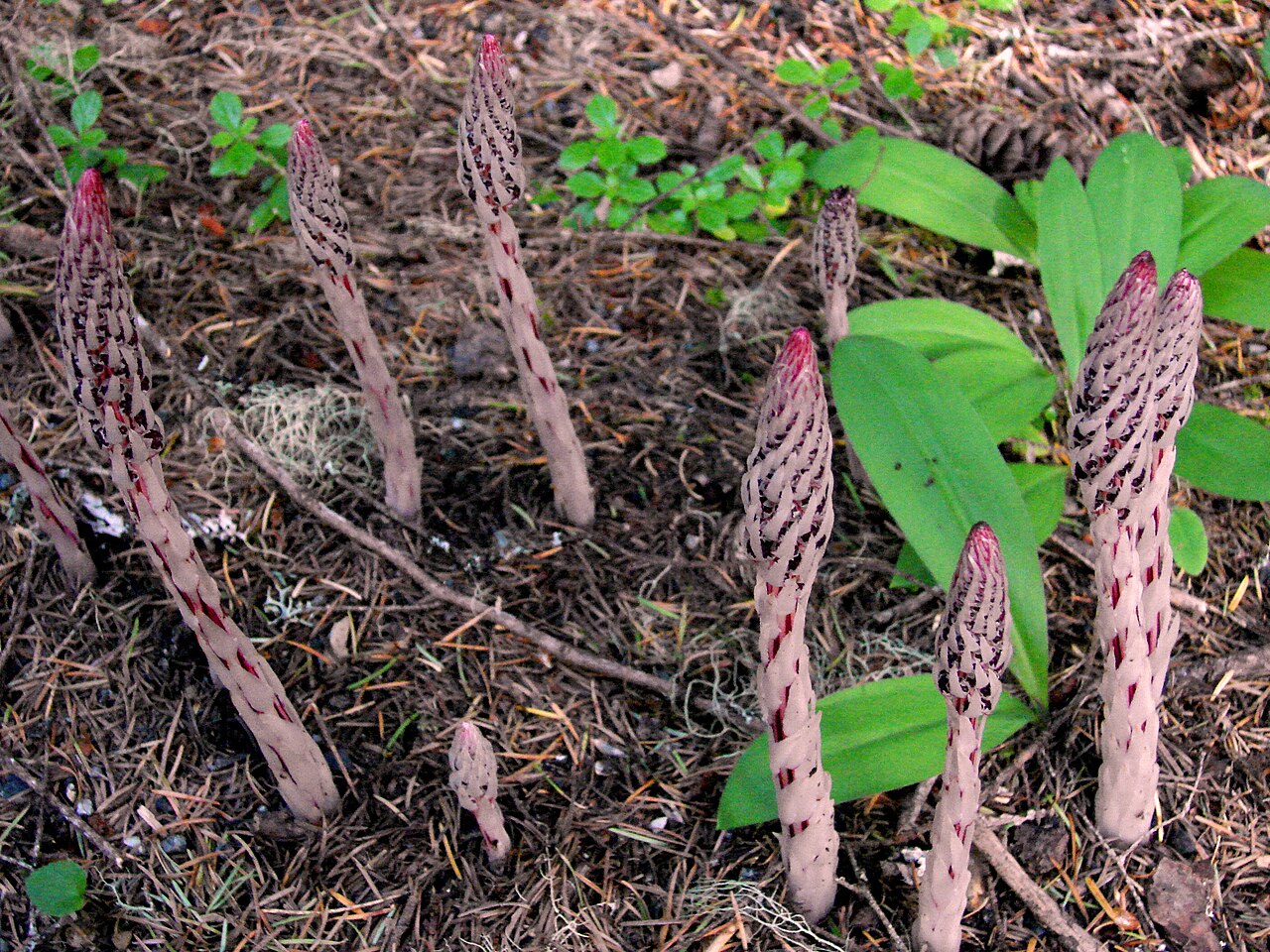
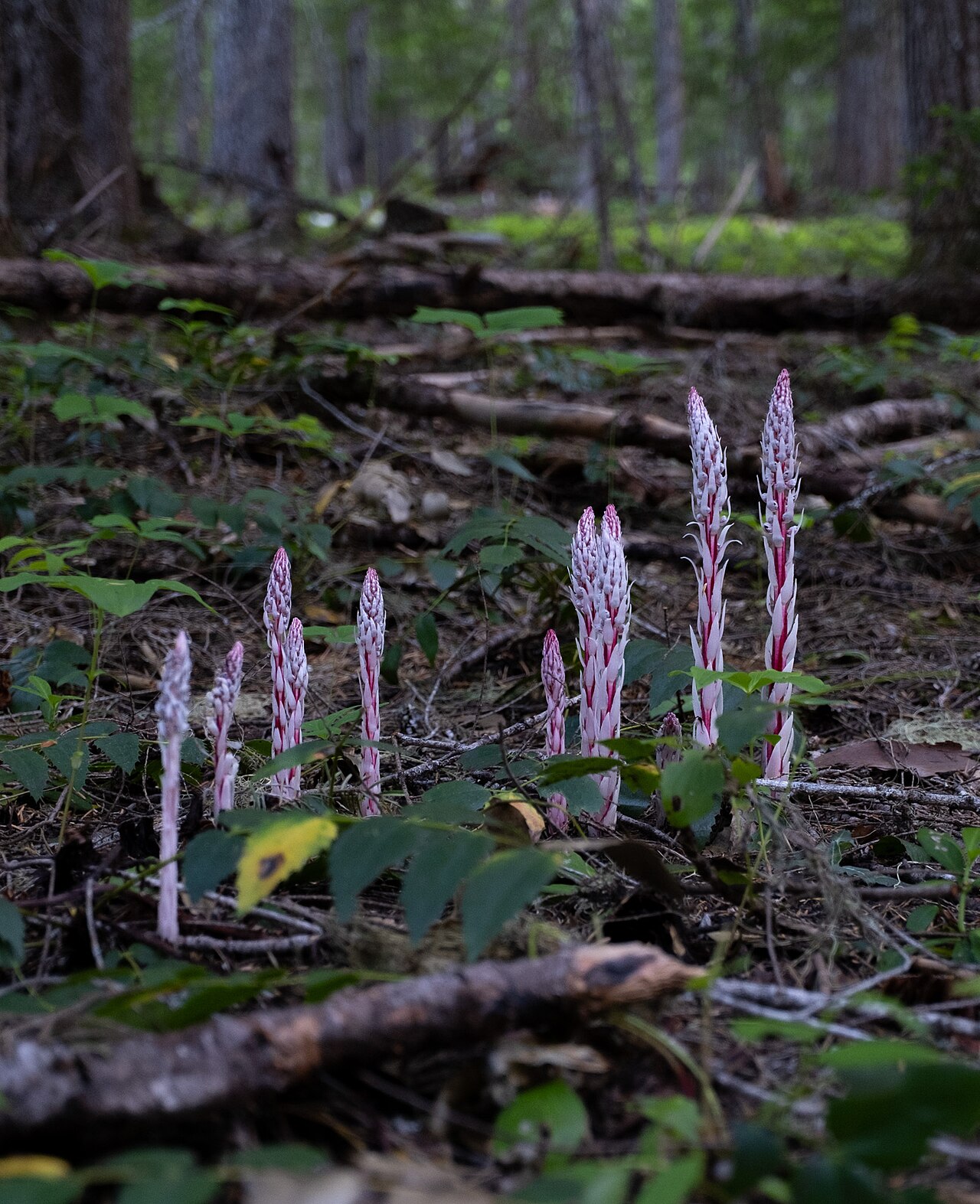
Look for leafless, white stems with red to maroon vertical stripes, standing alone or in small groups on a needle-covered forest floor, with many small flowers along the upper half.
Growth Habit
Sugarstick has no green leaves. All year it lives underground as a mass of fleshy roots tangled with fungal threads. In late spring or summer it sends up one or several stiff, upright, fleshy stems 4 to 16 inches tall (sometimes taller). The stems are white with red, pink or maroon stripes and carry narrow, pointed, scale-like bracts, especially near the base. Dried, brown stems often stand through the next year.
Flowers
Flowers are borne in a long, narrow spike along the upper half to two-thirds of the stem. Each flower is about 1/4 inch across, on a short stalk, and has no petals. It has five white to pinkish, cup-shaped sepals, ten prominent stamens with dark red to maroon anthers, and a rounded, ribbed ovary. Flowering runs from about May to August, depending on elevation.
Fruit
The fruit is a small, round capsule that splits open in late summer and fall, releasing huge numbers of tiny, dust-like seeds. The capsules stay on the dry, brown stems through winter.
Look-alikes
Snowplant (Sarcodes sanguinea) is entirely bright red and has bell-shaped red flowers. Pinedrops (Pterospora andromedea) has sticky, reddish-brown stems and nodding, urn-shaped flowers and often grows much taller. Pinesap and indian pipe are smaller, with nodding flowers. No other western plant has white stems with crisp red stripes.
Quick Facts
| Scientific Name | Allotropa virgata |
| Family | Ericaceae (heath family), subfamily Monotropoideae |
| Plant Type | Leafless mycoheterotrophic perennial |
| Mature Height | 4–16 in |
| Mature Spread | Single stems or small groups |
| Growth Rate | Not applicable; appears in summer |
| Sun Exposure | Shade to part shade (forest floor) |
| Water Needs | Dry to moist forest soils |
| Soil Type | Conifer forest duff over well-drained soil |
| Soil pH | Acidic (about 4.5–6.5) |
| Bloom Time | May–August |
| Flower Color | White to pink sepals; dark red stamens |
| Fall Color | None; dried brown stems persist |
| Fruit | Small round capsule with dust-like seeds |
| Deer Resistant | Not applicable; not cultivated |
| USDA Hardiness Zones | Not cultivated (wild in about zones 5–8) |
Native Range
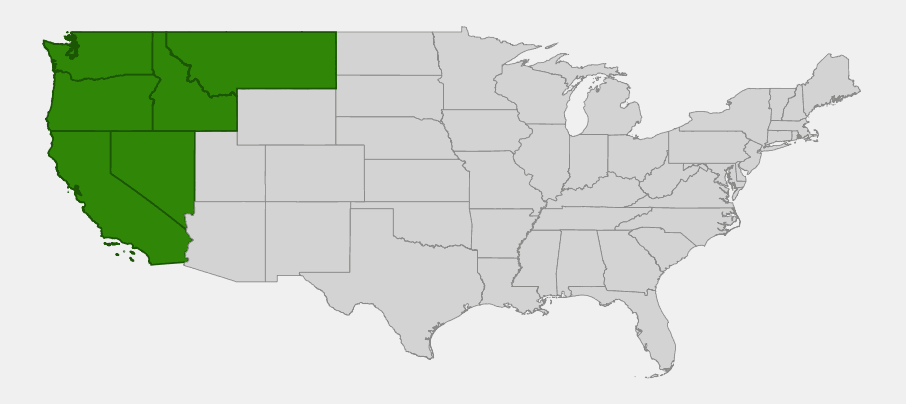
Sugarstick is endemic to western North America. USDA PLANTS lists it as native in Washington, Oregon, Idaho, Montana, Nevada and California. In Canada it grows in southern British Columbia, mainly on Vancouver Island and in the southern Coast and Cascade ranges.
In Washington and Oregon it grows in the Olympic Mountains, the Coast Range, the Cascades on both sides of the crest and the Blue Mountains. It extends east into northern and central Idaho and western Montana. In California it grows in the Klamath and North Coast ranges and along the Sierra Nevada, reaching the Carson Range on the Nevada side of Lake Tahoe. It is local and scattered throughout this range, abundant in some places and absent from large areas of similar-looking forest.
It grows in coniferous and mixed forests with deep needle litter, often under Douglas-fir, true firs, pines and hemlocks, from near sea level in coastal forests to about 9,000 feet in the Sierra Nevada. It tends to appear in places where its fungal partner, the matsutake, also fruits.
📋 Regional plant lists featuring Sugarstick: Montana & Wyoming · Western Oregon & Western Washington · California & Nevada
Can You Grow It?
No. Sugarstick cannot be grown in gardens or from nursery stock. It takes all of its food from specific soil fungi, which in turn are connected to the roots of living conifers. That three-way partnership cannot be moved or recreated. Plants that are dug up or transplanted die, and picking the stems prevents them from setting seed. Never dig, pick or buy it; enjoy it where it grows.
Light
In the wild it grows in the shade or dappled light of conifer forests. Its light needs are not about photosynthesis, since it has no chlorophyll; it simply grows where its host trees and fungi grow.
Soil & Water
It needs undisturbed forest soil with deep needle litter and a living network of fungi, especially the matsutake. These conditions are destroyed by soil disturbance, compaction and the loss of mature trees.
Planting Tips
There is no way to plant it. Seed is dust-fine and can only develop if it lands next to the right fungus, which must already be linked to living tree roots. Gardeners can help by protecting native conifer forests and their soils.
Pruning & Maintenance
In the wild, leave the stems standing, including the dry, brown ones, so the seed can scatter. Stay on trails near plants, since trampling compacts the soil and damages the fungal network.
Propagation
It is not propagated in cultivation. Seeds germinate only in contact with the right fungus in the wild. For this reason, any “sugarstick” offered for sale should be avoided.
Where to See It
- Old forests of the Cascades and Coast Range: look in summer along trails in Mount Rainier National Park, the Olympic Peninsula and the Oregon Cascades
- Sierra Nevada forests: mixed conifer stands around Lake Tahoe and in Yosemite and Sequoia country
- Northern Rockies: Douglas-fir and fir forests of northern Idaho and western Montana
- Photography and nature study: one of the most photogenic fungus-dependent plants
- Forest conservation: an indicator of healthy, undisturbed forest soils
Wildlife & Ecological Value
Sugarstick is a remarkable example of how plants, fungi and trees are linked in western forests.
For Pollinators
Its pollination has been little studied. The open flowers with exposed stamens are visited by insects such as small bees, and plants also set plenty of seed.
For Birds
It provides little direct food for birds.
For Mammals
Mammals rarely use the plant itself. Its fungal partner, the matsutake, is eaten by many forest mammals.
Ecosystem Role
Sugarstick takes sugars that conifer trees pass to their fungal partners. Its close link to the matsutake has made it a classic example in studies of mycoheterotrophic plants, and its presence shows that the fungal network in the soil is intact.
Cultural & Historical Uses
The genus name Allotropa comes from Greek words meaning “turned differently,” which botanists have linked to the way its flowers differ from those of its relatives, such as Monotropa. The species name virgata means “wand-like” or “striped,” fitting its straight, striped stems. Common names such as candystick and barber’s pole come from its red-and-white stripes.
Sugarstick is the only species in its genus. Studies of its roots found that it associates almost exclusively with the matsutake mushroom group, one of the most valuable wild mushrooms in the world. Some mushroom hunters in the Pacific Northwest treat sugarstick as a sign that matsutake may be nearby.
Like many plants in its group, sugarstick may not appear every year, even in places where it is known to grow. It spends most of its life underground and sends up stems only when conditions are right.
Frequently Asked Questions
Is sugarstick a fungus?
No. It is a flowering plant in the heath family, related to blueberries and rhododendrons. It has no chlorophyll and gets its food from soil fungi.
Can I grow sugarstick in my garden?
No. It depends completely on specific soil fungi connected to living conifers, and it cannot be grown from nursery stock or transplanted. Never dig it up.
Where can I see sugarstick?
In summer, in conifer forests from British Columbia through the Washington and Oregon Cascades to the Sierra Nevada, and in northern Idaho and western Montana. National parks such as Mount Rainier are good places to look.
Why is it red and white?
Its stems and scales contain red pigments in stripes. Without chlorophyll, it has no green color.
What is its connection to matsutake mushrooms?
Sugarstick gets its sugars from the matsutake fungus, which is in turn connected to the roots of conifers. Where you see sugarstick, matsutake may also grow.

Looking for a nursery that carries Sugarstick?
Browse our native plant nursery directory: California · Idaho · Montana · Nevada · Oregon · Washington

