
California Goldenbush (Ericameria ericoides)
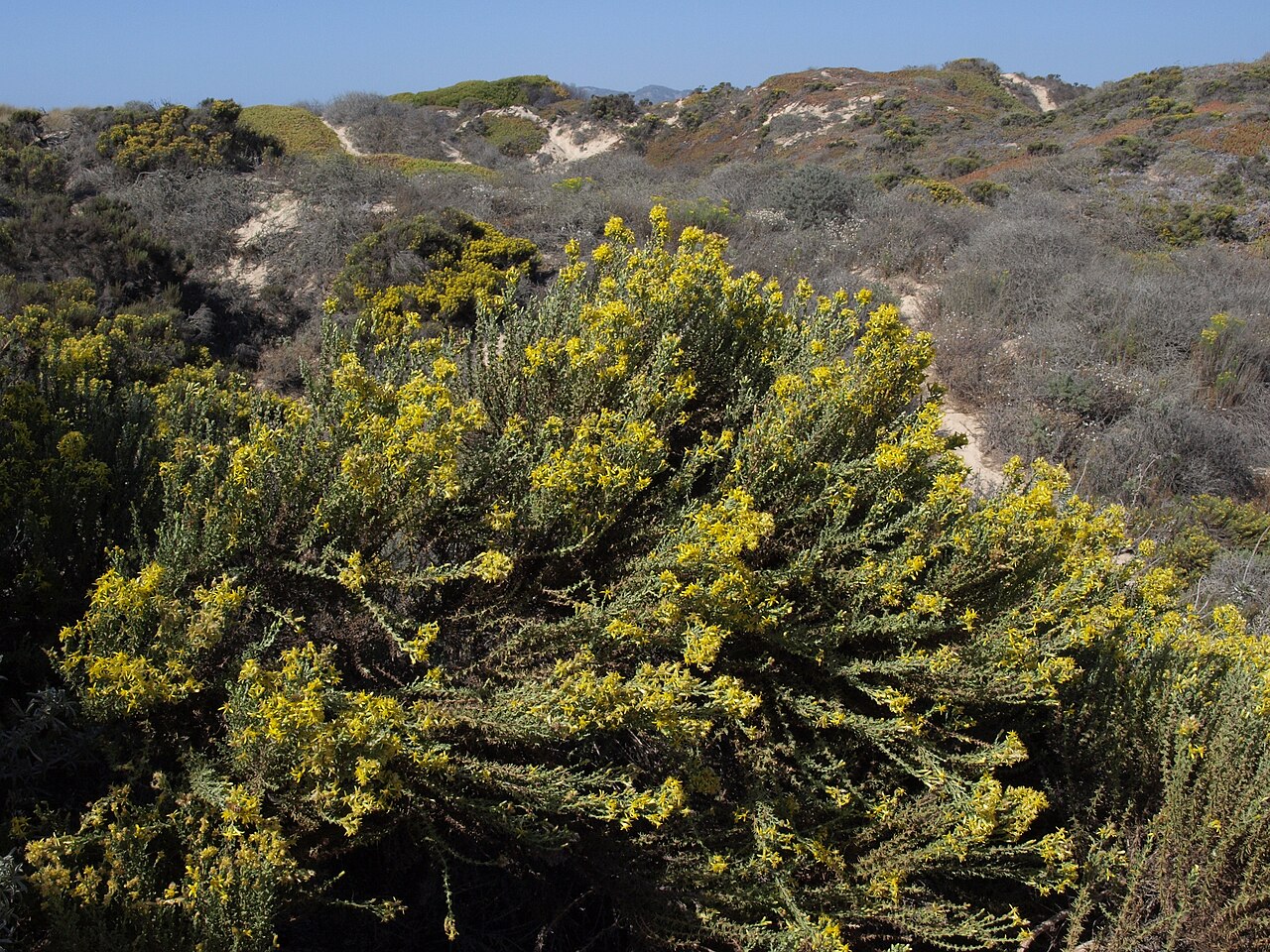
Ericameria ericoides, known as California Goldenbush, mock heather or California heathgoldenrod, is a low, rounded, evergreen shrub of the sunflower family (Asteraceae) that grows on the coastal sand dunes and sandy hills of central and southern California. It is densely clothed in tiny, needle-like leaves that give it the look of a heather, and in late summer and fall it is covered with small, bright yellow flower heads.
California goldenbush is usually 1 to 3 feet tall and wider than tall, forming dense mounds that help hold dune sand in place. It blooms when most coastal plants are dry and dormant, and its flowers are followed quickly by fluffy, tan seed heads. The foliage is resinous and slightly sticky, with a pleasant, pungent scent on warm days.
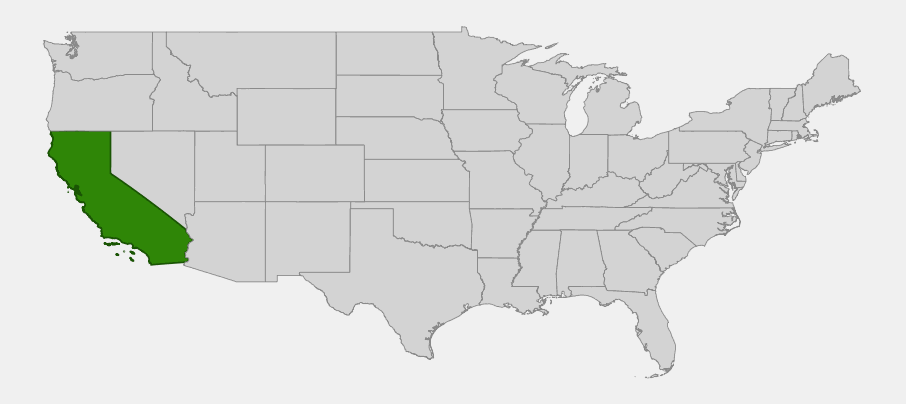
It is endemic to California, from the dunes and coastal hills of the northern San Francisco Bay Area south to the Los Angeles area. It is an important shrub of coastal dune scrub and a valuable late-season nectar source for bees, butterflies and other insects. This guide covers how to identify it, where it grows, how to grow it in a coastal or sandy garden, and its value to wildlife.
Identification
California goldenbush is easy to identify on coastal dunes in fall: look for a low, dense, dark green shrub with tiny, crowded, needle-like leaves and many small yellow flower heads.
Growth Habit
It is a compact, much-branched, evergreen shrub, usually 1 to 3 feet tall and up to about 4 feet wide, with many short, upright branches. The older stems are woody and brownish, and the young twigs are often sticky and covered with fine hairs.
Leaves
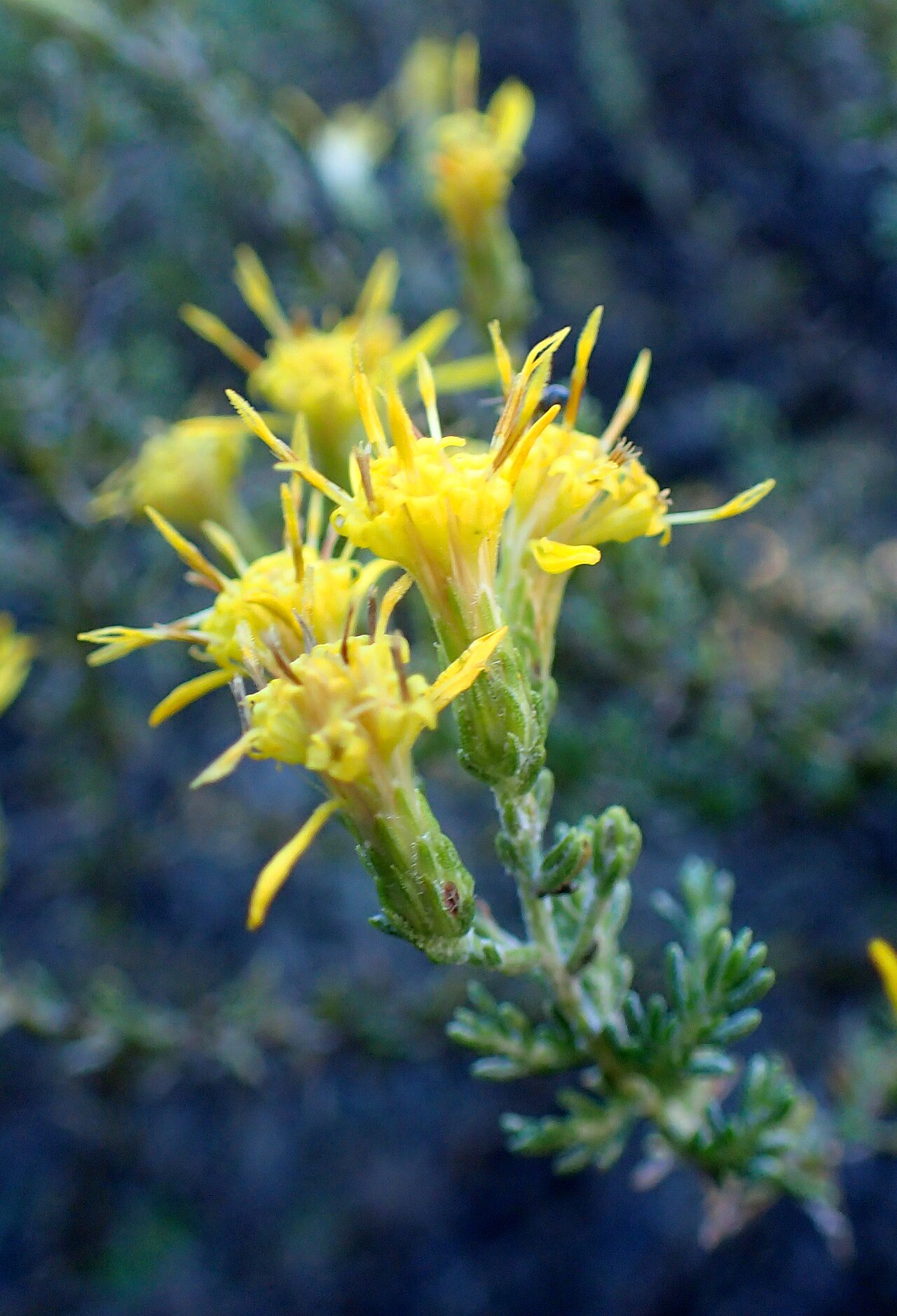
The leaves are the source of the name ericoides, “heath-like”. They are tiny, cylindrical and needle-like, up to about 1/2 inch long, and crowded in comb-like fans and clusters along the stems. They are dark green, resin-dotted and slightly sticky.
Flowers
The small flower heads are crowded at the tips of the branches. Each head has a few short, golden yellow ray flowers around a small cluster of yellow disk flowers. Blooming is mainly from late summer through fall, roughly August to November, with scattered flowers at other times.
Fruit & Seeds
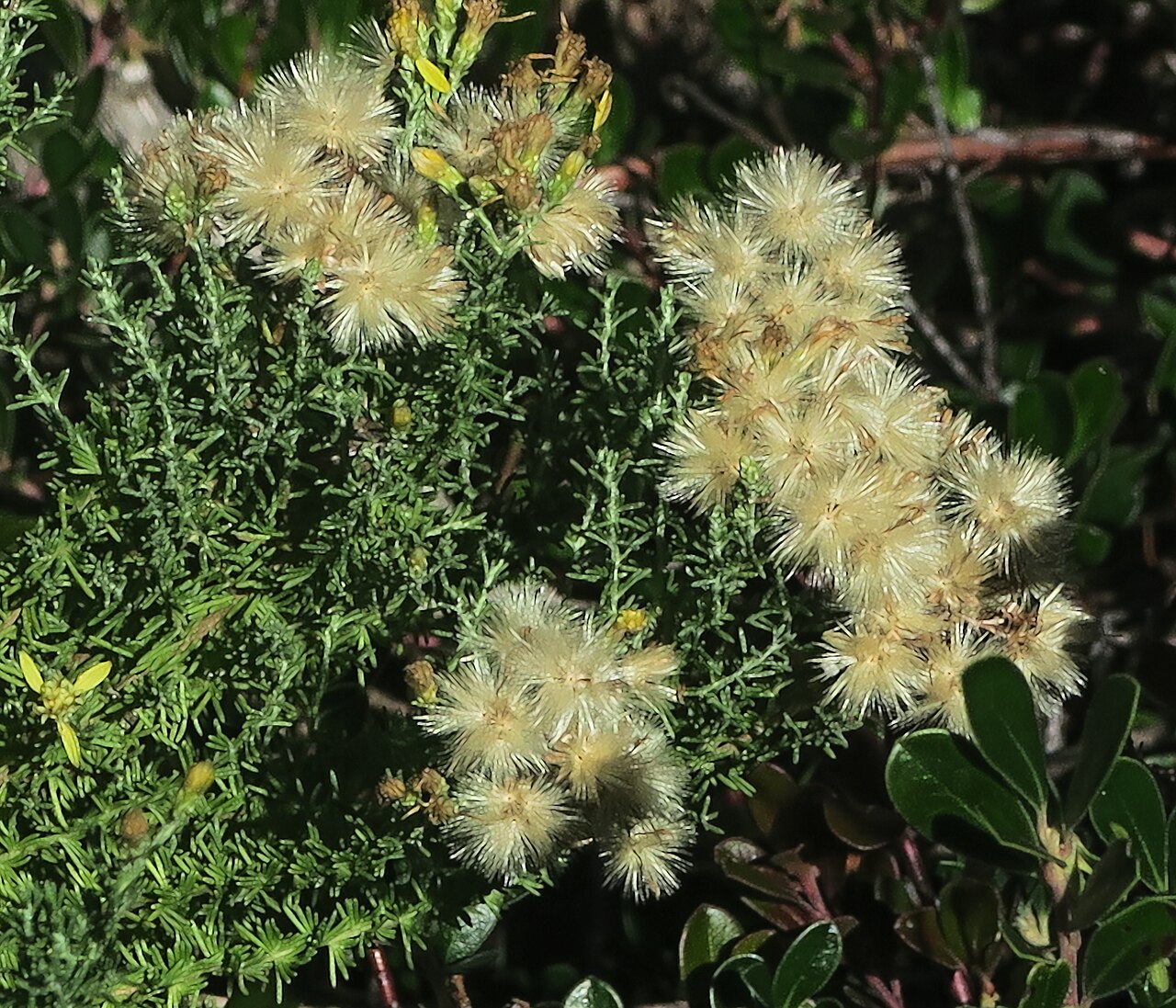
The seeds are small, hairy achenes with a tuft of tan or reddish bristles (pappus). Ripe heads look like small, fluffy tufts, and the shrub can be covered with them in late fall. They are carried away by the wind.
Look-alikes
Coast goldenbush (Isocoma menziesii) grows in similar coastal places but has larger, flat, often toothed leaves and rayless flower heads. Narrowleaf goldenbush (Ericameria linearifolia) has longer, narrow, flat leaves and large, showy flowers that bloom in spring, not fall. Other goldenbushes of the California coast have broader leaves or grow on rocky slopes rather than sand.
Quick Facts
| Scientific Name | Ericameria ericoides (Less.) Jeps. |
| Family | Asteraceae (sunflower family) |
| Plant Type | Evergreen shrub |
| Mature Height | 1–3 ft |
| Mature Spread | 2–4 ft |
| Growth Rate | Moderate |
| Sun Exposure | Full sun |
| Water Needs | Very low once established |
| Soil Type | Sandy, fast-draining soils; coastal dunes and sandy hills |
| Soil pH | About 6.0–8.0 |
| Bloom Time | August–November |
| Flower Color | Golden yellow |
| Fall Color | Evergreen; yellow flowers and tan seed heads in fall |
| Fruit | Small hairy achenes with a tuft of bristles |
| Deer Resistant | Generally resistant (resinous foliage) |
| USDA Hardiness Zones | 8–10 |
Native Range
California goldenbush is endemic to California. USDA PLANTS lists it only from California, where it grows along the coast and in nearby sandy places from the northern San Francisco Bay Area south to the Los Angeles area.
It is a characteristic shrub of the coastal dunes of Monterey Bay, the Nipomo-Guadalupe and Pismo dunes of San Luis Obispo and Santa Barbara Counties, and the remaining dune and bluff habitats of the Santa Monica Mountains coast, such as Point Dume. It also grows in sandy soils a short way inland, including old stabilized dunes and sandy hills.
Typical habitats are stabilized sand dunes, coastal dune scrub, sandy bluffs and sandy coastal sage scrub, at low elevations close to the ocean. Like many dune plants, it has lost much of its habitat to development, and it is often planted in dune restoration projects.
📋 Regional plant lists featuring California Goldenbush: California & Nevada
Growing & Care Guide
California goldenbush is a tough, low-maintenance shrub for coastal gardens, sandy soils and dune restoration in California. It is sold by a number of California native plant nurseries. Give it sun, sharp drainage and little summer water, and it rewards you with a fine-textured evergreen mound and a burst of yellow in fall.
Light
Plant it in full sun. It grows on open dunes and bluffs and becomes leggy and sparse in shade.
Soil & Water
It needs fast-draining soil and thrives in pure sand. It also grows in sandy loams, but heavy clay and poor drainage shorten its life. Water regularly during the first year, then little or not at all in summer near the coast; inland, an occasional deep watering in summer keeps it looking fresh. Overwatering is the most common cause of failure.
Planting Tips
Plant in fall or winter so the roots establish with the winter rains. Space plants 3 to 4 feet apart for a continuous low cover. It tolerates salt spray and wind, making it useful for seaside gardens, slopes and sandy banks, and it combines well with coyote brush, California sagebrush, lupines and coastal buckwheats.
Pruning & Maintenance
Lightly shear the shrub after the seed heads have dispersed in late fall or winter to keep it compact and remove spent flower stems. Avoid cutting into old, leafless wood. Old, woody plants can be replaced with young ones, as it is not a long-lived shrub in gardens.
Propagation
Grow it from seed collected in late fall; sow it on the surface of a sandy mix in winter. It can also be grown from softwood or semi-hardwood cuttings taken in spring or summer and rooted in a sandy medium. It may self-sow lightly in sandy gardens.
Landscape Uses
- Coastal and seaside gardens: tolerates wind, salt spray and sandy soil
- Pollinator gardens: late-season nectar and pollen when few other plants are flowering
- Dune and bluff restoration: a characteristic native shrub of coastal dune scrub that helps stabilize sand
- Low-water landscapes: fine-textured evergreen foliage with very little summer water
- Slopes and banks: a dense, low mound for sandy slopes
Wildlife & Ecological Value
Because it blooms in late summer and fall, when most coastal plants are dry, California goldenbush is an important late-season food source for insects.
For Pollinators
The many small flower heads offer easy access to nectar and pollen for native bees, honey bees, wasps, hover flies and beetles. In coastal dune areas it is one of the main plants in flower in fall, so it can be alive with insects on warm days.
For Butterflies
Butterflies, including late-season species, visit the flowers for nectar. Coastal butterfly gardens benefit from its long fall bloom, which bridges the gap between summer flowers and winter rains.
For Birds & Mammals
The dense, evergreen shrubs give cover to small birds, lizards and small mammals in the open dunes, and seed-eating birds feed on the seeds in fall and winter. The insects it attracts are also food for birds.
Ecosystem Role
As a low, dense, deep-rooted shrub, California goldenbush helps stabilize sand on coastal dunes and bluffs. It is a key component of central and southern California coastal dune scrub, a habitat that has been greatly reduced by development and invasive plants such as iceplant.
Cultural & Historical Uses
The genus name Ericameria combines Erica, the heath genus, with the Greek meris, part, for the heath-like leaves of many species. The species name ericoides also means “heath-like”. It was first described as Diplopappus ericoides by the German botanist Christian Friedrich Lessing and was later placed in Haplopappus before Willis Linn Jepson moved it to Ericameria.
The common name mock heather describes its resemblance to the heathers of Europe, although it is not related to them. Its fall flowers make coastal dunes glow gold at a time when few other plants are in bloom.
California goldenbush has become a standard plant in dune restoration along the California coast, where native dune scrub is being replanted after the removal of invasive iceplant and other weeds. It is a good example of a plant that is both ecologically important and attractive in gardens.
Frequently Asked Questions
Why is California goldenbush called mock heather?
Its dense, needle-like leaves make it look like a heather, but it is in the sunflower family and is not related to true heathers.
When does California goldenbush bloom?
Mainly from late summer through fall, about August to November. The yellow flowers are followed quickly by fluffy tan seed heads.
Where does California goldenbush grow?
It is endemic to California, on coastal dunes, sandy bluffs and sandy hills from the northern San Francisco Bay Area south to the Los Angeles area.
Is California goldenbush good for pollinators?
Yes. It blooms when few other coastal plants are flowering, and its many small flower heads feed native bees, butterflies, hover flies and other insects.
Does California goldenbush need summer water?
Very little. Once established near the coast it needs no regular summer water. Inland, occasional deep watering helps, but avoid overwatering, especially in heavy soil.

Looking for a nursery that carries California Goldenbush?
Browse our native plant nursery directory: California

