
Swamp Lousewort (Pedicularis lanceolata)
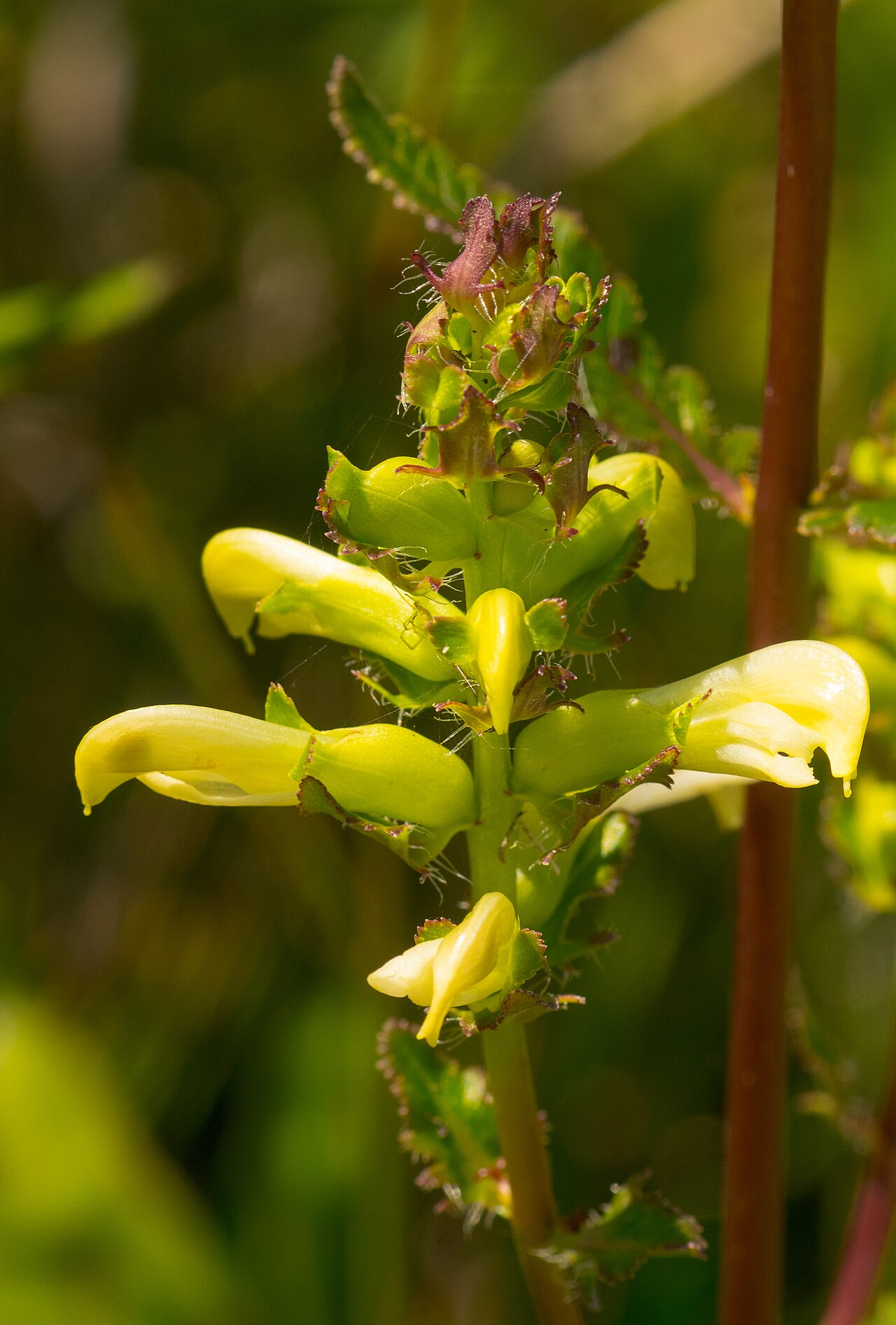
Pedicularis lanceolata, known as Swamp Lousewort, is a late-blooming wildflower of fens, wet prairies and sedge meadows in the Midwest and the East. It belongs to the broomrape family (Orobanchaceae), the family that includes many root parasites, and was formerly placed in the figwort family (Scrophulariaceae).
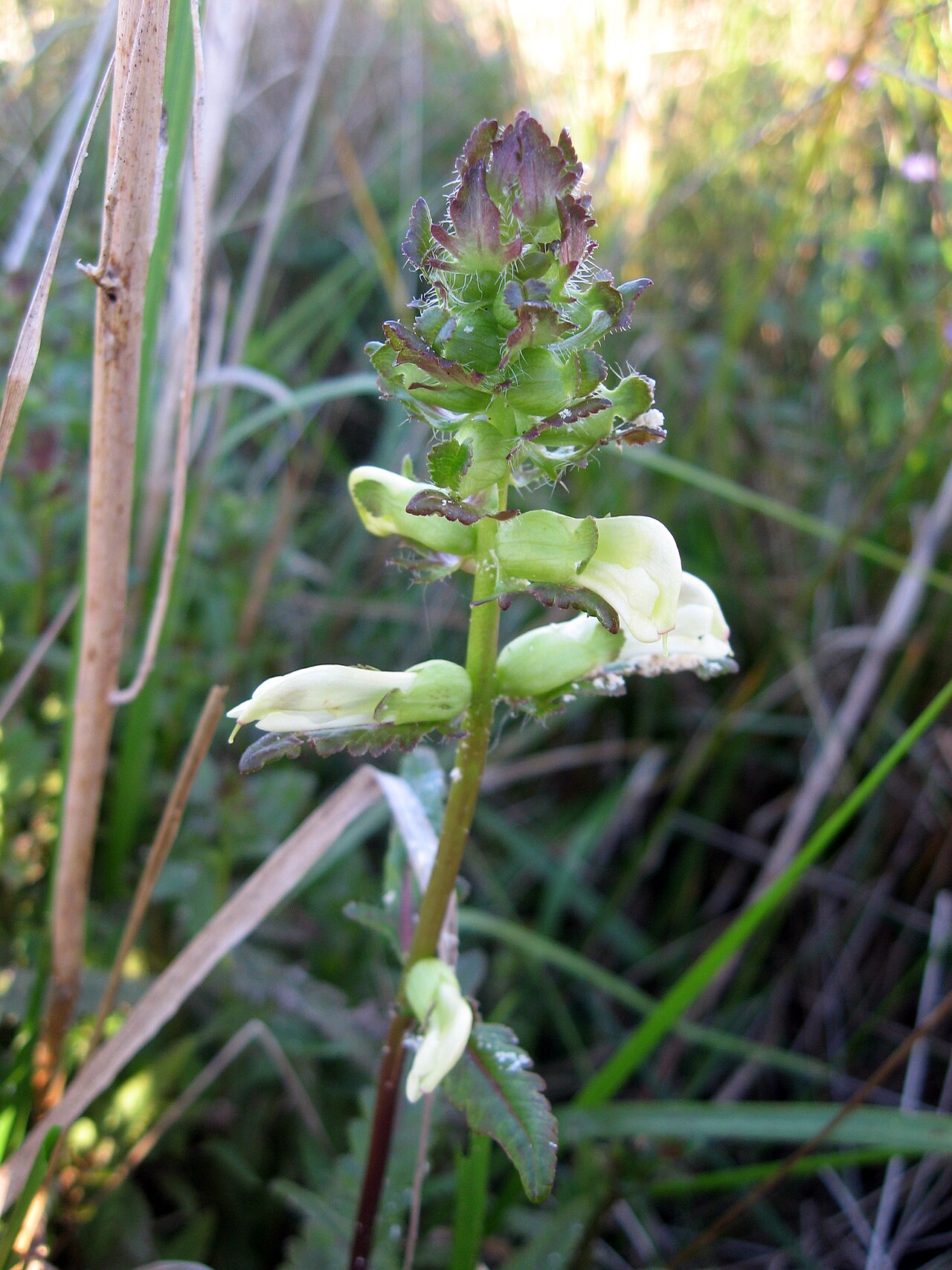
From August into October it carries spikes of pale yellow to cream flowers on upright stems 1 to 3 feet tall. Each flower is a curved, two-lipped tube with a hooded upper lip and a lower lip turned up to close the mouth, a shape made for bumble bees. The fern-like, toothed leaves are mostly opposite on the stem.
Swamp lousewort is a hemiparasite: it has green leaves and makes its own food, but its roots also attach to the roots of nearby plants, such as grasses, sedges and asters, and draw water and nutrients from them. That makes it a valuable part of natural wetlands, where it keeps dominant plants in check, and a difficult plant to grow in an ordinary garden.
Identification
Look in late summer and fall in wet, open, often limy ground for an upright plant with toothed, lance-shaped leaves in opposite pairs and a dense spike of pale yellow, hooded flowers.
Growth Habit
Swamp lousewort is a perennial with one to several upright stems, usually 1 to 3 feet tall, unbranched or with a few branches above. Stems are smooth to slightly hairy and often reddish. It grows singly or in loose groups among grasses and sedges.
Leaves
The leaves are lance-shaped, about 2 to 4 inches long, with shallow, rounded lobes that are themselves finely toothed, giving a crinkled, fern-like edge. Most leaves are opposite or nearly so, a useful difference from the more common wood betony, whose leaves are mostly alternate and in a basal rosette. Leaves are short-stalked or stalkless.
Flowers
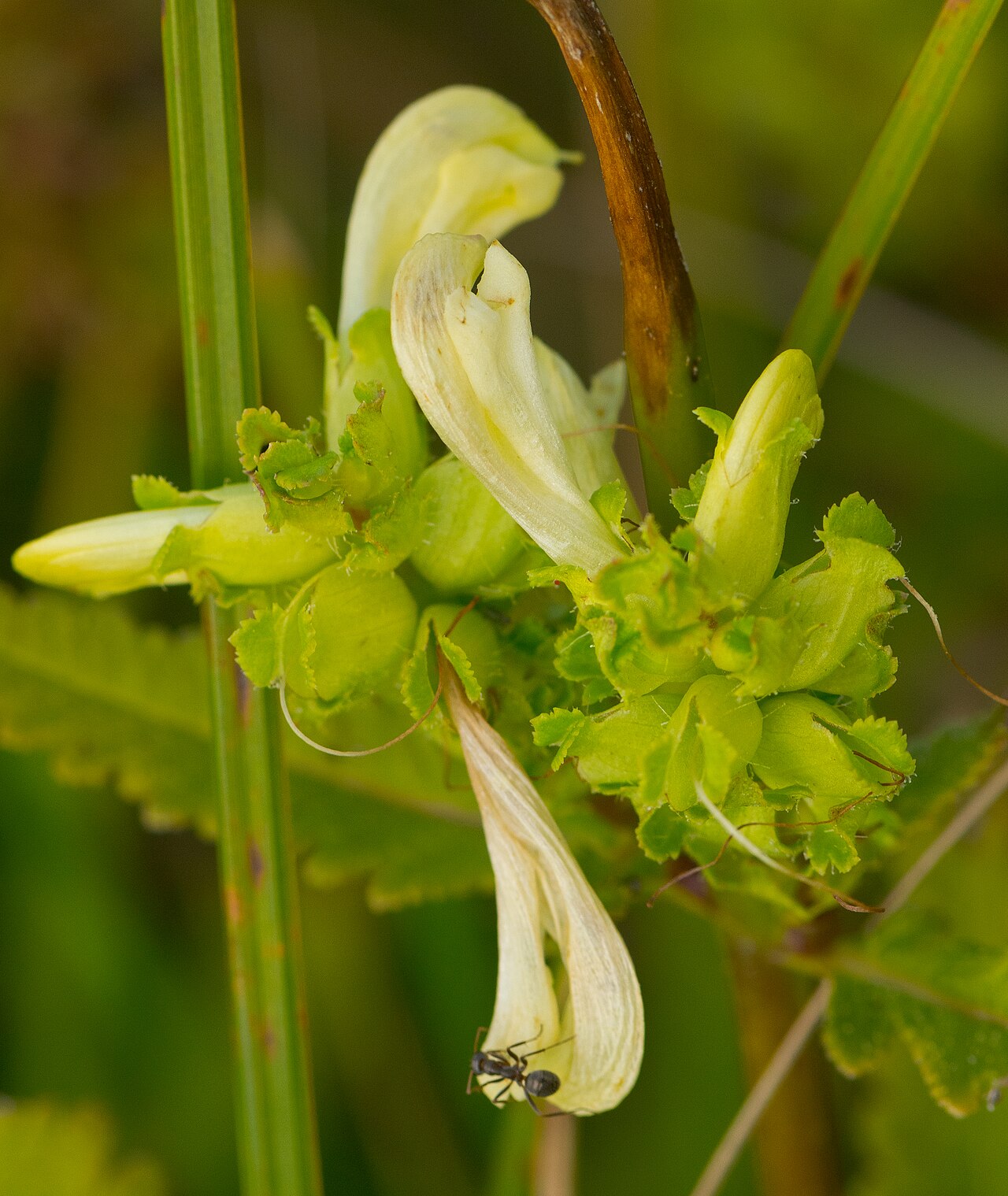
Flowers open from about August to October in a crowded spike at the top of the stem and in the upper leaf axils. Each flower is about 3/4 to 1 inch long, pale yellow to creamy white, and strongly two-lipped. The upper lip forms a curved hood (galea) without teeth, and the lower lip is bent upward against it, closing the throat. A leafy, two-lobed calyx surrounds the base.
Fruit & Seeds
The fruit is a flattened, oval capsule, held in the persistent calyx, that splits to release a few small, angular seeds in fall. Dry stalks with empty capsules often stand into winter.
Look-alikes
Canadian lousewort or wood betony (Pedicularis canadensis) blooms in spring, grows in drier woods and prairies, has mostly basal, alternate, deeply cut leaves and shorter, hairy flower heads that are often yellow and red. White turtlehead (Chelone glabra) shares the same wet habitats and fall bloom time, but its flowers are white, larger and turtle-head shaped, and its leaves are simply toothed, not lobed.
Safety Notes
Swamp lousewort is not known to be seriously toxic, but it is not an edible or medicinal plant to experiment with, and some Pedicularis can take up compounds from their host plants. Do not eat it.
Quick Facts
| Scientific Name | Pedicularis lanceolata |
| Family | Orobanchaceae (broomrape family) |
| Plant Type | Hemiparasitic perennial wildflower |
| Mature Height | 1–3 ft |
| Mature Spread | 6–12 in |
| Growth Rate | Slow to establish |
| Sun Exposure | Full sun to part shade |
| Water Needs | High; wet to moist soil |
| Soil Type | Wet loam, muck or peat; often calcareous |
| Soil pH | About 6.5–8.0 |
| Bloom Time | August–October |
| Flower Color | Pale yellow to cream |
| Fall Color | Stems and leaves turn brown to purplish |
| Fruit | Flattened capsules with a few seeds |
| Deer Resistant | Unknown; seldom noted as browsed |
| USDA Hardiness Zones | 3–7 |
Native Range
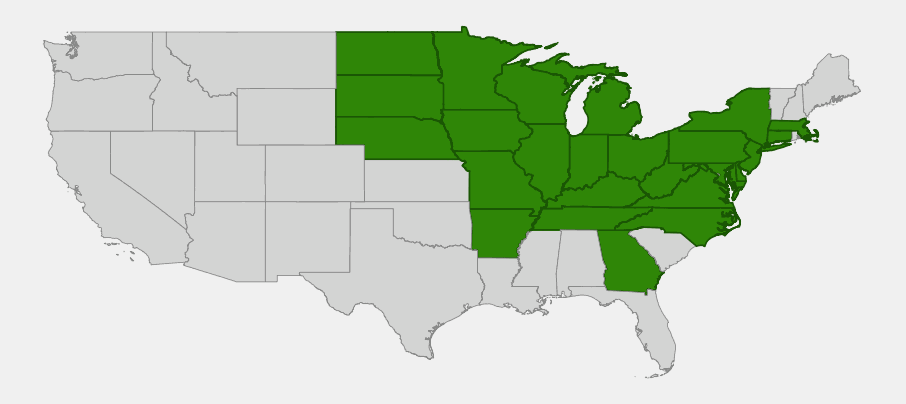
Swamp lousewort is native to eastern and central North America. USDA PLANTS lists it as native in Arkansas, Connecticut, Delaware, Georgia, Iowa, Illinois, Indiana, Kentucky, Massachusetts, Maryland, Michigan, Minnesota, Missouri, North Carolina, North Dakota, Nebraska, New Jersey, New York, Ohio, Pennsylvania, South Dakota, Tennessee, Virginia, Wisconsin and West Virginia, and in Manitoba and Ontario in Canada.
It is most frequent in the glaciated Midwest and Great Lakes region, from Ohio and Michigan west to Minnesota, Iowa and the eastern Dakotas and Nebraska. Farther east and south it becomes local and scattered, with outlying populations in the Appalachian region, the Atlantic states and Georgia and Arkansas. Because its wetland habitats have been widely drained, it is rare or of conservation concern in several states at the edges of its range.
Its habitats are open, wet, sunny places, often with groundwater seeping through limy soil: fens, calcareous seeps, wet prairies, sedge meadows, marsh edges, wet thickets and stream and lake shores. It usually grows among a diverse mix of sedges, grasses and wildflowers rather than in dense, single-species stands.
📋 Regional plant lists featuring Swamp Lousewort: New York, Pennsylvania & Northern New Jersey · Ohio & Indiana · Michigan, Wisconsin & Eastern Minnesota · Kentucky & Tennessee · Nebraska, Kansas & Eastern Colorado · Connecticut, Massachusetts & Rhode Island · New Hampshire, Maine & Vermont · Maryland, Virginia & West Virginia · Delaware, Southern New Jersey & Long Island · Illinois, Iowa & Missouri · Alabama, Georgia & Mississippi · North & South Carolina · Arkansas, Louisiana, Eastern Oklahoma & Eastern Texas · North Dakota, South Dakota & Western Minnesota
Growing & Care Guide
Be realistic before trying to grow swamp lousewort. It is a hemiparasite: its roots tap into the roots of neighboring plants, and it rarely thrives without them. It is almost never sold as nursery plants and does not transplant well. It is best suited to wetland restoration, where it can be sown among established host plants, and to protecting the places where it already grows. Never dig it from the wild; that almost always kills it and it is rare in some states.
Light
It needs full sun to light shade. In the wild it declines when shrubs or tall, dense vegetation shade over wet meadows.
Soil & Water
It requires constantly moist to wet soil, ideally with cool, mineral-rich groundwater seepage, as in a fen or wet prairie. It will not survive in average garden soil that dries out in summer.
Planting Tips
The practical way to establish it is to sow seed directly into an existing wet meadow, rain garden or restored wetland that already has sedges, grasses and asters for it to attach to. If you raise seedlings in pots, sow them together with a host such as a sedge or native grass in the same pot, then plant the pair together. Plants grown alone usually stay weak or die.
Pruning & Maintenance
No pruning is needed. Leave the stems standing until seed has dropped. In restorations, controlled burning or periodic cutting that keeps woody plants and aggressive invasives (such as reed canary grass and glossy buckthorn) out of the wetland helps the lousewort persist.
Propagation
Grow it from seed, collected in fall only from plants grown in cultivation or with permission from abundant populations. The seeds need a period of cold, moist stratification, roughly 60 to 90 days, before germinating in spring. Sow them in the fall on the soil surface among host plants, or stratify and sow in pots with a host plant. Expect slow, uneven results.
Landscape Uses
- Fen and wet prairie restoration: sown among sedges and grasses, it adds late flowers and diversity
- Bumble bee habitat: a late-season pollen and nectar source in wetlands
- Wet meadow diversity: as a hemiparasite, it checks dominant grasses so smaller wildflowers can persist
- Nature study and photography: a good indicator of high-quality, intact fens and wet prairies
- Large rain gardens with established hosts: only where sedges and grasses are already rooted
Wildlife & Ecological Value
Swamp lousewort is a small but important member of wetland plant communities, both as a late-season bee flower and as a plant that shapes which other plants thrive around it.
For Pollinators
The closed, hooded flowers are adapted for bumble bees, which are strong enough to push the lips apart. Queen and worker bumble bees visit it heavily in late summer and fall, when they are building up colonies and fattening for winter. Smaller bees may also collect pollen.
For Birds
Birds rarely feed on the plant directly, but the wet meadows where it grows support sedge wrens, swamp sparrows, rails and other wetland birds, which feed on the insects drawn to its flowers.
For Mammals
It is not an important food for mammals. Its value lies in contributing to diverse wet meadows used by many small mammals.
Ecosystem Role
As a root hemiparasite, swamp lousewort takes water and nutrients from grasses, sedges and other neighbors, slowing their growth. Ecologists have found that hemiparasites like louseworts can reduce the dominance of aggressive plants and increase the diversity of plant communities. Louseworts are also known host plants for some specialized insects.
Cultural & Historical Uses
The species was described in 1803 by the French botanist André Michaux in his Flora Boreali-Americana. The name lanceolata refers to the lance-shaped leaves. The genus name Pedicularis comes from the Latin pediculus, “louse.”
The odd name “lousewort” comes from an old European belief that livestock grazing in pastures with these plants became infested with lice. The plants were probably just common in poor, wet pastures where unhealthy animals were kept. Swamp lousewort has nothing to do with lice.
Botanists value swamp lousewort as a sign of intact fens and wet prairies, some of the most diverse and endangered plant communities in the Midwest. Its presence often signals a site with clean, steady groundwater and a long history without drainage or plowing.
Frequently Asked Questions
Is swamp lousewort a parasite?
It is a hemiparasite. It has green leaves and photosynthesizes, but its roots also attach to the roots of nearby plants and take water and nutrients from them. It does not kill its hosts.
Can I grow swamp lousewort in my garden?
Only with difficulty. It needs constantly wet soil and host plants such as sedges and grasses growing with it. It is best sown into an established wet meadow or wetland restoration, not planted alone in a bed.
How is swamp lousewort different from wood betony?
Swamp lousewort blooms in late summer and fall in wet places and has mostly opposite stem leaves. Wood betony (Pedicularis canadensis) blooms in spring in drier woods and prairies and has mostly basal, alternate leaves.
Why is it called lousewort?
From an old European belief that animals grazing on louseworts got lice. The belief is not true; the name just stuck.
What pollinates swamp lousewort?
Mainly bumble bees, which can force open the closed, hooded flowers to reach pollen and nectar in late summer and fall.

Looking for a nursery that carries Swamp Lousewort?
Browse our native plant nursery directory: Arkansas · Connecticut, Delaware & Georgia · Illinois, Indiana & Iowa · Kentucky, Maryland, Massachusetts, Michigan, Minnesota & Missouri · Nebraska, New Jersey, New York, North Carolina, North Dakota & Ohio · Pennsylvania, South Dakota, Tennessee & Virginia · West Virginia & Wisconsin

