
Bridges’ Penstemon (Penstemon rostriflorus)
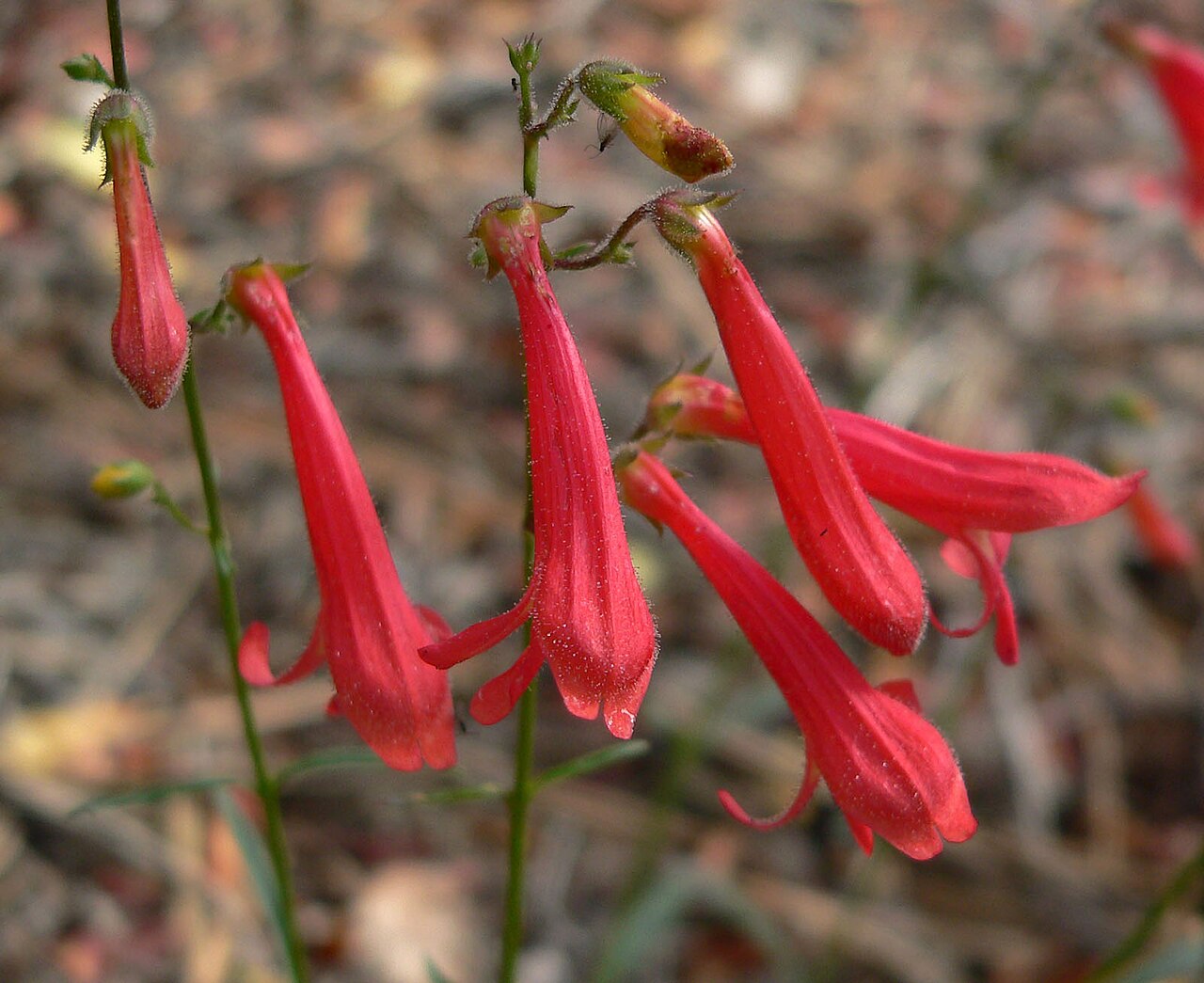
Penstemon rostriflorus, known as Bridges’ Penstemon, beaked penstemon or scarlet beardtongue, is a shrubby perennial wildflower of dry, rocky mountain slopes in the American Southwest and Great Basin. It belongs to the plantain family (Plantaginaceae) and was long known as Penstemon bridgesii, a name still used in many field guides.
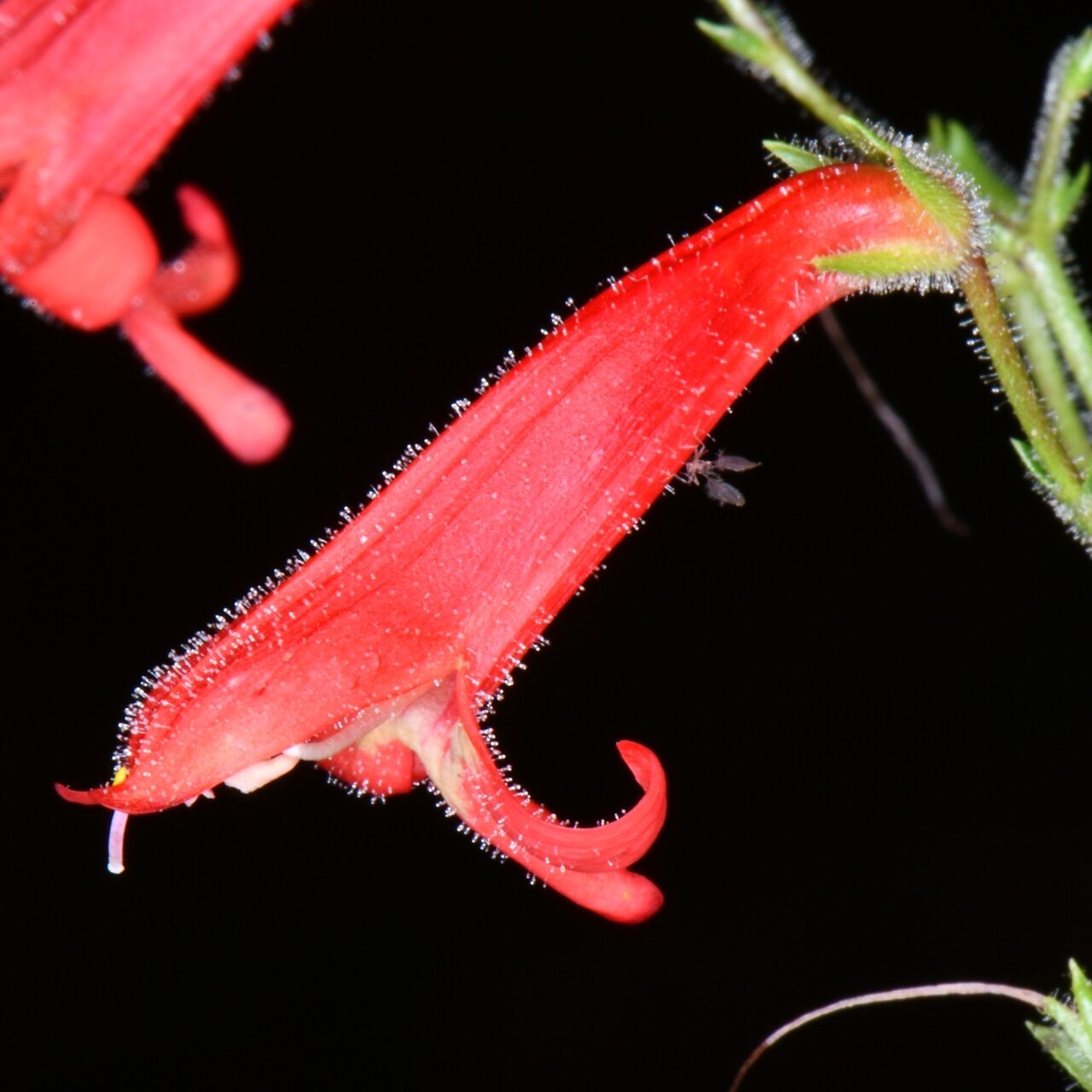
From early summer into fall it sends up slender stems lined with scarlet to orange-red tubular flowers about an inch long. Each flower has a projecting, beak-like upper lip and three lower lobes that fold sharply back, giving the species its scientific name rostriflorus, “beak-flowered.” Hummingbirds are its main pollinators.
Bridges’ penstemon grows from about 4,000 to over 11,000 feet in the Sierra Nevada, the desert mountains of California and Nevada, and across Utah, Arizona, western Colorado and New Mexico. Because it blooms later than most penstemons, it is a valuable late-season hummingbird plant for dry, sunny rock gardens and native landscapes in the interior West.
Identification
Look for a bushy, woody-based plant with narrow, opposite leaves and long, loose spikes of scarlet tubular flowers whose lower lips curl sharply back, blooming in mid to late summer.
Growth Habit
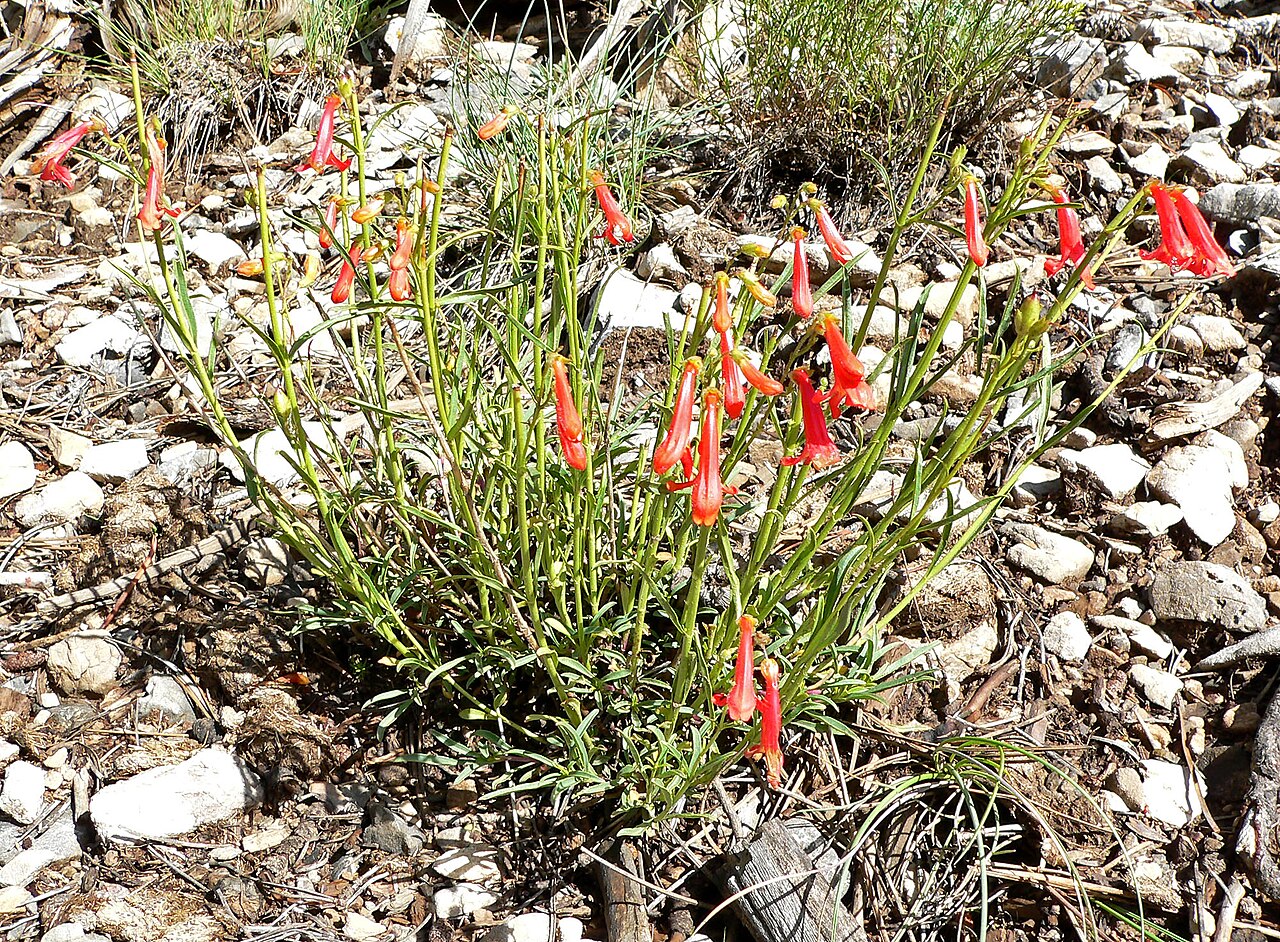
Bridges’ penstemon is a perennial subshrub 1 to 3 feet tall with a woody base and many slender, upright to spreading stems, forming a loose, bushy clump. Plants are long-lived and grow from a deep, woody root.
Leaves
Leaves are opposite, narrow and linear to narrowly lance-shaped, 1 to 3 inches long, smooth-edged and green to gray-green. Basal leaves are often slightly wider than those higher on the stem.
Flowers
Flowers are held in long, narrow, open clusters along the upper stems. Each is 1 to 1 1/4 inches long, scarlet to orange-red, and strongly two-lipped. The upper lip projects forward like a beak, and the three lobes of the lower lip are bent sharply back against the tube. The outside of the flower is finely glandular-hairy. The sterile stamen (staminode) is smooth or nearly so. Bloom runs from about June to September.
Fruit & Seeds
The fruit is a small, oval, woody capsule about 1/3 inch long that splits open in late summer and fall to release many small, angular seeds.
Look-alikes
Firecracker penstemon (P. eatonii) has scarlet tubes that are nearly straight-lipped, without the bent-back lower lobes, and blooms in spring. Scarlet bugler (P. barbatus) also has a reflexed lower lip, but its lower lip is bearded with yellow hairs and its flowers are usually more pinkish red. Scarlet gilia (Ipomopsis aggregata) has five evenly spreading, star-shaped petal lobes.
Quick Facts
| Scientific Name | Penstemon rostriflorus (syn. P. bridgesii) |
| Family | Plantaginaceae (plantain family) |
| Plant Type | Perennial subshrub |
| Mature Height | 1–3 ft |
| Mature Spread | 1–2 ft |
| Growth Rate | Moderate |
| Sun Exposure | Full sun |
| Water Needs | Low; dry, well-drained soil |
| Soil Type | Rocky, gravelly, sandy or limestone soils |
| Soil pH | About 6.5–8.0 |
| Bloom Time | June–September |
| Flower Color | Scarlet to orange-red |
| Fall Color | None; semi-evergreen base |
| Fruit | Small woody capsules |
| Deer Resistant | Moderate |
| USDA Hardiness Zones | 4–8 |
Native Range
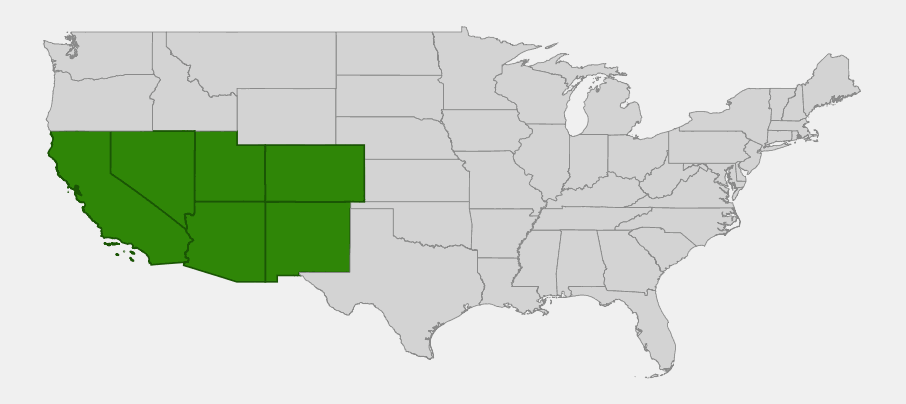
Bridges’ penstemon is native to the mountains of the southwestern United States. USDA PLANTS lists it as native in Arizona, California, Colorado, Nevada, New Mexico and Utah.
In California it grows in the Sierra Nevada, mainly on the east side, and in the White, Inyo and other desert ranges and the Transverse Ranges. It is widespread in the mountains of Nevada and Utah, and reaches southwestern Colorado, northern and central Arizona (including the Grand Canyon region and the Mogollon Rim) and northern New Mexico.
Its habitat is dry, open, rocky ground: talus slopes, cliffs, canyon walls, gravelly washes, sagebrush slopes, pinyon-juniper woodland and open conifer forest, often on granite or limestone.
📋 Regional plant lists featuring Bridges’ Penstemon: California & Nevada · Arizona & New Mexico · Utah & Western Colorado
Growing & Care Guide
Bridges’ penstemon is offered by some native plant nurseries and seed companies in the West. Like most dryland penstemons, it is easy if it gets sun and excellent drainage, and short-lived if kept wet.
Light
Full sun. In hot low-elevation gardens it appreciates a little afternoon shade.
Soil & Water
Plant in lean, fast-draining soil: gravel, sand, decomposed granite or rocky limestone. Water regularly for the first summer, then only during long dry spells. Rich soil, fertilizer and wet winter soil shorten its life.
Planting Tips
Plant in spring or early fall in a rock garden, on a sunny slope, in a gravel bed or along a dry wall. Keep the crown slightly high and mulch with gravel rather than bark. Space plants 18 to 24 inches apart and combine them with buckwheats, bunchgrasses and other dryland wildflowers.
Pruning & Maintenance
Cut back spent flower stems after seed has dropped, or leave a few for natural reseeding. Trim the woody base lightly in early spring if it gets leggy, but avoid cutting into bare old wood.
Propagation
Grow it from seed: sow outdoors in fall, or give seed 8 to 12 weeks of cold, moist stratification before spring sowing. Softwood cuttings taken in early summer can be rooted in a gritty mix.
Landscape Uses
- Hummingbird gardens: late-season scarlet flowers when few other red flowers bloom
- Rock and crevice gardens: tough, long-blooming color for dry, rocky spots
- Xeriscapes: very low water once established
- Slope and roadcut restoration: colonizes rocky, gravelly ground in the mountains
- Mixed dryland borders: pairs with buckwheats, sages and bunchgrasses
Wildlife & Ecological Value
Bridges’ penstemon is one of the most important late-summer hummingbird flowers of the western mountains.
For Pollinators
The red, beaked flowers are built for hummingbirds. Broad-tailed, rufous, black-chinned and Costa’s hummingbirds visit them, and its summer and fall bloom helps fuel migrating rufous hummingbirds. Bees sometimes collect pollen or take nectar.
For Birds
Besides hummingbirds, small seed-eating birds may pick at the seeds after capsules open.
For Mammals
Deer and bighorn sheep browse it lightly at times. Small rodents eat the seeds.
Ecosystem Role
It helps stabilize talus and rocky slopes and provides nectar late in the season in dry mountain habitats, when many other flowers have finished.
Cultural & Historical Uses
The species was named Penstemon rostriflorus by the California botanist Albert Kellogg in 1863. A few years later Asa Gray described it again as Penstemon bridgesii, honoring Thomas Bridges, an English naturalist who collected plants in California. Because Kellogg’s name was published first, P. rostriflorus is the accepted name, but the common name Bridges’ penstemon stuck.
The genus name Penstemon is usually explained as “five stamens,” for the four fertile stamens plus a sterile fifth stamen in each flower. The species name means “beak-flowered.”
Hikers in the Sierra Nevada, Great Basin and Colorado Plateau often find it on rocky trail edges in late summer, when its scarlet flowers stand out against granite and limestone.
Frequently Asked Questions
Is Bridges’ penstemon the same as Penstemon bridgesii?
Yes. Penstemon bridgesii is an older name for the same plant. The accepted name is Penstemon rostriflorus.
When does Bridges’ penstemon bloom?
Usually from June to September, later than most penstemons, depending on elevation.
Does Bridges’ penstemon attract hummingbirds?
Yes. Its scarlet, tubular flowers are pollinated mainly by hummingbirds.
How much water does it need?
Very little once established. Give it lean, fast-draining soil and water only during long droughts.
Where does Bridges’ penstemon grow?
In dry, rocky mountain habitats in California, Nevada, Utah, Arizona, western Colorado and New Mexico, from about 4,000 to 11,000 feet.

Looking for a nursery that carries Bridges’ Penstemon?
Browse our native plant nursery directory: Arizona · California · Colorado · Nevada & New Mexico · Utah

