
Goldeneye Phlox (Phlox roemeriana)
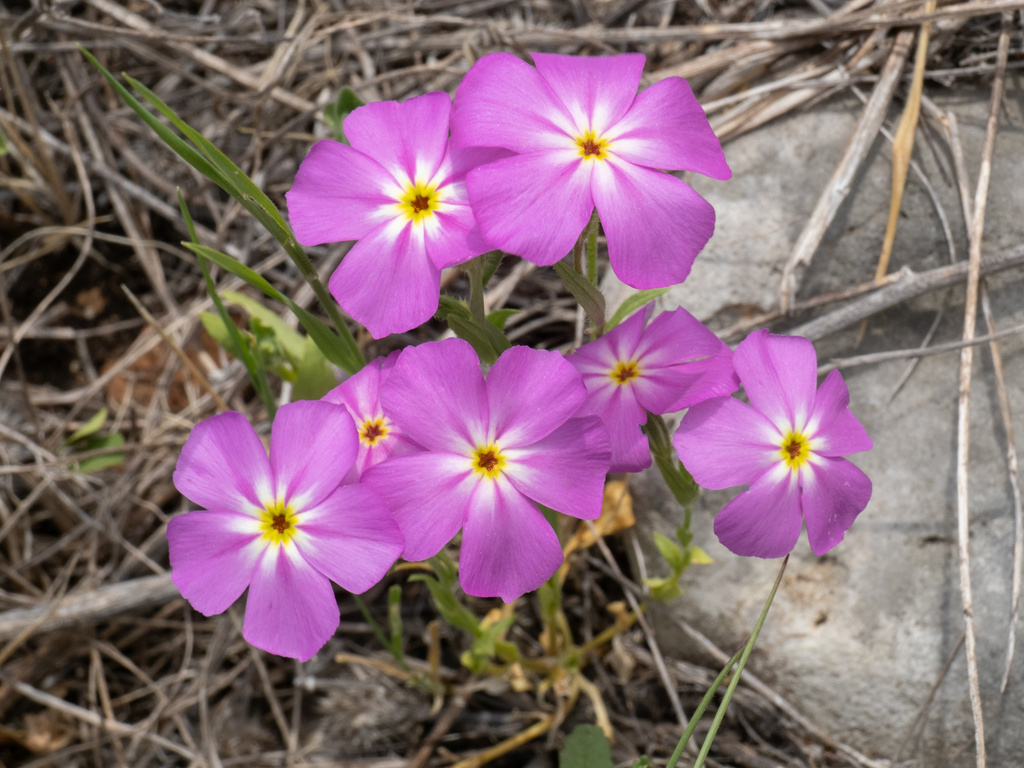
Phlox roemeriana, known as Goldeneye Phlox, is a small annual wildflower found only in Texas. A member of the phlox family (Polemoniaceae), it grows mainly on the Edwards Plateau, the limestone heart of the Texas Hill Country, and in nearby parts of central and west-central Texas.
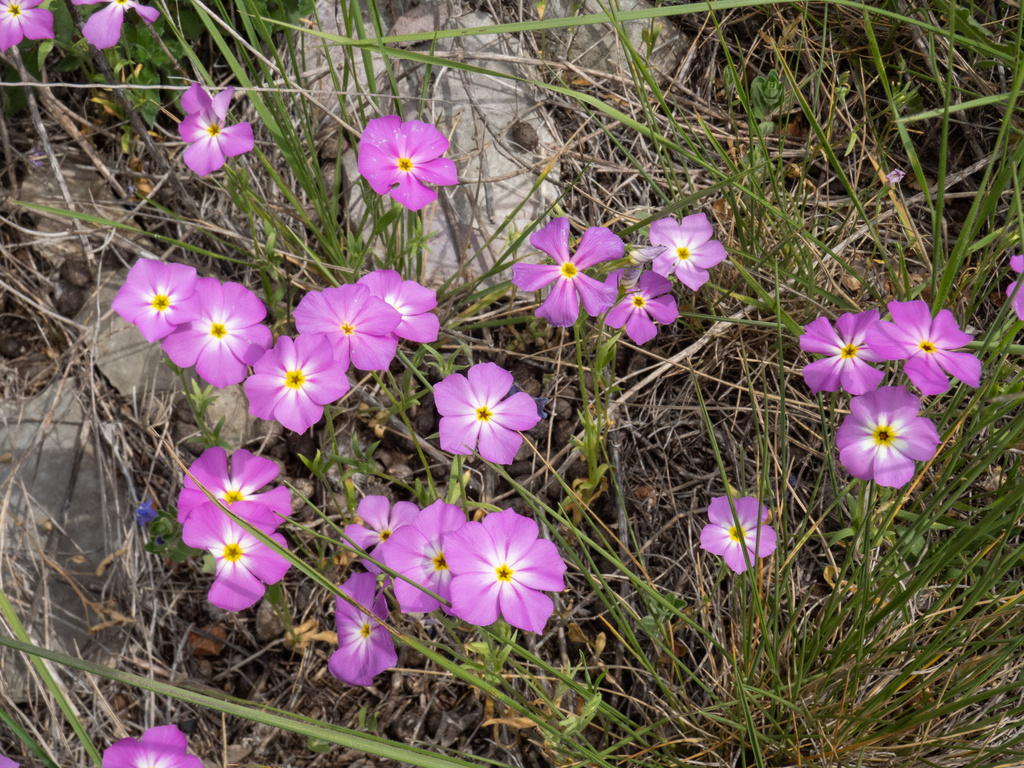
Each spring it opens flat, rose-pink to lavender flowers about 3/4 to 1 inch across, each with a bright golden-yellow eye surrounded by a white ring. The plants are low, usually only 3 to 8 inches tall, with narrow leaves and slender, slightly hairy stems. In wet years they can paint open, rocky ground and roadsides pink from late February into May.
Goldeneye phlox is easy to tell from Texas’s other annual phloxes by its yellow eye and unusually short, wide flower tube. It is a charming plant for Hill Country wildflower meadows and rock gardens, where it reseeds itself on thin, well-drained limestone soils and feeds early bees and butterflies.
Identification
Look for a low annual on rocky limestone ground in early spring with flat, pink to lavender, five-lobed flowers that have a yellow eye ringed in white.
Growth Habit
Goldeneye phlox is a winter annual. Seeds germinate in fall or winter, the small plants grow through the cool season, and they flower in spring before dying back in early summer heat. Plants are 3 to 8 inches tall, with one to several slender, erect or spreading stems branching from the base. Stems are covered with fine, sometimes glandular hairs.
Leaves
The leaves are narrow, lance-shaped to linear, about 1/2 to 2 inches long, and hairy. The lower leaves are opposite and the upper ones alternate, a typical pattern in the annual phloxes.
Flowers
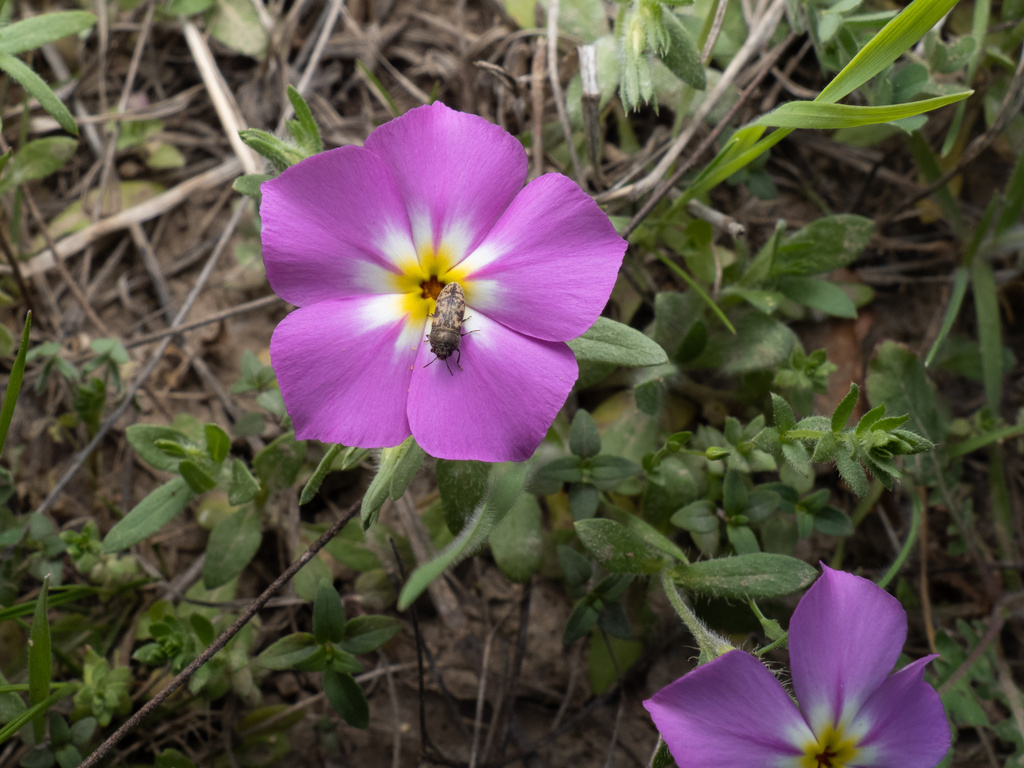
Flowers bloom from about late February to May, peaking in March and April. They are borne singly or in small, loose clusters at the stem tips. Each flower has five broad, rounded petal lobes that open nearly flat, rose-pink to purplish-pink or lavender, about 3/4 to 1 inch across. The center has a bright yellow eye surrounded by a white ring. The corolla tube is short and wide, roughly as long as or shorter than the lobes.
Fruit & Seeds
The fruit is a small, rounded capsule held in the persistent calyx. It splits into three parts to release a few small seeds in late spring, which lie dormant through the summer and germinate with fall or winter rains.
Look-alikes
Drummond phlox (Phlox drummondii) is the familiar annual phlox of sandy soils in eastern and southern Texas. Its flowers come in red, pink, purple or white, usually with a darker or white eye but not a yellow one, and its corolla tube is longer than the lobes. Pointed phlox (Phlox cuspidata) has smaller flowers with pointed lobes and a long, slender tube. Prairie phlox (Phlox pilosa) is a perennial with long, narrow leaves and pale pink to lavender flowers without a yellow eye.
Safety Notes
Goldeneye phlox is not known to be toxic to people or pets.
Quick Facts
| Scientific Name | Phlox roemeriana |
| Family | Polemoniaceae (phlox family) |
| Plant Type | Winter annual wildflower |
| Mature Height | 3–8 in |
| Mature Spread | 4–8 in |
| Growth Rate | Fast |
| Sun Exposure | Full sun to partial shade |
| Water Needs | Low; dry, well-drained soil |
| Soil Type | Rocky or gravelly limestone soils; sandy or clay loam |
| Soil pH | About 7.0–8.5 |
| Bloom Time | Late February–May |
| Flower Color | Rose-pink to lavender with a yellow eye and white ring |
| Fall Color | None; annual |
| Fruit | Small three-part capsules |
| Deer Resistant | Not well documented |
| USDA Hardiness Zones | 7–9 (sown as an annual) |
Native Range
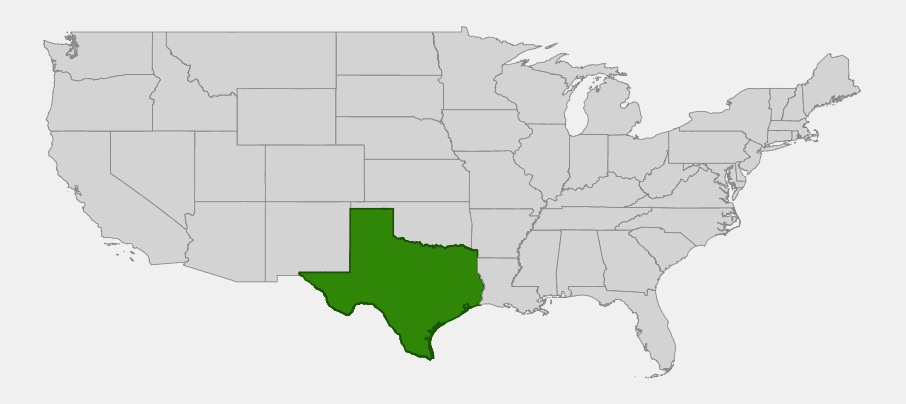
Goldeneye phlox is endemic to Texas, meaning it grows wild nowhere else in the world. USDA PLANTS lists it as native only in Texas.
Its range is centered on the Edwards Plateau, the limestone Hill Country of central Texas, including the area around San Antonio, Austin, New Braunfels, Kerrville and the Guadalupe River valley. It extends into adjacent parts of central and west-central Texas, including the eastern edge of the High Plains and other nearby limestone country, wherever thin, rocky limestone soils occur.
Typical habitats are open, rocky limestone slopes and flats, thin-soiled grasslands and savannas, openings in oak-juniper woodland, and roadsides and pastures with shallow soil. It is most abundant after a wet fall and winter, and in dry years it may be scarce.
📋 Regional plant lists featuring Goldeneye Phlox: South & West Texas
Growing & Care Guide
Goldeneye phlox is sometimes included in Texas wildflower seed mixes and offered by specialty native seed companies. As a winter annual, it is grown from seed sown in fall, much like bluebonnets.
Light
Sow it in full sun to light shade. In the wild it grows in open, rocky places and at the edges of oak-juniper woods, where it may get some shade during the day.
Soil & Water
It needs well-drained soil: thin, rocky or gravelly limestone soil is ideal, though it also grows in sandy and clay loams that do not stay wet. Fall and winter rains are enough to germinate the seed. In a very dry winter, an occasional watering helps the seedlings grow. It does not need summer water, since the plants die after setting seed.
Planting Tips
Scatter seed on bare, lightly raked ground from September to November, pressing it into the surface. Mix it with bluebonnets, paintbrush, pink evening primrose and other Hill Country annuals for a spring wildflower meadow, or sow it in gaps in a rock garden or along a gravel path. Avoid heavy mulch, which keeps the seed from reaching the soil.
Pruning & Maintenance
Do not mow or trim until the plants have dried and dropped their seed in late spring or early summer. After that, mow or rake lightly to open the ground for next year’s seedlings. Do not fertilize; rich soil favors weeds and grasses that crowd it out.
Propagation
Grow it only from seed. Collect the small capsules as they turn tan in late spring and store the seed dry over summer, then sow in fall. Once established in a suitable spot, it reseeds itself each year.
Landscape Uses
- Texas wildflower meadows: early spring color with bluebonnets and paintbrush
- Rock gardens: small, reseeding annual for thin limestone soils
- Pollinator gardens: nectar for early bees and butterflies
- Roadside and pasture plantings: reseeds in open, mown sites
- Hill Country restoration: grassland and woodland openings on limestone
Wildlife & Ecological Value
Goldeneye phlox is one of many spring annuals that feed early pollinators on the Edwards Plateau.
For Pollinators
The flowers are visited by small native bees, bee flies, butterflies and skippers. Their short, wide tube makes the nectar accessible to many short-tongued insects, unlike the long-tubed flowers of most phloxes.
For Birds
It is not a major bird plant, but insects attracted to the flowers and seeds that fall from the capsules provide some food for sparrows and other ground-feeding birds.
For Mammals
Rabbits and other small mammals may graze the young plants, though it is too small and short-lived to be an important food source.
Ecosystem Role
As part of the spring annual flora of Hill Country grasslands and savannas, goldeneye phlox fills open patches between bunchgrasses and contributes to the region’s famous spring wildflower displays.
Cultural & Historical Uses
The species was described in the late 1840s by the German botanist Adolf Scheele from plants collected by Ferdinand Roemer, a German geologist who traveled through central Texas in 1845 to 1847 and is often called the “father of Texas geology.” The name roemeriana honors him.
Roemer collected among the German settlements of the Hill Country, such as New Braunfels and Fredericksburg, which lie in the heart of goldeneye phlox country. He wrote a well-known account of his travels in Texas that is still read today.
Today goldeneye phlox is a favorite of Texas wildflower enthusiasts, who look for its yellow-eyed pink flowers along Hill Country roads and in parks such as Guadalupe River State Park in early spring.
Frequently Asked Questions
Where does goldeneye phlox grow?
It grows only in Texas, mainly on the limestone soils of the Edwards Plateau (Texas Hill Country) and nearby parts of central and west-central Texas.
Is goldeneye phlox an annual or a perennial?
It is a winter annual. It sprouts in fall or winter, blooms in spring, sets seed and dies by early summer.
How do I tell goldeneye phlox from Drummond phlox?
Goldeneye phlox has a yellow eye ringed with white and a short, wide flower tube. Drummond phlox has a longer tube and lacks the yellow eye, and it grows mainly on sandy soils in eastern and southern Texas.
When should I sow goldeneye phlox seed?
Sow it in fall, from September to November, on bare, well-drained ground, so the seed can germinate with winter rains.
When does goldeneye phlox bloom?
From late February to May, with the peak in March and April.

Looking for a nursery that carries Goldeneye Phlox?
Browse our native plant nursery directory: Texas

