
Balbis’ Airplant (Tillandsia balbisiana)
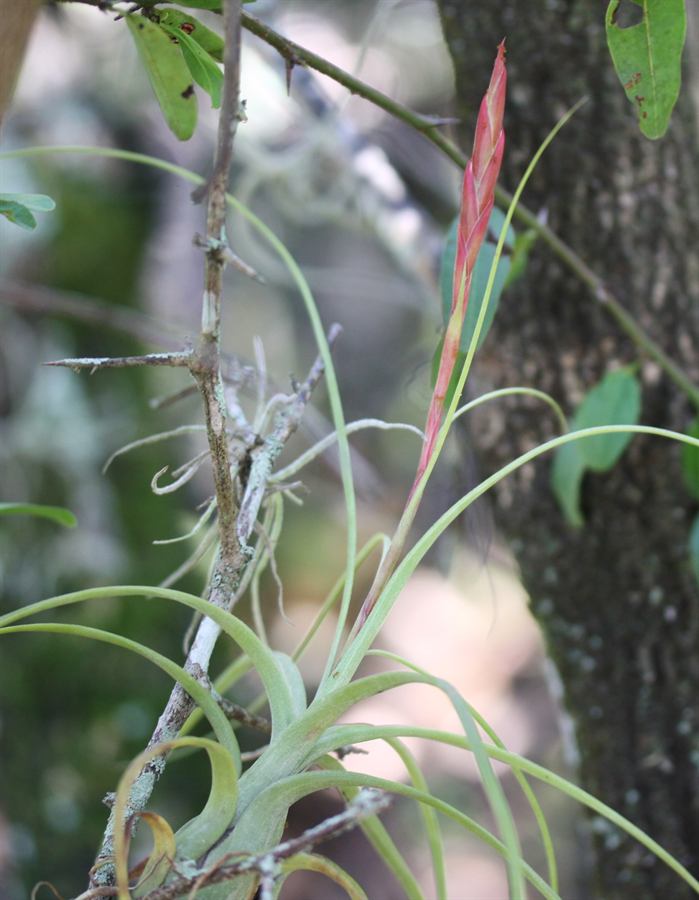
Tillandsia balbisiana, known as Balbis’ Airplant and listed by USDA PLANTS and the Atlas of Florida Plants as northern needleleaf, is an epiphytic bromeliad that grows on the trunks and branches of trees in central and southern Florida. It is a member of the pineapple family (Bromeliaceae). Like other airplants, it is not a parasite: its roots only anchor it to the bark, and it takes water and nutrients from rain, dew and dust through gray scales on its leaves.
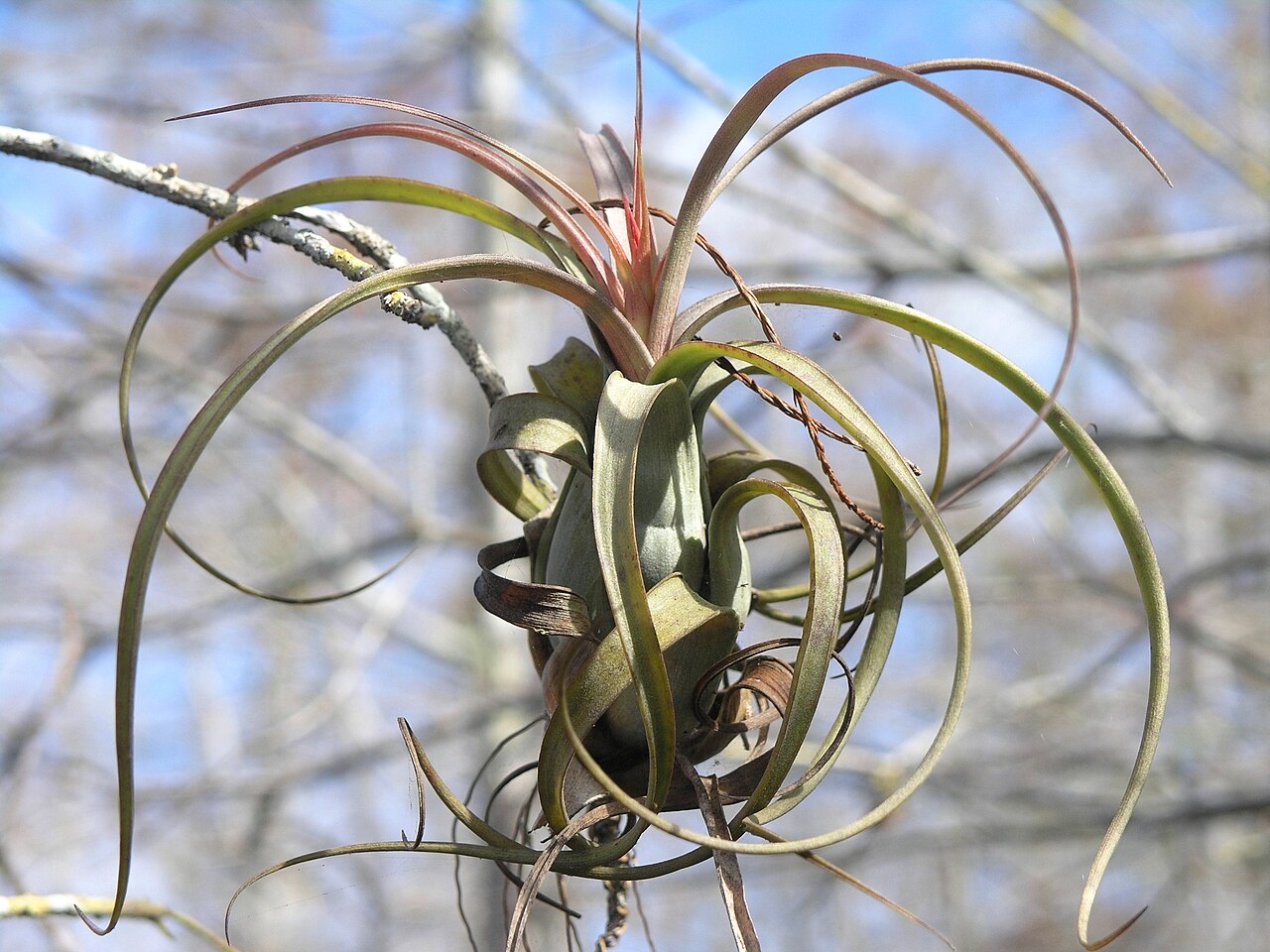
It is easy to recognize by its swollen, bulb-like base and its long, narrow, channeled leaves that twist and curl in every direction. In spring and summer it sends up a slender spike of bright red bracts that holds tubular violet flowers with protruding stamens. In the United States it grows only in Florida, but it is widespread in the West Indies, Mexico, Central America and northern South America.
In Florida, Balbis’ airplant is listed as a state Threatened species. Large native bromeliads there have been badly hurt by the introduced Mexican bromeliad weevil, and wild plants have also been taken for the plant trade. Never collect airplants from the wild. If you want to grow it, buy plants that are propagated in a nursery and checked for weevils.
Identification
Look for a gray-green airplant with a swollen, onion-like base and long, twisting, tube-like leaves, usually perched on a branch or trunk in a humid hammock, swamp or scrub.
Growth Habit
Plants grow singly or in small clumps, perched on bark. Each rosette is usually 8 to 16 inches long, and a flowering plant with its spike can reach about 2 feet. The bases of the leaves are broad and overlap tightly to form a hollow, bulb-like pseudobulb, 1 to 2 inches thick. The plant often hangs at an angle or upside down from its branch.
Leaves
The leaves are stiff, narrow and channeled, with their edges rolled inward so they look almost tubular. They taper to a long point and twist, curl and bend in all directions. They are covered with fine gray scales that give them a silvery, gray-green color, often flushed with red or purple in sun. The leaves near the flowering stem are often bright red.
Flowers
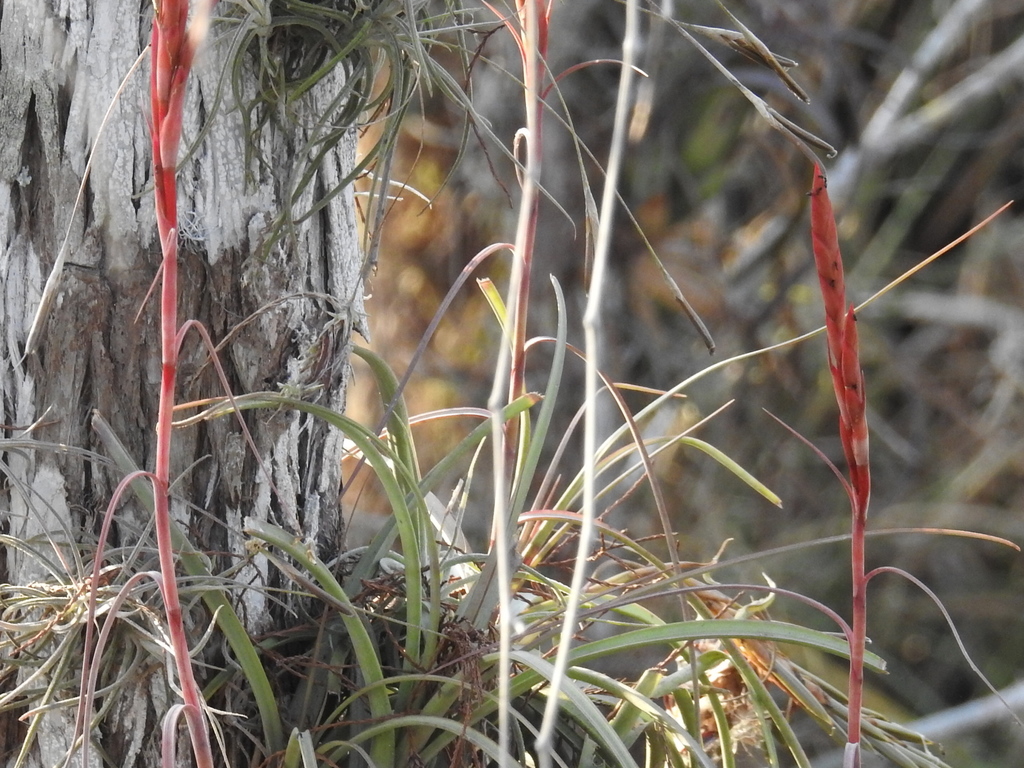
The flower spike is erect, slender and covered with red bracts. It is either a single spike or a few spikes spreading like fingers from the top of the stalk. The flowers are narrow and tubular, about 1 1/2 inches long, with violet petals and stamens that stick out past the petals. Blooming is mainly from spring through summer.
Fruit & Seeds
The fruit is a narrow capsule that splits open when ripe and releases many seeds, each with a parachute of fine hairs that carries it on the wind to new branches. After flowering, the parent plant slowly dies, but it usually produces one or more offsets (pups) from its base first.
Look-alikes
Southern needleleaf (Tillandsia setacea) has very thin, wiry leaves and no bulbous base. Potbelly airplant (T. paucifolia) also has a swollen base but is much smaller, with short, thick leaves. Twisted airplant (T. flexuosa) has wider, banded leaves and pink to white flowers. Cardinal airplant (T. fasciculata) has a large, open rosette of broad leaves and a flattened, fan-like flower head.
Quick Facts
| Scientific Name | Tillandsia balbisiana |
| Family | Bromeliaceae (pineapple family) |
| Plant Type | Epiphytic bromeliad (airplant) |
| Mature Height | 8–16 in (to about 2 ft in flower) |
| Mature Spread | 6–12 in |
| Growth Rate | Slow |
| Sun Exposure | Bright filtered light to part sun |
| Water Needs | Moderate; needs humid air and regular misting |
| Soil Type | None; grows on tree bark (epiphyte) |
| Soil pH | Not applicable |
| Bloom Time | Spring–summer |
| Flower Color | Violet flowers with red bracts |
| Fall Color | None; evergreen |
| Fruit | Narrow capsule with wind-dispersed, hairy seeds |
| Deer Resistant | Yes; grows out of reach on trees |
| USDA Hardiness Zones | 9b–11 |
Native Range
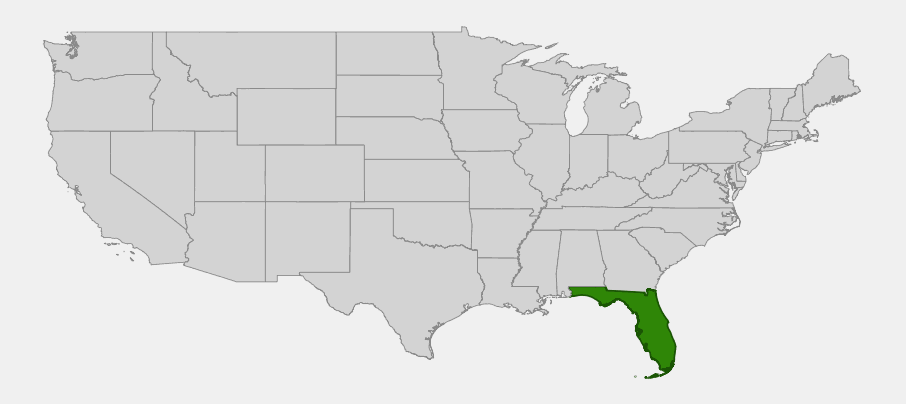
Balbis’ airplant is native to the West Indies, Mexico, Central America, Colombia and Venezuela, and reaches its northern limit in Florida. USDA PLANTS lists Florida as its only U.S. state, and the Atlas of Florida Plants records it as native and state Threatened.
In Florida it grows mainly in the central and southern peninsula and the Florida Keys, where frost is rare. It is most often seen in the Everglades and Big Cypress region, on trees in cypress swamps, hardwood hammocks and mangrove edges, but it also grows on oaks and other shrubs in scrub and pine flatwoods, where the light is brighter.
Hard freezes limit how far north it can grow. Since the late 1980s the Mexican bromeliad weevil has spread through much of southern Florida, and its larvae tunnel into the base of large native airplants and kill them. Balbis’ airplant is among the species affected, which is one reason it is protected by the state.
📋 Regional plant lists featuring Balbis’ Airplant: North & South Florida
Growing & Care Guide
Balbis’ airplant is grown by bromeliad collectors and can be grown outdoors on trees in frost-free parts of Florida or indoors in a bright, humid spot elsewhere. Because it is state Threatened in Florida, buy only nursery-propagated plants, never plants taken from the wild.
Light
Bright, filtered light suits it best, such as the dappled shade of an oak or a spot near a bright window indoors. It tolerates some direct morning sun, which brings out red tones in the leaves, but hot afternoon sun can scorch it.
Soil & Water
It needs no soil. Mist or soak it two or three times a week in warm weather and less in winter, and let it dry within a few hours. Water collecting inside the bulbous base can cause rot, so shake plants after soaking and hang them at an angle or upside down. Rainwater is better than hard tap water.
Planting Tips
Outdoors in southern Florida, tie it to the rough bark of a live oak, cypress or other tree with soft cotton string or a little plant-safe glue, never with copper wire. Indoors, mount it on cork bark or a piece of driftwood. Protect it from frost; temperatures below about 30°F can damage it.
Pruning & Maintenance
Remove dead leaves and the old flower spike when they dry. Check the base for chewing or tunnels, signs of the Mexican bromeliad weevil, and do not move bromeliads out of areas where the weevil is known to occur. A weak, diluted bromeliad fertilizer once a month in summer is optional.
Propagation
After flowering, the plant produces pups at its base. Leave them attached until they are about a third the size of the parent, then separate them, or leave the clump to grow as a group. It can also be raised from seed sown on damp mesh or bark, but seedlings take several years to flower.
Landscape Uses
- Tree plantings: a sculptural airplant for oak and cypress branches in frost-free gardens
- Mounted displays: grows well on cork bark or driftwood in a bright, humid room
- Bromeliad collections: a striking native species with red bracts and violet flowers
- Wildlife gardens: its tubular flowers suit hummingbirds
- Conservation: nursery-raised plants help keep demand off wild populations
Wildlife & Ecological Value
Balbis’ airplant is part of the rich community of epiphytes on trees in southern Florida’s swamps and hammocks.
For Pollinators
Its long, tubular violet flowers and bright red bracts fit the pattern of hummingbird-pollinated plants, and ruby-throated hummingbirds wintering in southern Florida visit bromeliad flowers like these.
For Birds
Birds sometimes pull the fine, hairy seeds and dry leaves from airplants for nest material, and small birds feed on insects that live among the leaves.
For Mammals
It offers little food for mammals. Because it grows on branches and trunks, it is out of reach of deer.
Ecosystem Role
The hollow, bulb-like base often shelters ants, which nest between the overlapping leaf bases, and spiders, beetles and tree frogs use the plant as well. Airplants also trap dust and debris and recycle nutrients high in the canopy. The decline of large native bromeliads because of the Mexican bromeliad weevil has made them a focus of conservation work in Florida.
Cultural & Historical Uses
The genus Tillandsia was named by Carl Linnaeus for the Swedish-Finnish physician and botanist Elias Tillandz. The species name honors Giovanni Battista Balbis, an Italian botanist of the early 1800s; the type specimen was collected in Jamaica by Carlo Bertero.
The name northern needleleaf, used by USDA and the Atlas of Florida Plants, refers to its narrow, needle-like leaves and its range reaching farther north than many tropical airplants, into central Florida. Horticulturists have selected several named forms and hybrids of the species for collectors.
Florida’s large airplants, including Balbis’ airplant, were heavily collected for the decorative plant trade before the state listed them. Today the greatest threat is the Mexican bromeliad weevil, first found in Florida in 1989. Researchers have studied biological control of the weevil, and conservationists encourage buying nursery-raised plants and leaving wild airplants in place.
Frequently Asked Questions
Is Balbis’ airplant a parasite?
No. It is an epiphyte. Its roots only hold it to the bark, and it gets water and nutrients from rain, dew and dust, not from the tree.
Is Balbis’ airplant protected in Florida?
Yes. The Atlas of Florida Plants lists it as state Threatened. Do not collect it from the wild; buy nursery-propagated plants instead.
Why does it have a swollen base?
The broad leaf bases overlap to form a hollow, bulb-like base. It stores water and often shelters ants, which nest inside.
Can I grow Balbis’ airplant indoors?
Yes. Mount it in bright, filtered light, mist or soak it regularly, and let it dry quickly. Hang it at an angle so water does not collect in the base.
What is the difference between Balbis’ airplant and northern needleleaf?
They are the same plant. Northern needleleaf is the name used by USDA PLANTS and the Atlas of Florida Plants; Balbis’ airplant comes from its scientific name.

Looking for a nursery that carries Balbis’ Airplant?
Browse our native plant nursery directory: Florida

