
Florida Butterfly Orchid (Encyclia tampensis)
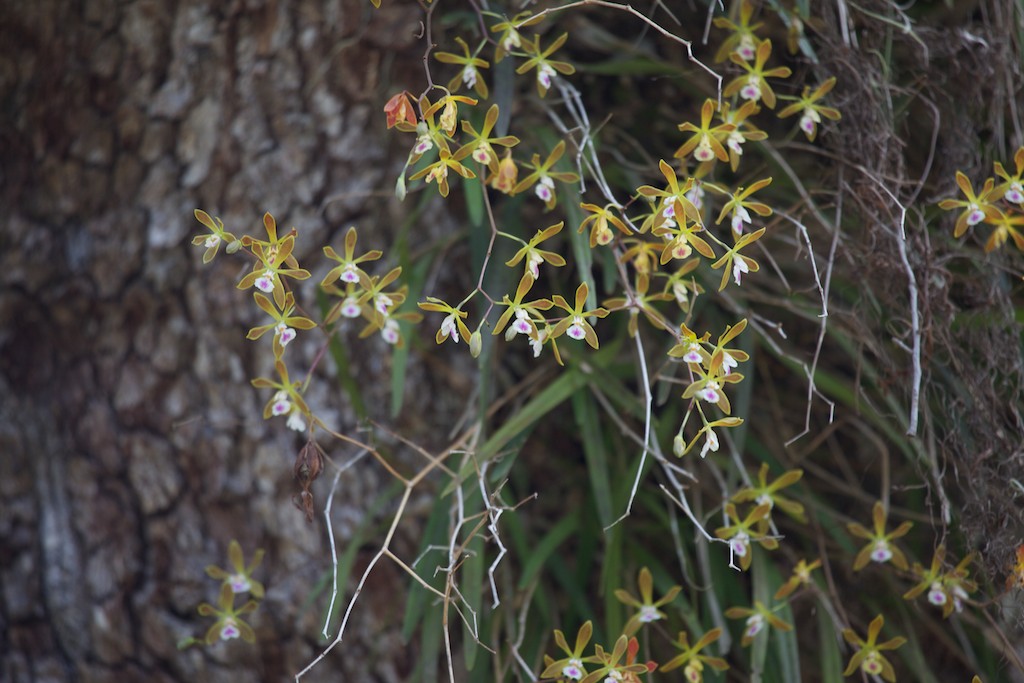
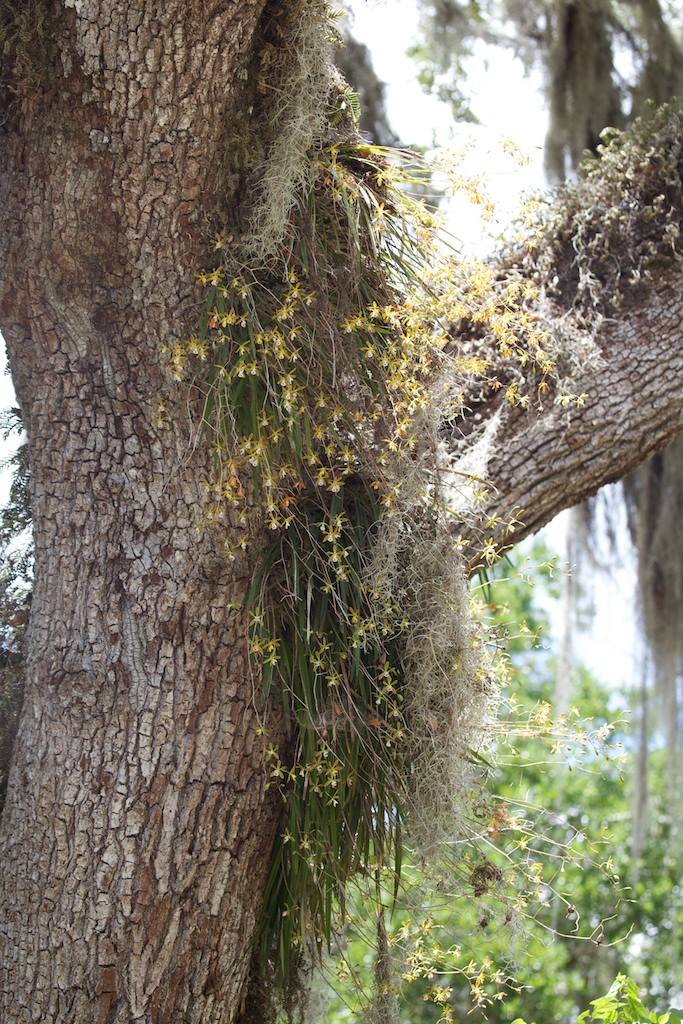
Encyclia tampensis, the Florida Butterfly Orchid, is the most familiar native orchid of the Florida peninsula. USDA PLANTS calls it the Tampa butterfly orchid, and both names are widely used. It is an epiphyte: it grows perched on the trunks and branches of trees, most often southern live oaks, holding on with thick, silvery roots and taking water from rain, dew and humid air. It does not take nutrients from the tree, so it does the host no harm.
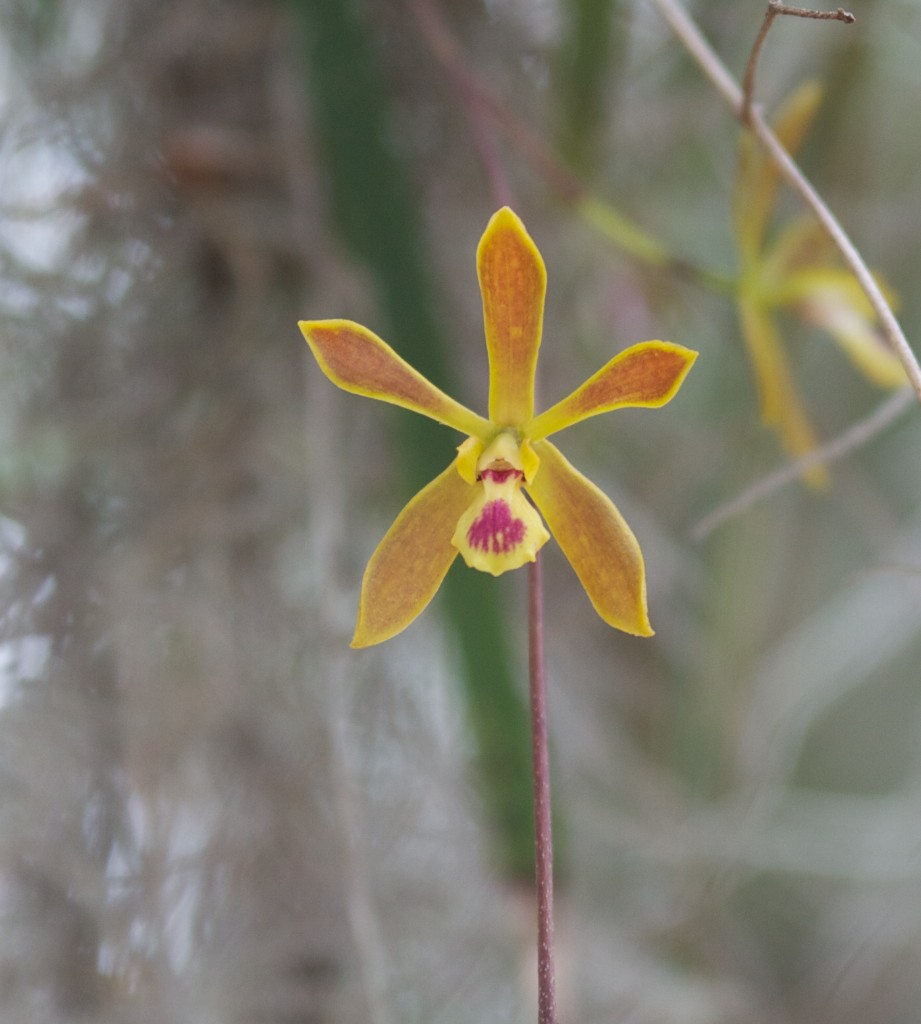
From late spring through summer, mature plants send up slender, branching flower stems carrying a dozen or more small, fragrant flowers. Each has narrow bronze, olive or yellowish petals and sepals around a white lip with a bright magenta spot. When the wiry stems move in a breeze, the flowers seem to flutter, which is how the plant earned its common name.
Although it is still one of Florida’s more common native orchids, the state of Florida lists it as Commercially Exploited because wild plants have long been stripped from trees for sale. This guide covers how to identify it, where it grows, how to grow nursery-propagated plants, and why wild plants should always be left on their trees.
Identification
Florida butterfly orchid is easy to recognize once you know where to look: clusters of small, egg-shaped pseudobulbs on oak bark, each topped by one to three narrow, grass-like leaves.
Pseudobulbs & Roots
The plant grows from a cluster of hard, rounded to egg-shaped pseudobulbs up to about 3 inches tall, which store water and food through Florida’s dry winters and springs. They are dark green, often tinged with purple, and become wrinkled when the plant is dry. Thick, whitish roots spread across the bark and anchor the clump; older plants can form large masses with dozens of pseudobulbs.
Leaves
Each pseudobulb carries one to three narrow, leathery, strap-shaped leaves, up to about 6 inches long and less than an inch wide. The leaves are stiff and grass-like, which is why non-flowering plants are easy to overlook among ferns and bromeliads on oak limbs.
Flowers
The flower stem rises from the top of a pseudobulb in late spring or summer and is often branched, carrying several to many flowers. The flowers are about 1 inch across and fragrant, with narrow, spreading sepals and petals in shades of green, olive, bronze or yellow-brown. The broad, three-lobed white lip is marked with a magenta to purple spot or streaks; a rare form has a pure white lip. Flowering runs mainly from May to September.
Look-alikes
The clamshell orchid (Prosthechea cochleata) also grows on trees in South Florida, but its dark purple, shell-shaped lip points upward. The fringed star orchid (Epidendrum ciliare) has white, deeply fringed lips. Butterfly orchid’s small white lip with a central magenta spot, on branching stems above clustered pseudobulbs, is distinctive.
Quick Facts
| Scientific Name | Encyclia tampensis (syn. Epidendrum tampense) |
| Family | Orchidaceae (orchid family) |
| Plant Type | Epiphytic perennial orchid with pseudobulbs |
| Mature Height | 6–24 in including flower stems |
| Mature Spread | 6–18 in; old clumps can be larger |
| Growth Rate | Slow |
| Sun Exposure | Bright filtered light to part shade |
| Water Needs | Moderate in summer; drier in winter |
| Soil Type | None; grows on tree bark (or a mount in cultivation) |
| Soil pH | Not applicable (epiphyte) |
| Bloom Time | May–September |
| Flower Color | Green to bronze with a white, magenta-spotted lip |
| Fall Color | None; evergreen |
| Fruit | Ribbed seed capsule with thousands of dust-like seeds |
| Deer Resistant | Yes; grows out of reach on tree trunks and limbs |
| USDA Hardiness Zones | 9b–11 |
Native Range
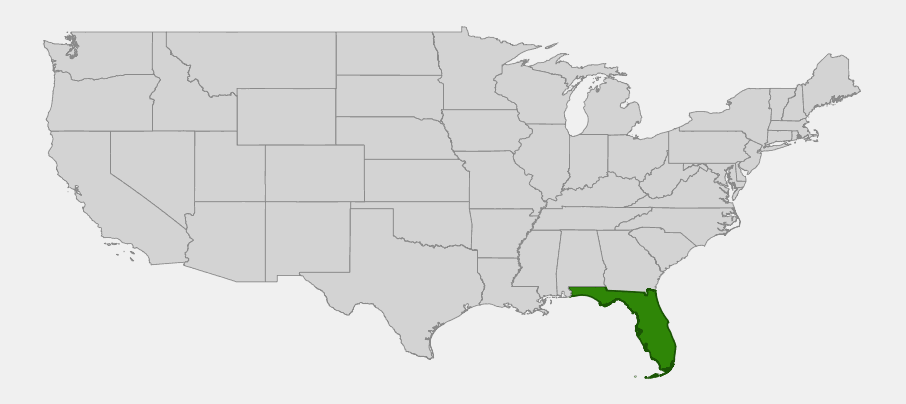
Florida butterfly orchid is the only member of its genus native to the United States. USDA PLANTS lists it as native only in Florida. Outside the U.S. it grows in the Bahamas, and a related variety occurs in Cuba.
In Florida it is found through most of the peninsula, from about Levy and Putnam Counties (where the Atlas of Florida Plants records its northernmost vouchered specimens) south through Central and South Florida to the Florida Keys. It is most common in the central and southern peninsula, where frost is rare.
It grows most often on southern live oaks, but also on pond apple, mangroves, bald cypress, pines and palms, in hardwood hammocks, swamps, along rivers and in old live oak trees in towns and parks. Large, sheltered limbs in humid, shady to partly sunny hammocks hold the biggest colonies.
📋 Regional plant lists featuring Florida Butterfly Orchid: North & South Florida
Growing & Care Guide
Florida butterfly orchid is one of the easiest native orchids for South and Central Florida gardeners, because it is adapted to the local climate and grows happily on a garden tree. Buy only nursery-propagated, seed-grown plants from a reputable orchid grower or native nursery. Never remove plants from trees in the wild: the species is listed by the state of Florida as Commercially Exploited, wild collection without permits is illegal, and collected plants often fail to re-establish.
Light
Give it bright, filtered light, like the dappled shade under an oak canopy. Morning sun with protection from harsh midday sun is ideal. Too much shade means fewer flowers; leaves that turn yellowish usually mean too much sun.
Soil & Water
Grow it without soil. In a garden, tie it to the trunk or a rough-barked limb of a live oak, buttonwood or similar tree. In a shadehouse, mount it on cork bark or a hardwood slab, or in a small slatted basket with very coarse bark. Water mounted plants often in the warm, rainy months, letting the roots dry between waterings, and water less in winter while the plant is resting. Outdoors in Florida, summer rain usually supplies most of what it needs.
Planting Tips
Attach a plant in spring or early summer, when new roots are forming, so they can grip the bark. Hold it firmly against the bark with cotton string, jute or plastic-coated wire that won’t cut the roots, pseudobulbs upright and the newest growth pointing toward fresh bark. Avoid copper wire. The roots usually take hold within a growing season, and any tie can then be removed or left to rot away.
Pruning & Maintenance
Little care is needed. Old pseudobulbs can be left in place, because they store water and food for new growth. Cut spent flower stems back after blooming. In northern and central Florida, protect potted or mounted plants from hard freezes; plants on trees in sheltered hammocks tolerate brief light frost.
Propagation
Large clumps can be divided in spring into sections with several pseudobulbs and active roots. Seed raising is done in sterile flask culture by specialist growers, and that is the source of the nursery plants on the market. Letting flowers on garden plants set seed costs nothing and helps spread the species naturally on nearby trees.
Landscape Uses
- Living tree decoration: tie it to a live oak or other rough-barked tree in a shady South or Central Florida garden
- Shadehouse and patio collections: mounted on cork or wood, alongside native bromeliads and ferns
- Native plant gardens: a fragrant summer bloomer above ground level, where most native gardens have no flowers
- Hammock restoration: reintroduced with nursery-raised plants as part of larger habitat projects
- Education: an easy way to show visitors a native orchid up close
Wildlife & Ecological Value
Butterfly orchid is part of the community of epiphytes, including Spanish moss, resurrection fern and airplants, that cover the limbs of Florida’s oaks and hammock trees and give them their lush look.
For Pollinators
The fragrant flowers attract bees, which are considered the main pollinators of Encyclia orchids. Like many orchids, the plant packs its pollen into waxy masses (pollinia) that stick to a visiting insect and are carried to the next flower. In the wild, only a small share of flowers sets fruit.
For Birds
Its seeds are too tiny to feed birds, but the moss-, fern- and orchid-draped limbs it shares with other epiphytes give insect-eating birds such as warblers, gnatcatchers and wrens good places to forage, and some birds use epiphyte material for nests.
For Mammals
Mammals rarely feed on it, because it grows on trunks and limbs out of reach of deer and most other browsers.
Ecosystem Role
Like all orchids, it depends on mycorrhizal fungi for its seeds to germinate: the dust-like seeds carry almost no food and need a fungal partner on the bark to start growing. Its presence on old trees is a sign of humid, well-shaded hammock habitat, and protecting large old oaks protects it.
Cultural & Historical Uses
The species was first described in 1847 as Epidendrum tampense, from plants collected near Tampa Bay, which gives it its species name and its USDA name, Tampa butterfly orchid. It was later moved to Encyclia, a genus name from a Greek word meaning “to encircle,” referring to the way the lip wraps around the column.
For generations, butterfly orchids were pulled from roadside and hammock oaks and sold to tourists and gardeners. That collection, along with the clearing of hammocks for development, is why Florida regulates it as Commercially Exploited under the Florida Department of Agriculture and Consumer Services plant rules. Taking plants from the wild for sale needs a permit, and taking them from private land needs the landowner’s permission.
Today seed-raised plants are widely available from Florida orchid growers, and the butterfly orchid is a favorite of native plant and orchid societies. Seeing one blooming on an old live oak in a city park or hammock is one of the small pleasures of a Florida summer.
Frequently Asked Questions
Is the Florida butterfly orchid a parasite?
No. It is an epiphyte: it uses the tree only for support, taking water and nutrients from rain, air and debris on the bark. It does not harm the host tree.
Can I take a butterfly orchid from a tree in the woods?
No. The state of Florida lists it as Commercially Exploited, and removing plants from public land, or from private land without permission, is not allowed. Collected plants also often die. Buy seed-grown plants from a nursery instead.
When does the Florida butterfly orchid bloom?
Mainly from late spring through summer, roughly May to September, with a peak in early summer. The fragrant flowers last several weeks.
How do I attach a butterfly orchid to a tree?
In spring or early summer, hold the plant against rough bark with soft string or plastic-coated wire, pseudobulbs upright, and keep it watered until new roots grip the bark. Live oaks and other rough-barked trees in filtered light work well.
Can it grow outside Florida?
Outdoors only in frost-free or nearly frost-free areas, roughly USDA zones 9b to 11. Elsewhere it can be grown as a mounted plant in a greenhouse or bright windowsill that is brought indoors in cold weather.

Looking for a nursery that carries Florida Butterfly Orchid?
Browse our native plant nursery directory: Florida