
Silky Phacelia (Phacelia sericea)
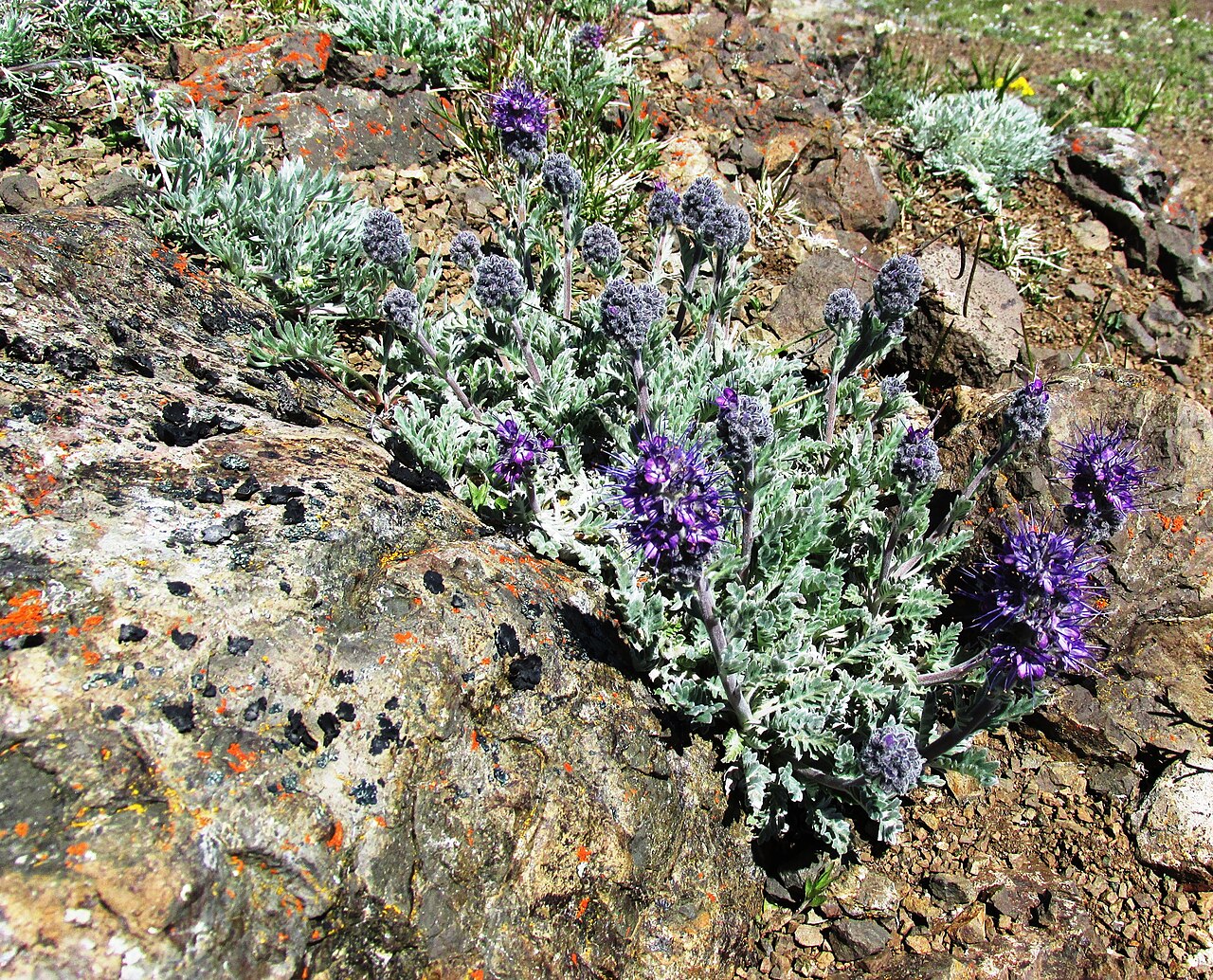
Phacelia sericea, known as Silky Phacelia or purple fringe, is a showy perennial wildflower of the mountains of western North America. It grows in clumps of silvery, finely divided leaves and sends up stout stems topped with dense, cylindrical spikes of deep purple to blue-violet flowers. The long stamens stick far out of each flower, so the spikes look like fuzzy purple bottlebrushes. Plants are usually 4 to 16 inches tall.
It belongs to the waterleaf group (Hydrophyllaceae, now often placed in the borage family, Boraginaceae). Silky phacelia grows from the foothills to above treeline in the Rocky Mountains, the Great Basin ranges, the Cascades, the Olympic Mountains and the Sierra Nevada. It favors open, rocky, well-drained ground: talus, gravelly slopes, ridges and road cuts. It blooms in early to midsummer, and bumblebees and many native bees visit the flowers.
Silky phacelia is a beautiful plant for rock gardens and dry, sunny gardens in cool, mountain climates, but it is not easy in hot, humid lowland gardens. Like several phacelias, its hairs can irritate sensitive skin, so wear gloves when handling it.
Identification
Look for a low clump of silvery-hairy, deeply divided leaves and dense spikes of purple flowers with long, protruding stamens, growing on rocky mountain ground.
Growth Habit
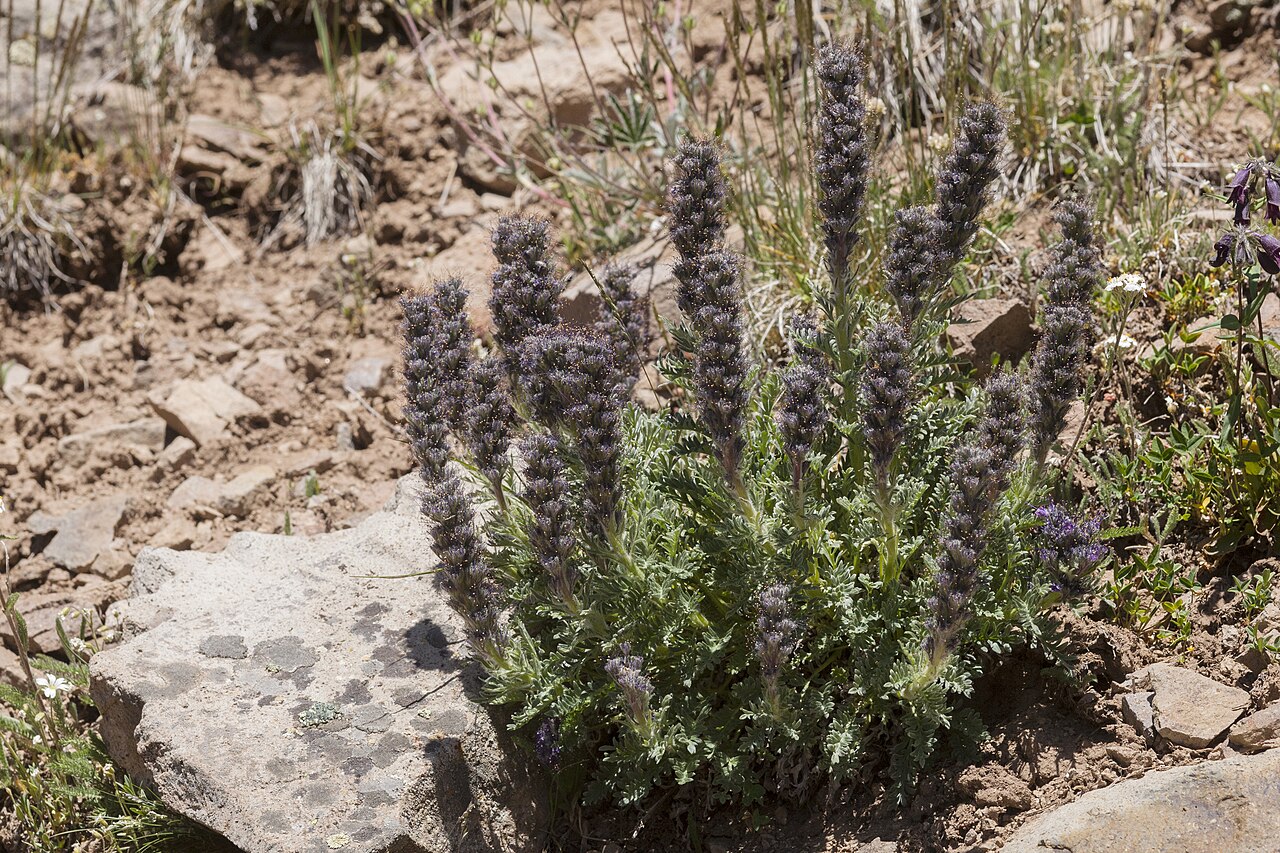
Silky phacelia is a short-lived perennial or sometimes a biennial, growing from a taproot and a branched woody base (caudex). It forms a clump of basal leaves with one to several erect, leafy stems, usually 4 to 16 inches tall and occasionally taller. The whole plant is covered with fine, silky hairs that give it a silvery-gray to greenish-gray look.
Leaves
The leaves are 1 to 4 inches long and pinnately divided into narrow, often further-cut lobes, giving them a feathery, fern-like outline. Most of the leaves are near the base, and smaller ones run up the stem. The dense, flat-lying hairs make them soft and silky to the touch and silvery in color, especially in plants from dry or high sites.
Flowers
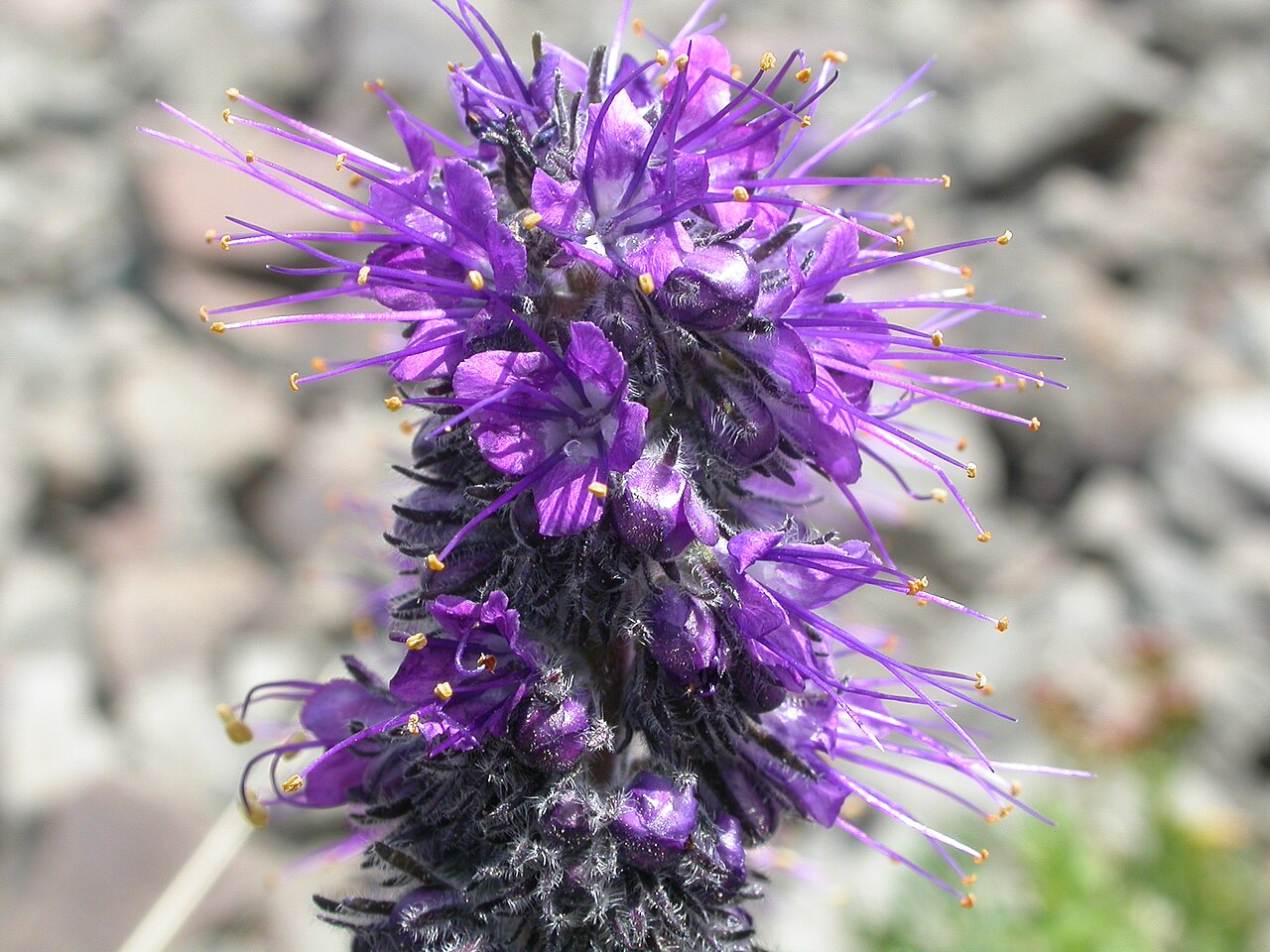
The flowers are small, about 1/4 inch long, bell-shaped and five-lobed, and are deep purple, violet or blue, rarely white. They are packed into many short, coiled clusters (cymes) that together make a dense, cylindrical spike 1 to 4 inches long at the top of each stem. The stamens are about twice as long as the petals, with purple filaments and yellow-orange anthers, which gives the spike its fringed, bottlebrush look. Bloom time is June to August, depending on elevation.
Fruit & Seeds
Each flower produces a small, hairy capsule with several small, pitted brown seeds. The dry spikes stay on the plant into late summer.
Varieties
Two varieties are usually recognized. Variety sericea has densely silky, silvery leaves and is widespread in the Rocky Mountains. Variety ciliosa is greener and less silky, with more spreading hairs, and grows mainly in the Great Basin and Sierra Nevada.
Look-alikes
Silverleaf phacelia (Phacelia hastata) has whole, undivided, lance-shaped leaves and whitish to pale lavender flowers. Lyall’s phacelia (P. lyallii) of Montana and southern Alberta and British Columbia is greener, with less divided leaves. Purple fringe can also be confused with small lupines or penstemons from a distance, but up close the coiled flower clusters and long stamens are distinctive.
Quick Facts
| Scientific Name | Phacelia sericea |
| Family | Hydrophyllaceae (waterleaf family), often included in Boraginaceae |
| Plant Type | Short-lived perennial or biennial wildflower |
| Mature Height | 4–16 in |
| Mature Spread | 6–12 in |
| Growth Rate | Moderate |
| Sun Exposure | Full sun to part shade |
| Water Needs | Low to medium; sharply drained |
| Soil Type | Gravelly, rocky, sandy or talus soils |
| Soil pH | Slightly acidic to slightly alkaline (about 6.0–8.0) |
| Bloom Time | June–August |
| Flower Color | Deep purple to blue-violet, rarely white |
| Fall Color | None; leaves stay silvery-green |
| Fruit | Small hairy capsule with pitted seeds |
| Deer Resistant | Moderate; hairy foliage is seldom browsed heavily |
| USDA Hardiness Zones | 3–7 |
Native Range
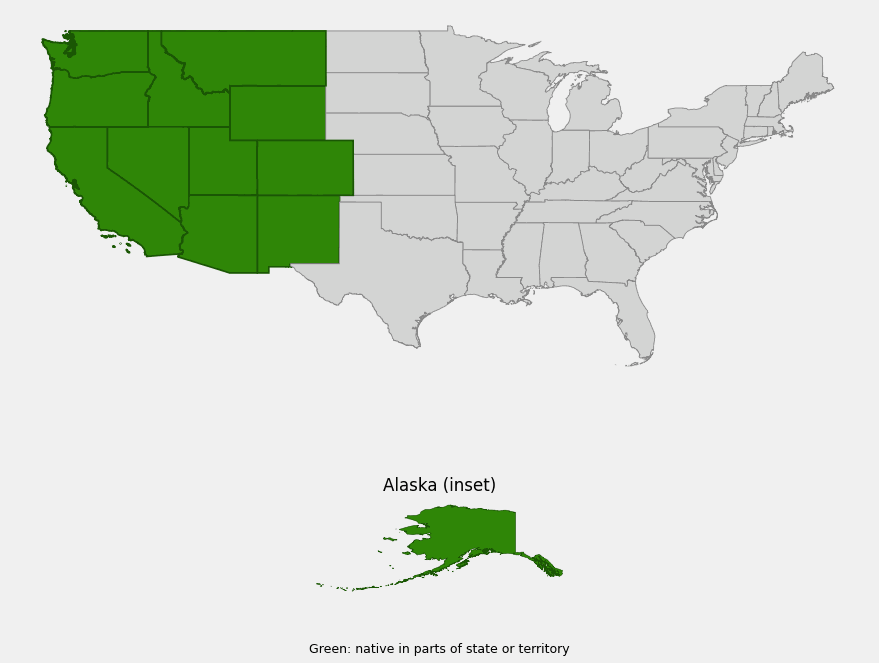
Silky phacelia is native to the mountains of western North America. USDA PLANTS lists it as native in Alaska, Arizona, California, Colorado, Idaho, Montana, Nevada, New Mexico, Oregon, Utah, Washington and Wyoming, and in Alberta and British Columbia. It is most common in the Rocky Mountains from Montana and Idaho to Colorado.
It grows in the Cascades, including the drier east side in Washington and Oregon, the Olympic Mountains, the Blue and Wallowa Mountains, the Great Basin ranges of Nevada and Utah, the Sierra Nevada and other high ranges of eastern California, and south to the mountains of northern New Mexico and Arizona. The Alaska records are few and come from the far southeast, near the British Columbia border along the Haines Highway, at the northern edge of its range.
Its habitat is open, rocky ground: talus and scree, gravelly slopes, rocky ridges, sagebrush openings, open conifer forest and disturbed sites such as road cuts. It ranges from about 4,000 feet in the north to more than 12,000 feet in Colorado, and is common at and above treeline in many ranges.
📋 Regional plant lists featuring Silky Phacelia: Idaho, Eastern Oregon & Eastern Washington · Montana & Wyoming · Utah & Western Colorado · Arizona & New Mexico · Alaska · Western Oregon & Western Washington · California & Nevada
Growing & Care Guide
Silky phacelia is a rewarding plant in cool, dry, sunny climates, where it behaves much as it does on a mountain slope. In hot, humid or wet-winter gardens it usually rots or burns out quickly. Seed is sometimes available from native seed companies in the West, and it is sold occasionally by rock garden nurseries.
Light
Give it full sun in cool climates and at high elevations. In warmer, lower gardens it does better with some afternoon shade.
Soil & Water
Plant it in very well-drained, gravelly or sandy soil with little organic matter, such as a scree bed, a rock garden or a raised bed full of grit. Water to establish it, then water only during long dry spells. Wet soil around the crown, especially in winter, is the most common cause of loss.
Planting Tips
Sow seed outdoors in fall or early winter so it gets a natural cold period, or plant small container-grown plants in spring. Plant the crown at or slightly above the soil surface and top-dress with gravel to keep it dry. Wear gloves when handling it; the hairs of many phacelias can cause an itchy rash similar to poison ivy in sensitive people.
Pruning & Maintenance
Little care is needed. You can cut off spent spikes after flowering, or leave some to set seed, since individual plants often live only a few years and self-sown seedlings keep a planting going. Avoid mulching with bark or compost, which holds too much moisture.
Propagation
Grow it from seed. Fresh seed sown in fall germinates in spring after winter cold. Seedlings have a taproot and should be moved to their final spot while small, as older plants resent transplanting.
Landscape Uses
- Rock gardens: silvery foliage and purple spikes for scree and crevice beds
- Dry mountain gardens: a native choice for xeriscapes in cool western climates
- Pollinator gardens: its flowers are busy with bumblebees and native bees
- Restoration: used in seed mixes for disturbed mountain slopes and road cuts
- Troughs: a small, striking plant for alpine troughs in suitable climates
Wildlife & Ecological Value
Silky phacelia is an important early-summer nectar and pollen source on high, rocky slopes where flowers are scattered.
For Pollinators
The flowers are visited heavily by bumblebees and by many solitary native bees, as well as butterflies and flies. The Xerces Society notes that it has special value to native bees. Its long, exposed stamens produce plenty of pollen.
For Birds
Small seed-eating birds may pick seeds from the dry spikes, but it is not a major bird food.
For Mammals
The hairy leaves are not a preferred food, though grazing animals may nibble it. Its roots help hold loose talus and gravel in place.
Ecosystem Role
Silky phacelia is one of the early colonizers of bare, rocky and disturbed ground in the mountains, including recently glaciated terrain and road cuts. It helps stabilize loose soil and feeds a wide range of insects in harsh, open habitats.
Cultural & Historical Uses
The genus name Phacelia comes from the Greek phakelos, meaning “bundle” or “cluster,” for the crowded flower clusters. The species name sericea means “silky,” describing the soft, silvery hairs on the leaves.
Phacelia is a large genus of roughly 200 species, most of them native to western North America. Several annual phacelias, such as lacy phacelia, are grown as bee forage and cover crops. Silky phacelia is one of the most widespread perennial species in the high mountains.
Its fuzzy purple spikes are a familiar sight to hikers in the high country of Glacier, Yellowstone, Rocky Mountain and Olympic National Parks, where it often grows on rocky trailsides and ridges with other alpine flowers.
Frequently Asked Questions
Why is it called silky phacelia?
The leaves and stems are covered with fine, flat-lying hairs that make them silky to the touch and silvery in color. The species name sericea means “silky.”
Can silky phacelia cause a rash?
Yes, in some people. Many phacelias have glandular or stiff hairs that can cause an itchy skin rash similar to poison ivy. Wear gloves when handling the plants.
Can I grow silky phacelia in my garden?
Yes, in cool, dry climates with very well-drained, gravelly soil and full sun. It is difficult in hot, humid or wet-winter gardens, where it tends to rot.
Is silky phacelia a perennial?
It is a short-lived perennial or sometimes a biennial. Individual plants often live only a few years, but they reseed in good conditions.
Does silky phacelia grow in Alaska?
USDA PLANTS lists it as native there, but it is rare, known only from a few sites in far southeast Alaska near the British Columbia border.

Looking for a nursery that carries Silky Phacelia?
Browse our native plant nursery directory: Alaska & Arizona · California · Colorado · Idaho · Montana · Nevada & New Mexico · Oregon · Utah · Washington · Wyoming