
Southern Needleleaf Airplant (Tillandsia setacea)
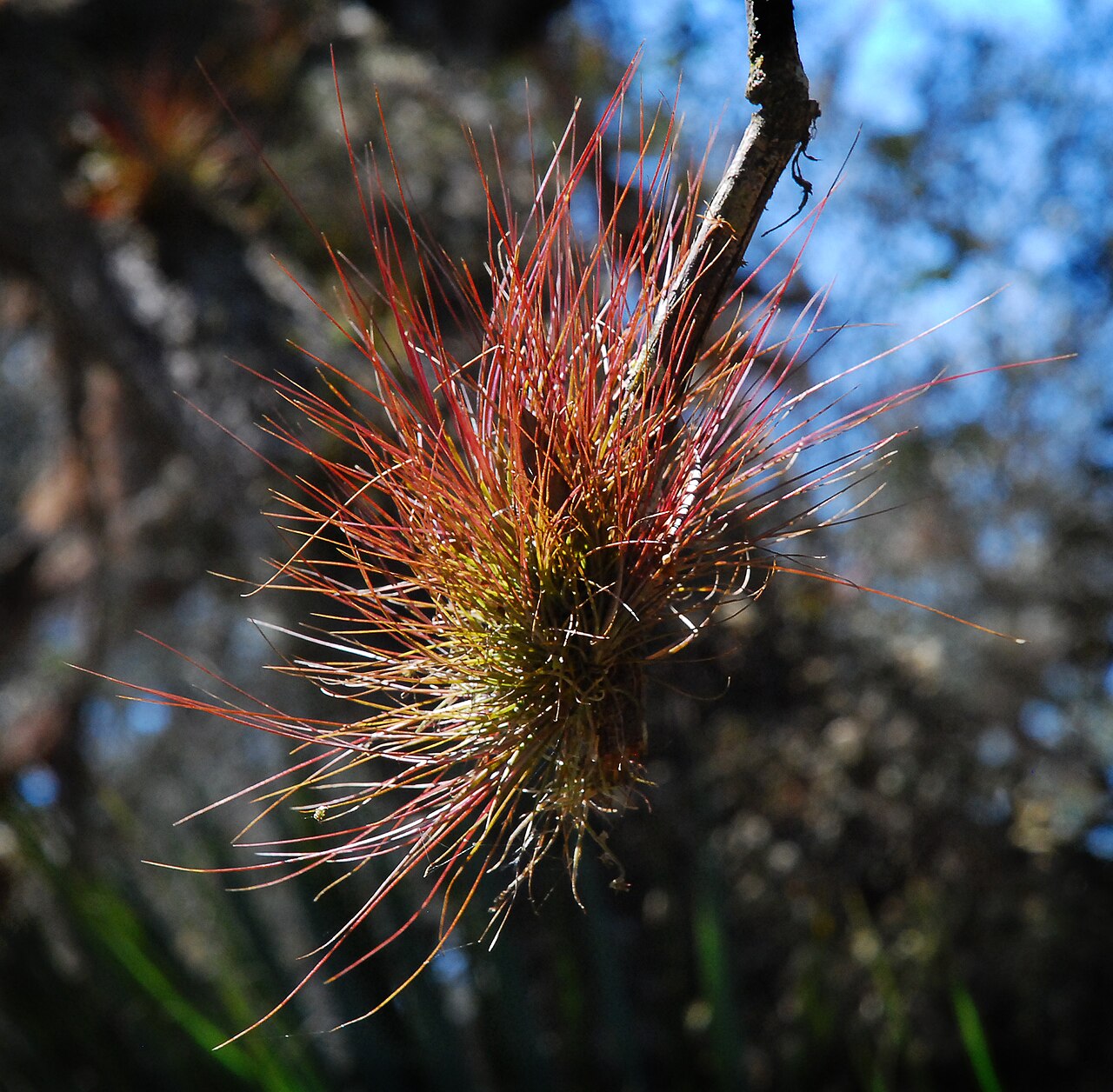
Tillandsia setacea, known as Southern Needleleaf Airplant (USDA: southern needleleaf), is a small native air plant of Florida, southeastern Georgia and Puerto Rico. It is a bromeliad, a member of the pineapple family (Bromeliaceae), and a relative of Spanish moss and ball moss. Older books sometimes misapplied the name Tillandsia tenuifolia to it.
It forms dense, rounded tufts 4 to 10 inches across of extremely thin, stiff, needle-like leaves, often turning bronze or red in sun. Like other Tillandsia, it is an epiphyte: it grows perched on the bark of trees, taking water and nutrients from rain, dew and dust through fine silvery scales on its leaves. It does not harm its host. In spring and again in fall it sends up slender pink to red spikes with small, tubular violet flowers.
Southern needleleaf is one of the more common native air plants in Florida, often abundant on oaks, cypress and other trees in swamps and hammocks. Even so, never collect air plants from the wild. Wild populations recover slowly, collecting from parks and public lands is prohibited, and several Florida air plants are state-listed. Buy only nursery-propagated plants.
Identification
Look for dense, grassy-looking tufts of very thin, wiry leaves, much finer than those of most other native air plants, growing on tree trunks and branches.
Growth Habit
Plants grow as stemless rosettes that quickly form offsets, so a mature plant is usually a dense, rounded clump of many heads, 4 to 10 inches across. Short, wiry roots serve only to anchor the plant to bark.
Leaves
The leaves are narrowly linear and almost round in cross-section, only about 1/16 inch wide and 4 to 10 inches long, tapering to a fine point. They are covered with tiny gray scales (trichomes) that absorb water. Leaves are green in shade and bronze, coppery or red in bright sun, and the leaf bases are often reddish-brown.
Flowers
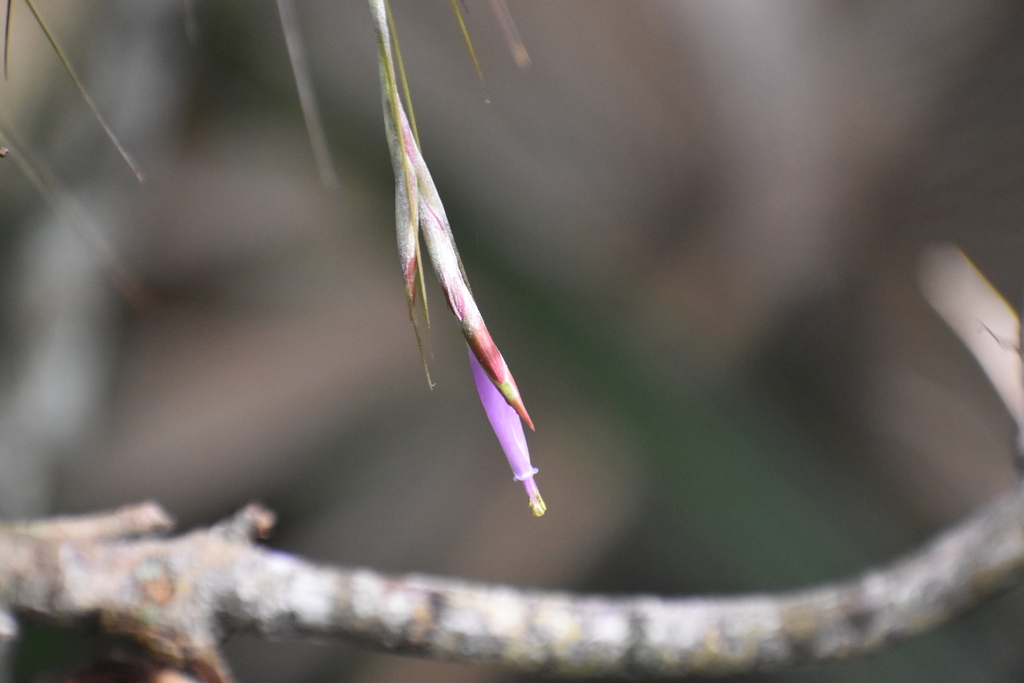
The flower spike is slender and simple, held among or slightly above the leaves, with narrow, overlapping pink to rosy-red bracts. One to a few flowers open at a time from the bracts; each is a narrow tube about 1 inch long with three violet to purple petals. In Florida, flowering is reported mainly in spring (March to May) and again in fall (September to November).
Fruit & Seeds
The fruit is a narrow, dry capsule that splits into three parts. The seeds carry tufts of fine, silky hairs (a coma) that let them float on the wind and catch on rough bark, where they germinate.
Look-alikes
Bartram’s airplant (Tillandsia bartramii) is very similar but has slightly broader leaves and a stouter flower spike that is often branched. Ball moss (T. recurvata) forms small gray balls with curved leaves. Young cardinal airplant (T. fasciculata) has much broader, stiffer leaves. Northern needleleaf (T. balbisiana) has leaves that are wide and swollen at the base, forming a bulb.
Safety & Conservation
Southern needleleaf is harmless to people and pets. Its main risk is from people: collecting wild air plants damages populations and is prohibited on public lands. It is not on Florida’s state endangered or threatened lists (Atlas of Florida Plants), but several of its relatives are, partly because of the introduced Mexican bromeliad weevil, which attacks larger native bromeliads. Buy nursery-propagated plants only.
Quick Facts
| Scientific Name | Tillandsia setacea |
| Family | Bromeliaceae (pineapple family) |
| Plant Type | Epiphytic evergreen perennial (air plant) |
| Mature Height | 4–10 in |
| Mature Spread | 4–10 in clumps |
| Growth Rate | Slow |
| Sun Exposure | Part shade to bright filtered sun |
| Water Needs | Moderate; high humidity and regular rain or misting |
| Soil Type | None; grows on tree bark |
| Soil pH | Not applicable (epiphyte) |
| Bloom Time | March–May and September–November |
| Flower Color | Violet flowers; pink to red bracts |
| Fall Color | Leaves redden in bright sun |
| Fruit | Narrow capsule with wind-borne plumed seeds |
| Deer Resistant | Yes; usually out of reach on trees |
| USDA Hardiness Zones | 9–11 |
Native Range
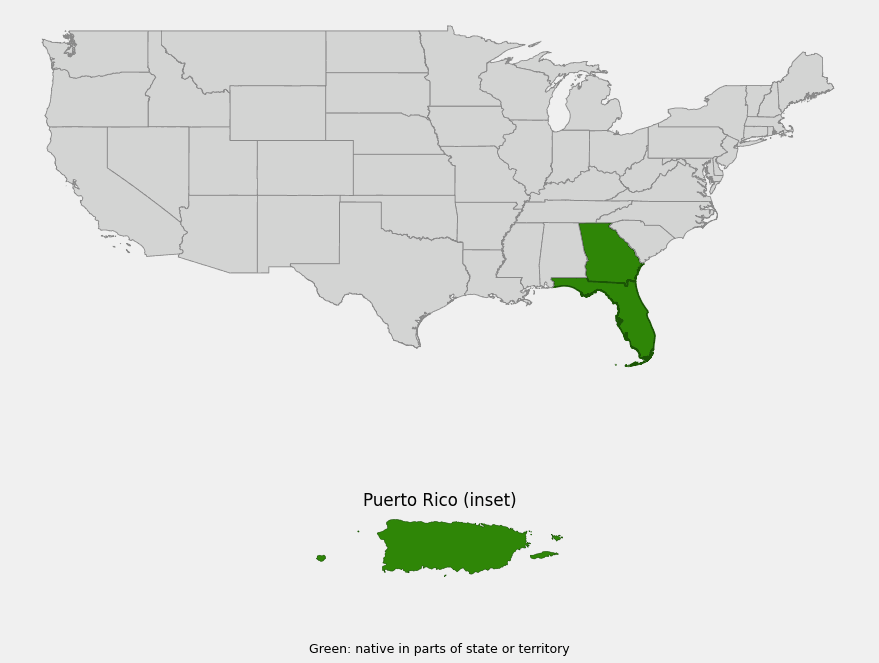
Southern needleleaf airplant grows in the American tropics and subtropics, from Mexico and Central America through the West Indies. USDA PLANTS lists it as native in Florida, Georgia and Puerto Rico. The species was first described in 1788 by the Swedish botanist Olof Swartz from plants of the West Indies.
In Florida it is widespread through the peninsula, from the northern peninsula south to the Everglades, and especially common in central and southern Florida. In Georgia it reaches its northern limit in the coastal plain of the southeastern part of the state. The plant is sensitive to hard freezes, which helps explain why it does not range farther north.
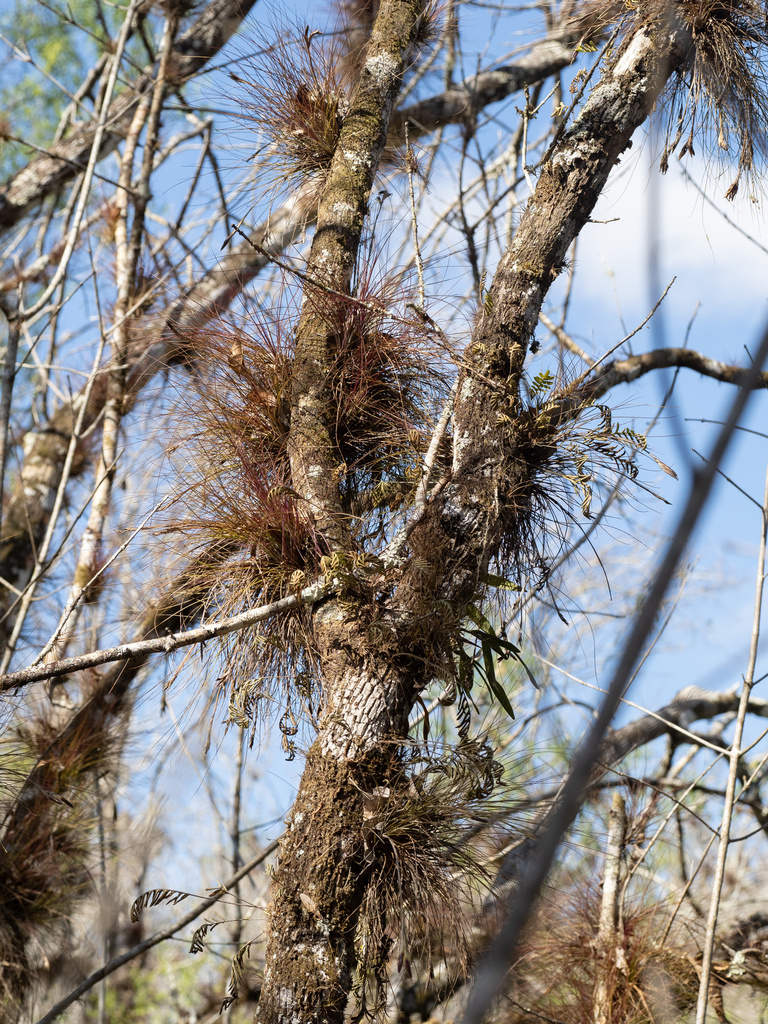
Typical habitats are humid places: cypress swamps and domes, hardwood hammocks, river swamps, bayheads and pine flatwoods, where it grows on oaks, bald and pond cypress, maples, pines and other trees, usually on the trunks and lower branches. It is often most abundant in sheltered swamp forests where humidity stays high.
📋 Regional plant lists featuring Southern Needleleaf Airplant: Alabama, Georgia & Mississippi · North & South Florida · Puerto Rico
Growing & Care Guide
Southern needleleaf is easy to grow outdoors in frost-free or nearly frost-free climates and can be kept as a houseplant elsewhere. Start with nursery-propagated plants only. Never pull air plants from trees in the wild.
Light
Give it bright, filtered light, such as the dappled shade under an oak or a bright, east-facing window. More sun brings out red and bronze leaf colors; harsh afternoon sun on a dry porch can scorch it.
Soil & Water
It needs no soil. Outdoors in Florida, rain, dew and humidity are usually enough, with misting in long droughts. Indoors, soak or mist it two or three times a week and let it dry within a few hours; plants that stay wet at the base can rot. Rainwater is best; avoid softened water. A very dilute bromeliad fertilizer can be added occasionally.
Planting Tips
Attach the clump to rough bark, a cork slab or driftwood with soft wire, fishing line or a dab of non-toxic glue, keeping the base free to dry. Oaks, cypress and other rough-barked trees make good natural hosts. Never bury the base in soil or moss.
Pruning & Maintenance
Little is needed. Trim off dead leaves and old flower spikes. Protect plants from hard freezes; in North Florida and Georgia, plants on trees usually survive brief frosts, but potted or mounted ones should be brought inside during freezes.
Propagation
Plants offset freely after flowering, forming clumps that can be divided once offsets are about a third the size of the parent. Seed can be sown on a moist, rough surface such as cork or a mesh screen and kept humid, but seedlings take years to reach flowering size.
Landscape Uses
- Living tree decoration: on oaks and cypress in Florida yards, where it grows naturally
- Mounted displays: on cork, driftwood or bark for porches and patios
- Houseplants: a fine-textured air plant for bright windows and terrariums with ventilation
- Native plant education: an easy example of epiphytes and bromeliads
- Wildlife gardens: adds structure and insect habitat high in trees
Wildlife & Ecological Value
Air plants like southern needleleaf add another layer of habitat in Southeastern swamps and hammocks, providing flowers, nesting material and shelter for small animals above the ground.
For Pollinators
The tubular violet flowers fit the pattern of plants pollinated by hummingbirds and long-tongued insects. Ruby-throated hummingbirds, which pass through Florida in spring and fall, may visit them. Plants also produce offsets, so they spread even without seed.
For Birds
Birds use the fine, wiry leaves of air plants as nesting material, and the dense clumps shelter insects and spiders that warblers, gnatcatchers and other small birds pick from the bark.
For Mammals
Mammals rarely eat it. Squirrels and other tree-dwelling mammals sometimes pull apart clumps, and the leaves may be used as nest lining.
Ecosystem Role
As an epiphyte, southern needleleaf captures water, dust and fallen organic matter from the air and slowly returns nutrients to the forest floor as it decays. Its clumps host small invertebrates such as tree frogs, spiders, ants and beetles. It is not a parasite and does not harm the trees it grows on.
Cultural & Historical Uses
The genus Tillandsia was named by Linnaeus for the Swedish-Finnish physician and botanist Elias Tillandz. According to an often-repeated story, Tillandz disliked water travel, and Linnaeus thought the name fitting for plants that seemed to avoid water by growing on trees. The species name setacea means “bristle-like,” describing the very fine leaves.
Air plants have long been gathered from Florida trees for decoration, especially for holiday displays and the novelty plant trade. As collecting and habitat loss reduced wild bromeliads, Florida began listing many species and regulating their collection. Southern needleleaf is still common, but the same rule applies: leave wild plants on their trees.
Today southern needleleaf is a favorite with Florida native plant gardeners. It is easy to grow on yard trees, and its fine leaves and violet flowers make it one of the most graceful native air plants.
Frequently Asked Questions
Does southern needleleaf airplant hurt the tree it grows on?
No. It is an epiphyte, not a parasite. It only uses the bark for support and takes water and nutrients from the air and rain.
Can I take air plants from trees in a park or forest?
No. Collecting plants is prohibited on public lands, several Florida air plants are state-listed, and wild populations recover slowly. Buy nursery-propagated plants instead.
Is southern needleleaf protected in Florida?
It is not on Florida’s state endangered or threatened plant lists, according to the Atlas of Florida Plants, but some of its relatives are. Laws on public and private land still apply.
How do I water a southern needleleaf airplant indoors?
Soak or mist it two or three times a week, then let it dry with good air circulation within a few hours. Use rainwater or filtered water if your tap water is softened.
Can it grow outdoors outside Florida?
Only in frost-free or nearly frost-free areas such as coastal southeastern Georgia and South Florida. Elsewhere, grow it as a houseplant or bring it indoors in winter.

Looking for a nursery that carries Southern Needleleaf Airplant?
Browse our native plant nursery directory: Florida & Georgia
