
Biennial Beeblossom (Oenothera gaura)
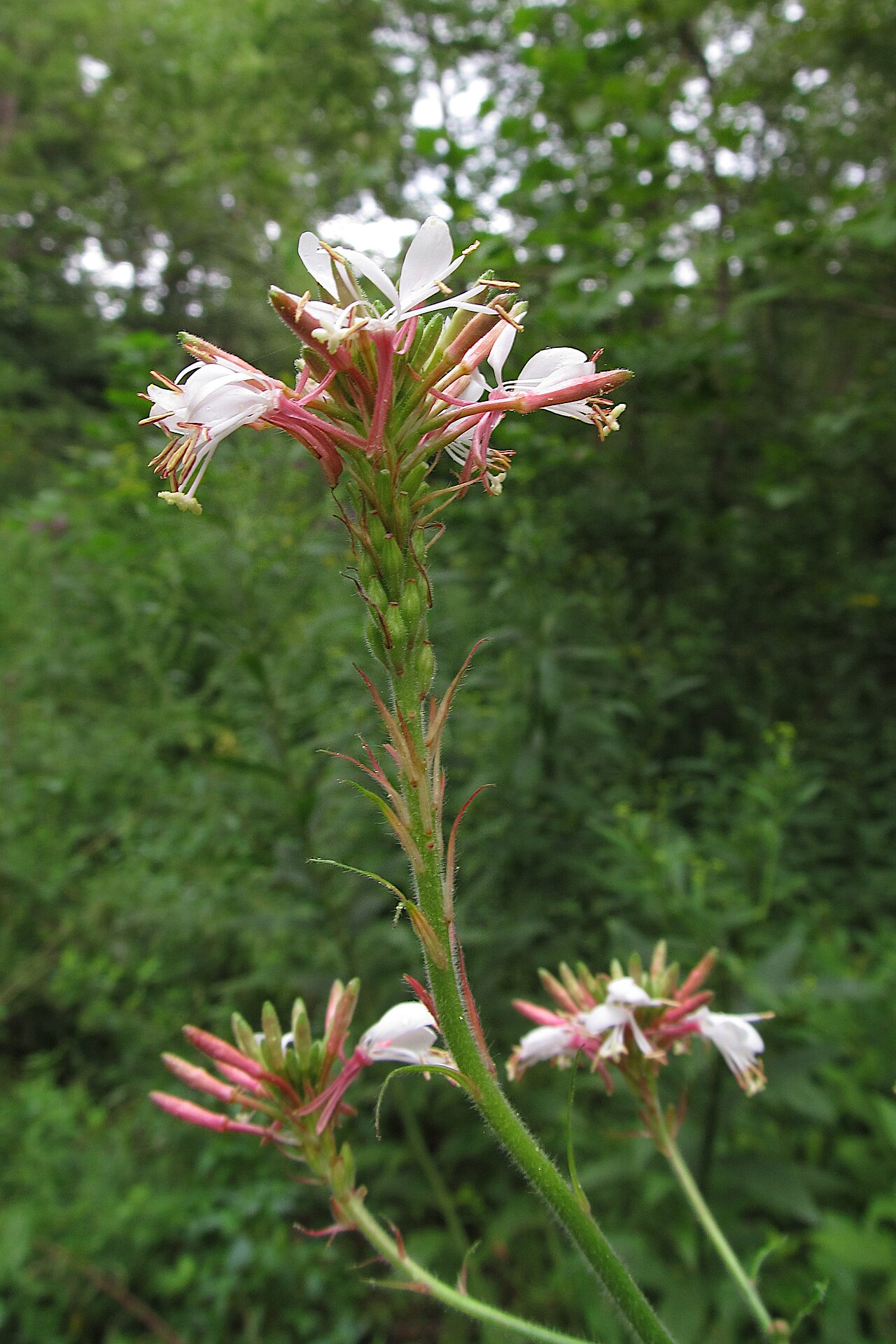
Oenothera gaura, known as Biennial Beeblossom or biennial gaura, is a tall, airy wildflower of old fields, prairies, roadsides and woodland edges in eastern North America. It belongs to the evening primrose family (Onagraceae). For more than two centuries it was known as Gaura biennis, a name still used in many field guides and seed catalogs; DNA studies led botanists to merge the gauras into Oenothera.
In its first year it forms a flat rosette of leaves. In the second summer it sends up a branching stem 2 to 6 feet tall (sometimes taller) that carries many slender spikes of small, butterfly-like flowers from midsummer into fall. Each flower opens white near evening, turns pink the next day and soon falls, so the plants show white and pink flowers together.
Biennial beeblossom is a good choice for informal meadows, prairie plantings and the back of a wildflower border. It is easy to grow, tolerates poor soil, and reseeds itself in open ground. Its flowers attract night-flying moths and early-morning bees.
Identification
Look for a tall, much-branched plant in late summer with long, wand-like spikes tipped by a few small white or pink flowers whose four petals all point upward.
Growth Habit
A biennial (occasionally a short-lived perennial) with a taproot. The first-year rosette lies flat on the ground and is often reddish in winter. The second-year stem is stout, softly hairy and widely branched in the upper part, usually 2 to 6 feet tall.
Leaves
The stem leaves are alternate, lance-shaped to elliptic, 1 to 5 inches long, softly hairy, with small, widely spaced teeth. They become smaller toward the top. The leaves of the rosette are larger and often have wavy, lobed edges.
Flowers
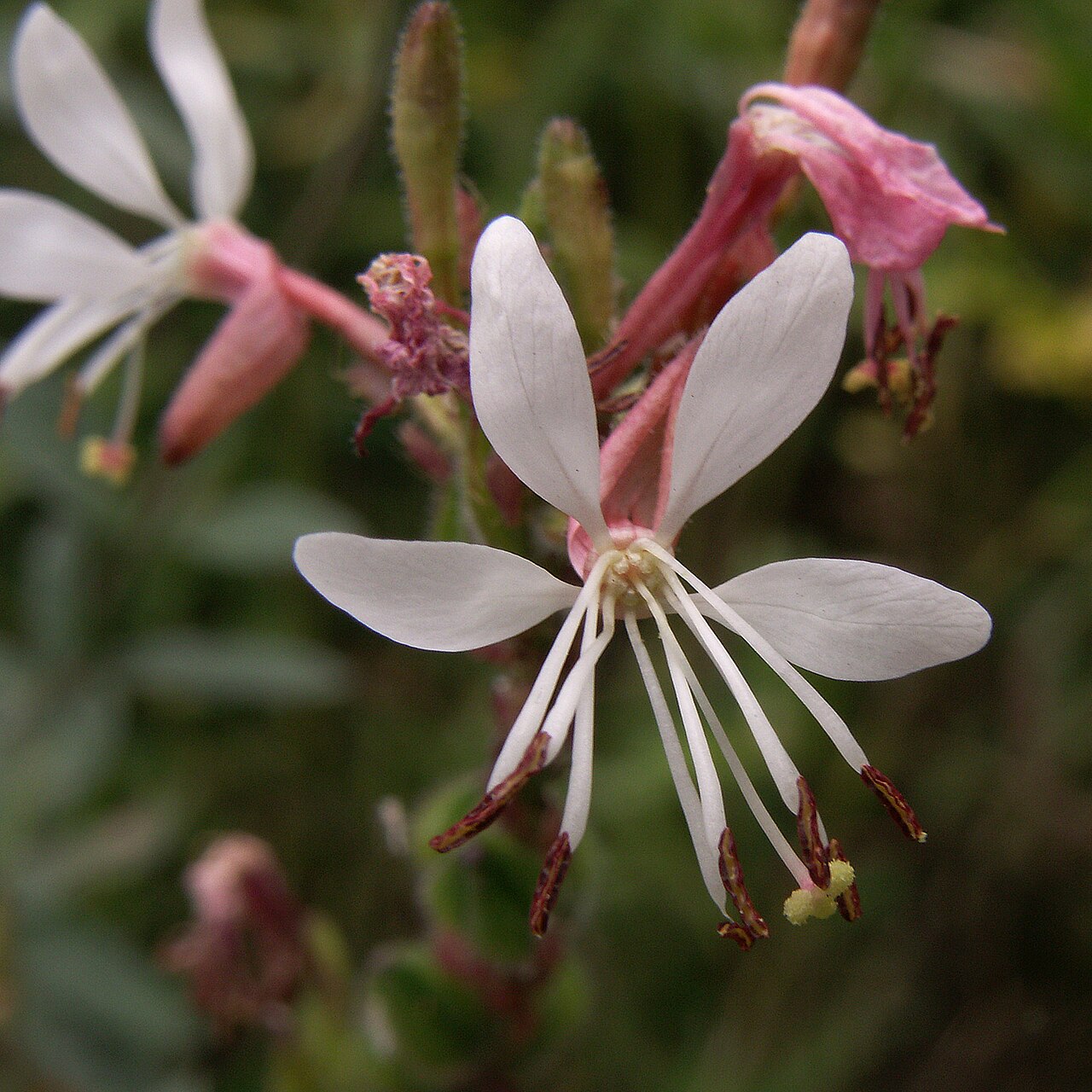
From July to October the branches end in slender spikes that open a few flowers each evening. The flowers are about 1/2 inch across, with four spoon-shaped petals that are white at first and turn pink to rose as they age, held upward on one side of the flower. Eight long stamens and a style with a four-lobed stigma hang below the petals. Each flower lasts only about a day.
Fruit
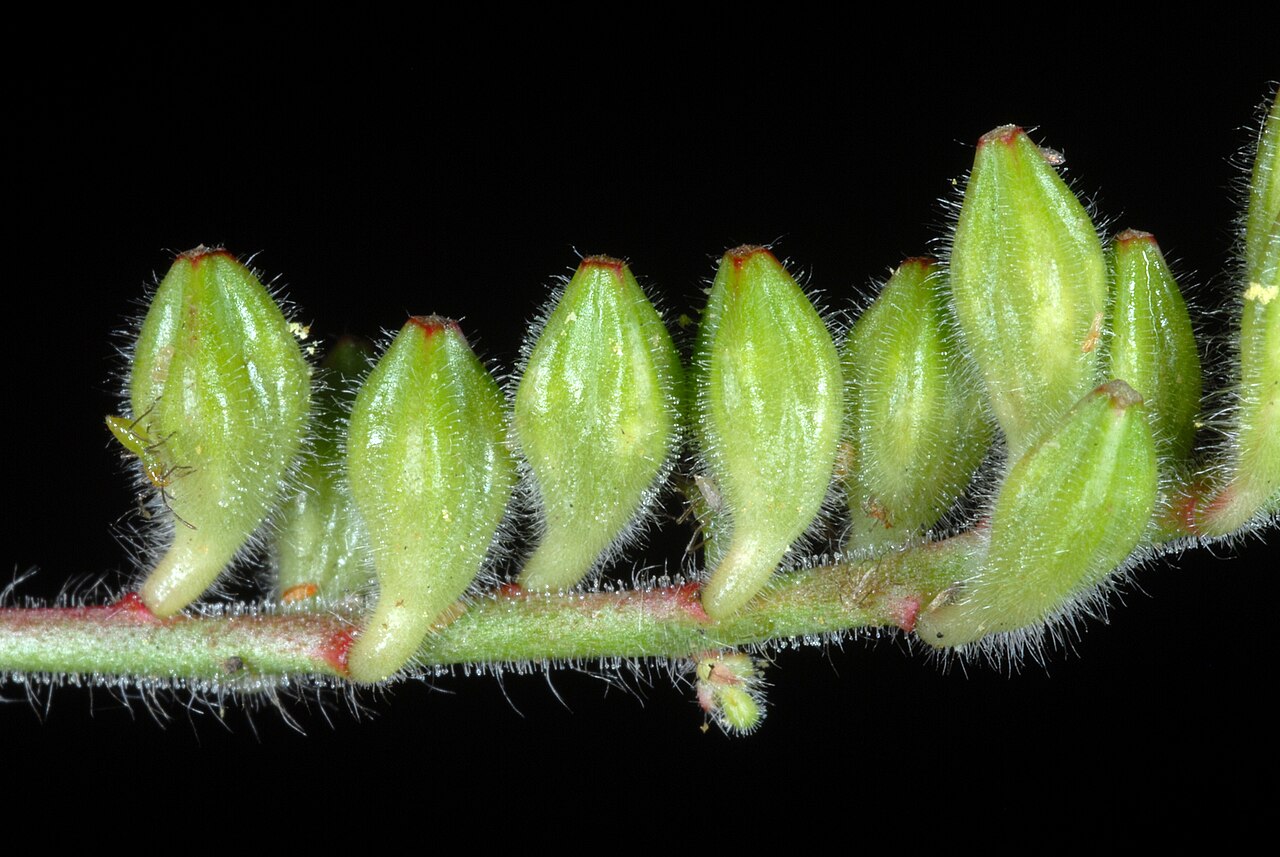
The fruit is a small, hard, nut-like capsule about 1/4 inch long, four-angled and hairy, that does not split open. It holds one to four seeds, and many fruits ripen along each spike from the bottom upward.
Look-alikes
Other beeblossoms are similar. Lindheimer’s beeblossom (Oenothera lindheimeri), the popular garden gaura from Texas and Louisiana, has larger flowers and is a perennial. Roadside gaura (O. suffulta) and scarlet beeblossom (O. suffrutescens) are plants of the Plains and Southwest. Southern beeblossom (O. simulans) of the Southeast is very similar but grows farther south.
Quick Facts
| Scientific Name | Oenothera gaura (syn. Gaura biennis) |
| Family | Onagraceae (evening primrose family) |
| Plant Type | Biennial wildflower |
| Mature Height | 2–6 ft |
| Mature Spread | 1–3 ft |
| Growth Rate | Fast |
| Sun Exposure | Full sun to part shade |
| Water Needs | Medium; tolerates dry to moist soil |
| Soil Type | Loam, clay or sandy soil; tolerates poor, disturbed ground |
| Soil pH | Slightly acidic to slightly alkaline (about 6.0–7.5) |
| Bloom Time | July–October |
| Flower Color | White, aging to pink |
| Fall Color | Rosette leaves often red in fall and winter |
| Fruit | Small, hard, four-angled nutlike capsule |
| Deer Resistant | Moderate |
| USDA Hardiness Zones | 4–8 |
Native Range
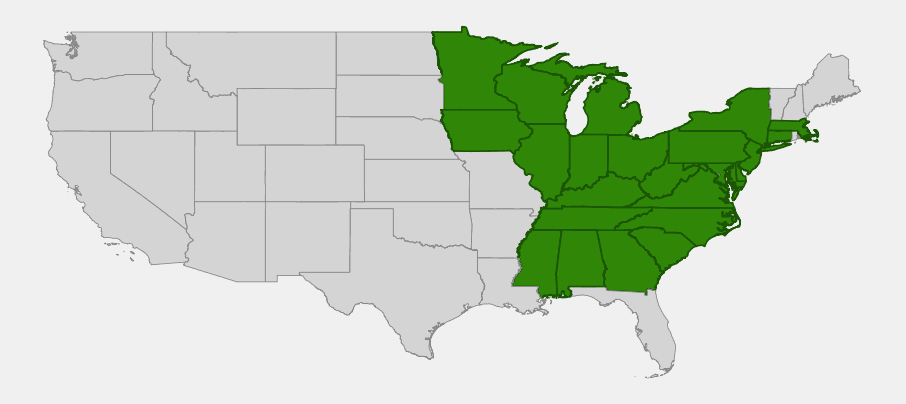
Biennial beeblossom is native to eastern North America. USDA PLANTS lists it as native in 23 states, from Massachusetts, New York and southern Michigan west to Wisconsin, Iowa and southeastern Minnesota, and south to Georgia, Alabama and Mississippi. In Canada it grows in southern Ontario and southwestern Quebec.
It is most common in the Ohio Valley, the mid-Atlantic and the Appalachian region, and becomes more scattered toward the edges of its range. In Minnesota it is rare and limited to the far southeast, and in New England it is found mainly in southern Massachusetts and Connecticut. In the Deep South it is replaced by the closely related southern beeblossom.
It grows in sunny or lightly shaded, open places: old fields and pastures, prairie remnants, the edges of woods and thickets, stream banks, railroad and road edges, and other disturbed ground. It often appears a year or two after soil disturbance and fades as taller perennials and shrubs take over.
📋 Regional plant lists featuring Biennial Beeblossom: New York, Pennsylvania & Northern New Jersey · Ohio & Indiana · Michigan, Wisconsin & Eastern Minnesota · Kentucky & Tennessee · Connecticut, Massachusetts & Rhode Island · New Hampshire, Maine & Vermont · Maryland, Virginia & West Virginia · Delaware, Southern New Jersey & Long Island · Illinois, Iowa & Missouri · Alabama, Georgia & Mississippi · North & South Carolina
Growing & Care Guide
Biennial beeblossom is an easy, adaptable wildflower for sunny, informal plantings. Because each plant flowers once and dies, it keeps itself going by reseeding, so give it some open ground.
Light
Full sun gives the most flowers and sturdiest stems. It tolerates part shade at woodland edges, where plants are taller and more open.
Soil & Water
Grows in average loam, clay or sandy soil, including poor and disturbed soil. It prefers moderate moisture but tolerates short droughts once its taproot is established. Rich soil can make it lanky and floppy.
Planting Tips
Sow seed in fall or late winter on bare soil, pressing it into the surface; the seed benefits from a cold period. First-year plants form only a rosette, so start seed two years in a row to get flowers every year. Space plants 1 to 2 feet apart, and place them at the back of a border or in a meadow where their height won’t hide shorter plants.
Pruning & Maintenance
No pruning is needed. Leave the dead stems standing through winter to drop seed for next year’s plants, then cut them down in spring. Pull unwanted seedlings while they are small. In a crowded garden, light soil disturbance in fall helps seedlings establish.
Propagation
Grows easily from seed. Collect the hard fruits in fall when they turn brown and sow them outdoors soon after. Plants do not divide because of their taproot and biennial habit.
Landscape Uses
- Meadows and prairie plantings: an airy, late-blooming filler among grasses and taller perennials
- Back of the border: height and fine texture in informal beds
- Moth and night gardens: white flowers that open near dusk
- Restoration of old fields: a quick native colonizer of disturbed ground
- Pollinator gardens: late-summer nectar for moths, bees and other insects
Wildlife & Ecological Value
Biennial beeblossom is a classic evening-flowering plant, timed to attract night-flying insects as well as early-rising bees.
For Pollinators
The flowers open near dusk and stay open into the next morning. They are visited by moths, including sphinx moths and smaller owlet moths, and by bees and syrphid flies early in the day. Caterpillars of some flower moths (Schinia) feed on beeblossoms and evening primroses.
For Birds
Goldfinches and other seed-eating birds pick at the dry fruits in fall and winter, and the tall, branched stems offer perches in open fields.
For Mammals
Deer and rabbits sometimes browse the young plants, but it is not a preferred food. Small mammals may eat fallen fruits.
Ecosystem Role
As a pioneer of disturbed ground, it helps cover bare soil quickly in old fields and along roadsides and is later replaced by longer-lived perennials, shrubs and trees. Its evening flowers support a nighttime pollinator community that many gardens lack.
Cultural & Historical Uses
The old genus name Gaura comes from the Greek gauros, “superb” or “proud,” a reference to the showy flowers of the group. The name “beeblossom” refers to the many bees that visit the flowers. In 2007 botanists Warren Wagner and Peter Hoch moved the gauras into Oenothera, and because the name Oenothera biennis was already taken by common evening primrose, this species became Oenothera gaura.
Linnaeus described the species as Gaura biennis in 1753. It was grown in European botanic gardens in the 18th century and was illustrated in Curtis’s Botanical Magazine in 1797.
Its habit of opening flowers late in the day and changing color as they age is shared with its relative, the familiar garden gaura (Oenothera lindheimeri), which was developed into many popular cultivars.
Frequently Asked Questions
Is biennial beeblossom the same as Gaura biennis?
Yes. Gaura biennis is the older name. Botanists now place all gauras in the evening primrose genus, Oenothera, and this species is called Oenothera gaura.
Does biennial beeblossom come back every year?
Each plant lives two years: it forms a rosette in the first year and flowers and dies in the second. It reseeds readily, so a patch usually persists if there is open ground for seedlings.
Why are the flowers white and pink?
Each flower opens white in the evening and turns pink as it ages over the next day, so a plant shows both colors at once.
How tall does biennial beeblossom get?
Usually 2 to 6 feet tall in its flowering year, sometimes taller in rich soil. It is best at the back of a border or in a meadow.
Is biennial beeblossom good for pollinators?
Yes. Its flowers feed moths in the evening and bees and flies in the morning, and its late-summer bloom helps fill a gap in many gardens.

Looking for a nursery that carries Biennial Beeblossom?
Browse our native plant nursery directory: Alabama · Connecticut, Delaware & Georgia · Illinois, Indiana & Iowa · Kentucky, Maryland, Massachusetts, Michigan, Minnesota & Mississippi · New Jersey, New York, North Carolina & Ohio · Pennsylvania, South Carolina, Tennessee & Virginia · West Virginia & Wisconsin

