
Roadside Gaura (Oenothera suffulta)
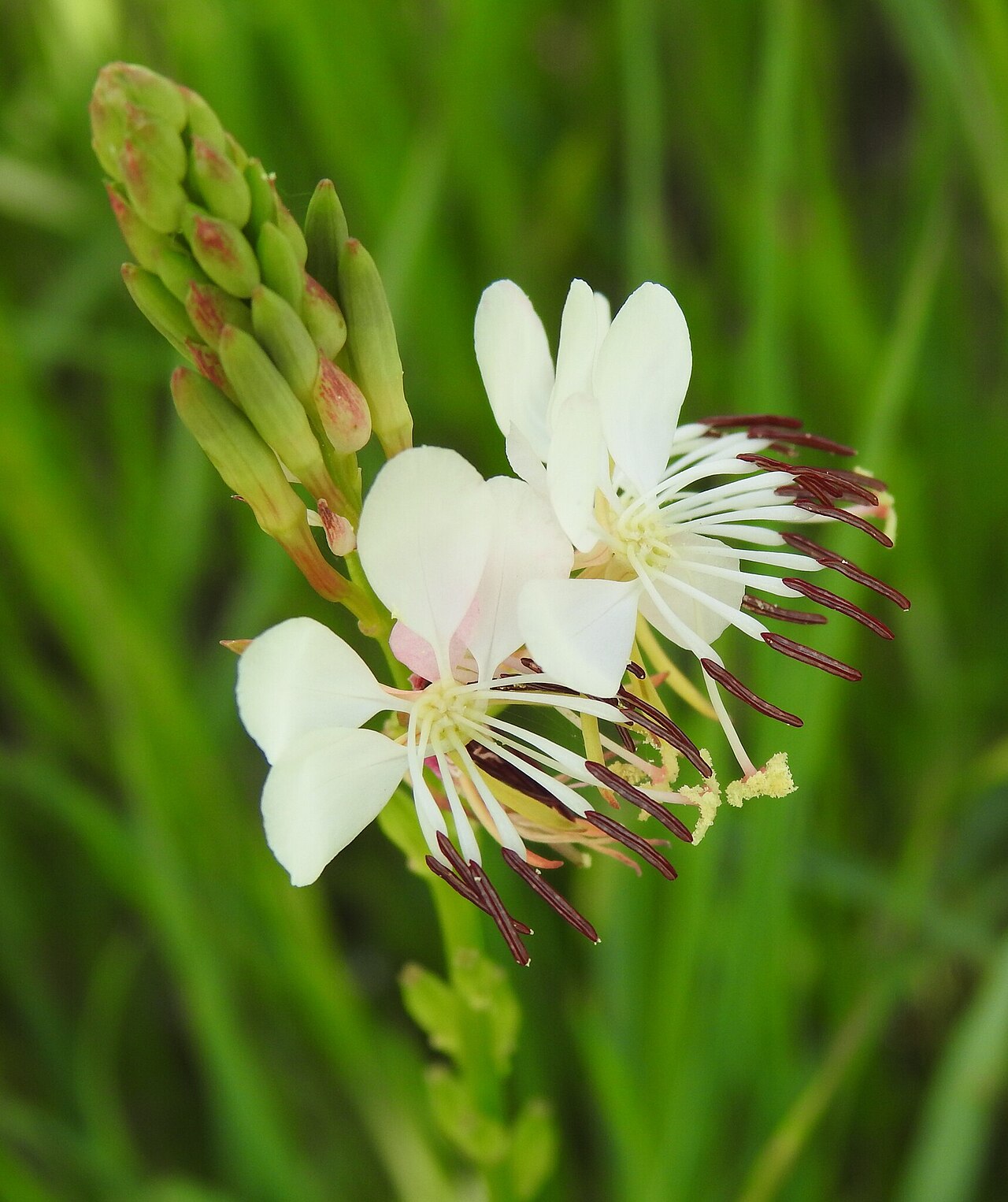
Oenothera suffulta, known as Roadside Gaura, and also called honeysuckle gaura or “kisses” (the USDA common name), is a slender annual wildflower of the evening primrose family (Onagraceae). For more than 150 years it was known as Gaura suffulta, and most Texas field guides and seed lists still use that name. In 2007, botanists moved the gauras into the large genus Oenothera, where they now form the section Gaura.
It is a plant of Texas and southern Oklahoma, where it grows in open, sandy and gravelly ground: roadsides, pastures, prairies, old fields and the edges of oak woodlands. From a low rosette of soft, hairy leaves it sends up branching stems 1 to 3 feet tall (occasionally to 4 feet), each ending in a dense, tapering spike of buds. In spring, a few flowers open on each spike every evening around sunset. They are white with four petals swept to one side and long, drooping red-tipped stamens, and they turn pink to rose as they age, so a single spike carries white, pink and red flowers at once.
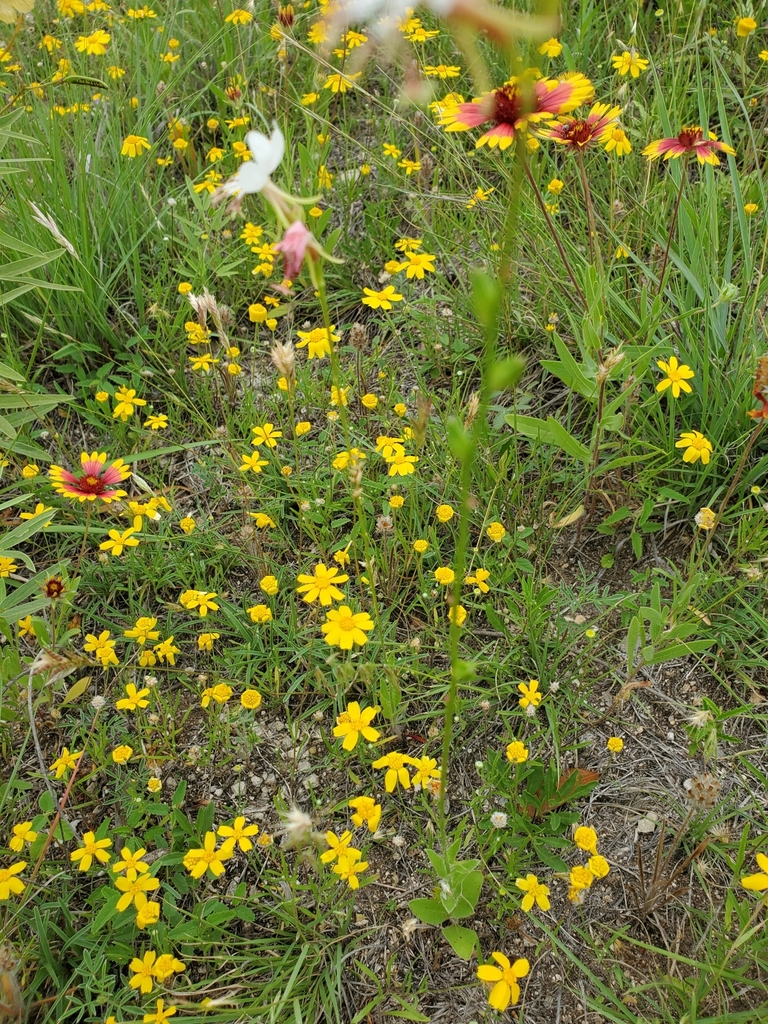
Roadside gaura is one of the many spring annuals that paint Texas roadsides from April to June, alongside bluebonnets, Indian blanket and coreopsis. It is easy to grow from seed in sunny, well-drained gardens and meadows within its range, and its evening flowers are visited by moths and night- and dawn-flying bees.
Identification
Roadside gaura looks like a delicate, airy version of the garden gaura. Look for spikes of small white-to-pink flowers with all four petals on the upper side, tall wiry stems, and soft, velvety leaves.
Growth Form
An annual herb, sometimes behaving as a winter annual: seeds germinate in fall or winter and form a flat basal rosette that bolts in spring. Stems are erect, usually 1 to 3 feet tall and branched from the base or above, ending in long flower spikes. Plants die after setting seed in early summer.
Leaves
Basal leaves form a rosette and are up to about 4 inches long and 1 inch wide, oblong to lance-shaped. Stem leaves are alternate, 1/2 to 3 1/2 inches long, becoming smaller up the stem, with smooth, wavy or toothed edges. The undersides are softly velvety-hairy, giving the foliage a grayish-green look.
Flowers
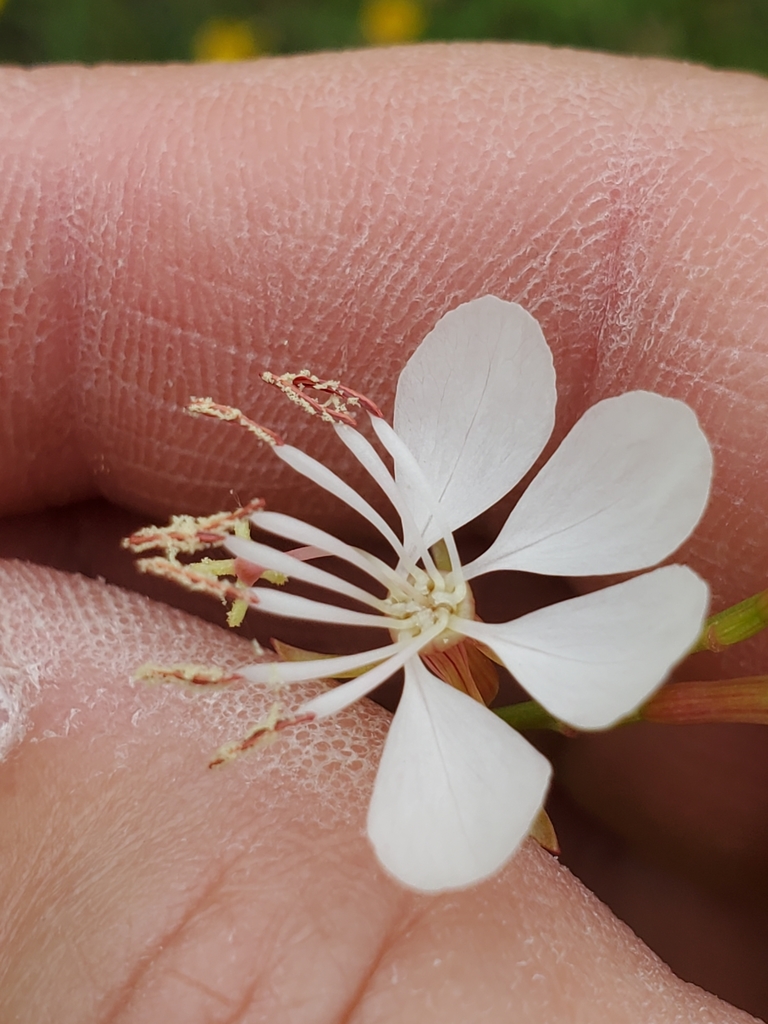
Flowers are crowded in dense spikes that open from the bottom up from about April to June. Each flower has four spoon-shaped petals about 1/2 inch long, all held on the upper side of the flower, and eight long stamens with reddish-brown anthers that droop below with the style and four-lobed stigma. Several flowers open on each spike around sunset; they are white at first and turn pink to red the next day before falling. The flowers have little or no scent.
Fruit
The fruit is a small, hard, woody capsule that does not split open. It is four-angled with broad wings on the angles and holds a few seeds; the whole fruit falls and is dispersed as a unit.
Look-alikes
Its closest relatives are other gauras now placed in Oenothera. Lindheimer’s Beeblossom (O. lindheimeri), the parent of the garden “gaura,” is a long-lived perennial with a woody base and larger flowers. Scarlet Beeblossom (O. suffrutescens) is a low, spreading perennial with narrow leaves and smaller flowers that age quickly to red. Woolly beeblossom (O. curtiflora, the old Gaura parviflora) is a tall, weedy annual with tiny flowers less than 1/4 inch across.
Safety
Roadside gaura is not known to be toxic to people, pets or livestock. It is a harmless wildflower of pastures and roadsides.
Quick Facts
| Scientific Name | Oenothera suffulta (formerly Gaura suffulta) |
| Family | Onagraceae (evening primrose family) |
| Plant Type | Annual or winter annual wildflower |
| Mature Height | 1–3 ft (occasionally to 4 ft) |
| Mature Spread | 6–18 in |
| Growth Rate | Fast |
| Sun Exposure | Full sun |
| Water Needs | Low to moderate; moist in spring, dry in summer |
| Soil Type | Sandy, gravelly or loamy, well-drained soils |
| Soil pH | About 6.0–8.0 |
| Bloom Time | April–June |
| Flower Color | White, aging to pink or red |
| Fall Color | None; dies after seeding in early summer |
| Fruit | Small, hard, winged, four-angled capsule that does not split |
| Deer Resistant | Moderately; occasionally browsed |
| USDA Hardiness Zones | Annual; grows wild in about zones 7–9 |
Native Range
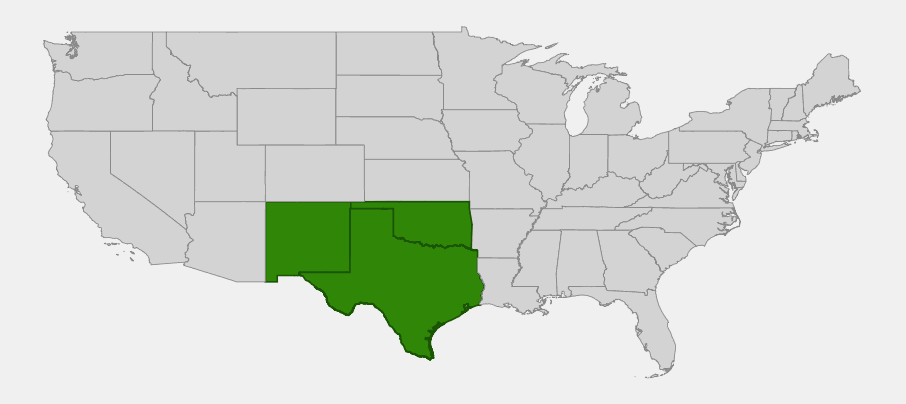
Roadside gaura is native to the south-central United States. It grows across most of Texas outside the Trans-Pecos, including the Edwards Plateau and Hill Country, the Cross Timbers, the Blackland Prairie, the Post Oak Savannah and South Texas, and north into southern Oklahoma. USDA PLANTS lists it as native in Texas, Oklahoma and New Mexico.
The New Mexico records are few and scattered: herbarium collections from southeastern and central counties such as Eddy, Lincoln and Torrance. They are best regarded as outlying records at the western edge of the range, and the plant is far more common in central and north-central Texas than anywhere else.
It favors open, sunny ground with sandy or gravelly soil: roadsides, pastures, old fields, prairie openings, sandy oak woodlands and disturbed sites. Like many Texas spring annuals, it is most abundant after wet winters, when roadsides can be lined with its airy white and pink spikes.
📋 Regional plant lists featuring Roadside Gaura: Arkansas, Louisiana, Eastern Oklahoma & Eastern Texas · South & West Texas
Growing & Care Guide
Roadside gaura is an easy annual for sunny wildflower plantings in Texas and Oklahoma. It is grown from seed rather than transplants and is sometimes included in Texas wildflower seed mixes or sold by native seed companies under the name Gaura suffulta.
Light
Plant it in full sun. In shade the stems flop and flowering is sparse.
Soil & Water
It prefers sandy, gravelly or loamy soils that drain well, from slightly acidic to alkaline, and does well in poor soils where taller grasses are sparse. It needs moisture from fall to spring to grow its rosette and flower, and then tolerates heat and drought as it sets seed. Avoid fertilizer and summer irrigation, which favor weeds and lush, floppy growth.
Planting Tips
Sow seed in fall (September to November) on bare, lightly raked soil and press it in; it needs winter rains to germinate and form rosettes. Mix it with other Texas spring annuals such as bluebonnet, Indian blanket and lanceleaf coreopsis for a natural roadside look. Because individual plants are wiry and see-through, plant it in drifts.
Pruning & Maintenance
Little care is needed. Let plants ripen and drop their seed before mowing in early summer; mowing too early prevents reseeding. Light disturbance of the soil in fall helps new seedlings establish.
Propagation
Grow it from seed. The hard, nutlike fruits can be collected when they turn brown in early summer and sown whole in fall. Where it is happy, it reseeds itself from year to year.
Landscape Uses
- Wildflower meadows: an airy white-and-pink accent among spring annuals
- Roadside and pasture plantings: a native annual for sandy, disturbed ground
- Pollinator gardens: evening flowers for moths and native bees
- Low-water gardens: grows on winter rain and needs no summer water
- Naturalized areas: reseeds where soil is open and sunny
Wildlife & Ecological Value
Roadside gaura has the night-and-dawn flower schedule typical of its family, which ties it to a different set of pollinators than most spring wildflowers.
For Pollinators
Its flowers open around sunset and are visited at dusk by moths, including hawkmoths and smaller night-flying moths, and in the early morning by native bees, which collect its pollen before the flowers fade. Gauras as a group are known for specialist bees that gather pollen mostly from evening primrose relatives. Gauras are also larval hosts for several moths, including flower moths in the genus Schinia.
For Birds
The hard fruits are eaten by seed-eating birds such as sparrows and doves where they fall, and the insects on the plants feed ground-foraging birds.
For Mammals
Deer and livestock may browse it, but it is not a major forage plant. Small mammals eat fallen seed.
Ecosystem Role
As a fast-growing annual, it quickly colonizes bare, sandy ground after disturbance and is part of the colorful spring flora of Texas roadsides, pastures and prairies. Its evening flowers add nectar and pollen at a time of day when few other flowers are open.
Cultural & Historical Uses
The species was first described in 1850 as Gaura suffulta, a name credited to the botanist George Engelmann and published by Asa Gray from Texas collections. The name suffulta is Latin for “propped up” or “supported.” In 2007, Warren Wagner, Peter Hoch and colleagues moved all the gauras into Oenothera based on DNA evidence, and in 2013 they placed this species closest to O. patriciae and O. triangulata.
The old common name “kisses,” which USDA still uses, is one of several fanciful folk names Texans have given to gauras. Another, “honeysuckle gaura,” refers to the long stamens that stick out like those of a honeysuckle flower.
Gardeners know the genus from the popular perennial “gaura” or “whirling butterflies,” selected from Lindheimer’s beeblossom. Roadside gaura is its short-lived wild cousin, a spring annual that disappears by summer but returns each year from seed in the sandy soils of Texas.
Frequently Asked Questions
Is it Gaura suffulta or Oenothera suffulta?
Both names refer to the same plant. It was named Gaura suffulta in 1850 and moved to Oenothera in 2007, when botanists showed that the gauras belong within the evening primrose genus. Many Texas guides and seed sellers still use Gaura suffulta.
Is roadside gaura a perennial?
No. It is an annual or winter annual. Seeds sprout in fall or winter, plants bloom from April to June, set seed and die. It returns each year from seed.
Why do the flowers change color?
The flowers open white around sunset and turn pink to red the next day as they age. A spike usually shows white, pink and red flowers together.
Can I grow it outside Texas?
It is native only to Texas, southern Oklahoma and a few places in New Mexico. Gardeners elsewhere should look for beeblossoms native to their own region, such as scarlet beeblossom in the Plains and West.
When should I sow the seed?
Sow in fall on bare, sunny, well-drained soil. The seeds need the cool, wet months of winter to sprout and form rosettes before blooming in spring.

Looking for a nursery that carries Roadside Gaura?
Browse our native plant nursery directory: New Mexico & Oklahoma · Texas