
Tall Western Groundsel (Senecio integerrimus)
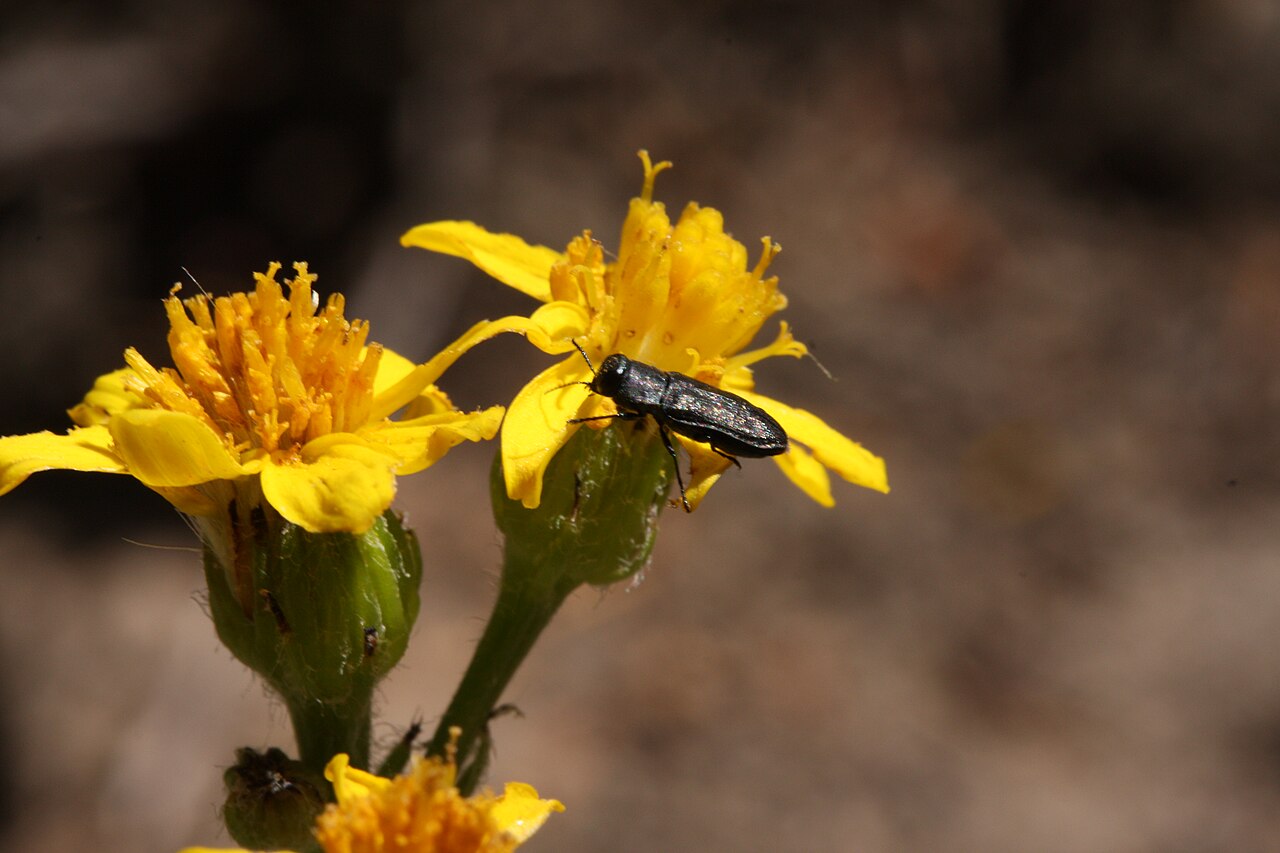
Senecio integerrimus, known as Tall Western Groundsel (USDA: lambstongue ragwort), is a spring-blooming wildflower of the aster family (Asteraceae) that grows across the American West and into the northern Great Plains. It is one of the most common native groundsels in sagebrush country, open pine forests and mountain meadows. Each plant sends up a single sturdy stem, usually 8 to 28 inches tall, topped by a flat cluster of bright yellow daisy-like flower heads.
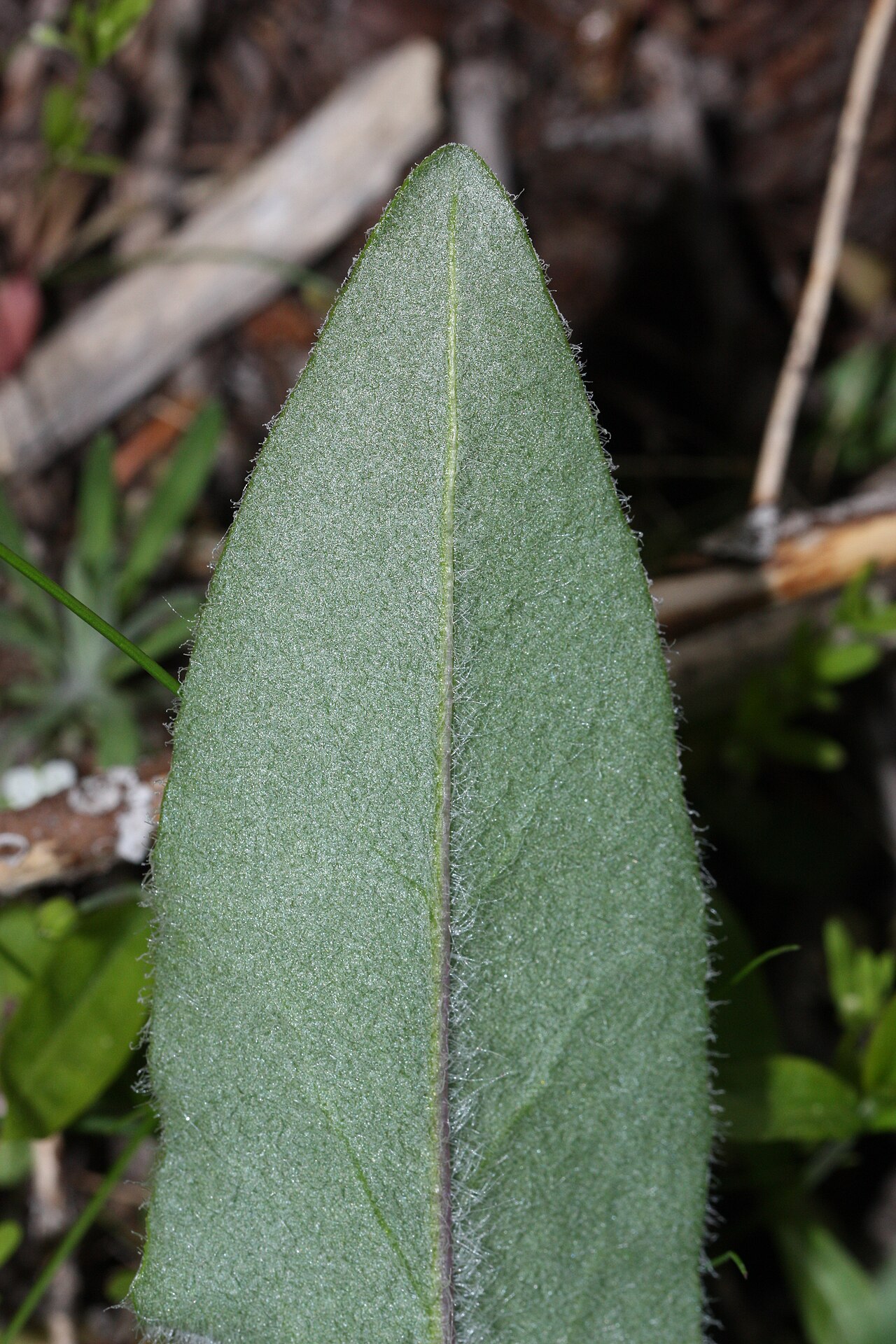
Its other common name, lambstongue, describes the leaves. Most of them sit in a basal rosette, and the broad, untoothed blades are covered when young with soft, cobwebby white hairs that wear off as the season goes on. The species name integerrimus means “completely entire,” a reference to these smooth-edged leaves, which set it apart from many toothed or lobed groundsels.
Tall western groundsel is a short-lived perennial (sometimes behaving as a biennial) that blooms from about April at low elevations to July or August in the high mountains. It feeds early bees, butterflies, flies and beetles when little else is in flower. Like many Senecio species, it contains pyrrolizidine alkaloids and should be treated as toxic to livestock, pets and people. It is not a plant to eat or use as a remedy.
Identification
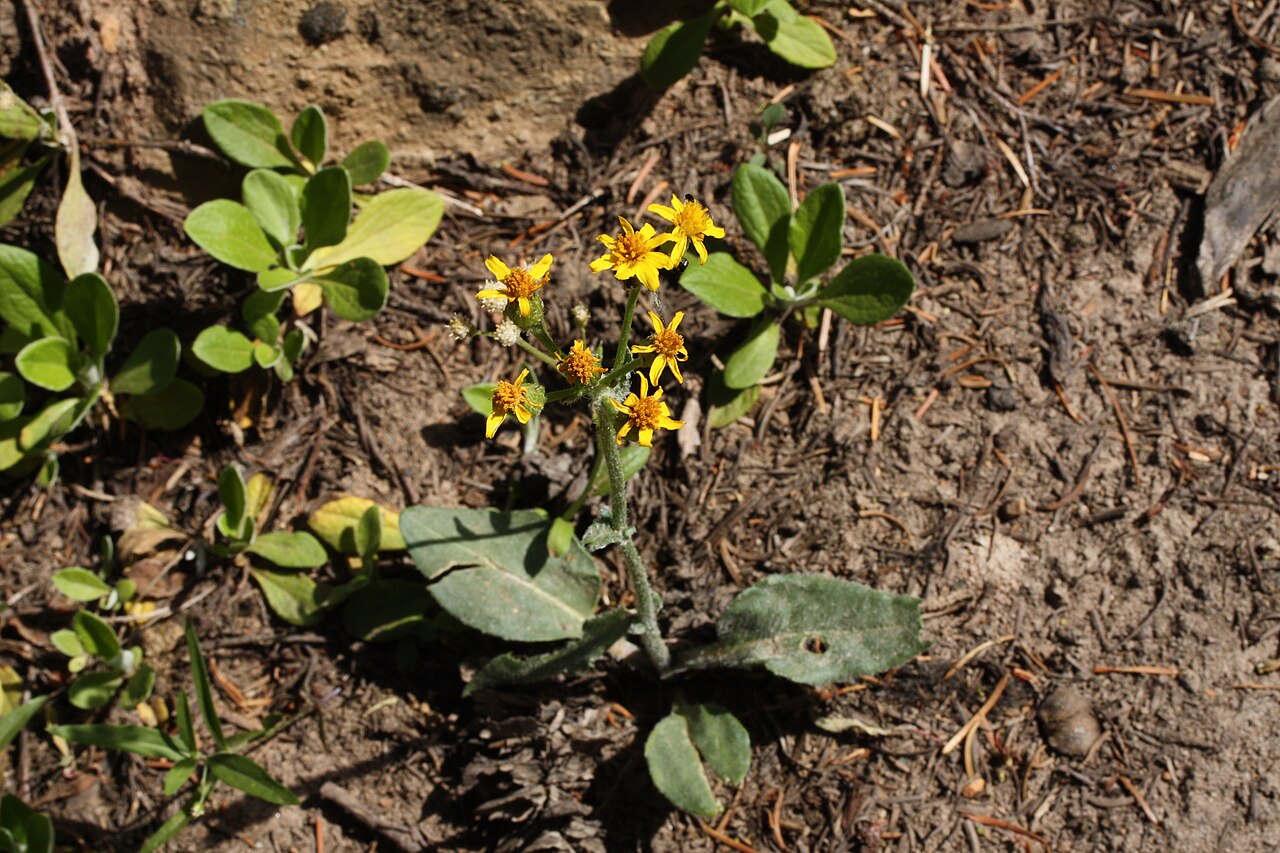
Tall western groundsel is easiest to recognize by its combination of a single upright stem, large untoothed basal leaves with white woolly hairs, and a crowded, flat-topped cluster of yellow (sometimes cream) flower heads in spring.
Growth Habit
The plant grows from a short crown with thick, fleshy, fibrous roots. In spring it produces a basal rosette and then usually one stout, unbranched stem 8 to 28 inches (20 to 70 cm) tall. The leaves get smaller up the stem, so most of the leafy bulk is near the ground. After seed is set, the stem dries and the plant dies back to the crown until the next spring.
Leaves
The basal leaves are elliptic to lance-shaped, 2 1/2 to 10 inches long including the stalk, and up to about 2 1/2 inches wide, with smooth or barely wavy edges. Young leaves and stems are covered in loose, tangled white hairs, which give them a gray-green, felted look. The hairs gradually fall away, often remaining only in the leaf axils by early summer. The upper stem leaves are small, narrow and stalkless.
Flowers
The flower heads are crowded at the top of the stem in a dense, rounded to flat-topped cluster. The central, terminal head is often the largest and sits on the shortest stalk. Each head has a cup of green bracts, often black-tipped, around a yellow center of disk flowers and usually 8 or 13 ray flowers about 1/4 to 1/2 inch long. Rays are normally bright yellow, but in some varieties they are cream or pale yellow, and some heads have no rays at all.
Fruit & Seeds
Each flower produces a small, ribbed seed (a cypsela, often called an achene) topped by a tuft of soft white bristles. By early summer the heads turn into small white puffs, and the seeds blow away on the wind like tiny dandelion seeds.
Varieties
Botanists recognize several varieties that differ in hairiness, ray color and size. Var. integerrimus is the Great Plains and Rocky Mountain form. Var. exaltatus is widespread in the Pacific Northwest and Intermountain West. Var. major grows mostly in California. Var. ochroleucus has cream to whitish rays. Var. scribneri is a smaller form of the northern Rockies.
Look-alikes
Many yellow groundsels grow in the West. Butterweed groundsel (Senecio serra) and arrowleaf ragwort (S. triangularis) have toothed leaves along a leafy stem. Western ragworts in the genus Packera, such as Golden Ragwort, usually have lobed or toothed basal leaves and spread by rhizomes. The thick, untoothed, white-woolly basal leaves and single stem are the best clues for tall western groundsel.
Safety
Tall western groundsel, like many plants in the genus Senecio, contains pyrrolizidine alkaloids, compounds that can cause cumulative and permanent liver damage. Livestock usually avoid it when other forage is available, but poisoning is possible in overgrazed pastures or in contaminated hay. Keep it out of hay fields and do not let horses, cattle or pets eat it. Do not eat any part of the plant or use it in herbal remedies or teas.
Quick Facts
| Scientific Name | Senecio integerrimus |
| Family | Asteraceae (aster family) |
| Plant Type | Short-lived herbaceous perennial or biennial wildflower |
| Mature Height | 8–28 in (20–70 cm) |
| Mature Spread | 6–12 in |
| Growth Rate | Moderate |
| Sun Exposure | Full sun to partial shade |
| Water Needs | Low to moderate; moist in spring, dry in summer |
| Soil Type | Well-drained loam, gravel, rocky or sandy soil |
| Soil pH | About 6.0–8.0 |
| Bloom Time | April–July (to August at high elevations) |
| Flower Color | Bright yellow, sometimes cream |
| Fall Color | None; dies back after seed set |
| Fruit | Small seeds with white fluffy bristles |
| Deer Resistant | Largely; the alkaloids discourage browsing |
| USDA Hardiness Zones | 3–8 |
Native Range
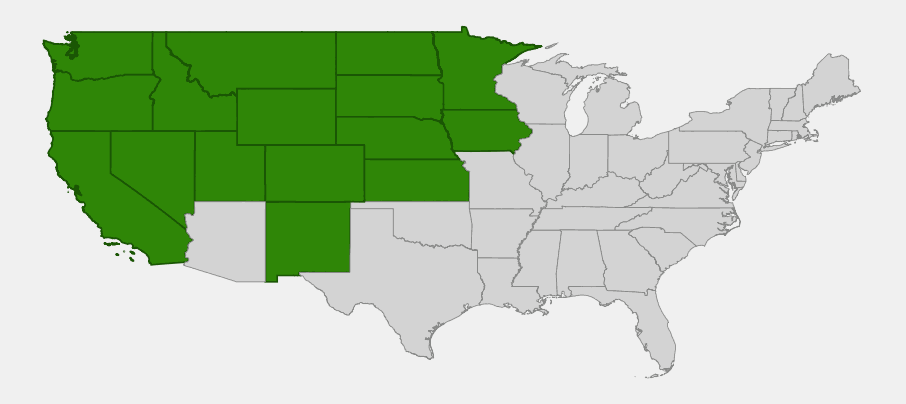
Tall western groundsel is native to western and central North America. USDA PLANTS lists it as native in the lower 48 states and Canada, and records it from 16 states: California, Colorado, Idaho, Iowa, Kansas, Minnesota, Montana, Nebraska, Nevada, New Mexico, North Dakota, Oregon, South Dakota, Utah, Washington and Wyoming. In Canada it grows in British Columbia, Alberta, Saskatchewan and Manitoba.
It is most common in the Intermountain West, the Rocky Mountains and the Sierra Nevada and Cascades. In Washington and Oregon it grows chiefly east of the Cascade crest. On the Great Plains it reaches eastward through the Dakotas, Nebraska and western Kansas, reaching its eastern limit in prairies of Minnesota and Iowa.
Habitats include sagebrush steppe, bunchgrass grasslands, mountain meadows, open ponderosa pine and lodgepole pine forests, aspen groves, rocky slopes and dry prairies, from foothills to the subalpine zone. It often comes up strongly after fire, when sunlight reaches the ground.
📋 Regional plant lists featuring Tall Western Groundsel: Idaho, Eastern Oregon & Eastern Washington · Montana & Wyoming · Michigan, Wisconsin & Eastern Minnesota · Nebraska, Kansas & Eastern Colorado · Utah & Western Colorado · Illinois, Iowa & Missouri · North Dakota, South Dakota & Western Minnesota · California & Nevada
Growing & Care Guide
Tall western groundsel is not common in the nursery trade, but it is offered by some native seed companies in the West and is easy to grow from seed in a dry, sunny native garden. It suits naturalistic plantings, not formal beds, and it is best kept away from pastures and hay fields because of its toxicity to livestock.
Light
Full sun is best. It also grows in the light shade of open pine or aspen woodland, but it flowers less in deeper shade.
Soil & Water
Give it well-drained soil: loam, gravel, sandy or rocky soil all work. It does well with moisture from snowmelt or spring rain followed by a dry summer, the typical pattern in its native range. Once established it needs no summer watering in the West. Avoid heavy, wet clay and rich, fertilized soil, which can lead to rot and floppy growth.
Planting Tips
Sow seed outdoors in fall so that it gets a natural winter chill, or plant small container plants in spring. Scatter it in a dry meadow, sagebrush garden or prairie planting with native bunchgrasses, balsamroots, buckwheats and lupines. Its basal rosettes stay small, so it fits between grasses without crowding them.
Pruning & Maintenance
Little care is needed. Cut back the dry stems in summer if you want a tidier look, or leave some to release seed. Because individual plants are short-lived, let it self-sow to keep it in the garden. Pull seedlings where they are not wanted, wearing gloves, and do not put plants in hay or feed for animals.
Propagation
Grow it from seed. Fall sowing outdoors is simplest; for indoor sowing, give seed a cold, moist stratification of several weeks in the refrigerator first. Seedlings usually form only a rosette in their first year and flower in the second. Division of the crown is possible but rarely needed.
Landscape Uses
- Sagebrush and dryland gardens: early yellow color among bunchgrasses and shrubs
- Meadow and prairie plantings: a self-sowing spring wildflower for informal plantings
- Pollinator gardens: early nectar and pollen for native bees, butterflies and flies
- Habitat restoration: reseeding burned or disturbed sagebrush and pine-forest sites
- Open woodland edges: light shade under ponderosa pine and aspen
Wildlife & Ecological Value
Tall western groundsel is one of the earliest and most widespread yellow wildflowers of the interior West, and its open flower heads attract a wide range of insects.
For Pollinators
The flat clusters of flower heads are visited by bumblebees, other native bees, butterflies, flies and beetles, which collect nectar and pollen. Because it blooms in spring, it is an important food source when many summer wildflowers have not yet opened.
For Birds
Finches and other small seed-eating birds may eat the seeds. Insects on the flowers provide food for insect-eating birds that nest in sagebrush and open forest.
For Mammals
Deer, elk and livestock usually avoid it because of its bitter alkaloids. This leaves the plants standing to flower and seed even in grazed areas.
Ecosystem Role
Tall western groundsel is an early colonizer of bare and burned ground, helping to cover soil after fire. Its seeds, carried on the wind, let it find new open patches quickly.
Cultural & Historical Uses
Thomas Nuttall described Senecio integerrimus in 1818 from the plains of the Missouri River, which he explored in 1811. The name Senecio comes from the Latin senex, “old man,” a reference to the white, hair-like bristles on the seeds. “Groundsel” is an old English name for these plants.
Because many groundsels and ragworts contain pyrrolizidine alkaloids, range managers have long watched them as possible livestock poisons. Tall western groundsel is generally avoided by grazing animals and is a minor concern compared with weedy species such as tansy ragwort, but it shows why Senecio plants should never be used as food, tea or medicine.
For hikers, tall western groundsel is one of the first yellow flowers of spring in sagebrush and pine country, often blooming alongside balsamroots, lupines and phlox. Its spread after fire makes it a common sight in recovering burns across the West.
Frequently Asked Questions
Is tall western groundsel poisonous?
Yes, it should be treated as toxic. Like many Senecio species, it contains pyrrolizidine alkaloids that can damage the liver of livestock, pets and people. Do not eat it, and keep it out of hay and pastures.
Why is it called lambstongue?
The broad, untoothed basal leaves are covered in soft white hairs when young, giving them a fuzzy, tongue-like look.
Is it a perennial?
It is a short-lived perennial that sometimes behaves as a biennial. Individual plants may live only a few years, but they self-sow in suitable sites.
When does it bloom?
Usually April to July, depending on elevation. It blooms in early spring at low elevations and as late as August in high mountain meadows.
How is it different from other yellow groundsels?
Look for a single stout stem, large untoothed basal leaves with white woolly hairs, and a crowded, flat-topped cluster of flower heads. Most other western groundsels have toothed or lobed leaves or leafy, branched stems.

Looking for a nursery that carries Tall Western Groundsel?
Browse our native plant nursery directory: California · Colorado · Idaho, Iowa & Kansas · Minnesota & Montana · Nebraska, Nevada, New Mexico & North Dakota · Oregon · South Dakota & Utah · Washington · Wyoming