
Ten-Angled Pipewort (Eriocaulon decangulare)
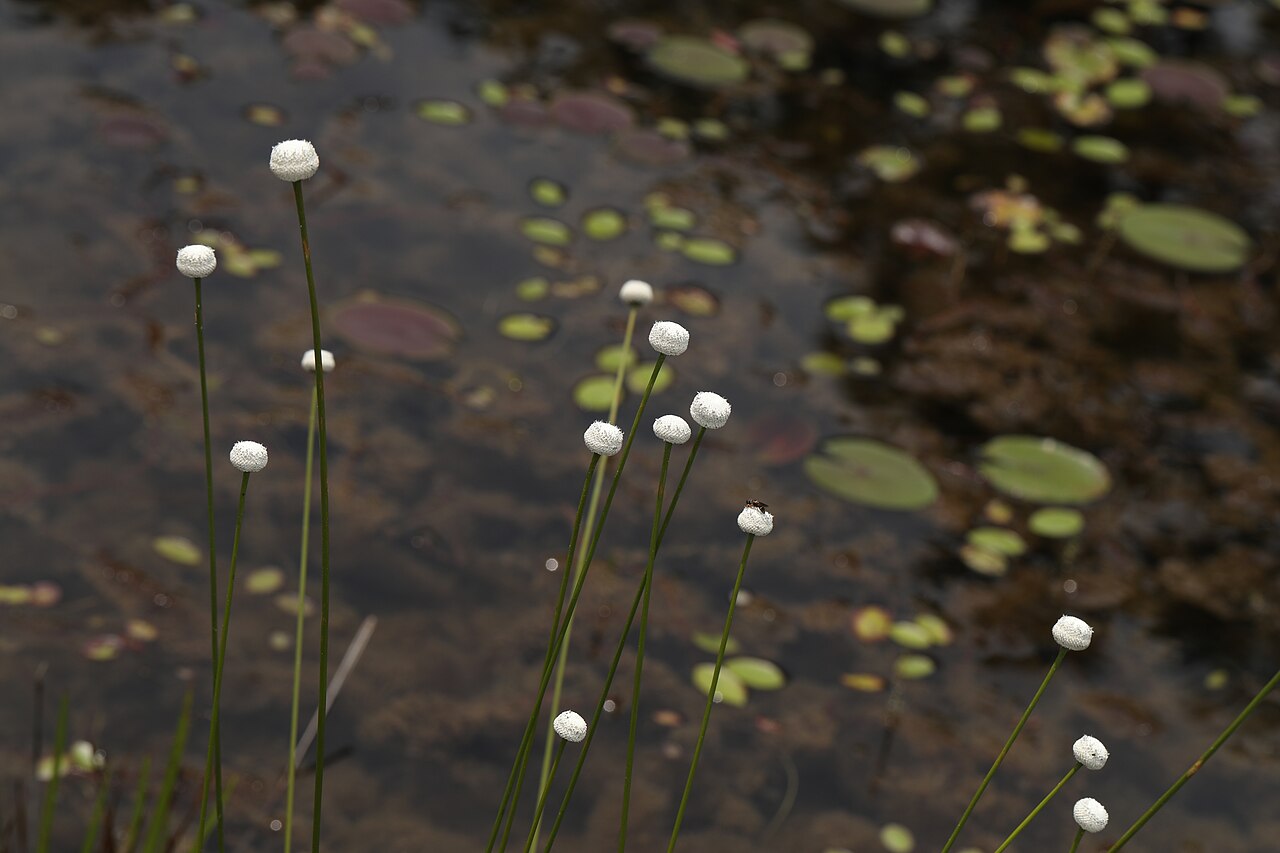
Eriocaulon decangulare, known as Ten-Angled Pipewort, hat pin or bog button, is a perennial wetland plant of the southeastern Coastal Plain. It belongs to the pipewort family (Eriocaulaceae), a group of grass-like plants with rosettes of narrow leaves and small, dense, button-like flower heads on long, leafless stalks. It is the largest pipewort in North America: its hard, white heads can stand 1 to 3 feet tall, and its flower stalks have about ten narrow ribs, which give it its common and scientific names.
Ten-angled pipewort grows in wet, acidic, sunny places: seepage bogs, pitcher plant bogs, wet pine savannas and flatwoods, pond and lake margins, ditches and the edges of cypress domes. Its range runs from New Jersey south to Florida and west to East Texas, southeastern Oklahoma and Arkansas, with a few scattered inland populations. It also grows in Mexico and Central America.
For gardeners it is a striking plant for bog gardens and wet, sunny pond margins, where its white “pins” mix with pitcher plants, sundews and orchids. Use only nursery-propagated plants or seed; never dig plants from wild bogs, many of which are rare and protected habitats.
Identification
Look for a rosette of narrow, spongy leaves in a wet, sunny bog or savanna, with tall, ribbed, leafless stalks topped by hard, round, white flower heads about the size of a large pea or marble.
Growth Habit
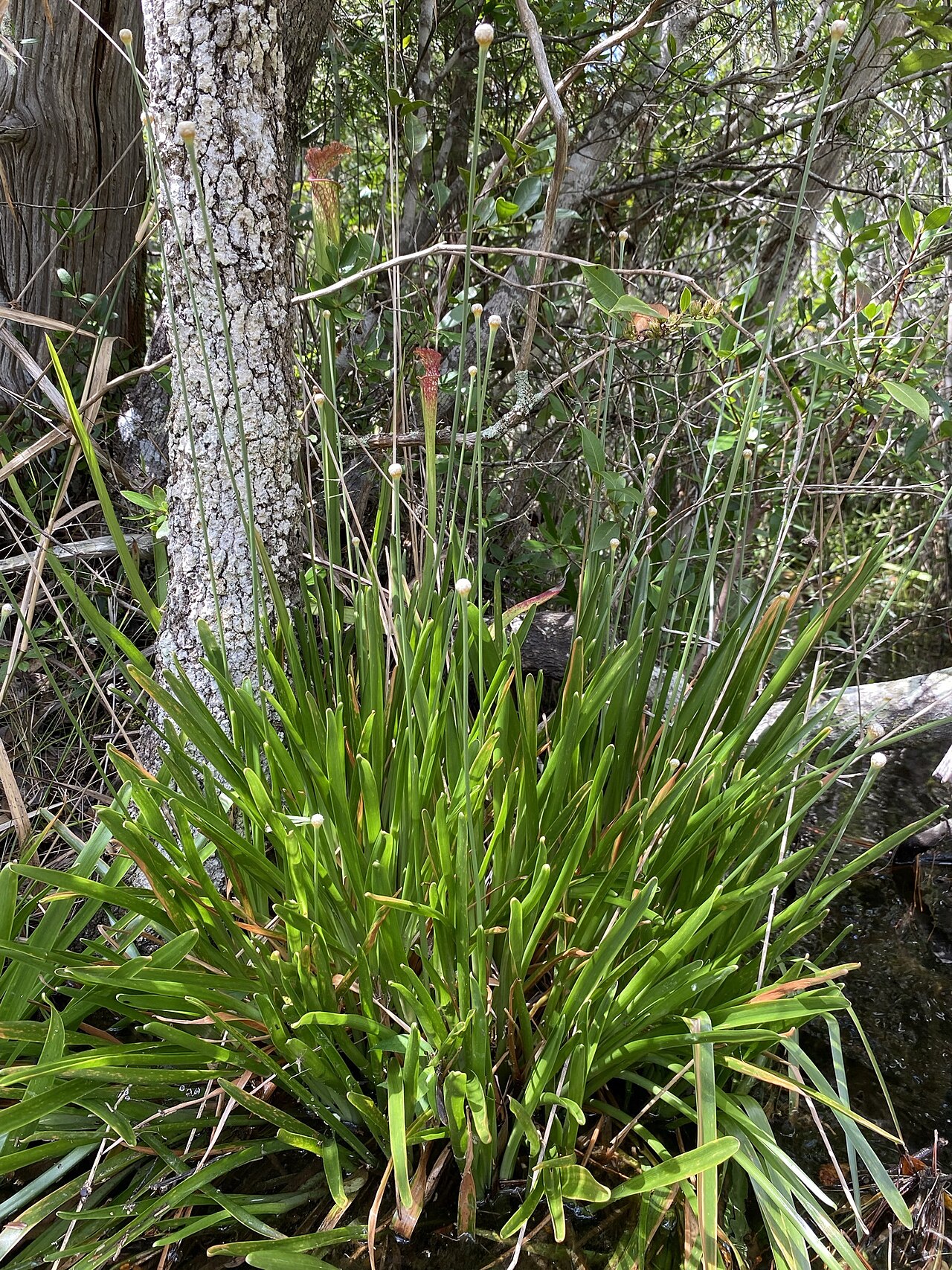
Ten-angled pipewort forms a basal rosette, sometimes a small clump of several rosettes, from a short, thick stem with spongy roots. From late spring to fall it sends up one to many leafless flowering stalks (scapes), usually 1 to 3 feet tall and occasionally taller.
Leaves
The leaves are linear and taper to a point, about 4 to 16 inches long and up to about 1/2 inch wide at the base. They are bright to dark green, smooth and somewhat spongy, with a network of air channels visible when the leaf is held up to light. Plants of the variety latifolium have wider leaves.
Stalks
The flowering stalks are stiff, twisted and have about ten narrow, raised ribs or angles. At the base each stalk is wrapped in a tubular sheath that is shorter than the leaves.
Flower Heads
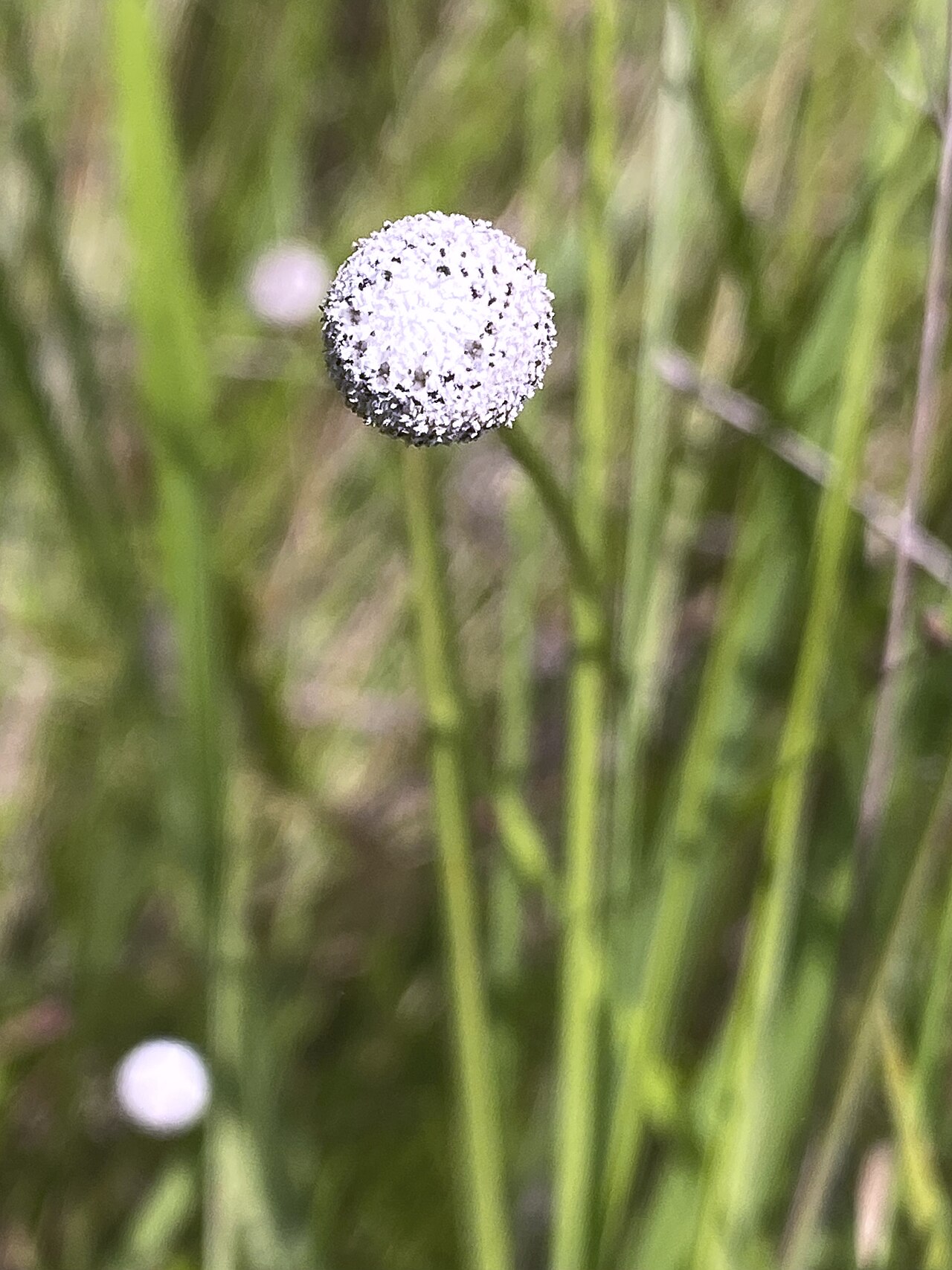
Each stalk carries a single, hard, hemispherical to round head, about 1/2 to 3/4 inch across. The heads hold many tiny male and female flowers mixed with whitish bracts, and the flower parts are tipped with short, white, club-shaped hairs, so the whole head looks white or grayish-white. Heads are firm and do not crush easily, unlike some smaller pipeworts.
Fruit
The fruit is a tiny capsule with two or three seeds. The heads stay on the stalks for weeks and slowly turn gray or tan as the seeds ripen.
Look-alikes
Flattened pipewort (Eriocaulon compressum) has soft heads that are easily squashed and flattened stalk sheaths. Bog buttons (Lachnocaulon) are much smaller, with small grayish heads. Hatpins (Syngonanthus flavidulus) have yellowish-white heads on very thin stalks and grow in drier pinelands. Seven-angle pipewort (Eriocaulon aquaticum) is a smaller, northern species of lake shores.
Quick Facts
| Scientific Name | Eriocaulon decangulare |
| Family | Eriocaulaceae (pipewort family) |
| Plant Type | Herbaceous perennial wetland plant |
| Mature Height | 1–3 ft (in flower) |
| Mature Spread | 6–18 in |
| Growth Rate | Moderate |
| Sun Exposure | Full sun to light shade |
| Water Needs | High; constantly wet to shallowly flooded |
| Soil Type | Wet sand, peat or muck; bogs and seeps |
| Soil pH | Strongly acidic (about 4.0–5.5) |
| Bloom Time | Late spring to fall, mainly summer |
| Flower Color | White |
| Fall Color | None notable |
| Fruit | Tiny capsules in persistent gray-white heads |
| Deer Resistant | Generally not browsed |
| USDA Hardiness Zones | 6–10 |
Native Range
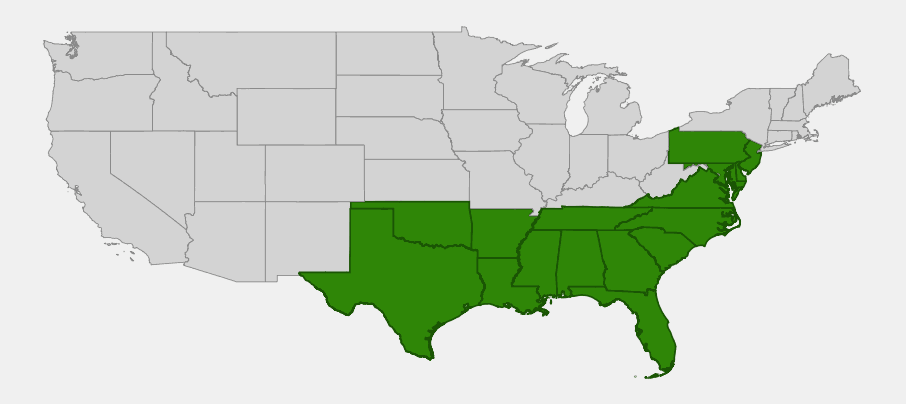
Ten-angled pipewort is native to the eastern and southeastern United States, Mexico and Central America. USDA PLANTS lists it as native in Alabama, Arkansas, Delaware, Florida, Georgia, Louisiana, Maryland, Mississippi, New Jersey, North Carolina, Oklahoma, Pennsylvania, South Carolina, Tennessee, Texas and Virginia. It does not grow in Canada.
Most of its U.S. range lies on the Atlantic and Gulf Coastal Plains, from the New Jersey Pine Barrens south through the Carolinas and Georgia to south Florida, and west along the Gulf Coast to Louisiana and East Texas, with populations inland to southern Arkansas and southeastern Oklahoma. It is most common in the Carolinas, Georgia, Florida and the central Gulf states. Records from Pennsylvania, Tennessee and the mountains of North Carolina are scattered, outlying populations at the edge of its range, and it is rare in several of these states.
It grows at low elevations, generally below about 1,000 feet, in wet, acidic, open habitats: seepage bogs and pitcher plant bogs, wet pine savannas and flatwoods, wet ditches, borders of ponds, lakes and cypress domes, and some fens and tidal marshes. It depends on sunlight, and many populations need regular fire or other disturbance to keep shrubs and trees from shading them out.
📋 Regional plant lists featuring Ten-Angled Pipewort: New York, Pennsylvania & Northern New Jersey · Kentucky & Tennessee · Maryland, Virginia & West Virginia · Delaware, Southern New Jersey & Long Island · Alabama, Georgia & Mississippi · North & South Florida · North & South Carolina · Arkansas, Louisiana, Eastern Oklahoma & Eastern Texas
Growing & Care Guide
Ten-angled pipewort is easy to please if you can give it what it needs: constant moisture, acidic soil low in nutrients and plenty of sun. It is an ideal companion for pitcher plants and sundews in a bog garden.
Light
Full sun gives the most flowers and the sturdiest plants. It tolerates light shade, but in shade it flowers less and weakens over time, just as wild populations decline when shrubs close in.
Soil & Water
Grow it in a lean, acidic mix such as peat moss with coarse sand, the same mix used for carnivorous plants. Keep the soil wet at all times; it tolerates shallow standing water for part of the year. Use rainwater or other low-mineral water if your tap water is hard, and never fertilize, because nutrients encourage algae and competing plants.
Planting Tips
Plant in spring in a bog garden, a lined bog bed, a tray-watered container or the shallow, sunny margin of a pond. Set the crown at soil level. Combine it with pitcher plants, sundews, meadow beauties and native orchids. Buy plants from nurseries that propagate their own stock, and never collect them from the wild.
Pruning & Maintenance
Remove old flower stalks in late winter if you want a tidy look, or leave them for their winter interest. Pull out grasses, sedges and woody seedlings that try to shade the rosettes; in larger bogs, periodic burning or cutting mimics the natural fire that keeps the habitat open.
Propagation
Divide offset rosettes from larger clumps in spring. Seed is tiny; sow it on the surface of a moist peat and sand mix, keep it constantly wet and in bright light, and expect slow growth for the first year.
Landscape Uses
- Bog gardens: tall white “hat pins” among pitcher plants and sundews
- Pond margins: a sunny, shallow-water edge plant for acidic ponds
- Container bogs: works in tray-watered pots with carnivorous plants
- Wet savanna restoration: a typical forb of fire-maintained pine savannas and seeps
- Dried arrangements: the long-lasting heads are sometimes used in dried flower work
Wildlife & Ecological Value
Ten-angled pipewort is a characteristic plant of the species-rich, fire-maintained wetlands of the southeastern Coastal Plain.
For Pollinators
Its tiny flowers are visited by small insects, including small bees, flies and beetles, which collect pollen. The heads also make good hunting perches for crab spiders and other small predators.
For Birds
It offers little direct food for birds, but the open bogs and savannas where it grows are important habitat for birds such as Bachman’s sparrows, which use wet pine savannas.
For Mammals
Mammals rarely eat it. Its rosettes give a little cover to small animals, frogs and invertebrates in wet ground.
Ecosystem Role
It is an indicator of healthy, open, acidic wetlands. Populations thrive where fire, mowing or other disturbance keeps out shrubs, and they shrink when wetlands are drained or overgrown. It often grows with rare plants such as pitcher plants, sundews and native orchids.
Cultural & Historical Uses
The genus name Eriocaulon comes from Greek words meaning “woolly stem,” and the species name decangulare means “ten-angled,” for the ribs on its flower stalks. The name “pipewort” may refer to the hollow, pipe-like stalks of some species.
Because the dried heads keep their shape and color, pipeworts have long been gathered for dried flower arrangements in some parts of the world. In the United States, the white heads of ten-angled pipewort are a familiar sign of late-summer bogs to naturalists and photographers.
Botanists studying inland mountain bogs in North Carolina found that ten-angled pipewort grows best in very acidic, sunny sites with sphagnum moss and declines in shade, which shows why managing these wetlands with fire or brush cutting matters for its survival.
Frequently Asked Questions
Why is it called ten-angled pipewort?
Its flowering stalks usually have about ten narrow ribs or angles, and the scientific name decangulare means “ten-angled.”
Is ten-angled pipewort a grass?
No. It has grass-like leaves, but it belongs to the pipewort family (Eriocaulaceae), which is related to the grasses and sedges but has distinctive button-like flower heads.
Can I grow ten-angled pipewort in a bog garden?
Yes. It grows well in a sunny bog garden with acidic, nutrient-poor, constantly wet soil, the same conditions pitcher plants need.
When does ten-angled pipewort bloom?
From late spring to fall, mainly in summer. In Florida it can begin flowering in spring.
How is it different from other pipeworts?
It is the largest North American pipewort, with tall, ribbed stalks and hard, white heads about 1/2 to 3/4 inch across. Other pipeworts and bog buttons have smaller or softer heads.

Looking for a nursery that carries Ten-Angled Pipewort?
Browse our native plant nursery directory: Alabama & Arkansas · Delaware, Florida & Georgia · Louisiana, Maryland & Mississippi · New Jersey, North Carolina & Oklahoma · Pennsylvania, South Carolina, Tennessee, Texas & Virginia

