
Skunkweed (Navarretia squarrosa)
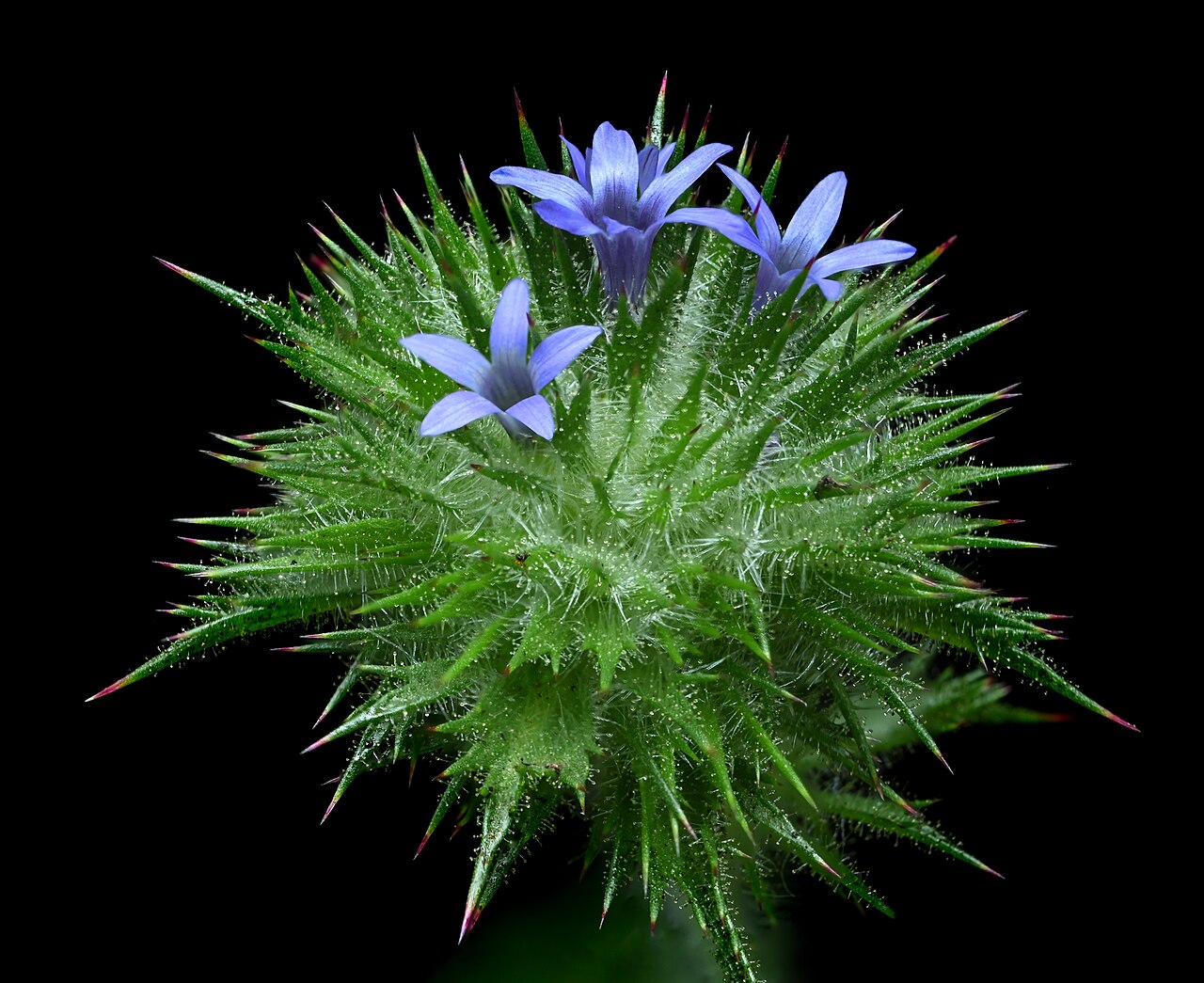
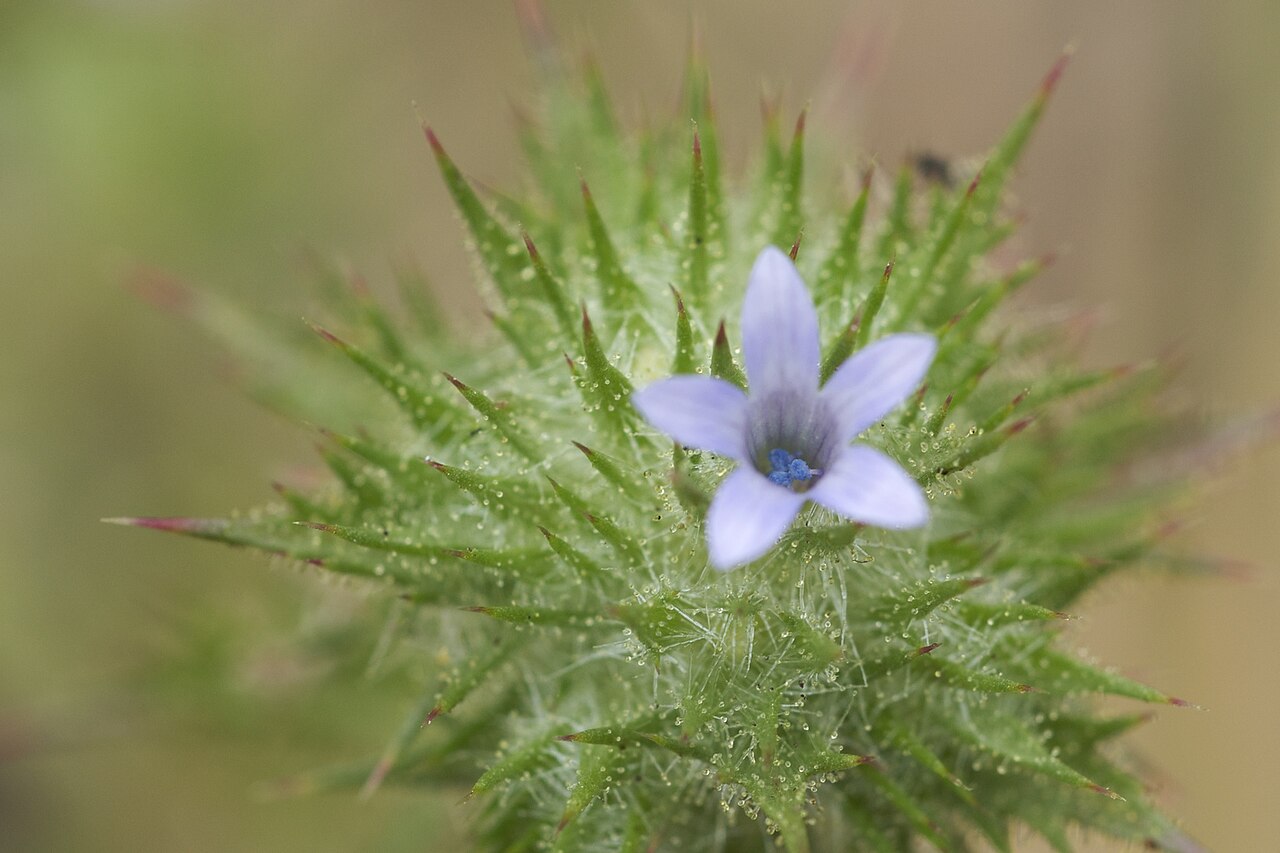
Navarretia squarrosa, known as Skunkweed, skunkbush or California stinkweed, is a small, spiny annual wildflower of the Pacific Coast. It belongs to the phlox family (Polemoniaceae). The whole plant is covered with sticky glandular hairs that give off a strong, skunk-like smell, especially on warm days or when brushed. Its deeply lobed, prickly leaves and bracts form dense, bristly balls, and from these peek small, bright blue to lilac, five-petaled flowers in summer.
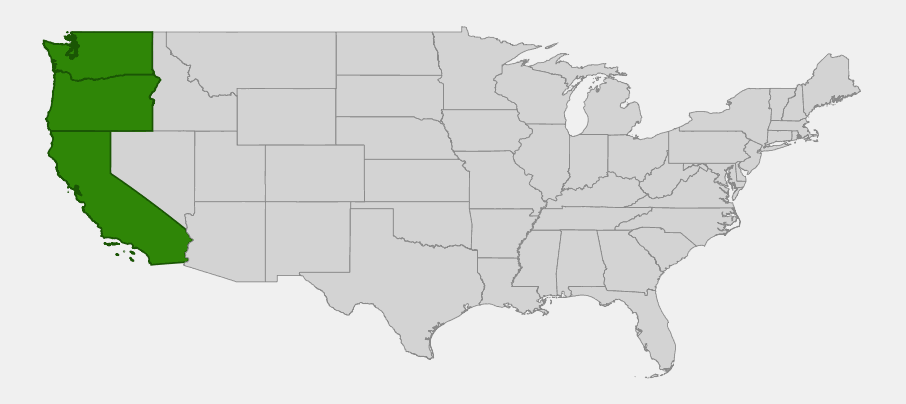
Skunkweed is native from southwestern British Columbia south through western Washington and Oregon to California. It grows in open, sunny places with sandy, gravelly or compacted soil: grasslands, coastal terraces and bluffs, dried pond and vernal pool margins, fields, trail edges and roadsides. It is often noticed late in summer, when most other annuals have dried up and its blue flowers and pungent odor stand out.
This is a plant to appreciate in the wild or in naturalistic restoration plantings rather than a garden ornament. It thrives in disturbed, open ground and can be weedy, and it has been introduced to other parts of the world. Within its native range, though, it is a genuine member of West Coast grassland and coastal communities and supports small native bees.
Identification
Look for a low, sticky, prickly annual with a strong skunky smell, deeply cut spiny leaves, and dense, bristly heads with small blue flowers in summer.
Growth Habit
Skunkweed is a summer annual, usually 4 to 20 inches tall, with one main stem or several spreading branches. Plants in poor, dry soil may be only a few inches high, while those in better ground become bushy. The stems are reddish to green and covered with glandular, sticky hairs.
Leaves
The leaves are alternate, about 1/2 to 2 inches long, and once or twice divided into narrow lobes that end in sharp spines. They are sticky and glandular, and they give off the plant’s characteristic skunk-like smell when touched.
Flowers
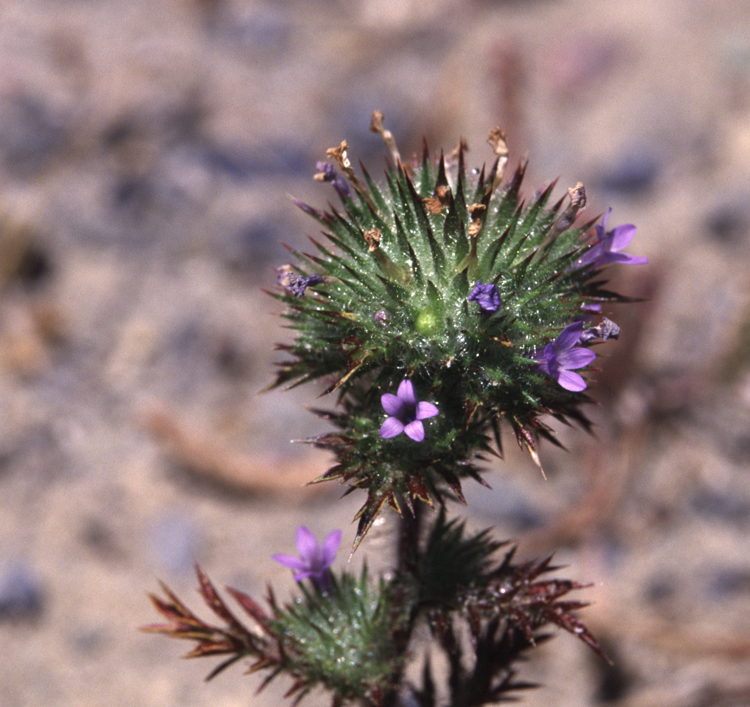
The flowers grow in dense, rounded heads at the stem and branch tips, surrounded by spiny, leaf-like bracts. Each flower is about 1/3 to 1/2 inch long, with a narrow tube and five spreading lobes that are pale to deep blue or lilac. Only a few flowers in a head are open at once. It blooms mainly from June to September.
Fruit
The fruit is a small capsule hidden among the spiny bracts, holding several tiny seeds that become sticky when wet. The dry, spiny heads stay on the dead plants into fall.
Look-alikes
Other Navarretia species, such as needleleaf navarretia (N. intertexta) of vernal pools, are similar but usually have white or paler flowers and lack the strong skunky odor. Coyote thistles (Eryngium) of vernal pools, such as Vasey’s coyote thistle, also have spiny heads, but they belong to the carrot family and have tiny white or bluish flowers in tight balls.
Quick Facts
| Scientific Name | Navarretia squarrosa |
| Family | Polemoniaceae (phlox family) |
| Plant Type | Summer annual wildflower |
| Mature Height | 4–20 in |
| Mature Spread | 4–12 in |
| Growth Rate | Fast |
| Sun Exposure | Full sun |
| Water Needs | Low to medium; moist in spring, dry in summer |
| Soil Type | Sandy, gravelly or compacted clay; open, often disturbed ground |
| Soil pH | Slightly acidic to neutral (about 5.5–7.5) |
| Bloom Time | June–September |
| Flower Color | Pale to deep blue or lilac |
| Fall Color | None; dies after setting seed |
| Fruit | Small capsule hidden in spiny heads |
| Deer Resistant | Yes; strong-smelling and prickly |
| USDA Hardiness Zones | 7–10 (annual) |
Native Range
Skunkweed is native to the Pacific Coast of North America. This page treats it as native in California, Oregon and Washington, and in Canada it grows in southwestern British Columbia, including southern Vancouver Island and the lower Fraser Valley. USDA PLANTS also shows it in Montana and Pennsylvania, but those records are introduced: the Montana collections come from roadsides, a driveway and a pasture in Sanders County, and Pacific Northwest floras describe its native range as British Columbia to California. It has also become naturalized in Australia and New Zealand.
In Washington it grows west of the Cascade crest, especially around Puget Sound and in the lowlands of western Washington. In Oregon it grows mainly in the Willamette Valley, the Coast Range foothills and southwestern Oregon. In California it is widespread in the North Coast, the San Francisco Bay Area and the Coast Ranges, and it extends into the Central Valley edges and Sierra Nevada foothills.
It grows at low elevations, mostly below about 2,500 feet, in open, sunny sites with sandy, gravelly or compacted clay soils: coastal grasslands and bluffs, prairies and oak savannas, margins of dried ponds and seasonal wetlands, fields, trail edges and roadsides. It often appears on bare, trampled or disturbed soil.
📋 Regional plant lists featuring Skunkweed: Western Oregon & Western Washington · California & Nevada · Idaho, Eastern Oregon & Eastern Washington
Growing & Care Guide
Skunkweed is rarely grown on purpose. It is best left to grow where it appears naturally, or used in restoration seed mixes for open, dry-summer grasslands within its native range. If you want it, it needs only sun, open ground and the usual West Coast pattern of wet winters and dry summers.
Light
Full sun. It does not compete well in shade or under tall, dense vegetation.
Soil & Water
It grows in sandy, gravelly or compacted clay soils, often in places that are wet in winter and bone dry by midsummer. No summer water is needed; it completes its life cycle on stored soil moisture.
Planting Tips
Scatter seed on bare, open ground in fall so that winter rains settle it into the soil. It germinates in spring and blooms in summer. Place it away from paths and patios, where its smell and spiny heads might be unwelcome. Only use it within its native range on the Pacific Coast.
Pruning & Maintenance
No pruning is needed. If you want to limit it, pull plants before the seed heads mature, wearing gloves because the bracts are prickly and sticky. Leave some plants to set seed if you are restoring a grassland.
Propagation
Propagate from seed collected from dry heads in late summer or fall. It self-sows readily on bare, open soil.
Landscape Uses
- Grassland restoration: a native summer annual for open coastal and valley grasslands
- Seasonal wetland edges: grows on dried margins of ponds and seasonal wetlands
- Native bee habitat: late-season flowers when few other annuals bloom
- Natural areas: best appreciated where it occurs on its own
- Educational plantings: a memorable example of a scented, spiny native annual
Wildlife & Ecological Value
Skunkweed is a late-blooming annual that fills a gap in summer for insects in the dry grasslands of the Pacific Coast.
For Pollinators
Its small blue flowers are visited by native bees, including small solitary bees, and by flies and butterflies. Because it blooms from midsummer into early fall, it provides nectar and pollen when most spring annuals have finished.
For Birds
Seed-eating birds such as finches and sparrows may forage on the seeds of small annuals in the grasslands where skunkweed grows, though its spiny heads protect the seeds somewhat.
For Mammals
Its strong smell, sticky hairs and spines make it unappealing to deer, rabbits and livestock, which generally avoid it.
Ecosystem Role
As a pioneer annual of open and disturbed ground, it quickly colonizes bare soil in grasslands, coastal terraces and dried wetland margins, helping cover the soil during the dry season.
Cultural & Historical Uses
The genus Navarretia honors Francisco Fernández Navarrete, an 18th-century Spanish physician and naturalist. The species name squarrosa means “rough with spreading tips,” a fitting description of its spiny, bristling bracts.
Its common names, skunkweed, skunkbush and California stinkweed, all refer to its powerful odor, which many people compare to a skunk and others to strong cannabis. The smell comes from the sticky glands that cover the plant.
Skunkweed was first collected by early naturalists visiting the Pacific Coast in the early 19th century and was described from California material. Today it is often noticed by hikers in the San Francisco Bay Area and on the prairies of the Puget Sound region, where its smell in late summer is hard to miss.
Frequently Asked Questions
Why is it called skunkweed?
The whole plant is covered with sticky glands that give off a strong, skunk-like smell, especially in warm weather or when it is touched.
Is skunkweed native?
Yes, it is native to the Pacific Coast from British Columbia to California. Records in Montana, Pennsylvania and on other continents are introduced.
Is skunkweed an annual?
Yes. It sprouts in spring, flowers from June to September and dies after setting seed.
Is skunkweed poisonous?
It is not known as a significant poisonous plant, but it is prickly, sticky and strong-smelling, and animals avoid it. Do not eat it.
Should I plant skunkweed in my garden?
It is not a typical garden plant because of its smell and spiny heads. It is best left in natural areas or used in grassland restoration within its native range.

Looking for a nursery that carries Skunkweed?
Browse our native plant nursery directory: California · Oregon · Washington

