
Spiny Cliffbrake (Pellaea truncata)
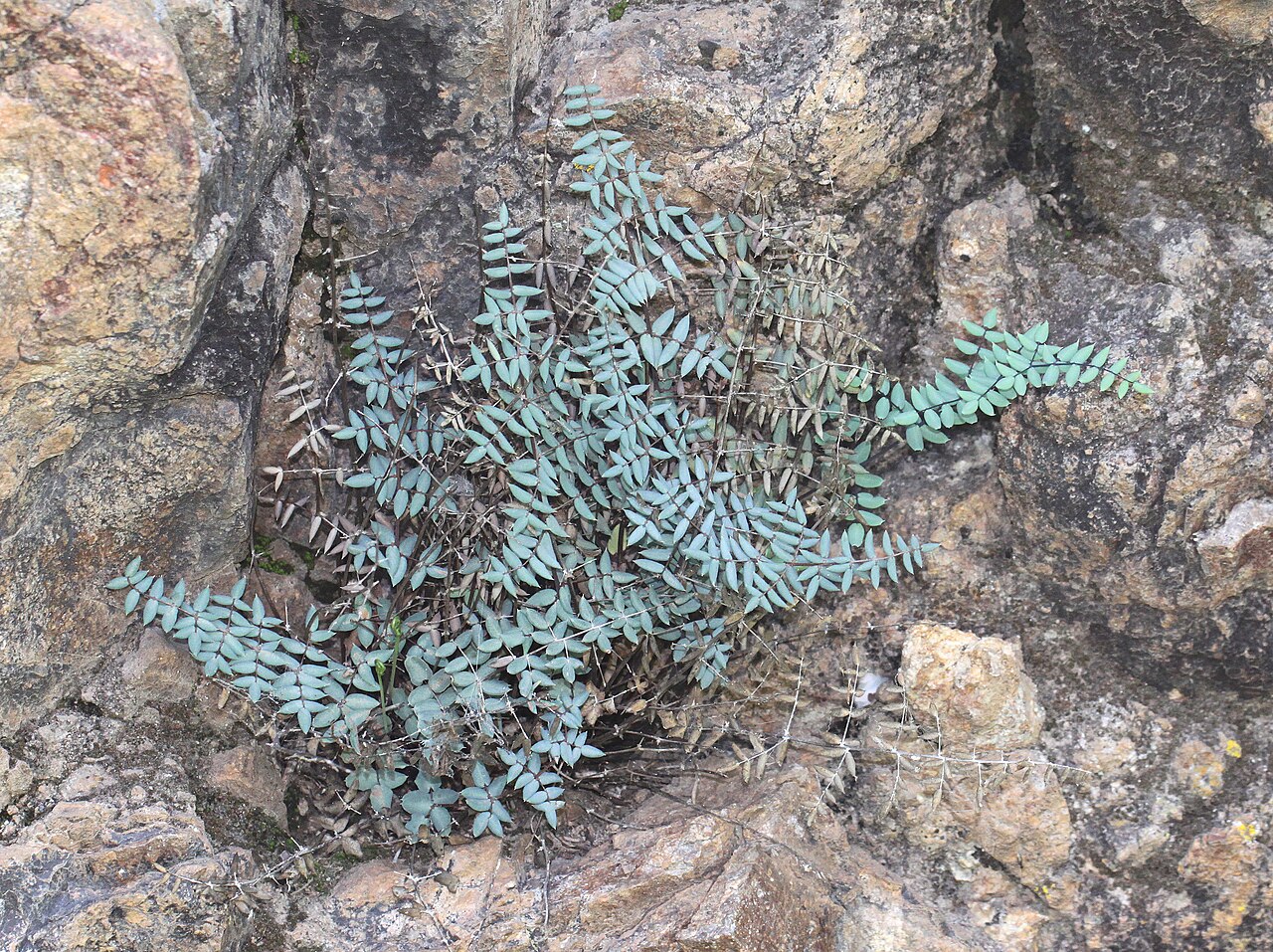
Pellaea truncata, known as Spiny Cliffbrake or spiny cliff-brake, is a small, tough fern of the rocky Southwest. It grows in cracks in cliffs, among boulders and on rocky slopes from southern California and Nevada east to Colorado, New Mexico and West Texas, and south into northern Mexico. Its stiff, blue-green fronds are divided into many small, leathery segments, each ending in a tiny sharp point, the “spine” of its common name.
It belongs to the brake fern family (Pteridaceae), in a genus of cliffbrakes adapted to dry rock. Cliffbrakes look nothing like the soft, lacy ferns of moist woodlands. Their fronds are thick and waxy, their dark stalks are wiry, and they can dry out almost completely during drought and then green up again after rain. Spiny cliffbrake was once lumped with the similar Mexican species Pellaea longimucronata, and older references sometimes use that name for it.
Spiny cliffbrake is a quiet but rewarding plant for southwestern rock gardens, stone walls and dry shade, and an easy fern to find on hikes in canyon country. This guide covers how to identify it, where it grows, and how to grow it in the garden.
Identification
Several cliffbrakes and lip ferns share the dry rocks of the Southwest. Spiny cliffbrake is identified by its twice-divided, bluish fronds with small, well-separated, sharp-tipped segments and by its smooth, hairless surfaces.
Rhizome & Stipes
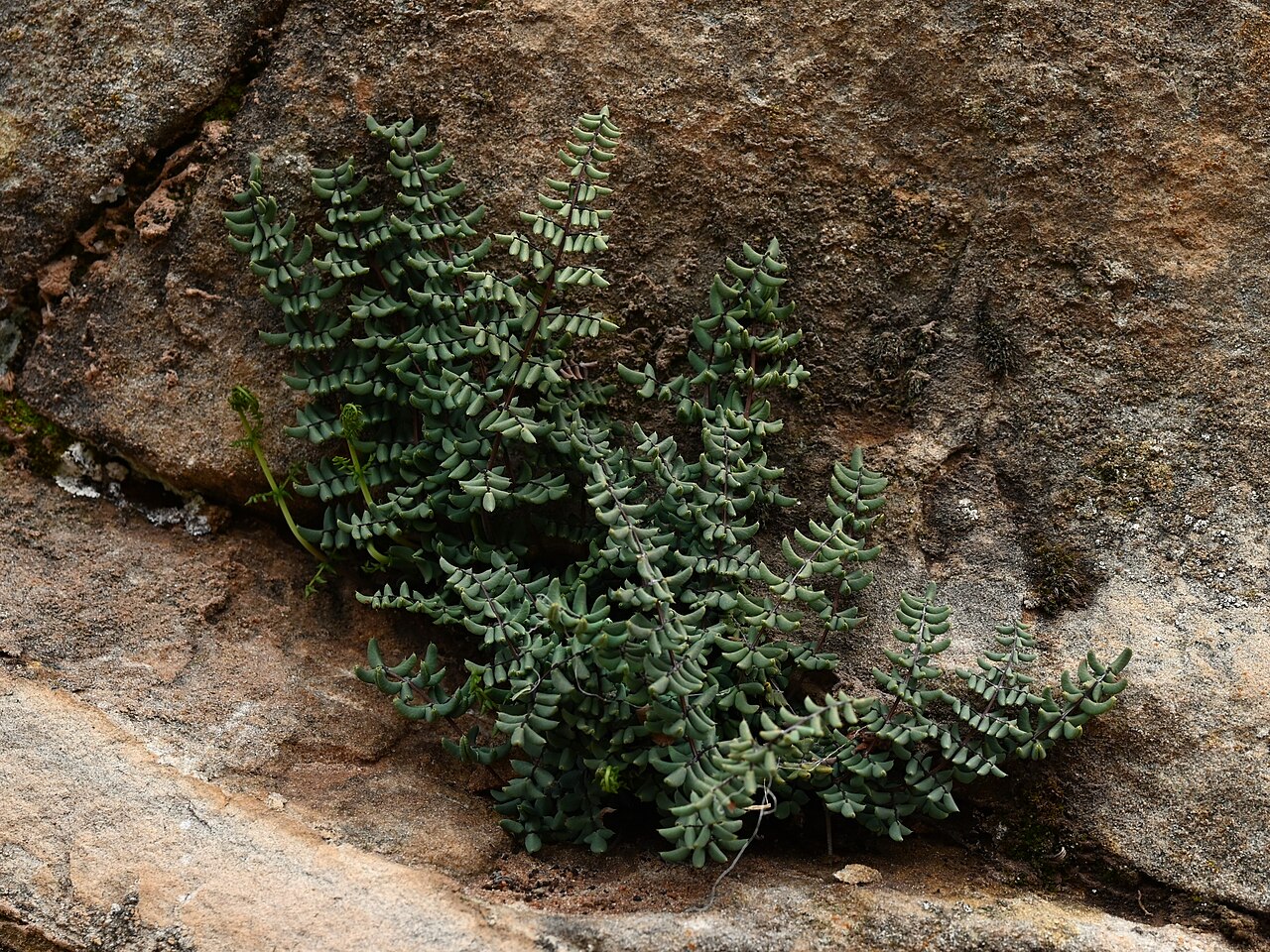
The fern grows from a short, compact, creeping rhizome covered in narrow brown scales, so the fronds rise close together in a tight clump. The stipes (leaf stalks) are dark reddish-brown to purplish-black, shiny, wiry and round in cross-section, and they make up roughly half the length of the frond.
Fronds
Fronds are erect to arching, usually about 4 to 16 inches long, narrowly triangular to oblong, and divided twice (bipinnate) near the base. The blade is blue-green to gray-green, thick, leathery and smooth on both sides, without the hairs or scales that cover many other desert ferns. The segments are small, about ⅛ to ⅜ inch long, oblong to narrowly oval, often slightly folded, and each ends in a sharp, hard tip (a mucro). The rachis is dark like the stipe.
Spores
As in other cliffbrakes, the edges of the fertile segments roll under to form a pale, papery false indusium that protects a band of sporangia along the margin. Spores ripen from late spring through fall. Spiny cliffbrake is a sexually reproducing diploid species, unlike some of its relatives that reproduce without fertilization.
Similar Species
Bird’s-foot fern (Pellaea mucronata) of California has its segments arranged in threes like a bird’s foot. Wright’s cliffbrake (P. wrightiana) usually has once-divided pinnae or fewer, longer segments, and coffee fern (P. andromedifolia) has softer, more widely spaced segments. Lip ferns (Cheilanthes and Myriopteris) are usually hairy or scaly, and cloak ferns (Astrolepis) are covered with star-shaped scales.
Quick Facts
| Scientific Name | Pellaea truncata Goodd. (syn. P. longimucronata in part) |
| Family | Pteridaceae (brake fern family) |
| Plant Type | Evergreen to semi-evergreen rock fern; perennial |
| Mature Height | 4–16 in |
| Mature Spread | 6–12 in clumps |
| Growth Rate | Slow |
| Sun Exposure | Partial shade to full sun |
| Water Needs | Low; drought tolerant, curls up in dry spells |
| Soil Type | Rock crevices, gravel and fast-draining rocky soil |
| Soil pH | About 6.0–7.5; usually on granite, volcanic rock or sandstone, rarely limestone |
| Bloom Time | None (fern); spores ripen about May–November |
| Flower Color | None; reproduces by spores |
| Fall Color | None; fronds stay blue-green or dry to tan |
| Fruit | None; spores borne under rolled leaf margins |
| Deer Resistant | Yes; rarely browsed |
| USDA Hardiness Zones | 6–9 |
Native Range
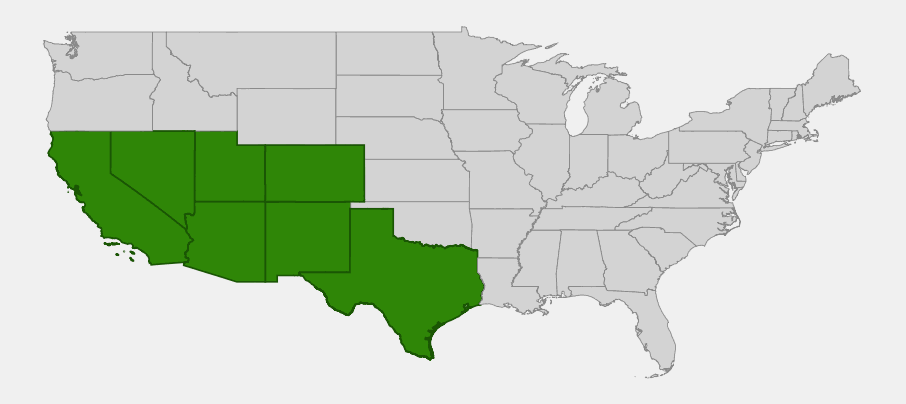
Spiny cliffbrake is native to the southwestern United States and northern Mexico. USDA PLANTS and the Lady Bird Johnson Wildflower Center list it from seven states: Arizona, California, Colorado, Nevada, New Mexico, Texas and Utah. In Mexico it grows in Baja California, Sonora and Chihuahua.
It is most common in the mountains and canyons of Arizona and New Mexico, where it grows on cliffs, ledges and boulder piles in oak woodland, pinyon-juniper woodland, chaparral and desert grassland. In California it is found mainly in the desert mountain ranges and the Peninsular Ranges, in Nevada mostly in the Spring Mountains and other southern ranges, in Utah and Colorado on canyon walls of the Colorado Plateau, and in Texas in the mountains of the Trans-Pecos.
The fern grows on many kinds of rock, including granite, volcanic rock and sandstone, but it is rarely found on limestone. It usually roots in north-facing or shaded cracks where a little moisture collects, at roughly 2,000 to 7,500 feet elevation.
📋 Regional plant lists featuring Spiny Cliffbrake: Arizona & New Mexico · California & Nevada · Utah & Western Colorado · South & West Texas
Growing & Care Guide
Spiny cliffbrake is a fern for dry gardens, not moist shade. It wants sharp drainage, air around its crown and a cool root run between rocks. It is rarely sold outside specialist native and fern nurseries in the Southwest, so buy nursery-grown plants or grow it from spores rather than prying wild plants from rock cracks, which almost always kills them.
Light
Give it bright, partial shade, such as the north or east side of a boulder or wall, or dappled light under open trees. In mountain gardens it tolerates more sun. In hot desert gardens, afternoon shade keeps the fronds from scorching.
Soil & Water
Plant it in a gritty, fast-draining mix of coarse sand, gravel and a little compost, ideally wedged between rocks so its roots stay cool. Avoid heavy or constantly damp soil, which rots the rhizome. Water regularly the first season. After that, occasional deep watering in summer keeps it green, but it can go dormant in drought and recover after rain.
Planting Tips
Set the rhizome at the soil surface, not buried, and tuck the plant into a crevice or pocket in a rock garden, dry-stacked wall or trough. Top-dress with gravel to keep the crown dry. It combines well with other dry-land ferns such as lip ferns and cloak ferns, and with small succulents.
Pruning & Maintenance
Remove dead fronds in late winter if you want a tidier look, cutting them at the base without disturbing the rhizome. Do not fertilize. Watch for overwatering, the most common cause of failure in gardens.
Propagation
Mature clumps can be divided carefully in spring, keeping several fronds and a section of rhizome on each piece. Spores sown on sterile, moist mix under cover germinate fairly readily, but young plants take a year or more to reach garden size.
Landscape Uses
- Rock gardens and crevice gardens: a fern that thrives in the narrow, dry cracks other ferns cannot use
- Stone walls and dry-stacked terraces: roots into joints between stones and softens hard edges
- Dry shade: under open trees or on the shady side of boulders in desert and mountain gardens
- Troughs and containers: a slow, compact grower for gritty mixes in shallow containers
- Naturalistic canyon gardens: with lip ferns, spikemoss, small agaves and other rock-dwelling natives
Wildlife & Ecological Value
Ferns have no flowers or fruit, so spiny cliffbrake plays a smaller role for wildlife than many shrubs and wildflowers. Its value is in the specialized rock habitat it shares with many small animals and other plants.
For Pollinators
As a fern it does not produce flowers, nectar or pollen, so it has no direct value to pollinators. It often grows beside flowering rock plants such as penstemons, heuchera and small cacti that bees and hummingbirds visit.
For Birds
Birds do not eat it, but rock wrens, canyon wrens and other cliff-dwelling birds forage for insects among the ferns, mosses and lichens in rock crevices where it grows.
For Mammals
Its tough, leathery fronds are rarely eaten by deer or livestock. Small mammals such as rock squirrels and woodrats use the crevices and boulder piles that are its home.
Ecosystem Role
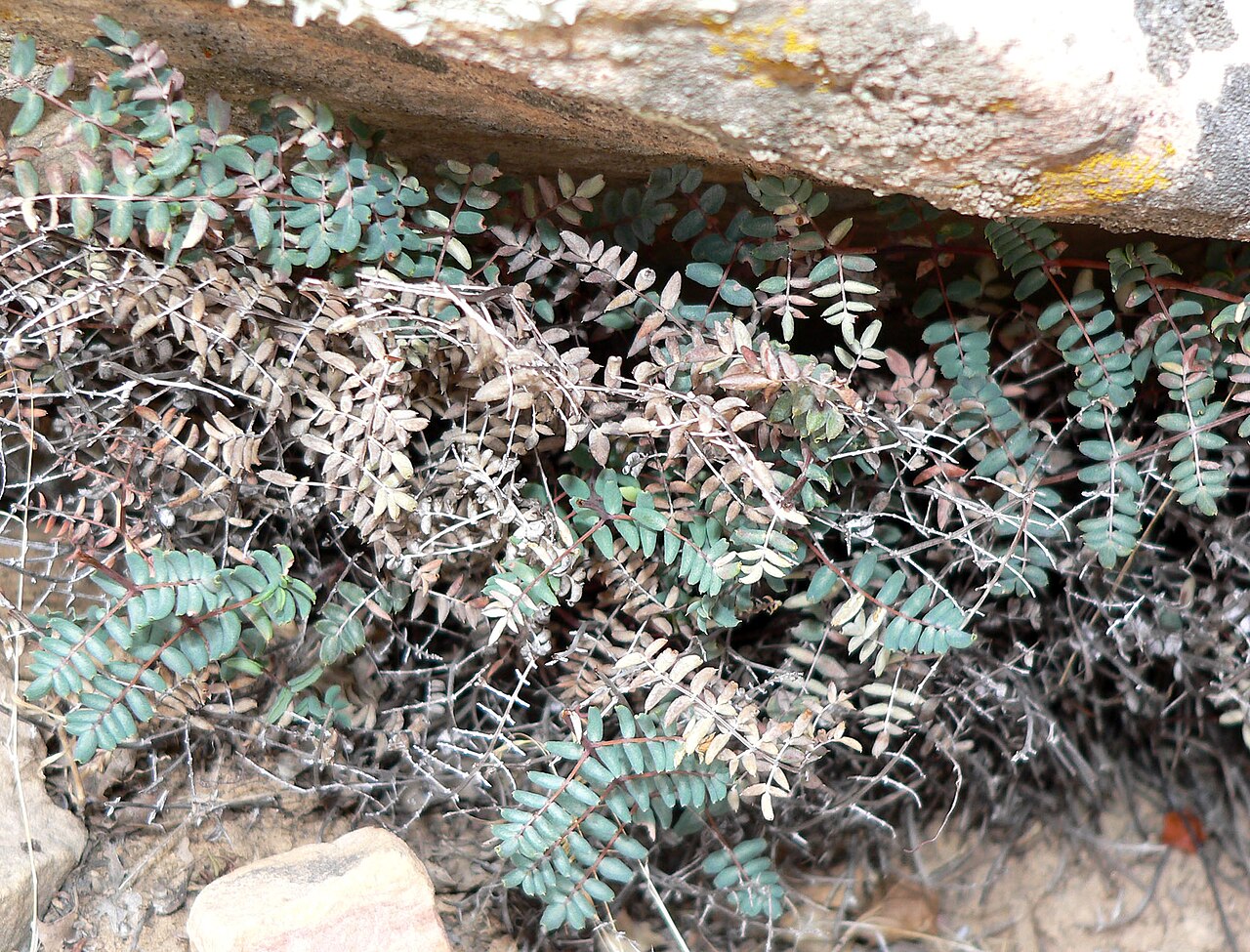
Spiny cliffbrake is one of the pioneer plants of bare rock. Its roots and the litter of old fronds trap dust and organic matter in cracks, slowly building pockets of soil that other plants can use. It shelters small insects, spiders and lizards in the shade of its fronds.
Cultural & Historical Uses
Pellaea truncata was named by Leslie N. Goodding, a botanist who collected widely in Arizona and the Southwest in the early twentieth century. The species name is Latin for “cut off” or “truncate.” The genus name Pellaea comes from a Greek word meaning dark or dusky, for the dark stalks of cliffbrakes.
For many years spiny cliffbrake was treated as part of Pellaea longimucronata, a name now usually applied to a related Mexican fern. Later studies of the cliffbrakes, including work on their chromosome numbers and modes of reproduction, helped sort out the confusing group of drought-adapted Pellaea species in the Southwest.
Cliffbrakes in general have been used in folk medicine in Mexico and the Southwest, mainly as teas. Such uses are not well documented for this species, and ferns should not be eaten or used as remedies without expert knowledge. Today spiny cliffbrake is valued by hikers, fern enthusiasts and rock gardeners as one of the characteristic small ferns of southwestern canyon country.
Frequently Asked Questions
Why is it called spiny cliffbrake?
Each small leaf segment ends in a tiny, hard, sharp point. The points are not dangerous, but they give the fronds a prickly feel and inspired the name. “Cliffbrake” refers to its home on cliffs and its kinship with brake ferns.
Can spiny cliffbrake grow in full sun?
It tolerates sun in cooler mountain gardens, especially wedged between rocks that keep its roots cool. In hot, low-desert gardens give it afternoon shade, or the fronds will scorch and go dormant early.
Does spiny cliffbrake need a lot of water?
No. It is a drought-adapted fern that curls up and goes semi-dormant when dry, then revives after rain. Too much water in heavy soil is a bigger danger than drought.
Is spiny cliffbrake evergreen?
In mild climates the fronds often stay blue-green all year. In cold winters or long droughts they may dry to tan, and new fronds appear when growing conditions return.
How do I tell spiny cliffbrake from other desert ferns?
Look for blue-green, smooth fronds divided into many small, separate, sharp-tipped segments on dark, wiry stalks. Lip ferns and cloak ferns are usually hairy or scaly, and bird’s-foot fern has segments in groups of three.

Looking for a nursery that carries Spiny Cliffbrake?
Browse our native plant nursery directory: Arizona · California · Colorado · Nevada & New Mexico · Texas & Utah

