
Spring Avens (Geum vernum)
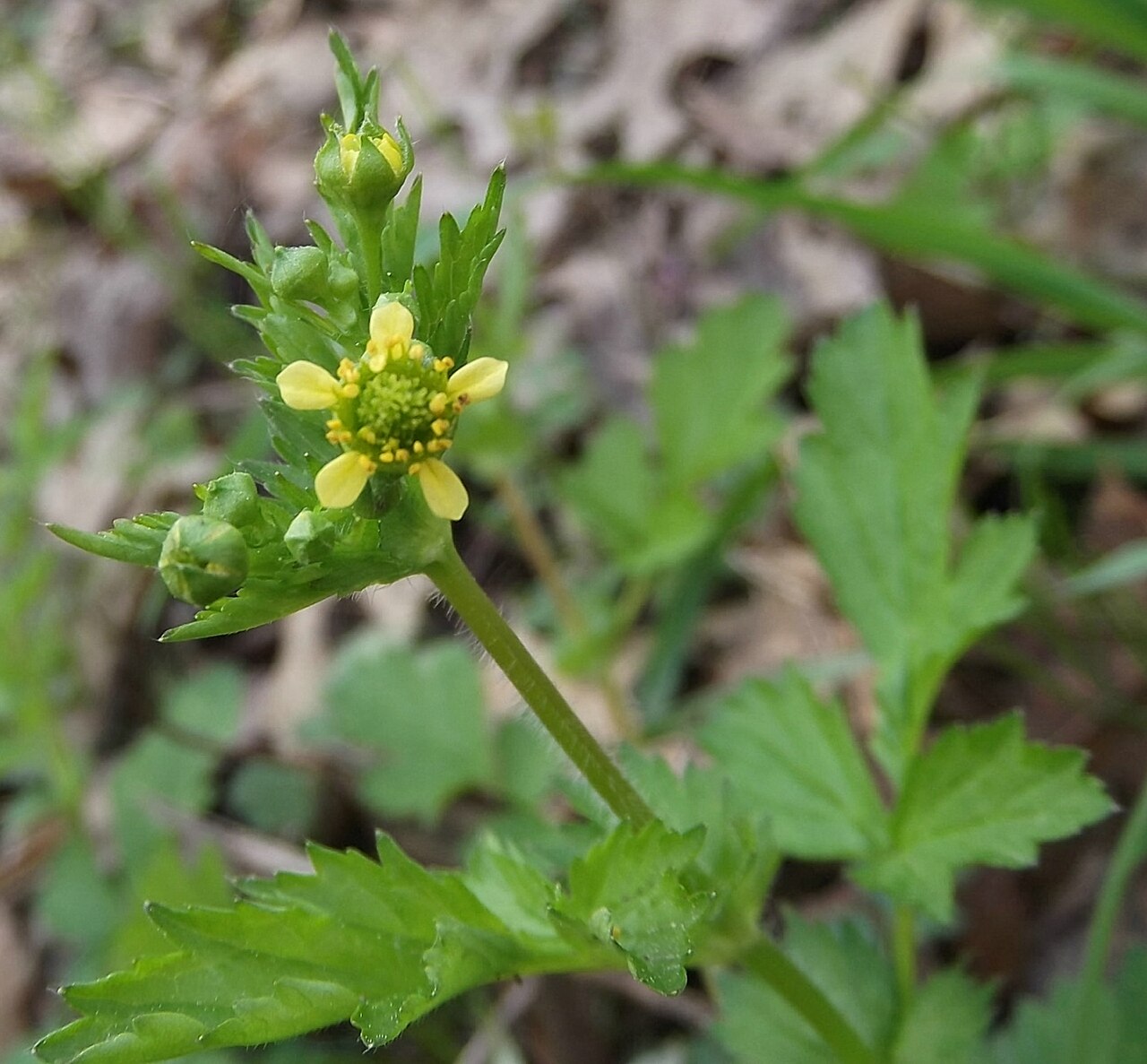
Geum vernum, known as Spring Avens, is a small native woodland perennial of the rose family (Rosaceae) found across much of the eastern and central United States. As its name suggests, it is the earliest of the eastern avens to bloom: in April and May it holds up loose sprays of tiny yellow flowers on slender stems about 8 to 24 inches tall, at the same time as many spring ephemerals.
Spring avens is a modest plant rather than a showy one. Its flowers are less than half an inch across, and it is easily overlooked among other spring greenery. It is interesting to botanists and naturalists for its variable leaves, which are often rounded and undivided at the base of the plant but deeply lobed or divided on the stem, and for its small, round heads of hooked fruits that catch on fur and clothing.
It grows in moist, rich woods, floodplain forests, stream banks and shaded trailsides, especially in the Ohio and Mississippi river valleys. This guide explains how to identify it, where it grows, and where it fits in a shady native garden.
Identification
Spring avens is best identified by its early bloom, its very small yellow flowers, its mix of rounded basal leaves and divided stem leaves, and its small fruiting heads raised on a short stalk above the calyx. White avens (Geum canadense), which often grows nearby, has white flowers and blooms later.
Growth Habit
Plants form a small rosette of basal leaves from a short rootstock. In spring one or a few branched, finely hairy flowering stems rise to about 8 to 24 inches (20 to 60 cm). Plants often grow in loose patches where conditions suit them.
Leaves
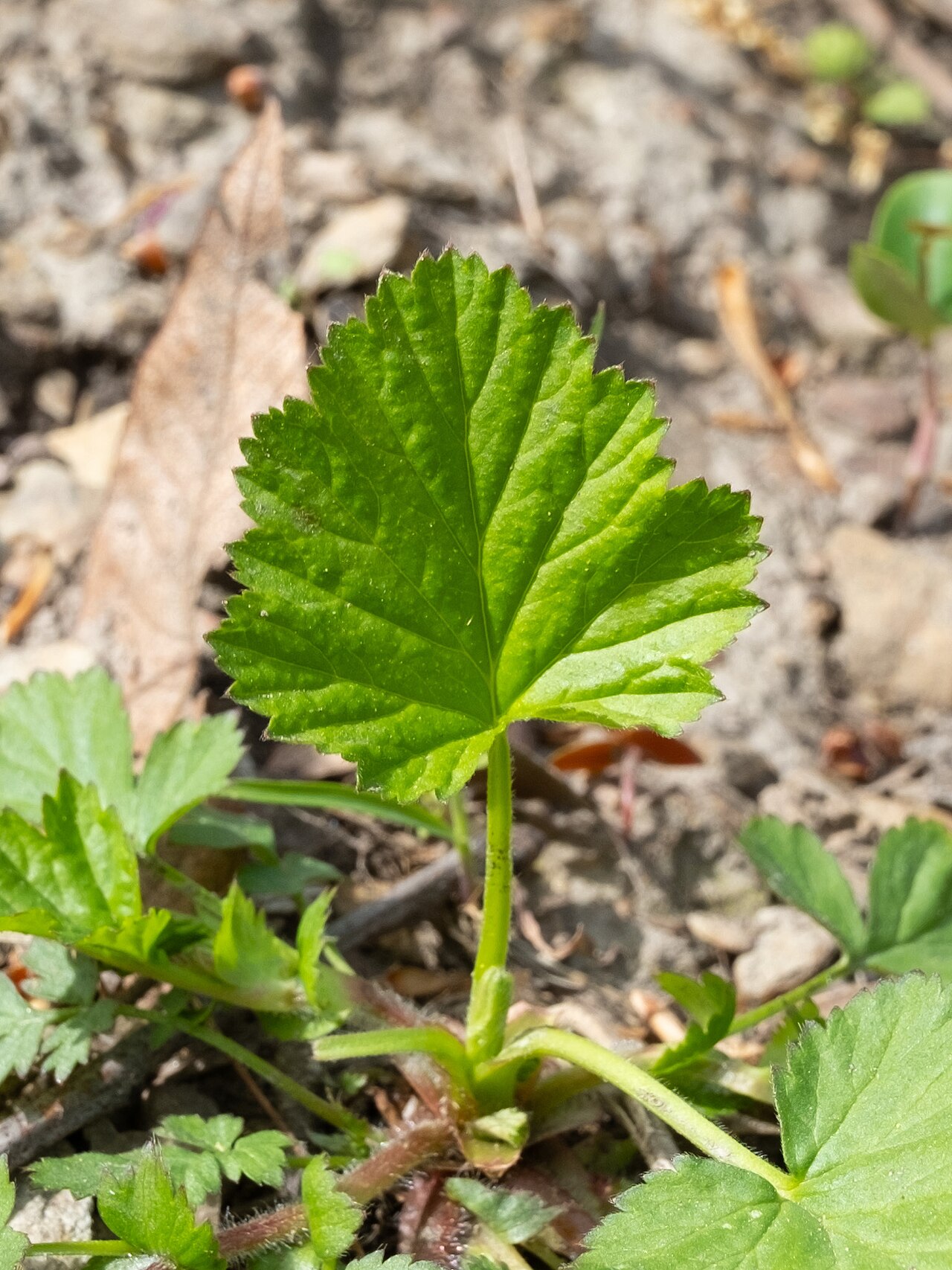
The basal leaves are long-stalked and highly variable. Many are simple, rounded to kidney-shaped with scalloped or toothed edges, while others are divided into a large, rounded end lobe and a few small side leaflets. The leaves on the flowering stem are quite different: they are deeply three- to five-lobed or divided into narrow, toothed segments, and they become smaller toward the top of the stem.
Flowers
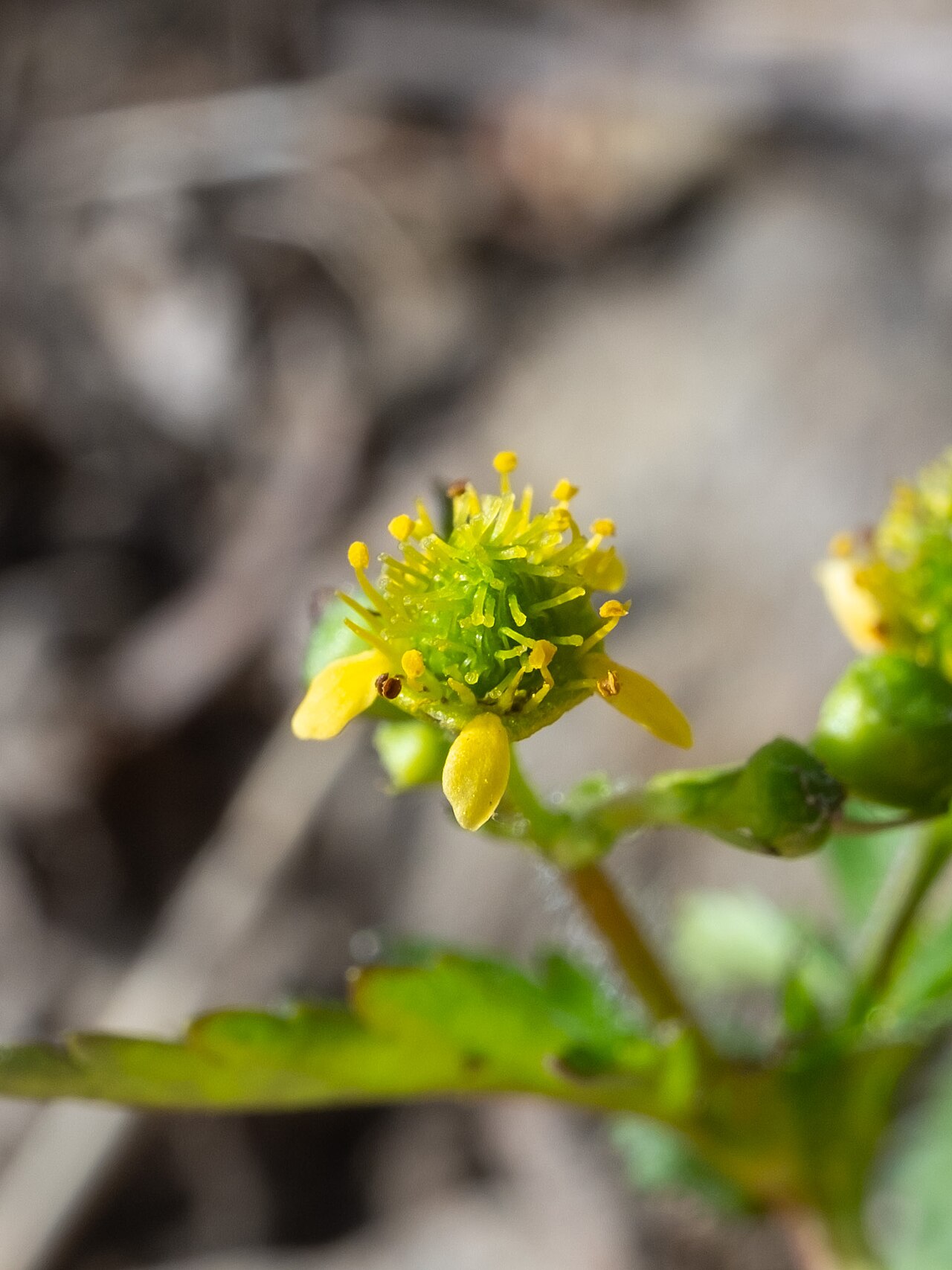
The flowers appear from April into June. Each one is only about ¼ to ⅓ inch across, with five small, pale to bright yellow petals about as long as the green sepals, and many stamens around a green center of pistils. They are held singly at the ends of slender branches in a loose, open cluster.
Fruit & Seeds
After flowering, the center of the flower develops into a small, round head of achenes, raised on a short stalk above the persistent sepals. This stalked fruit head is a good way to separate spring avens from other eastern avens. Each achene carries a jointed style that ends in a tiny hook, so the ripe heads act like little burs that catch on animal fur, clothing and shoelaces.
Quick Facts
| Scientific Name | Geum vernum (Raf.) Torr. & A. Gray |
| Family | Rosaceae (rose family) |
| Plant Type | Herbaceous perennial |
| Mature Height | 8–24 in |
| Mature Spread | 6–12 in |
| Growth Rate | Moderate |
| Sun Exposure | Part shade to full shade |
| Water Needs | Moderate to high; moist soil |
| Soil Type | Rich, moist loam or alluvial soil |
| Soil pH | Slightly acidic to slightly alkaline (about 6.0–7.5) |
| Bloom Time | April–June |
| Flower Color | Yellow |
| Fall Color | None notable; basal leaves often stay green into winter |
| Fruit | Small, stalked round head of hooked achenes |
| Deer Resistant | Moderately; not a preferred deer browse |
| USDA Hardiness Zones | 4–8 |
Native Range
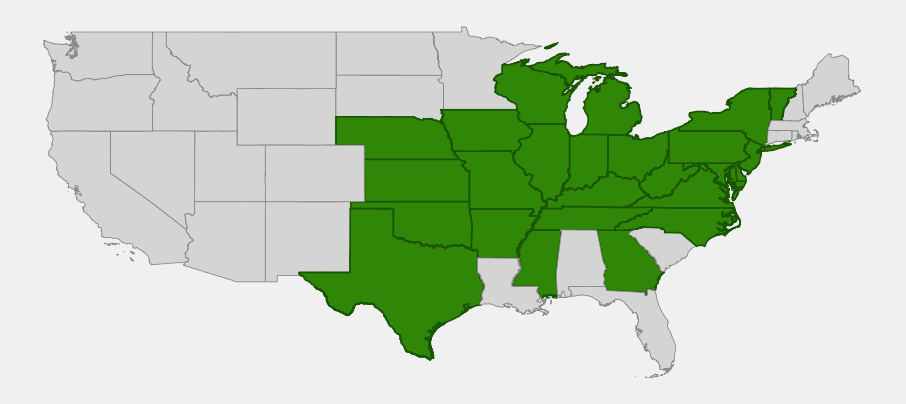
Spring avens is native to the eastern and central United States and southern Ontario. USDA PLANTS records it from Nebraska, Kansas, Oklahoma and Texas east to Georgia, North Carolina, Maryland, New Jersey and New York, and north to Wisconsin and Michigan. Its center of abundance is the Midwest and the Ohio and middle Mississippi valleys, from Missouri and Iowa east through Illinois, Indiana, Ohio and Kentucky.
At the edges of its range it becomes scarce. In New England it is known only from historical records in Vermont, and plants found in Berkshire County, Massachusetts are considered introduced, so Massachusetts is not included in the native range shown here. It is listed as endangered in New York, and it is rare in parts of the Southeast and at the western edge of the plains.
Typical habitats are moist deciduous woods, floodplain and bottomland forests, wooded stream banks, ravines and the shaded edges of trails and clearings. It tolerates some disturbance and often appears along woodland paths and in partly cleared woods, which is one reason it has spread a little beyond its original range.
📋 Regional plant lists featuring Spring Avens: Illinois, Iowa & Missouri · Ohio & Indiana · Kentucky & Tennessee · Michigan, Wisconsin & Eastern Minnesota · Nebraska, Kansas & Eastern Colorado · Arkansas, Louisiana, Eastern Oklahoma & Eastern Texas · Maryland, Virginia & West Virginia · North & South Carolina · Alabama, Georgia & Mississippi · New York, Pennsylvania & Northern New Jersey · Delaware, Southern New Jersey & Long Island
Growing & Care Guide
Spring avens is rarely sold by nurseries and is not a showy garden plant. It is best suited to naturalistic woodland gardens and restorations within its range, where it adds early-season flowers and fills in among taller woodland plants. It establishes easily from seed and can self-sow freely in moist, shady sites.
Light
Grow it in part shade to full shade. It does well under deciduous trees, where it gets spring sun before the canopy leafs out.
Soil & Water
Give it rich, moist soil with plenty of organic matter, such as leaf litter or alluvial loam. It tolerates occasional flooding and brief dry spells once established but grows best where the soil stays evenly moist through spring.
Planting Tips
Sow seed in fall directly where you want plants, or start it in pots outdoors over winter. Set out young plants in spring or fall about 12 inches apart. Use it among later, taller woodland plants so its early flowers come first and its foliage stays as a low layer later in the season.
Pruning & Maintenance
Little maintenance is needed. Remove the fruiting stems before the burs ripen if you do not want it to spread or if the hooked fruits are a nuisance along paths. A light layer of shredded leaves in fall keeps the soil rich and moist.
Propagation
Propagate by seed. Fresh seed sown outdoors in fall usually germinates the following spring. Established clumps can also be divided in early spring or fall.
Landscape Uses
- Woodland gardens: an early, low-maintenance groundlayer plant under deciduous trees
- Floodplain and riparian restoration: suited to moist bottomland forest and stream-bank plantings within its range
- Naturalized areas: a good choice for informal shady areas where self-seeding is welcome
- Pollinator support: offers early-season pollen and nectar to small bees and flies
- Educational plantings: an easy example for teaching how hooked fruits are dispersed by animals
Wildlife & Ecological Value
Spring avens is a small but useful early-season plant in eastern woodlands.
For Pollinators
Its small, open yellow flowers bloom when relatively few flowers are available, and they are visited by small native bees such as sweat bees and mining bees, as well as syrphid flies and other small flies.
For Birds
Birds make little direct use of it, but woodland ground-foraging birds may pick at the seeds, and the plant adds to the leafy groundlayer that gives cover for insects and the birds that eat them.
For Mammals
The hooked fruits catch in the fur of deer, raccoons, rabbits and other mammals, which carry the seeds to new sites. Deer occasionally graze the foliage but do not usually prefer it.
Ecosystem Role
As an early-blooming plant of floodplains and moist woods, it helps hold soil along stream banks and in bottomlands. Its spread by animal-carried burs helps it colonize disturbed openings along trails and streams.
Cultural & Historical Uses
The species was first described by Constantine Rafinesque in the early nineteenth century, and John Torrey and Asa Gray moved it into Geum in their Flora of North America (1840). The species name vernum means “of spring,” referring to its early bloom. Avens is an old English name for plants of the genus.
Geum vernum has been used in botanical studies of how the hooked, jointed fruits of the avens evolved. In the 1940s, extracts from the plant were also tested for antimicrobial activity in laboratory studies. Some other avens have a long history of herbal use, but there is little record of traditional uses of spring avens.
For most people the plant is simply one of the small yellow flowers of spring woodlands, and its burs are a familiar nuisance on socks and dog fur after a walk in floodplain woods.
Frequently Asked Questions
How can I tell spring avens from white avens?
White avens (Geum canadense) has white petals and blooms later, mainly in late spring and summer. Spring avens has small yellow petals, blooms from April, and its fruiting head sits on a short stalk above the sepals.
Is spring avens invasive?
No. It is a native plant. It can self-sow readily in moist, shady soil and may seem weedy along trails, but it is part of the natural woodland flora within its range.
Why do its seeds stick to my clothes?
Each achene ends in a tiny hook formed from part of the style. The hooks catch on fur and fabric, which is how the plant spreads its seeds.
Does spring avens need shade?
It does best in part shade to full shade with moist, rich soil. It can tolerate some sun in spring if the soil stays moist.
Is spring avens rare?
It is common in much of the Midwest and the Ohio Valley but rare at the edges of its range. It is listed as endangered in New York and known only historically in Vermont.

Looking for a nursery that carries Spring Avens?
Browse our native plant nursery directory: Arkansas · Delaware & Georgia · Illinois, Indiana, Iowa & Kansas · Kentucky, Maryland, Michigan, Mississippi & Missouri · Nebraska, New Jersey, New York, North Carolina, Ohio & Oklahoma · Pennsylvania, Tennessee, Texas, Vermont & Virginia · West Virginia & Wisconsin

