
Common Pipewort (Eriocaulon aquaticum)
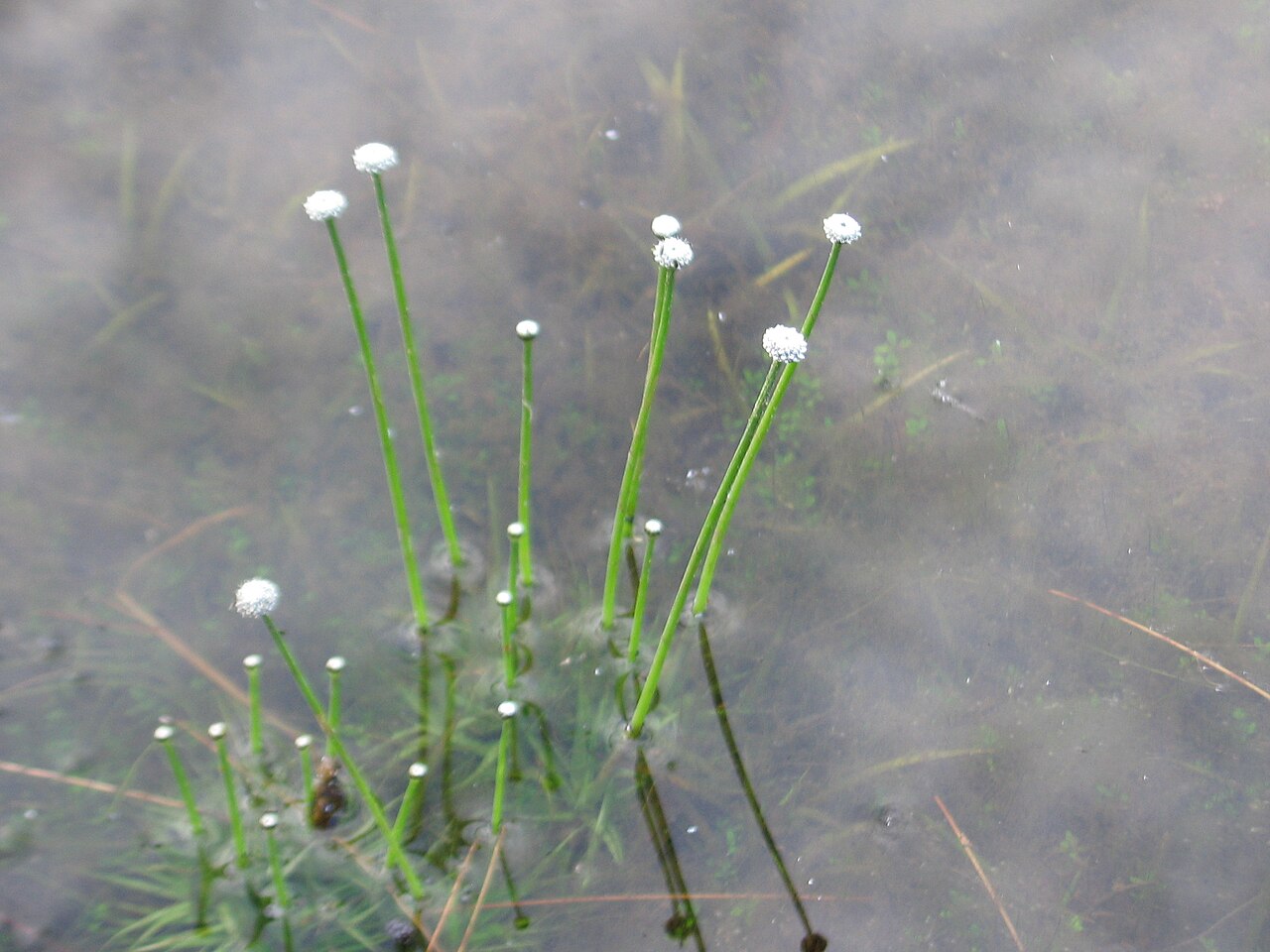
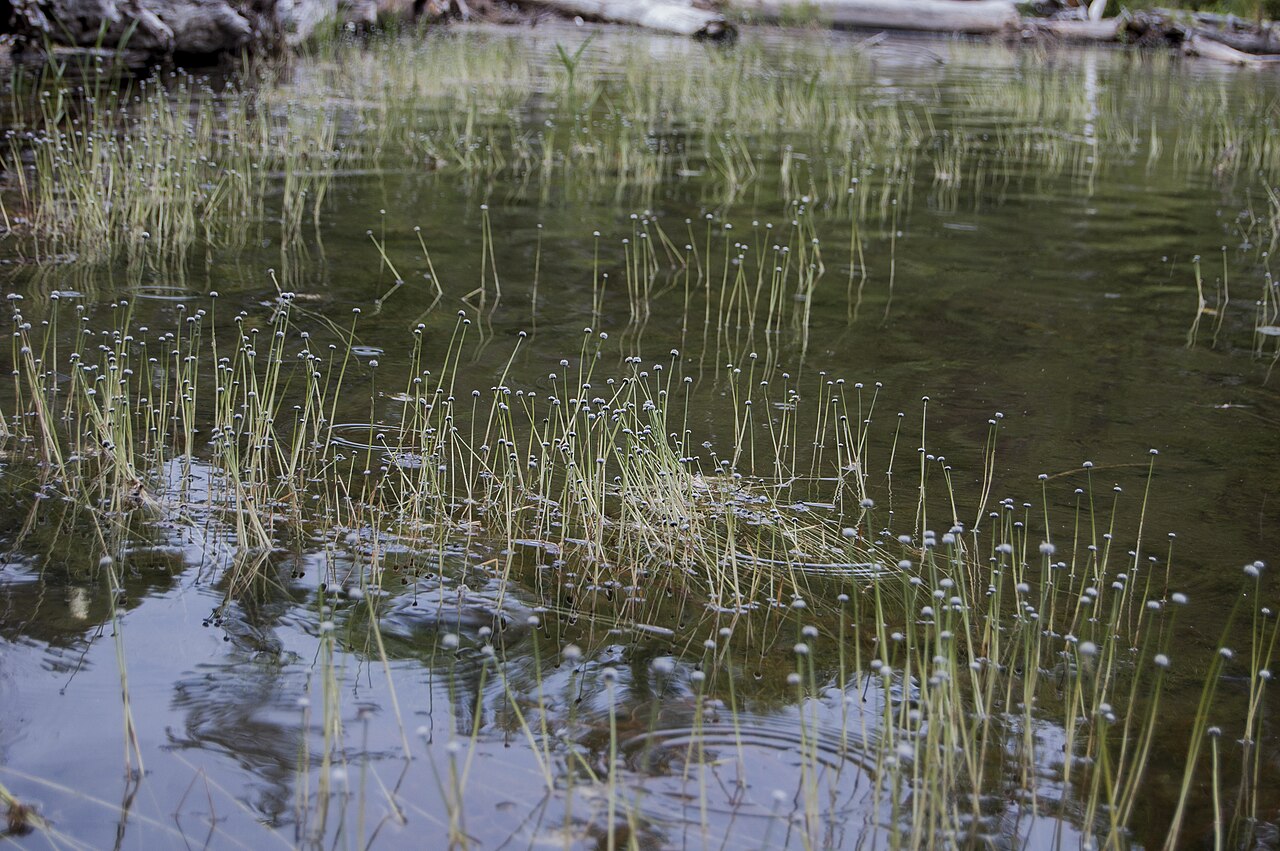
Eriocaulon aquaticum, known as Common Pipewort, seven-angled pipewort, northern pipewort or hatpins, is a small aquatic plant of clear, acidic lakes and ponds in northeastern North America. Most of the plant lives underwater as a tuft of soft, translucent, grass-like leaves, but in summer it sends up slender stalks that hold small, white, button-like flower heads just above the surface. In a quiet cove, a colony looks like a scatter of pins stuck into the water, which explains the folk name hatpins.
It belongs to the pipewort family (Eriocaulaceae), a mostly tropical family with only a few species in the northern United States and Canada. Common pipewort is the most northern and widespread of them, ranging from Newfoundland and Ontario south through New England and the Great Lakes states to the mountains and coastal plain of the Carolinas. It is also one of very few native North American plants that also grows wild in Europe, where it is found only on the western coasts of Ireland and Scotland.
Common pipewort is a sign of a clean, nutrient-poor lake, and it is a good native choice for the shallow margins of natural ponds and water gardens with soft, acidic water. This guide covers how to identify it, where it grows, and how to grow it.
Identification
Out of flower, common pipewort looks like many other small rosette plants of lake bottoms. In flower it is easy to recognize, and a few details of its leaves and roots help identify it even underwater.
Leaves & Roots
The leaves form a basal rosette, like a small tuft of grass or a sea-anemone. They are soft, flat, tapering, usually 1 to 4 inches long (longer in deep water), and translucent. Held to the light, they show a distinctive lattice of fine cross-veins between the lengthwise veins. The roots are white, thick, spongy and unbranched, and they also show crosswise partitions, a feature that separates pipewort from quillworts and other rosette plants of lake bottoms.
Flower Stalks
From midsummer the plant sends up one to several leafless stalks (scapes), usually 2 to 8 inches tall on shore but much longer in deeper water, where they stretch to bring the flower head to the surface. Each stalk is slightly twisted and has (usually) seven narrow ridges, the source of the names seven-angled pipewort and septangulare, an older scientific name.
Flowers
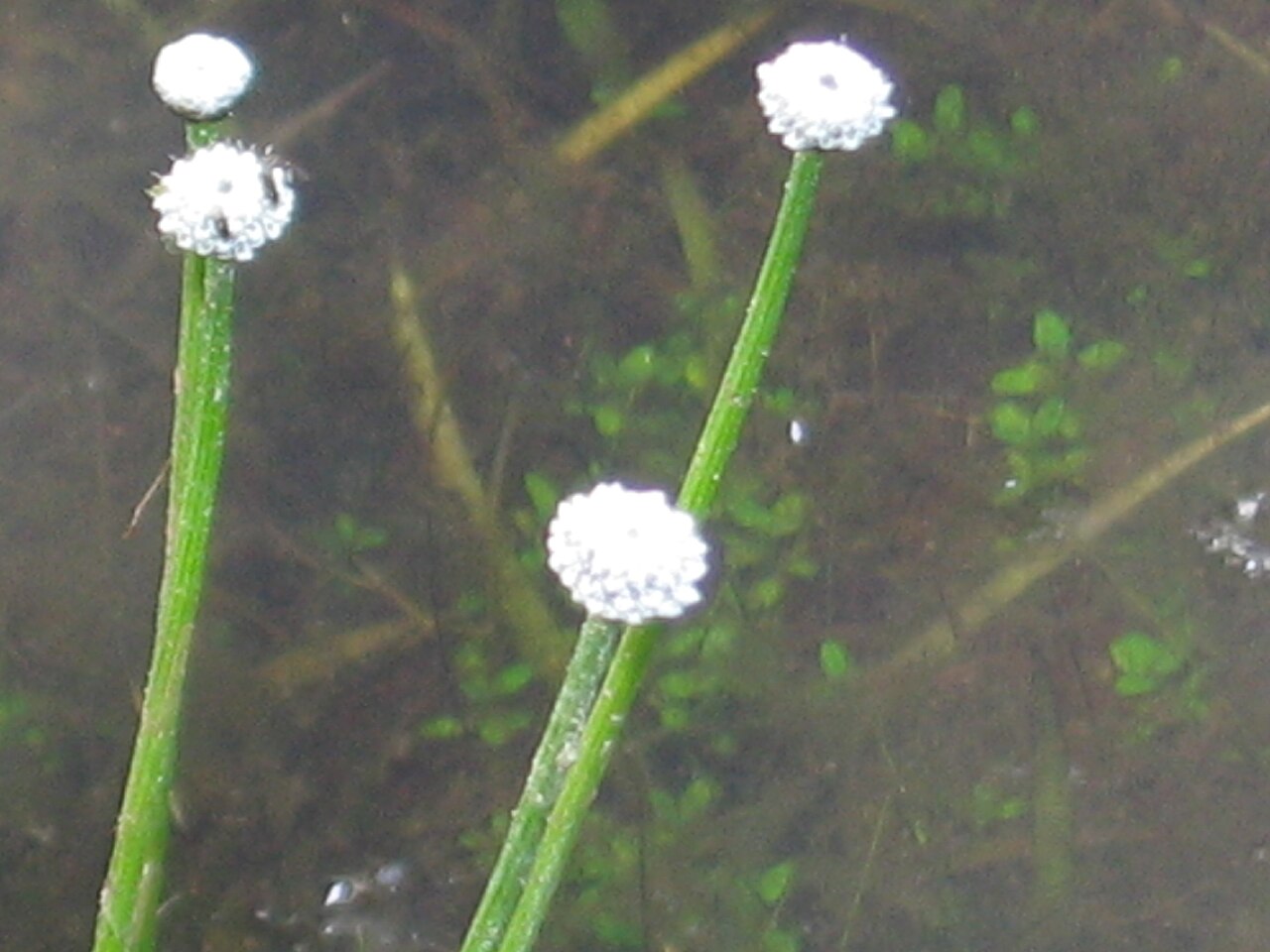
The flower head is a small, flattened to rounded “button” about ⅛ to ⅖ inch across, gray-white and woolly with white hairs. It contains many tiny unisexual flowers: male flowers in the center and female flowers around the edge. Each flower has two to three tiny petals tipped with a nectar gland and white hairs, and the dark anthers show as black specks. It blooms from July into September.
Fruit & Seeds
The female flowers produce small, thin-walled capsules containing tiny seeds. Common pipewort spreads mostly by forming new rosettes, so it often grows in dense colonies or underwater lawns. Rosettes that break loose may drift and root elsewhere.
Quick Facts
| Scientific Name | Eriocaulon aquaticum (Hill) Druce (syn. E. septangulare, E. pellucidum) |
| Family | Eriocaulaceae (pipewort family) |
| Plant Type | Aquatic herbaceous perennial (rosette) |
| Mature Height | 2–8 in above water; stalks longer in deep water |
| Mature Spread | 2–4 in rosettes; spreads into colonies |
| Growth Rate | Slow to moderate |
| Sun Exposure | Full sun to partial shade |
| Water Needs | Aquatic; shallow water or saturated shoreline |
| Soil Type | Sand, gravel or peaty muck on lake and pond bottoms |
| Soil pH | Acidic, about 4.5–6.5; soft, nutrient-poor water |
| Bloom Time | July–September |
| Flower Color | Gray-white (woolly) heads with dark specks |
| Fall Color | None; evergreen underwater rosettes |
| Fruit | Tiny capsule with minute seeds |
| Deer Resistant | Not applicable; aquatic and rarely browsed |
| USDA Hardiness Zones | 3–8 |
Native Range
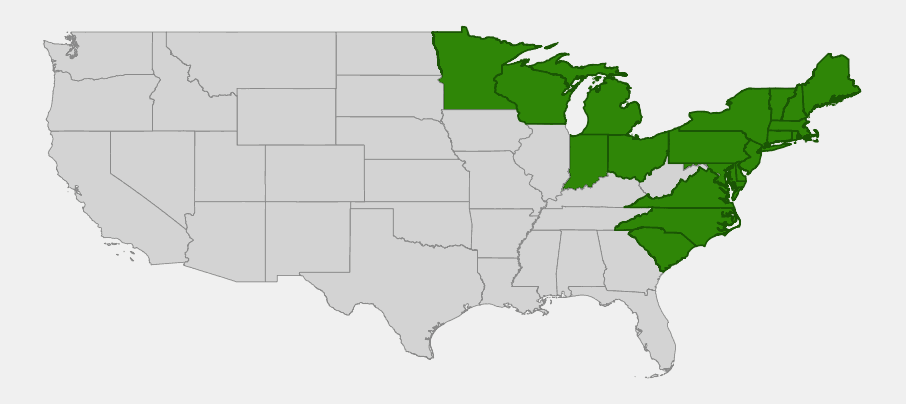
Common pipewort is native to northeastern North America. USDA PLANTS records it from 19 states (and the District of Columbia): all six New England states, New York, New Jersey, Pennsylvania, Delaware, Maryland, Virginia, North Carolina, South Carolina, Ohio, Indiana, Michigan, Wisconsin and Minnesota. In Canada it ranges from Newfoundland and the Maritime provinces west through Quebec to Ontario. It also grows in western Ireland and the Hebrides and western coast of Scotland, one of the few native plants shared between North America and Europe.
It is most common in the glaciated lake country of New England, the Adirondacks, northern Michigan, Wisconsin and Minnesota, and in the New Jersey Pine Barrens. Farther south it becomes scarce and scattered, mostly in ponds and slow streams of the Coastal Plain and in a few mountain bogs and ponds, and it is rare in several southern and midwestern states at the edge of its range.
Its habitat is very specific: shallow water and wave-washed shores of clear, soft-water, acidic lakes and ponds with sandy, gravelly or peaty bottoms, usually from the waterline to a few feet deep. It also grows along slow, acidic streams and in seasonally flooded pond margins.
📋 Regional plant lists featuring Common Pipewort: Connecticut, Massachusetts & Rhode Island · New Hampshire, Maine & Vermont · New York, Pennsylvania & Northern New Jersey · Delaware, Southern New Jersey & Long Island · Maryland, Virginia & West Virginia · North & South Carolina · Ohio & Indiana · Michigan, Wisconsin & Eastern Minnesota
Growing & Care Guide
Common pipewort is not a typical garden plant, but it can be grown in the shallow margin of a natural pond, a lined wildlife pond or a large container water garden if the water is soft, clear and low in nutrients. Buy plants from native aquatic nurseries rather than collecting from lakes, where it may be locally rare or protected.
Light
Give it full sun or light shade. It grows best in clear water where light reaches the bottom; murky or algae-filled water shades it out.
Soil & Water
Plant it in sand, fine gravel or a sand and peat mix, not rich garden soil or fertilized aquatic potting mix. The water should be soft, acidic and low in nutrients, such as rainwater or water from a natural acidic pond. Keep the crown in about 1 to 12 inches of water, or on a constantly saturated shoreline. Hard, alkaline or nutrient-rich water encourages algae and other plants that crowd it out.
Planting Tips
Set rosettes in spring or early summer, pressing the roots into the sand and weighing them down with a little gravel until they root. Plant several together to form a small colony. It is a small plant, so place it at the front of a pond edge where its flower heads can be seen, and keep vigorous plants such as cattails away from it.
Pruning & Maintenance
No pruning is needed. Remove fallen leaves and debris that would smother the rosettes, and avoid adding fertilizer to the pond. The rosettes stay green under the water through winter as long as the pond does not freeze solid.
Propagation
Divide established clumps by separating rosettes with their roots in spring or summer. It can be grown from seed sown on wet sand, but seedlings are tiny and slow, so division is much easier.
Landscape Uses
- Natural ponds and lake shores: a native groundcover for sandy shallows in soft-water lakes
- Wildlife ponds: adds underwater structure for aquatic insects and small fish
- Container water gardens: a small, curious accent in tubs of soft rainwater
- Bog and pond restoration: in shoreline restoration of acidic, nutrient-poor lakes within its range
- Indicator plant: its presence signals clear, soft, low-nutrient water
Wildlife & Ecological Value
Common pipewort is small, but its underwater lawns and summer flowers support a surprising number of creatures in clear northern lakes.
For Pollinators
Unlike many water plants that rely on wind or water to move pollen, common pipewort has nectar glands on its tiny petals and is visited by small insects such as flies, small bees and wasps that land on the flower heads above the water.
For Birds
Ducks and other waterbirds feed in the shallows where it grows and may eat rosettes and seeds along with the insects and snails living among them. It is not a major food plant for birds.
For Mammals
Muskrats and beavers sometimes eat aquatic rosette plants, but pipewort is not known as an important mammal food.
Ecosystem Role
Its dense rosettes and spongy roots help stabilize sandy lake bottoms against wave action, and they shelter aquatic insects, snails, small crustaceans and young fish. Common pipewort belongs to a community of “isoetid” rosette plants, with quillworts and water lobelia, that oxygenate sediments around their roots and are very sensitive to nutrient pollution, shoreline development and invasive plants. Its loss is often an early sign of declining water quality.
Cultural & Historical Uses
The English botanist John Hill first described the plant as Cespa aquatica in the 1760s from European material, and George Claridge Druce transferred the name to Eriocaulon in the early twentieth century. North American botanists long called it Eriocaulon septangulare, the name used in many older field guides. The genus name comes from Greek words for wool and stem, for the woolly heads on their slender stalks.
Its presence on both sides of the Atlantic has long puzzled botanists. In Europe it is found only in western Ireland and on the Isle of Skye and nearby parts of western Scotland, and it is protected or considered of special conservation interest there. Some botanists have suggested that the European populations arrived from North America by birds or other long-distance dispersal, while others see them as survivors of a once-wider range.
In North America common pipewort is mainly known to naturalists, lake ecologists and canoeists, who see its white “hatpins” scattered across sandy shallows in late summer. Several states list it as rare at the edge of its range, and lake associations in the Northeast use it, along with other rosette plants, as an indicator of healthy soft-water lakes.
Frequently Asked Questions
Why is it called seven-angled pipewort?
The slender flower stalk usually has seven narrow ridges, or angles, along its length. The older scientific name Eriocaulon septangulare means the same thing.
What does common pipewort look like underwater?
It forms small rosettes of soft, translucent, tapering leaves like tufts of grass. Held up to the light, the leaves show a fine grid of cross-veins, and the roots are white and spongy with crosswise partitions.
Can I grow common pipewort in my pond?
Yes, if the pond has clear, soft, acidic, low-nutrient water and a sandy or gravelly bottom in full sun. It struggles in hard, alkaline or fertilized water. Use nursery-propagated plants.
Is common pipewort the same as ten-angled pipewort?
No. Ten-angled pipewort (E. decangulare) is a larger plant of wet pinelands in the Southeast with bigger, whiter heads on taller stalks. Common pipewort is smaller, more northern, and usually grows in standing water.
Does common pipewort grow outside North America?
Yes. Besides its large range in the northeastern United States and eastern Canada, it grows wild in western Ireland and western Scotland, the only pipewort native to Europe.

Looking for a nursery that carries Common Pipewort?
Browse our native plant nursery directory: Connecticut & Delaware · Indiana · Maine, Maryland, Massachusetts, Michigan & Minnesota · New Hampshire, New Jersey, New York, North Carolina & Ohio · Pennsylvania, Rhode Island, South Carolina, Vermont & Virginia · Wisconsin

