
Madrean Springbeauty (Claytonia rosea)
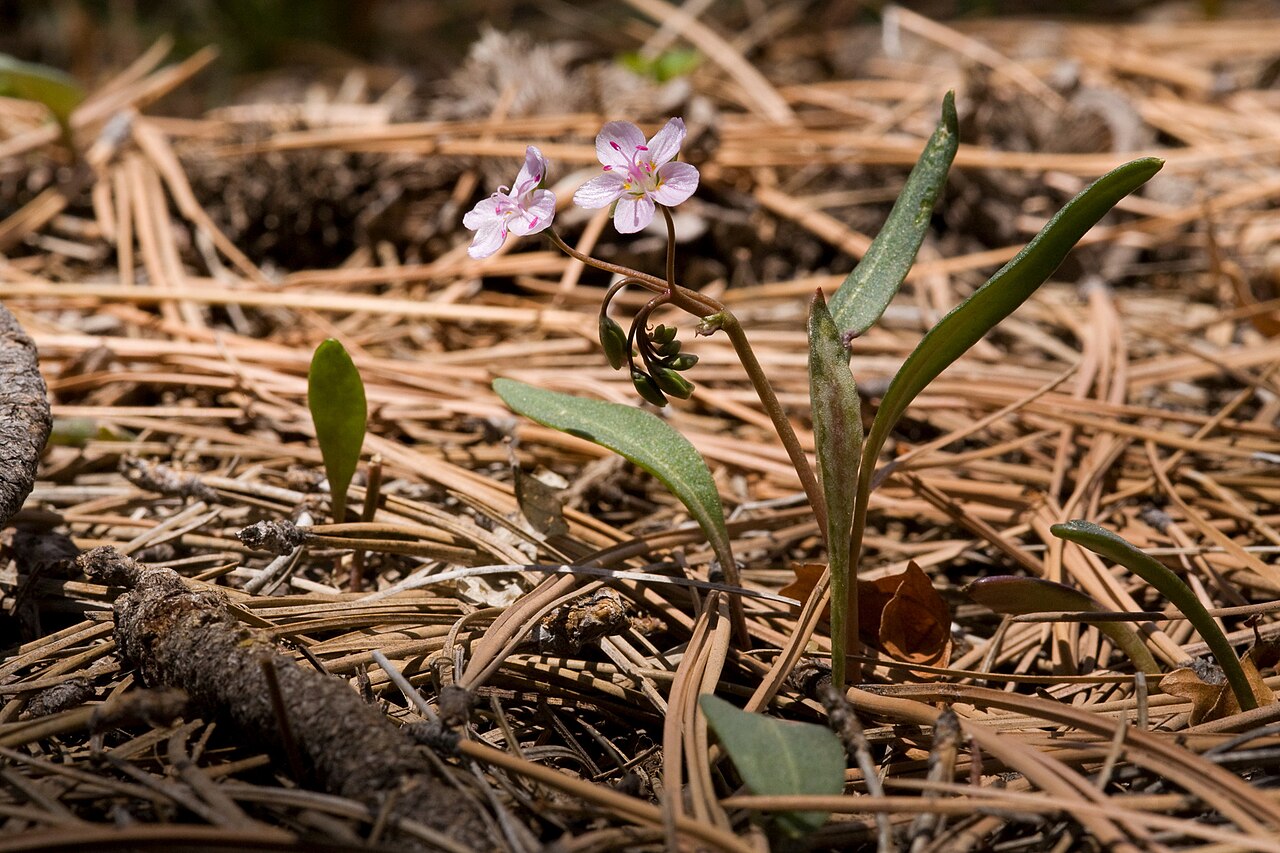
Claytonia rosea, known as Madrean Springbeauty, western springbeauty or Rocky Mountain springbeauty, is a small spring ephemeral of the miner’s lettuce family (Montiaceae). It grows from a small round underground tuber and sends up a few narrow leaves and short stems of pink to white, five-petaled flowers, usually only 2 to 6 inches tall.
It is one of the earliest wildflowers of spring in the pine and oak forests of the Southwest and southern Rocky Mountains. It blooms from February to May, depending on elevation, often right after the snow melts, and dies back to its tuber by early summer. Its range runs from the Colorado Front Range and southern Utah through Arizona and New Mexico into the Sierra Madre of Mexico, which gives it the name Madrean.
Madrean springbeauty is rarely offered by nurseries. It is best enjoyed in the wild or encouraged where it already grows under pines and oaks. Leave wild plants and their tubers in the ground.
Identification
In early spring, look on the ground under ponderosa pines and oaks for tiny clumps with one or two grass-like leaves, a pair of narrow leaves partway up the stem, and pink-veined, five-petaled flowers.
Growth Habit
It is a low, hairless perennial from a deep, round tuber. Each plant sends up one to several slender, often reclining flowering stems 2 to 6 inches long. The whole plant above ground lasts only a few weeks in spring before withering.
Leaves
There are usually one or two basal leaves that are long, narrow and grass-like to narrowly lance-shaped, and they are sometimes absent at flowering. Partway up each flowering stem is a single pair of opposite, stalkless leaves that are linear to narrowly lance-shaped. The leaves are smooth and somewhat fleshy.
Flowers
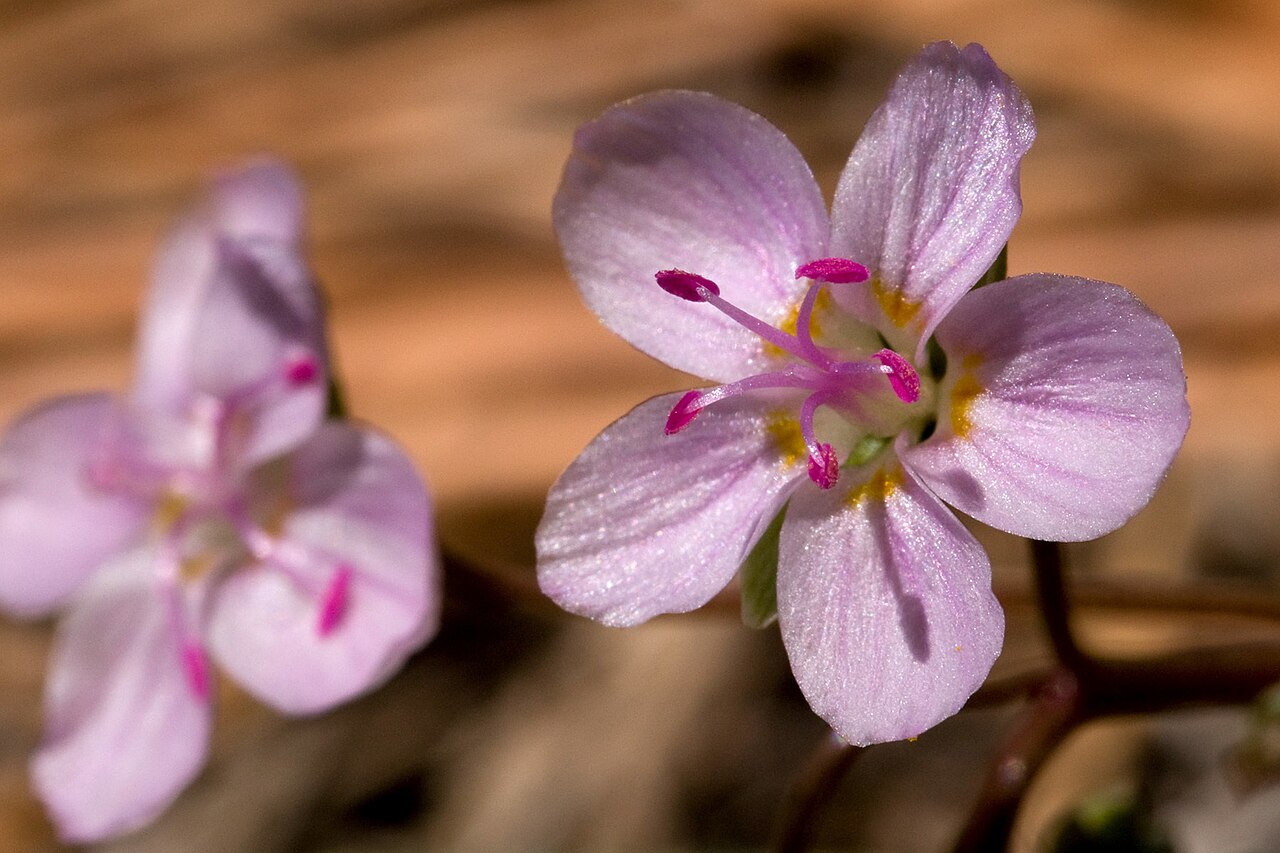
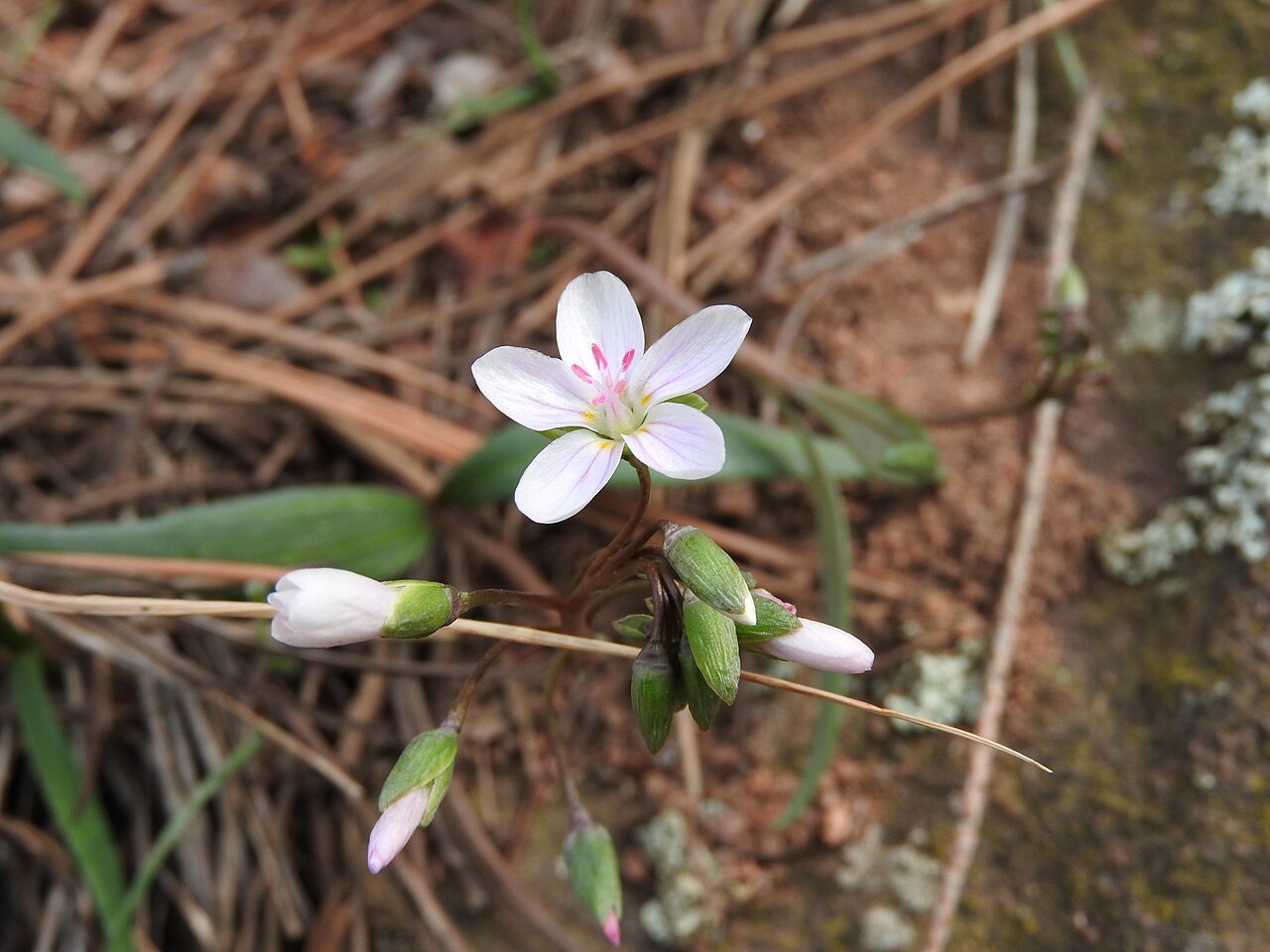
Flowers are borne in a short, loose cluster at the stem tip and open one after another. Each is about 1/2 inch across, with two green sepals and five petals that range from white to pale pink to rose-magenta, usually with darker pink veins. The stamens have pink anthers. Bloom time is February to May.
Fruit
The fruit is a small, round capsule that splits to release a few shiny black seeds. As in other springbeauties, the seeds are flung a short distance as the capsule dries, and ants may carry them farther.
Look-alikes
lanceleaf springbeauty (Claytonia lanceolata) grows at higher elevations farther north and west and has broader, lance-shaped to oval stem leaves, often with white flowers. Madrean springbeauty was once treated as a variety of it. Its very narrow stem leaves, pinkish flowers and lower-elevation pine and oak habitat in the Southwest help tell it apart.
Quick Facts
| Scientific Name | Claytonia rosea (syn. Claytonia lanceolata var. rosea) |
| Family | Montiaceae (miner’s lettuce family; formerly Portulacaceae) |
| Plant Type | Herbaceous perennial spring ephemeral from a tuber |
| Mature Height | 2–6 in |
| Mature Spread | 2–4 in |
| Growth Rate | Slow (summer-dormant) |
| Sun Exposure | Full sun to part shade (sun in early spring) |
| Water Needs | Moist in spring, dry in summer |
| Soil Type | Well-drained gravelly or sandy loam, forest litter |
| Soil pH | Slightly acidic to neutral (about 6.0–7.5) |
| Bloom Time | February–May |
| Flower Color | White to pink or rose-magenta with darker veins |
| Fall Color | None (dormant by early summer) |
| Fruit | Small capsule with shiny black seeds |
| Deer Resistant | Moderate; deer and elk may graze it |
| USDA Hardiness Zones | 4–8 |
Native Range
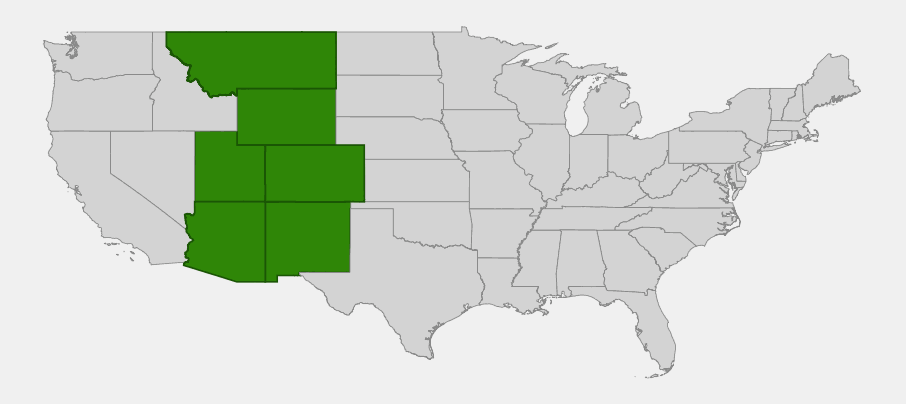
Madrean springbeauty is native to the Southwest and the southern Rocky Mountains. USDA PLANTS lists it as native in Arizona, Colorado, Montana, New Mexico, Utah and Wyoming. It also grows south into the Sierra Madre Occidental and northern Mexico, east to the mountains of Coahuila.
It is most common along the Colorado Front Range foothills and in the mountains of Arizona, New Mexico, southern Utah and southwestern Colorado. Records from Wyoming are few and lie at the northern edge of its range, and the Montana record in USDA PLANTS is an outlying report.
It grows on hillsides, mesas, dry meadows and open slopes in montane forests of ponderosa and Chihuahuan pine and oak, and on moist ledges of mountain slopes, from roughly 5,000 to 9,000 feet. It often comes up through pine needle litter soon after snowmelt.
📋 Regional plant lists featuring Madrean Springbeauty: Arizona & New Mexico · Utah & Western Colorado · Montana & Wyoming
Growing & Care Guide
Madrean springbeauty is a wildflower to protect more than to plant. It is rarely sold, and wild plants should never be dug. Where it already grows on your land, it is easy to keep: leave the pine litter, avoid summer watering and don’t disturb the soil.
Light
Full sun to part shade. It grows in early spring, when the open pine canopy lets in plenty of light, and is dormant before summer shade or heat matters.
Soil & Water
Well-drained, gravelly or sandy loam with natural leaf and needle litter. It needs moisture from snowmelt and spring rain while in growth, then a dry summer dormancy. Regular summer irrigation can rot the tubers.
Planting Tips
Sow seed where you want plants, in naturalistic plantings under pines or oaks, in rock gardens or among bunchgrasses. Mark the spot so the dormant tubers aren’t dug up later. Only use seed or plants from legitimate, propagated sources.
Pruning & Maintenance
None needed. Let the foliage wither on its own so the tuber can store energy for next spring, and leave needle litter in place as natural mulch.
Propagation
Grow from fresh seed sown outdoors in fall, so winter cold and moisture break dormancy. Seedlings take a few years to form tubers large enough to bloom.
Landscape Uses
- Rock gardens: tiny early flowers among stones and gravel
- Ponderosa pine woodland gardens: one of the first signs of spring under pines
- Naturalized areas: leave existing colonies undisturbed
- Early pollinator food: nectar and pollen when little else is open
- Wildflower walks: a classic early-spring find in Southwestern forests
Wildlife & Ecological Value
As one of the first flowers after snowmelt, Madrean springbeauty matters to wildlife out of proportion to its size.
For Pollinators
The flowers feed early-flying native bees, including small mining and sweat bees, as well as flies and early butterflies. The pink nectar guides on the petals lead insects to the nectar at the flower’s center.
For Birds
Ground-foraging birds may eat the seeds, and birds take insects that visit the flowers.
For Mammals
Pocket gophers, ground squirrels and other rodents dig and eat the starchy tubers, and deer and elk may graze the early green shoots.
Ecosystem Role
Spring ephemerals like this one take up nutrients and produce food early in the year, before larger plants leaf out, and return them to the soil as their leaves wither. Their early nectar helps queen bumble bees and solitary bees start their nests.
Cultural & Historical Uses
The genus Claytonia honors John Clayton, an eighteenth-century botanist in colonial Virginia whose plant collections were described by Gronovius and Linnaeus. The species name rosea means rosy and refers to the pink flowers.
Springbeauties’ small starchy tubers, sometimes called Indian potatoes, were a traditional spring food for many Indigenous peoples of western North America. They were dug and eaten raw, boiled or roasted. Taking tubers kills the plant, so they should be left alone today.
Swedish-American botanist Per Axel Rydberg named Claytonia rosea in the early 1900s. Later botanists often merged it into Claytonia lanceolata, but modern treatments again recognize it as a separate species of the Southwest and Mexico.
Frequently Asked Questions
When does Madrean springbeauty bloom?
From February to May. It blooms earlier at lower elevations, often soon after the snow melts under pines.
Why does Madrean springbeauty disappear in summer?
It is a spring ephemeral. Its leaves and flowers wither by early summer, and the plant survives underground as a small tuber until the next spring.
How is it different from lanceleaf springbeauty?
Madrean springbeauty has very narrow, linear stem leaves and usually pink flowers, and it grows in Southwestern pine and oak forests. Lanceleaf springbeauty has broader stem leaves and grows farther north and higher.
Can I grow Madrean springbeauty in my garden?
It is rarely sold. It can be grown from responsibly collected seed in well-drained soil with a dry summer, but never dig plants or tubers from the wild.
Where can I see Madrean springbeauty?
Look in early spring in open ponderosa pine and oak forests of the Colorado Front Range, northern Arizona, New Mexico and southern Utah.


