
Fremont Barberry (Mahonia fremontii)
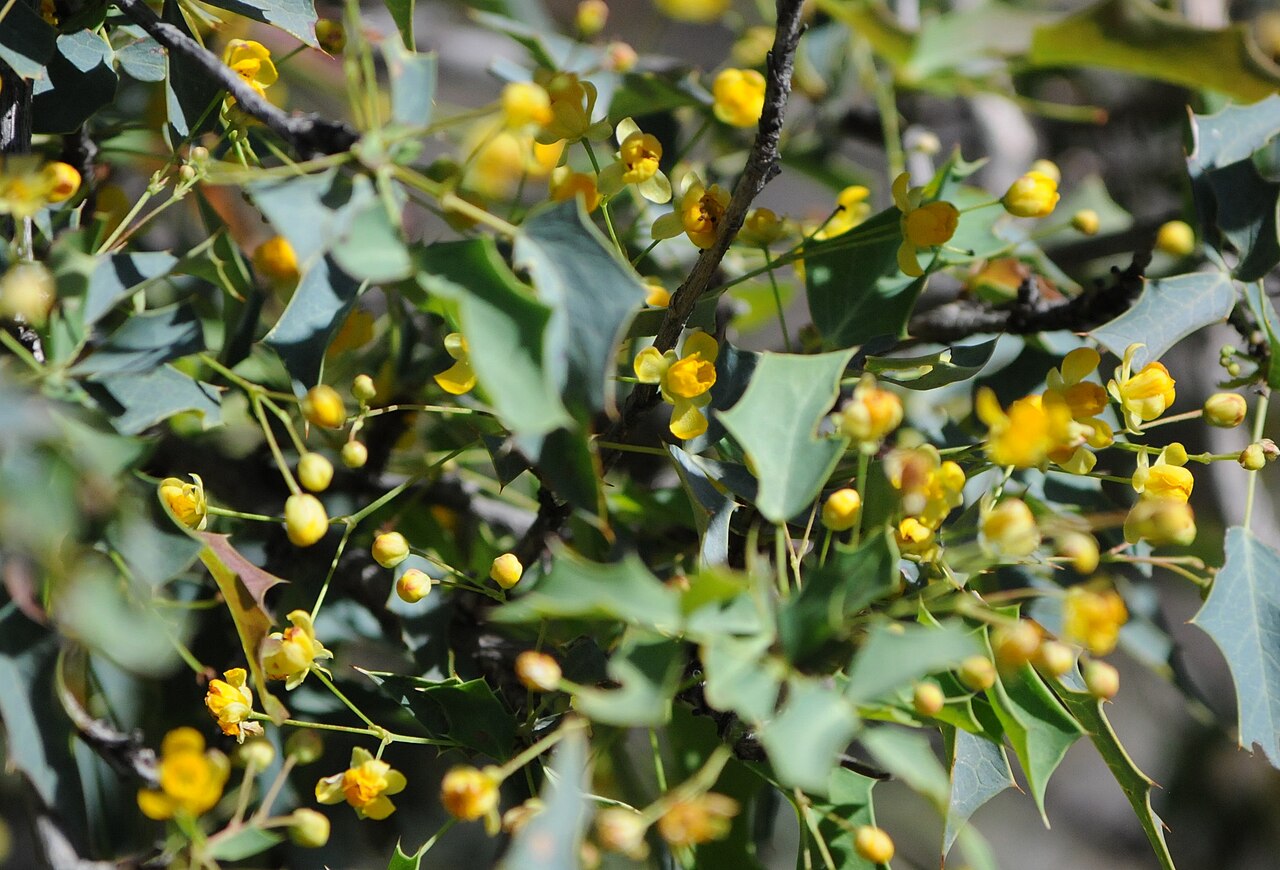
Mahonia fremontii, known as Fremont Barberry or Fremont’s mahonia (the USDA PLANTS name), is an evergreen shrub of the desert mountains and canyon country of the American Southwest. It forms a stiff, rounded to upright shrub usually 3 to 8 feet tall, with small, holly-like, blue-gray leaflets edged in sharp spines. In spring it is covered with clusters of bright yellow, fragrant flowers, followed by round berries that ripen from yellowish to red, purple or nearly black.
It belongs to the barberry family (Berberidaceae). Botanists have long debated whether the evergreen, compound-leaved barberries belong in their own genus, Mahonia, or in Berberis. USDA PLANTS uses Mahonia fremontii, while many recent floras, including Plants of the World Online, call it Berberis fremontii. Both names refer to the same plant. It is named for the explorer John C. Frémont, whose expeditions collected many western plants.
In the wild, Fremont barberry grows on dry, rocky slopes, canyon rims and washes in pinyon-juniper woodland and desert grassland, from the Colorado Plateau of Utah and western Colorado to Arizona, New Mexico, southern Nevada and the desert mountains of eastern California. It is one of the most ornamental drought-tolerant shrubs of the region, and it makes an excellent wildlife-friendly barrier hedge. This guide covers identification, range, growing it in dry gardens, and its value to pollinators and birds.
Identification
Fremont barberry is easy to recognize by its combination of blue-gray, spiny, holly-like leaflets, yellow spring flowers, and an upright woody habit. A few related shrubs in the Southwest look similar, so the shape and number of the leaflets are worth checking.
Form & Bark
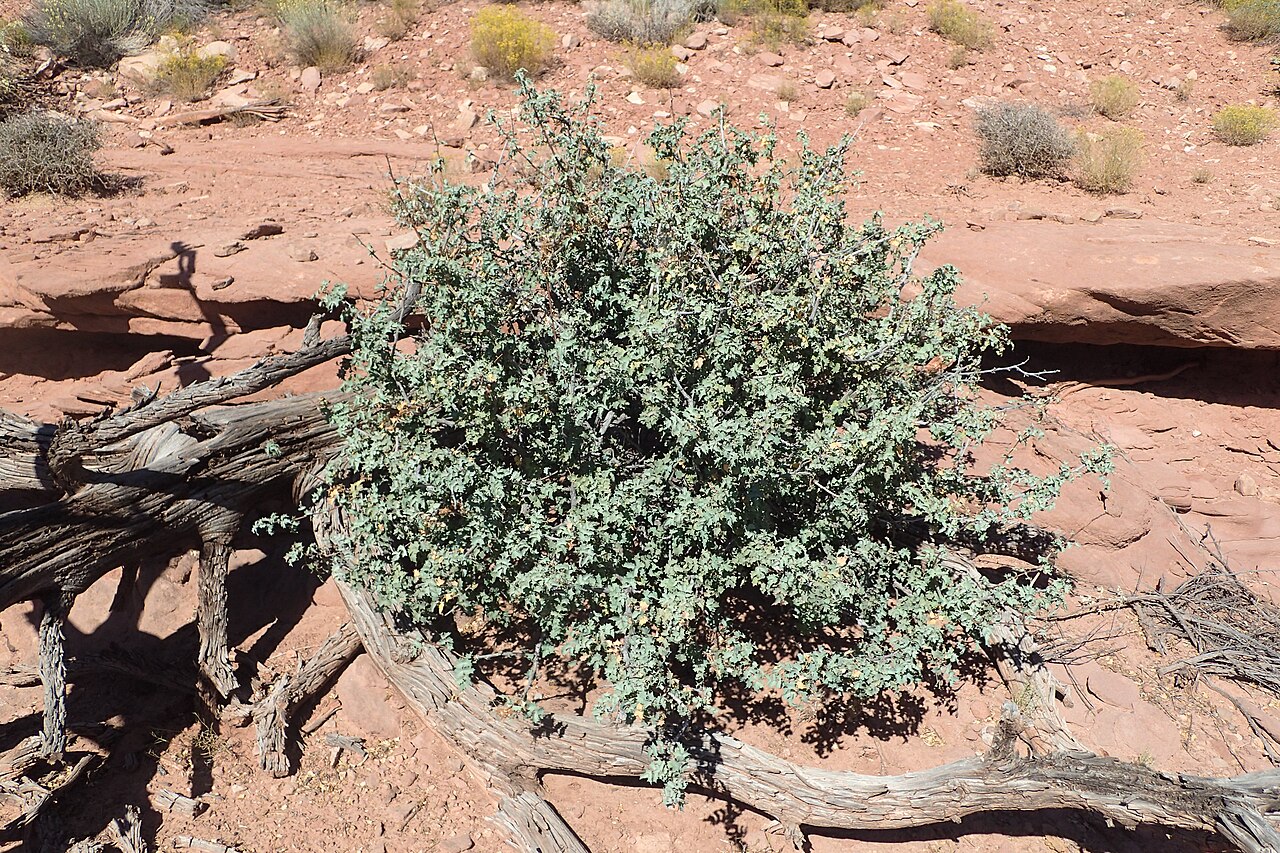
It is a stiff, densely branched evergreen shrub, usually 3 to 8 feet tall and about as wide, sometimes reaching 12 to 15 feet in sheltered canyons. The stems are upright and woody, with gray to brownish bark. The inner wood and roots are bright yellow, a feature shared by most barberries.
Leaves
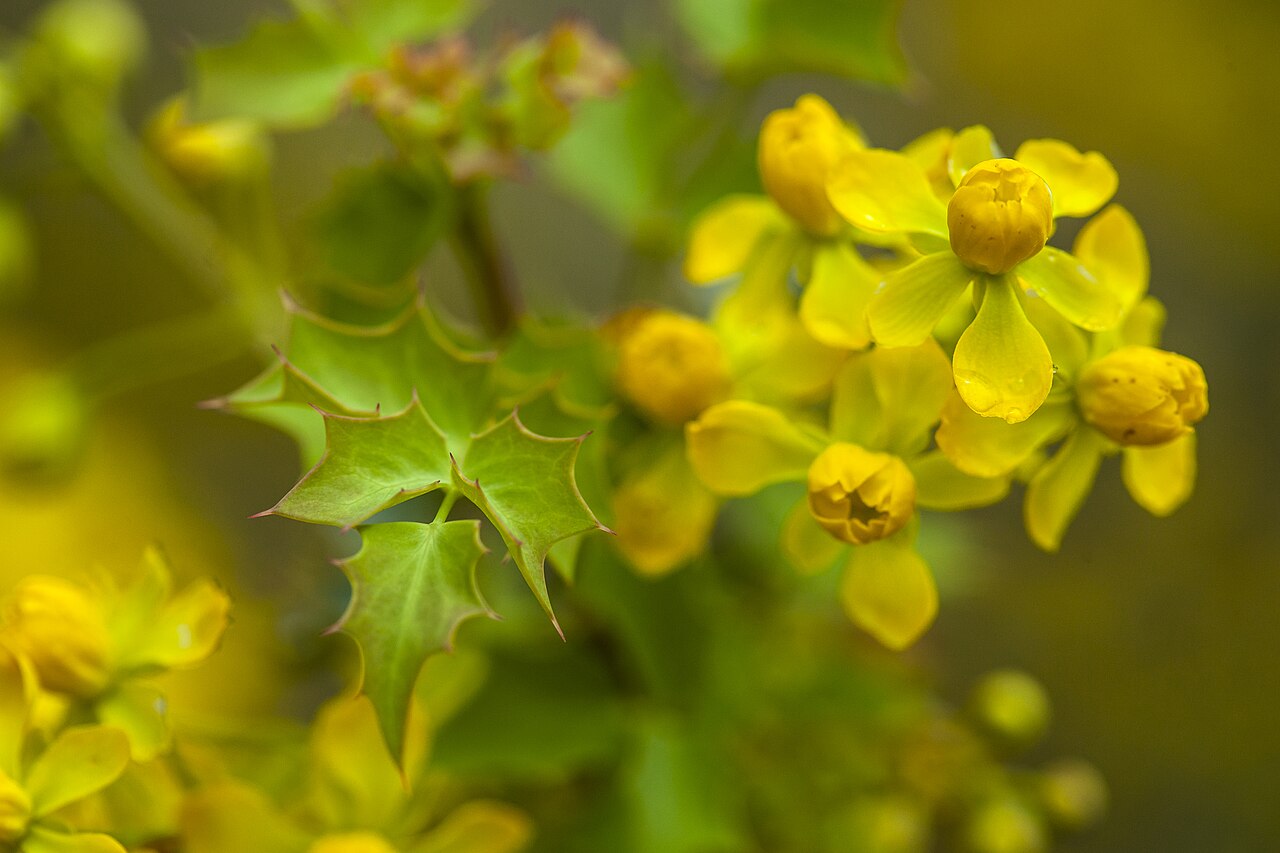
The leaves are pinnately compound, usually with 3 to 7 (most often 5) leaflets. Each leaflet is thick and leathery, about ½ to 1 inch long, oval to lance-shaped, and edged with a few large, sharp, spine-tipped teeth, much like a small holly leaf. New leaves are often purplish, mature leaves are blue-green to gray-green with a waxy bloom, and older leaves become distinctly bluish. The foliage stays on the plant all year.
Flowers
In spring, usually from April to June depending on elevation, short clusters of about 5 to 12 bright yellow flowers appear along the branches. Each flower is cup-shaped and about ½ inch across, with nine petal-like sepals and six petals arranged in whorls of three. They have a sweet scent, and a shrub in full bloom can be covered in yellow.
Fruit
The fruit is a round to egg-shaped berry about ½ inch across. It ripens in summer from yellowish or reddish to purple or nearly black. When ripe the berries are often somewhat dry and inflated rather than juicy, with a few seeds inside.
Look-alikes
Agarita (Mahonia trifoliolata) of Texas and southern New Mexico usually has just 3 narrow, very spiny leaflets per leaf and red, juicy berries. Creeping Oregon Grape (Mahonia repens) is a low groundcover of mountain forests with larger, less spiny leaflets and dark blue berries. Red barberry (Mahonia haematocarpa) of the desert Southwest is very similar to Fremont barberry but has narrower leaflets and juicy red berries.
Quick Facts
| Scientific Name | Mahonia fremontii (Torr.) Fedde (syn. Berberis fremontii Torr.); USDA common name Fremont’s mahonia |
| Family | Berberidaceae (barberry family) |
| Plant Type | Evergreen shrub |
| Mature Height | 3–8 ft (occasionally to 12–15 ft) |
| Mature Spread | 3–6 ft |
| Growth Rate | Slow to moderate |
| Sun Exposure | Full sun to part shade |
| Water Needs | Low; very drought tolerant once established |
| Soil Type | Dry, rocky, gravelly or sandy soil with excellent drainage |
| Soil pH | About 6.5–8.5 (tolerates alkaline soils) |
| Bloom Time | April–June |
| Flower Color | Bright yellow |
| Fall Color | Evergreen; blue-gray foliage, often purplish in cold weather |
| Fruit | Round berry, yellowish to red, purple or nearly black, ripening in summer |
| Deer Resistant | Yes; the spiny leaves discourage browsing |
| USDA Hardiness Zones | 5–9 |
Native Range
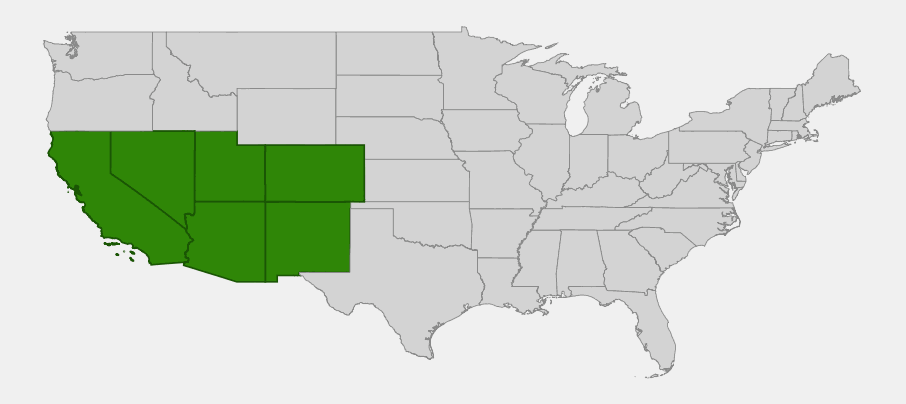
Fremont barberry is a plant of the interior Southwest. USDA PLANTS records it as native in six states: Arizona, California, Colorado, Nevada, New Mexico and Utah. Its heartland is the Colorado Plateau, including the canyon country of southern and eastern Utah, western Colorado, northern Arizona and northwestern New Mexico, where it is a familiar shrub in national parks such as Arches, Canyonlands, Capitol Reef and Mesa Verde.
From the plateau it extends south through the mountains of central Arizona, including the Superstition Mountains, and into New Mexico. In the west it reaches southern Nevada and the desert mountains of eastern California, where it is uncommon and limited to a few ranges in the Mojave Desert region.
It grows mostly between about 3,000 and 7,000 feet, on dry, rocky slopes, canyon walls and rims, sandstone ledges, mesas and gravelly washes. Typical settings are pinyon-juniper woodland, desert grassland and the upper edge of desert scrub, often in the partial shelter of rocks or other shrubs.
📋 Regional plant lists featuring Fremont Barberry: Arizona & New Mexico · California & Nevada · Utah & Western Colorado
Growing & Care Guide
Fremont barberry is a tough, long-lived shrub for dry gardens in the Southwest and the Intermountain West. It asks for little water once established, it looks good all year, and its spring bloom is spectacular. Its main needs are sharp drainage and patience, since it grows slowly at first.
Light
Plant it in full sun for the densest growth and heaviest bloom. It also grows well in part shade, especially in hot low-desert gardens, where afternoon shade helps it look its best.
Soil & Water
It needs well-drained soil: rocky, gravelly or sandy soils are ideal, and it tolerates alkaline and calcareous soils. Avoid heavy, wet clay and low spots where water collects, which can cause root rot. Water regularly during the first year or two, then reduce to deep, occasional watering in long summer droughts. Established plants in their native range often survive on rainfall alone.
Planting Tips
Plant container-grown shrubs in fall or early spring. Give it room for its mature width and keep it away from walkways, because the leaflets are sharply spiny. It is excellent as an informal barrier or security hedge, as a specimen against rocks, or mixed with other dry-country shrubs. Wear gloves when handling it.
Pruning & Maintenance
Little pruning is needed. Remove dead or crossing branches after flowering, and cut back older stems near the base if the shrub becomes leggy. It needs no fertilizer and has few pests. In grain-growing areas, note that some barberries are alternate hosts of wheat stem rust, and western barberries have historically been regarded with suspicion by farmers.
Propagation
Grow it from seed cleaned from ripe berries and sown outdoors in fall, or given 2 to 3 months of cold, moist stratification before spring sowing. Germination is often slow and uneven. Cuttings are difficult to root, so most nursery plants are grown from seed.
Landscape Uses
- Xeriscapes and dry gardens: an evergreen shrub that needs little water once established
- Barrier and security hedges: spiny leaflets make a dense, wildlife-friendly barrier
- Rock gardens and slopes: blue-gray foliage contrasts with red rock and gravel
- Wildlife gardens: spring flowers for bees and summer berries for birds
- Habitat restoration: pinyon-juniper and desert grassland plantings in its range
Wildlife & Ecological Value
Fremont barberry is a useful wildlife plant in dry country, offering early nectar, summer fruit and dense, spiny cover year-round.
For Pollinators
The fragrant yellow flowers attract native bees, including bumble bees and smaller solitary bees, as well as flies and butterflies. Like other barberries, the stamens snap inward when touched at the base, dusting visiting insects with pollen.
For Birds
Fruit-eating songbirds of pinyon-juniper country eat the berries and help spread the seeds. The dense, spiny branches give nesting and roosting birds good protection from predators.
For Mammals
Small mammals eat the fallen berries and shelter under the shrub. The spiny evergreen leaves are browsed very little by deer, which makes it a good choice for gardens with deer pressure.
Ecosystem Role
In pinyon-juniper woodlands and on canyon slopes, Fremont barberry adds evergreen cover and helps hold rocky soils. Its early flowers support bees at a season when few other shrubs are in bloom, and its fruits are a food source in late summer when water and food are scarce.
Cultural & Historical Uses
Several Indigenous peoples of the Southwest used Fremont barberry. The Zuni used the crushed berries as a purple coloring for the skin and for ceremonial objects. The bright yellow roots and inner bark, like those of other barberries, were used as a yellow dye for baskets and other materials. The berries were eaten fresh or dried by some groups, though they are rather dry and sour.
The species was named by the botanist John Torrey in honor of John C. Frémont, whose expeditions through the West in the 1840s collected the type specimen. The name Mahonia honors the 19th-century American horticulturist Bernard McMahon, who helped distribute plants from the Lewis and Clark expedition.
Like other barberries, Fremont barberry contains berberine and related alkaloids, mostly in the roots and bark. These compounds give the wood its yellow color. The roots should not be used as a home remedy, and the plant is best valued as an ornamental and wildlife shrub.
Frequently Asked Questions
Is Fremont barberry the same as Berberis fremontii?
Yes. USDA PLANTS uses the name Mahonia fremontii, and many recent floras use Berberis fremontii. Both refer to the same Southwestern shrub. USDA’s common name is Fremont’s mahonia.
Is Fremont barberry drought tolerant?
Very. It grows on dry rocky slopes in pinyon-juniper woodland and desert grassland, and once established it needs only occasional deep watering in long droughts. Good drainage is more important than extra water.
Are Fremont barberry berries edible?
The berries have been eaten by people in the Southwest, but they are small, dry and sour, and the roots and bark contain alkaloids. They are better left for the birds.
Is Fremont barberry deer resistant?
Yes. Its stiff, spiny leaflets discourage deer, and it is seldom browsed.
When does Fremont barberry bloom?
Usually from April to June, depending on elevation. The bright yellow, fragrant flowers can cover the shrub, and berries ripen in summer.

Looking for a nursery that carries Fremont Barberry?
Browse our native plant nursery directory: Arizona · California · Colorado · Nevada & New Mexico · Utah

