
Big Deervetch (Lotus crassifolius)
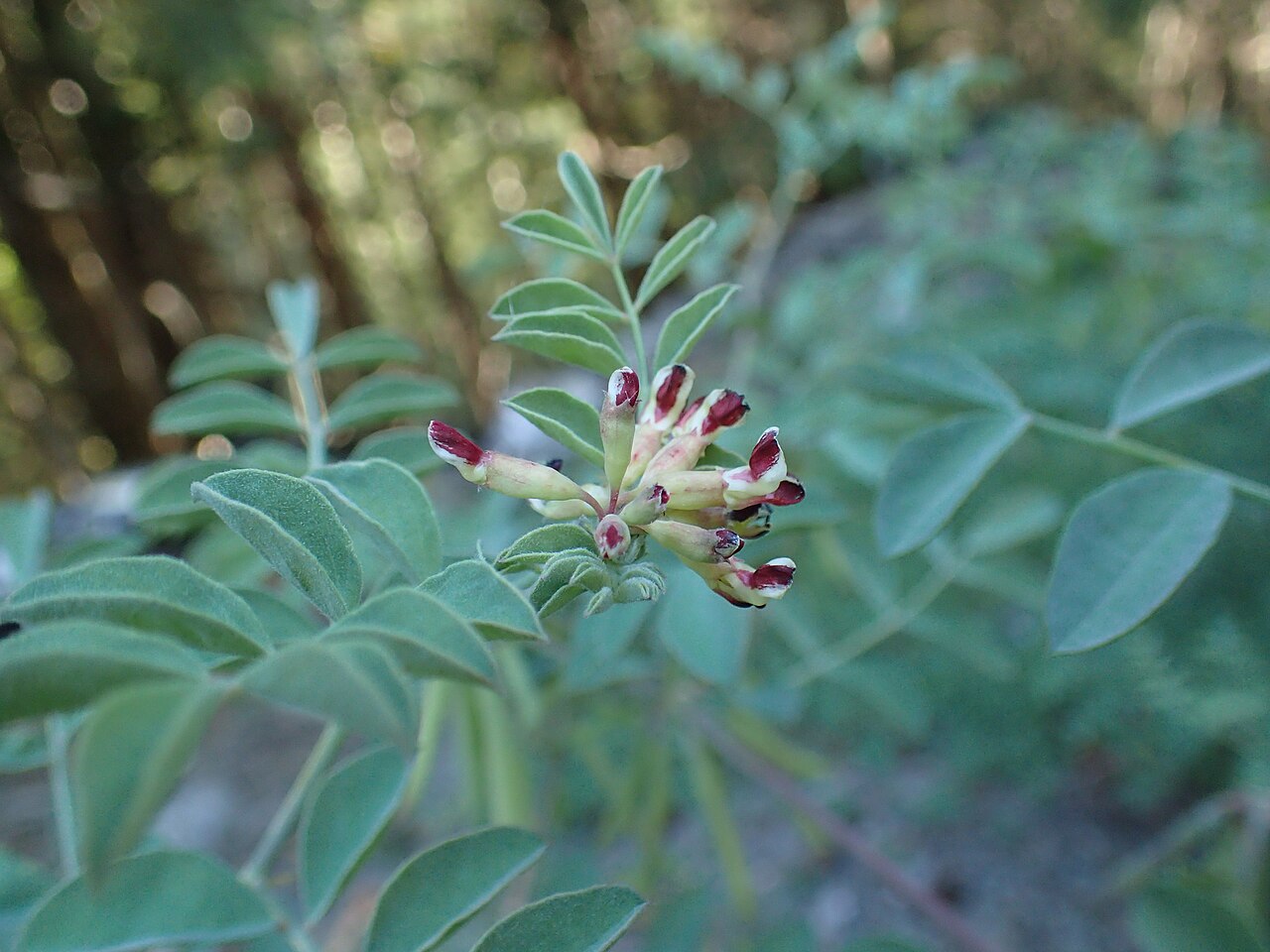
Lotus crassifolius, known as Big Deervetch or broad-leaved lotus, is a robust native legume of the mountains and foothills of the Pacific states. It is a long-lived perennial with thick, hollow stems that sprawl or stand up to 3 to 5 feet long, carrying pinnate leaves of fleshy, blue-green, oval leaflets. From spring into summer it bears rounded clusters of small pea flowers, cream to greenish-yellow and usually marked with deep red or purple, followed by long, slender pods.
It belongs to the pea family (Fabaceae). USDA PLANTS lists it as Lotus crassifolius, but most western botanists, including the Jepson flora of California, now place it in the genus Hosackia as Hosackia crassifolia, separating the native western “lotuses” from the Old World bird’s-foot trefoils. The species name crassifolius means “thick-leaved.” The common name deervetch refers to how readily deer browse this group of plants.
Big deervetch grows from Washington and Oregon south through the Cascades, Klamath Mountains, Coast Ranges and Sierra Nevada to southern California and northern Baja California. It is a plant of open conifer and mixed forests, oak woodland and chaparral, and it often thrives on disturbed ground such as roadsides, burns and logged slopes. This guide covers how to identify it, where it grows, how to use it in native plantings, and its value as a nitrogen-fixing wildlife plant.
Identification
Big deervetch is the largest of the native western Lotus and Hosackia species. Its size, its thick, blue-green leaflets and its dense clusters of two-toned flowers make it fairly easy to recognize.
Stems & Form
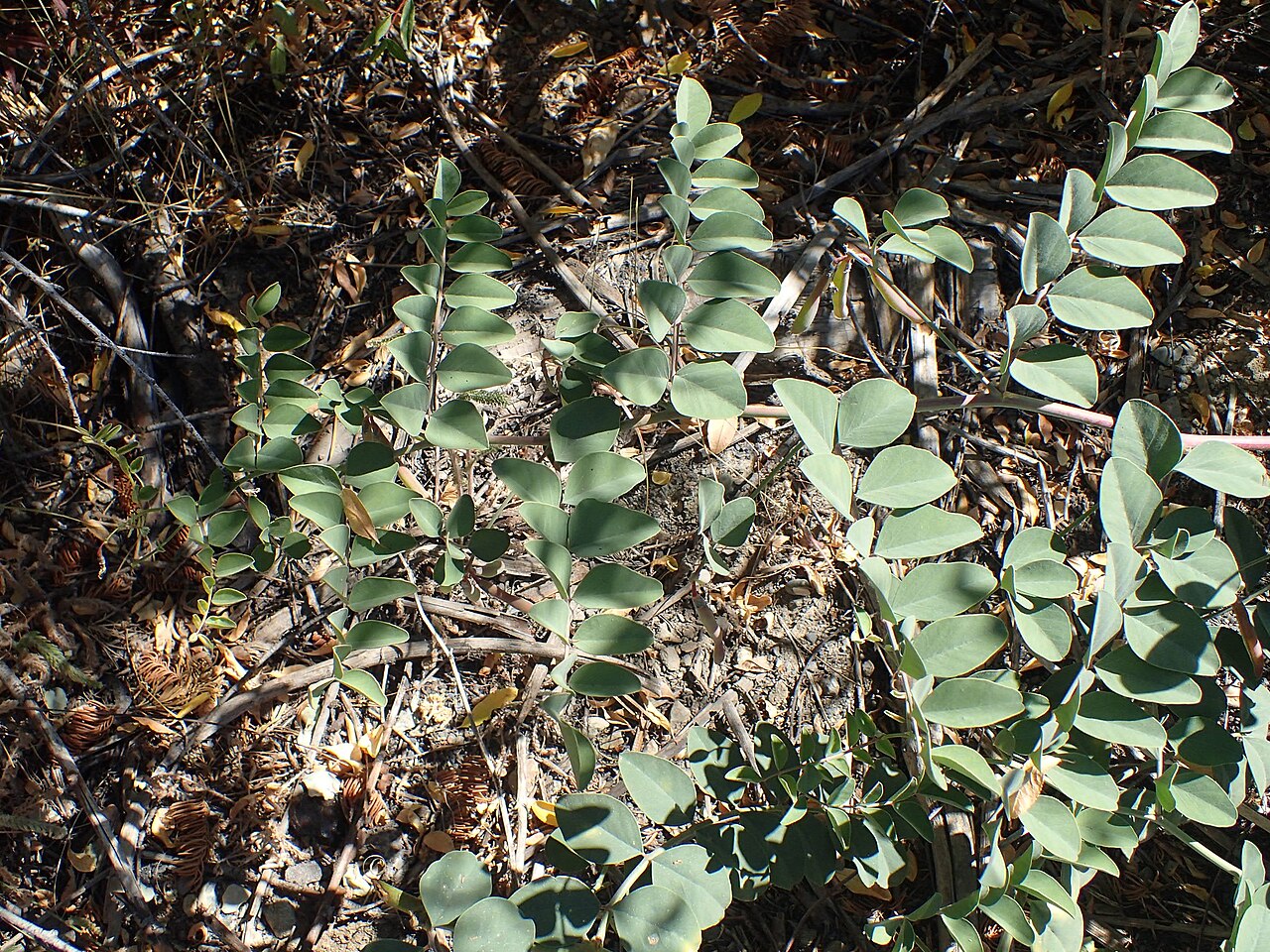
It grows from a deep, woody root crown and produces several to many thick, hollow, smooth stems each year. The stems may stand upright when supported by shrubs or spread loosely over the ground, reaching about 3 to 5 feet long. A large plant forms a loose, bushy clump several feet across. The stems die back to the crown in winter in colder areas.
Leaves
The leaves are pinnately compound, with about 7 to 15 oval to rounded leaflets, each roughly ½ to 1½ inches long. The leaflets are thick, somewhat fleshy and smooth, and they have a blue-green or grayish cast. A pair of small, gland-like stipules sits at the base of each leaf.
Flowers
The flowers are carried in rounded clusters (umbels) of about 10 to 20 at the end of long stalks that arise from the leaf axils. Each flower is a small pea flower about ½ inch long, with a banner, two wings and a keel. Flower color varies: most are cream, whitish or greenish-yellow, marked or tinged with deep red to purple, especially on the banner, and some plants have pinker or yellower flowers. Bloom runs from spring into summer, depending on elevation.
Fruit & Seeds
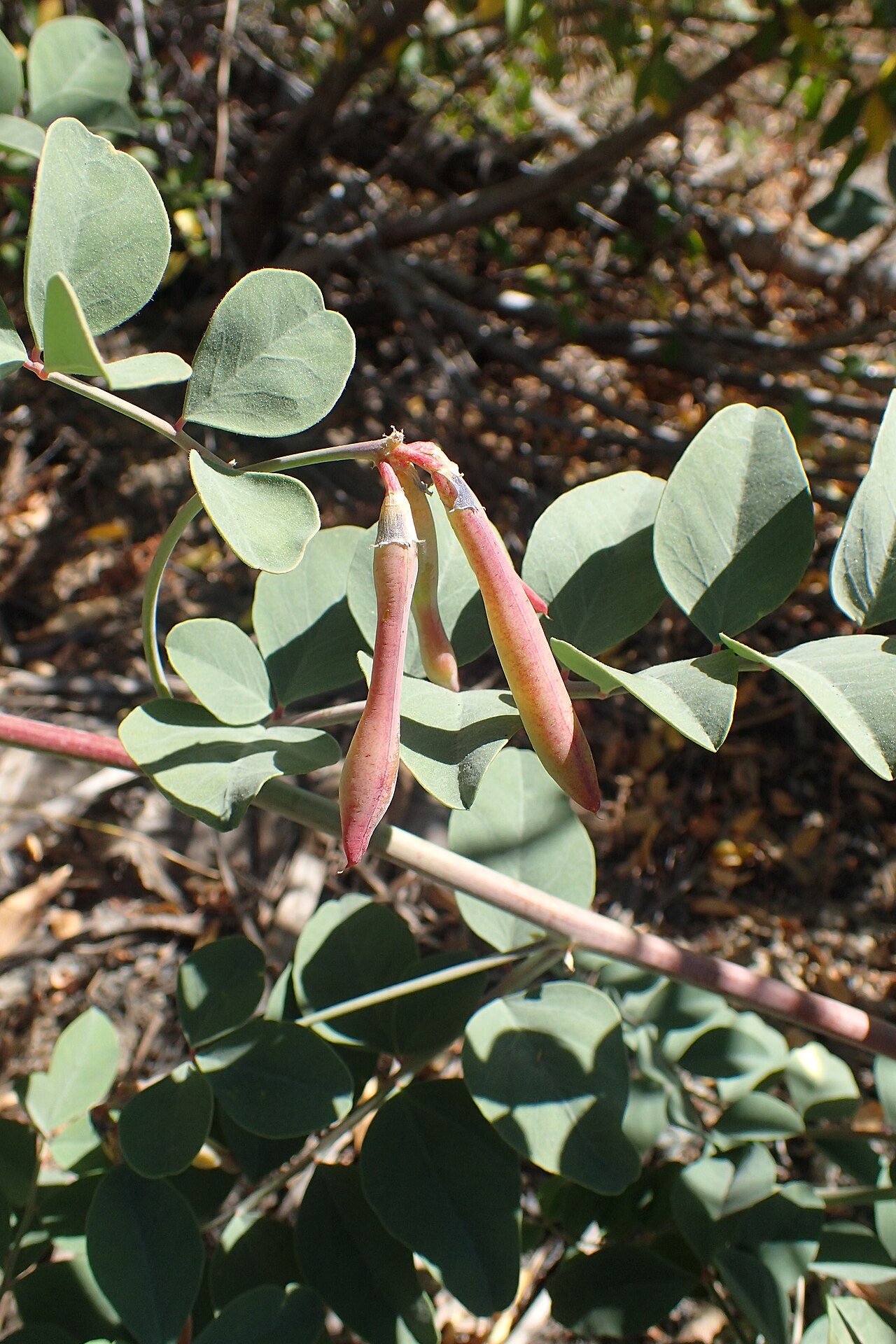
The fruit is a long, straight, slender pod, about 1½ to 2½ inches long, often reddish as it matures and brown when dry. Each pod holds a row of small seeds, which are often speckled. The pods split open when dry, scattering the seeds near the parent plant.
Look-alikes
Witch’s Teeth (Lotus formosissimus, also called Hosackia gracilis) is a smaller plant of wet coastal meadows with pink and yellow flowers. Other western deervetches, such as Spanish lotus (Acmispon americanus) and the many Acmispon species, have much smaller leaves with only a few leaflets and solitary or few flowers. Introduced bird’s-foot trefoil (Lotus corniculatus) has bright yellow flowers and only five leaflets.
Quick Facts
| Scientific Name | Lotus crassifolius (Benth.) Greene (syn. Hosackia crassifolia Benth.); USDA common name big deervetch |
| Family | Fabaceae (pea family) |
| Plant Type | Herbaceous perennial legume from a woody root crown |
| Mature Height | 1–3 ft (stems sprawling to erect, up to about 5 ft long) |
| Mature Spread | 2–4 ft |
| Growth Rate | Moderate to fast |
| Sun Exposure | Full sun to part shade |
| Water Needs | Low to moderate; dry to moderately moist, well-drained soil |
| Soil Type | Sandy, gravelly or rocky loam; often on disturbed soil |
| Soil pH | About 5.5–7.5 |
| Bloom Time | April–August (spring to summer, depending on elevation) |
| Flower Color | Cream to greenish-yellow, marked with deep red to purple |
| Fall Color | None notable; stems die back in winter |
| Fruit | Long, slender pod with small seeds |
| Deer Resistant | No; readily browsed by deer |
| USDA Hardiness Zones | 6–9 |
Native Range
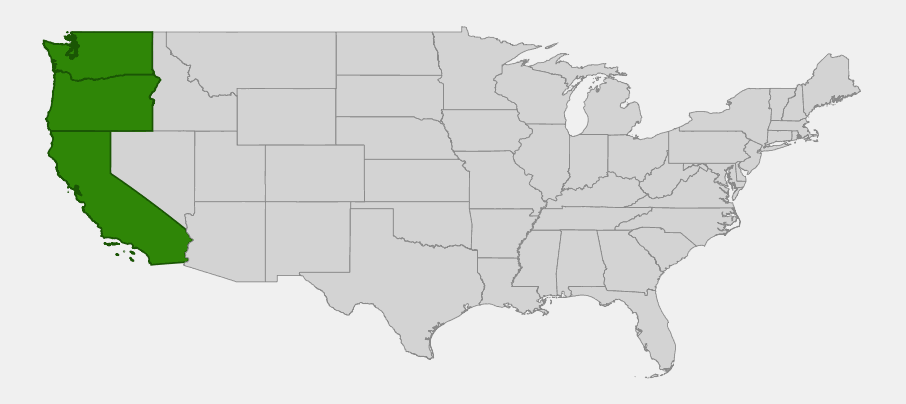
Big deervetch is a plant of the Pacific Coast states. USDA PLANTS records it as native in California, Oregon and Washington, and its range continues south into northern Baja California, Mexico. It is most common in California, where it grows in nearly every major mountain range from the Klamath and North Coast Ranges through the Sierra Nevada to the Transverse and Peninsular Ranges.
In Oregon it grows in the Siskiyou and Klamath Mountains, the Coast Range and the Cascades, and in Washington it reaches the southern Cascades. Most populations are west of the Cascade crest or on its slopes. A rare, separate variety, Otay Mountain lotus (var. otayensis), is known only from Otay Mountain in San Diego County, California.
Big deervetch grows in many plant communities, including chaparral, oak woodland, mixed evergreen forest and open conifer forests of ponderosa pine, Douglas-fir and other trees. It favors sunny openings, forest edges, roadsides, stream terraces and recently burned or logged areas, from the foothills up to about 8,500 feet.
📋 Regional plant lists featuring Big Deervetch: California & Nevada · Western Oregon & Western Washington · Idaho, Eastern Oregon & Eastern Washington
Growing & Care Guide
Big deervetch is seldom sold as a garden plant, but it is a valuable species for restoration and for informal, wildlife-friendly plantings in its native range. It is tough, fixes its own nitrogen, and quickly covers disturbed ground.
Light
It grows best in full sun or light part shade, as in open forest edges. In deep shade it becomes sparse and flowers poorly.
Soil & Water
Plant it in well-drained sandy, gravelly or rocky soil. It does not need rich soil, because, like other legumes, it hosts nitrogen-fixing bacteria in its root nodules. Water seedlings and new plants until they are established. Mature plants are fairly drought tolerant, relying on a deep root, though they stay greener and bloom longer with occasional summer moisture.
Planting Tips
Sow seed or set out young plants in fall or early spring. Give each plant room to sprawl, or let it scramble up through low shrubs. It works well on slopes, along woodland edges, and in burned or disturbed areas being restored. In gardens with heavy deer pressure, expect it to be browsed.
Pruning & Maintenance
Cut back old stems to the crown in late fall or winter. Otherwise, little maintenance is needed. Avoid fertilizing; it is adapted to poor soils and needs no added nitrogen.
Propagation
Grow it from seed. The seeds have a hard coat, so scarify them lightly (for example, by rubbing with sandpaper) or soak in hot water before sowing to improve germination. Sow in fall outdoors or in spring in deep pots, because the seedlings quickly develop a long taproot and resent transplanting later.
Landscape Uses
- Restoration of burns and disturbed slopes: a fast, nitrogen-fixing native groundcover
- Woodland edge and wildlife gardens: flowers for bees and forage for deer
- Erosion control: deep roots and sprawling stems help hold loose slopes
- Soil improvement: adds nitrogen to poor, disturbed soils
- Native plant collections: showcases the native western Hosackia group
Wildlife & Ecological Value
Big deervetch is an important plant for wildlife in western forests and chaparral, providing nectar and pollen, forage, seeds and soil nitrogen.
For Pollinators
The pea flowers are pollinated mainly by bees, especially bumble bees and other native bees strong enough to push open the keel. Native deervetches as a group are also caterpillar host plants for several small butterflies, including some blues.
For Birds
Quail, grouse and other ground-feeding birds eat legume seeds, and the sprawling stems give cover to ground-foraging birds. The plants also support insects that birds feed to their young.
For Mammals
As its common name suggests, big deervetch is good forage for deer, which browse the leaves and young stems. Livestock and other grazers also eat it. Rodents gather the seeds.
Ecosystem Role
As a nitrogen-fixing legume, big deervetch enriches soils after fire, logging and other disturbance, helping other plants establish. It is one of the early colonizers of burned forest and roadsides in its range, and its deep roots help stabilize loose soil on slopes.
Cultural & Historical Uses
The genus name Hosackia, now used for big deervetch by many western botanists, honors David Hosack (1769–1835), a New York physician and botanist who founded the Elgin Botanic Garden, the first public botanical garden in the United States. He is also remembered as the doctor who attended Alexander Hamilton after his fatal duel.
The species was first described by the English botanist George Bentham as Hosackia crassifolia, and it was later moved into Lotus by Edward Lee Greene. Recent DNA studies showed that the native New World “lotuses” are distinct from the Old World Lotus, so they are now usually divided among Hosackia, Acmispon and other genera.
Big deervetch has no well-documented food or medicinal uses by people. Its main value is ecological: it is a forage plant for deer and livestock, a nitrogen fixer on poor soils, and a common sight along mountain roads and trails of the Pacific states in early summer.
Frequently Asked Questions
Is big deervetch the same as Hosackia crassifolia?
Yes. USDA PLANTS uses Lotus crassifolius, while most western floras, including the Jepson flora of California, now call it Hosackia crassifolia. Both names refer to the same plant.
Why is it called deervetch?
Deer readily browse the leaves and stems of this and related plants, and the plants look somewhat like vetches. The name is used for many native western legumes in the Lotus, Hosackia and Acmispon groups.
Does big deervetch fix nitrogen?
Yes. Like most legumes, it forms root nodules with nitrogen-fixing bacteria, which lets it grow in poor, disturbed soils and enrich them for other plants.
Where does big deervetch grow?
It grows in California, Oregon and Washington, and into northern Baja California, mainly in the mountains and foothills: open conifer and mixed forests, oak woodland, chaparral, forest edges and disturbed areas such as roadsides and burns.
Can I grow big deervetch in my garden?
Yes, in sunny, well-drained spots within its native range, especially in wildlife or restoration plantings. Grow it from scarified seed sown where it will grow, since seedlings develop a long taproot. Deer will browse it.

Looking for a nursery that carries Big Deervetch?
Browse our native plant nursery directory: California · Oregon · Washington

