
Autumn Coralroot (Corallorhiza odontorhiza)
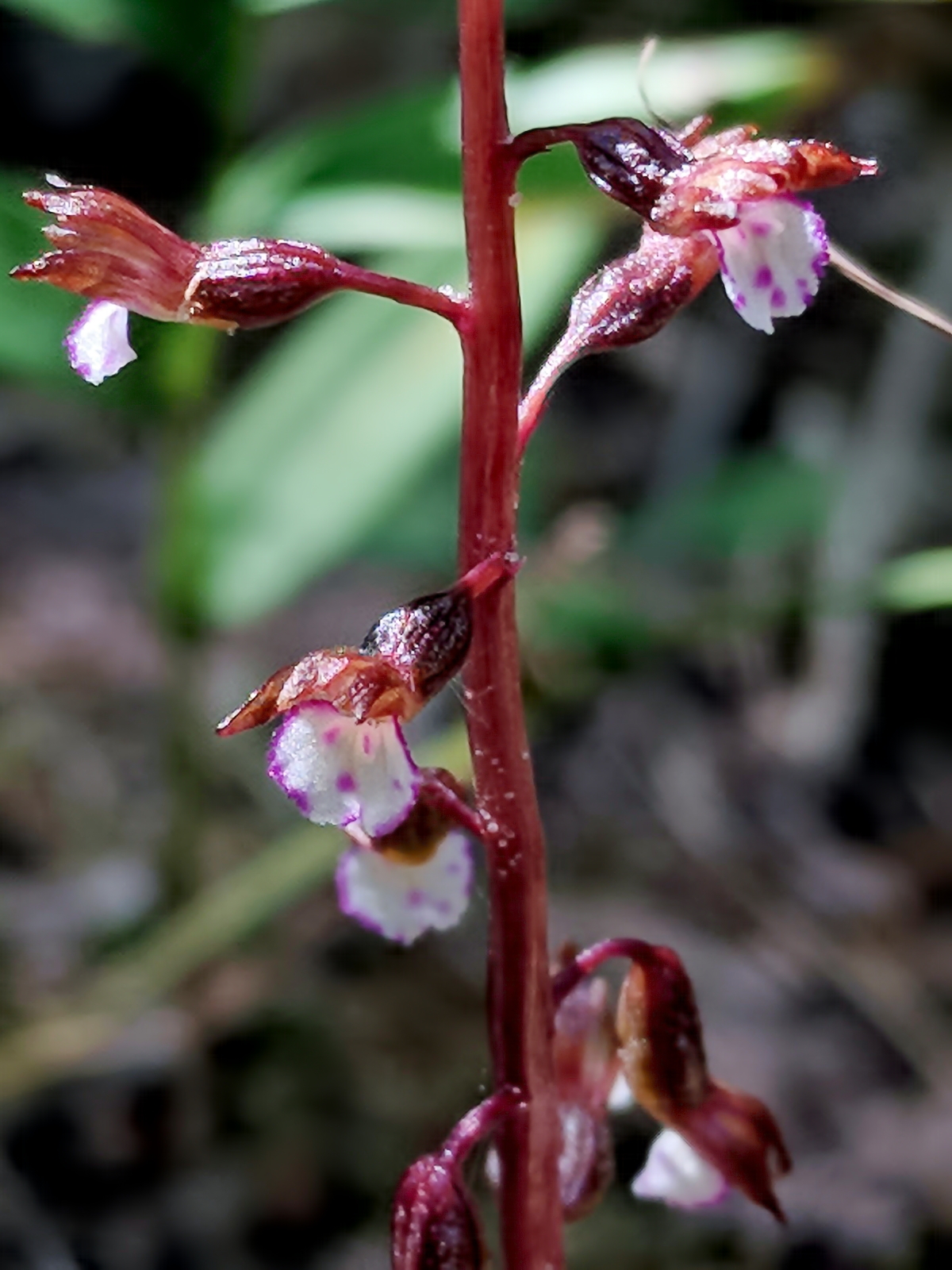
Corallorhiza odontorhiza, known as Autumn Coralroot or fall coralroot, is a small, leafless orchid of eastern and central North American woodlands. It has no green leaves and makes little or no food of its own. Instead it is mycoheterotrophic: it gets its sugars and nutrients from soil fungi that are linked to the roots of nearby trees. All you see above ground is a slender purplish-brown or greenish stem, usually 2 to 8 inches tall, carrying a few tiny flowers in late summer and fall.
Autumn coralroot grows from southern Ontario and New England south to Florida and west to Minnesota, eastern Kansas and eastern Texas, and in mountains from Mexico to Central America. It is a plant of dry to moist deciduous and mixed forests, especially oak and beech woods, where it rises through the leaf litter from August to October, when few other orchids are flowering.
Autumn coralroot cannot be grown from nursery stock or transplanted. It depends completely on its fungal partners and dies if dug up. This page is a guide to identifying and appreciating it in the wild. The best way to help it is to protect the forests and leaf litter where it lives.
Identification
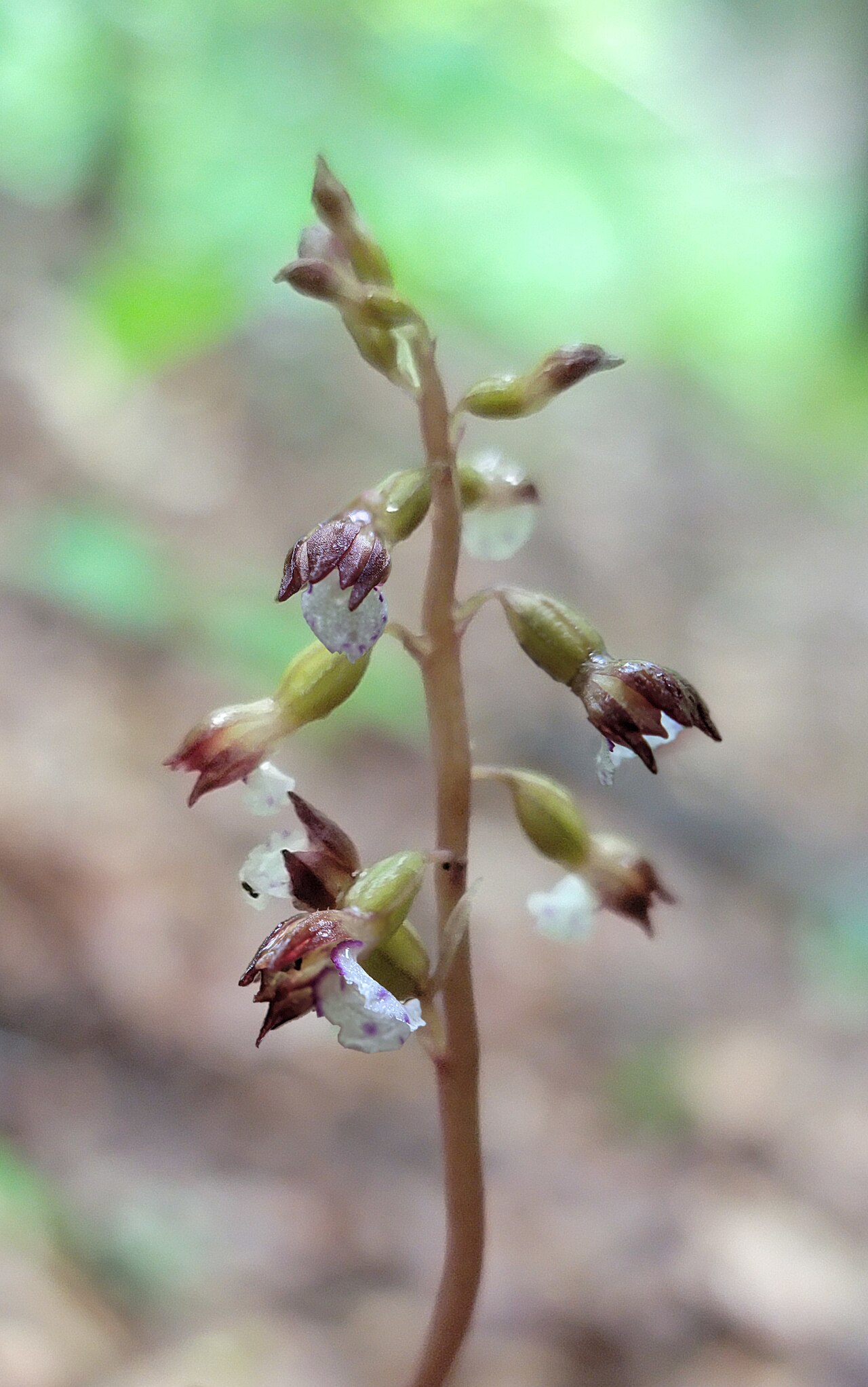
Look in late summer and fall for a thin, leafless, purplish-brown to greenish stem a few inches tall, with small drooping flowers or plump green seed capsules along its upper part. It often grows in small groups in leaf litter under oaks.
Growth Habit
Autumn coralroot lives most of the year as a small, branched, coral-like underground rhizome, which gives the genus its name. In late summer it sends up one or a few flowering stems. Each stem is smooth, purplish-brown, brownish or greenish, swollen at the base, and usually 2 to 8 inches (occasionally to 12 inches) tall. The stems wither after the seeds are shed, and plants may not appear at all in some years.
Leaves
There are no green leaves. The stem has only a few thin, sheathing scales near the base. Its lack of chlorophyll is why it relies on fungi for food rather than on sunlight.
Flowers
Each stem carries about 5 to 20 tiny flowers, each less than 1/4 inch long. The sepals and petals are greenish to purplish-brown, and the small lip is white, usually spotted or edged with purple. Two forms are found. In the common northern and eastern form (variety odontorhiza), the flowers usually stay closed and pollinate themselves, so they look like small green or brownish buds. In variety pringlei the flowers open fully and show a larger, white, purple-spotted lip. Flowering runs from August to October.
Fruit & Seeds
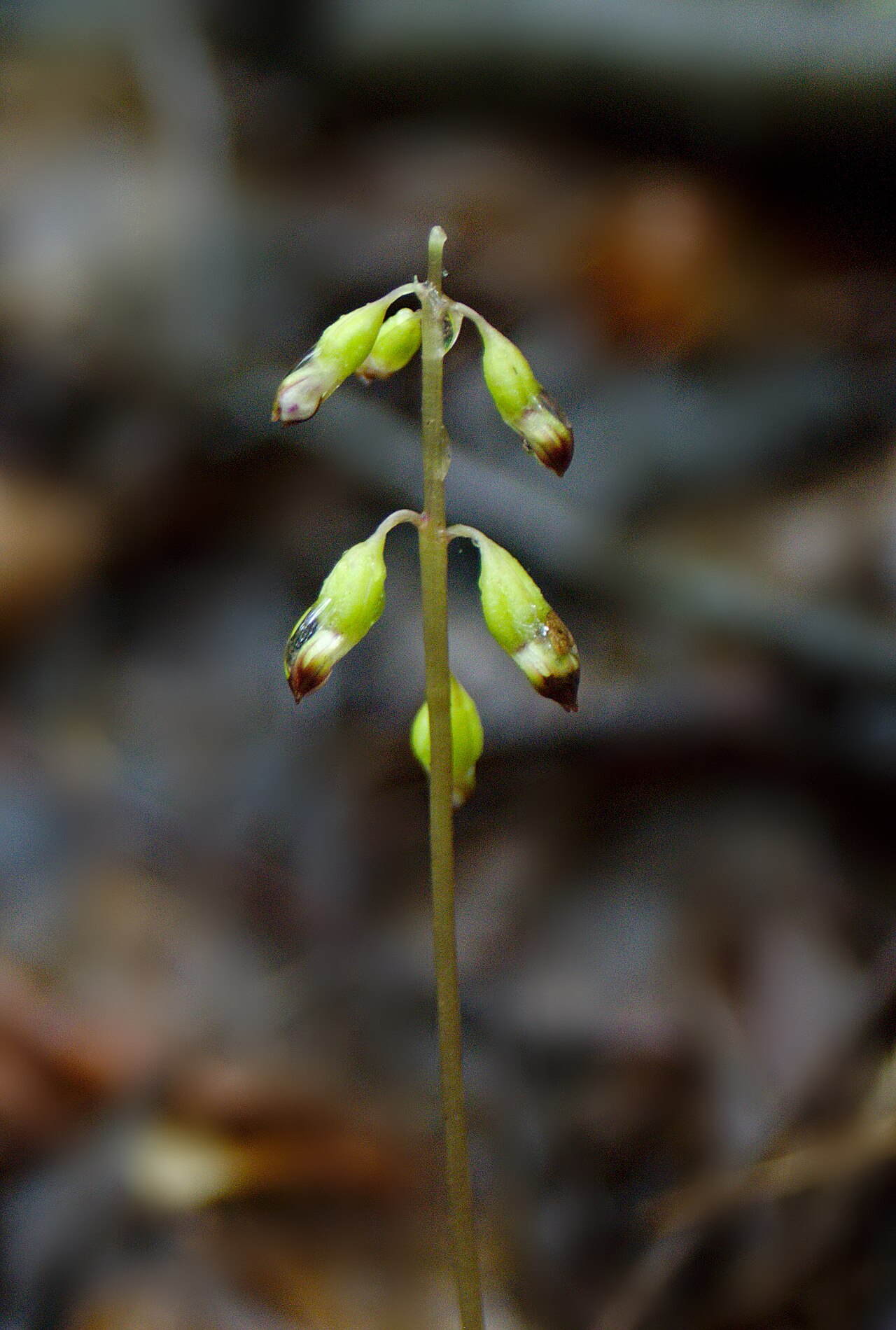
The ovaries swell quickly into drooping, oval capsules about 1/4 inch long, which turn brown and split to release thousands of dust-like seeds. Plants with fat green capsules are often easier to spot than plants in flower. The dried stems can stand into early winter.
Look-alikes
Spring coralroot (C. wisteriana) is similar but flowers in spring, not fall. Spotted coralroot (C. maculata) is larger, blooms in summer and has bigger flowers with a three-lobed, spotted lip. Crane-fly orchid also has a leafless flower stalk in summer, but it has a single winter leaf and much larger, spidery flowers. Beechdrops and other parasitic plants look similar from a distance but are not orchids and grow only under their host trees.
Quick Facts
| Scientific Name | Corallorhiza odontorhiza |
| Family | Orchidaceae (orchid family) |
| Plant Type | Leafless mycoheterotrophic orchid (perennial) |
| Mature Height | 2–8 in (rarely to 12 in) |
| Mature Spread | A single stem or small clump |
| Growth Rate | Slow; appears irregularly |
| Sun Exposure | Shade (does not depend on sunlight) |
| Water Needs | Dry to moist forest soil |
| Soil Type | Humus-rich forest soil under leaf litter |
| Soil pH | Acidic to neutral |
| Bloom Time | August–October |
| Flower Color | Greenish to purplish-brown with a white, purple-spotted lip |
| Fall Color | None (stems turn brown after seeding) |
| Fruit | Small drooping capsule with dust-like seeds |
| Deer Resistant | Not applicable; not a garden plant |
| USDA Hardiness Zones | About 4–9 in the wild |
Native Range
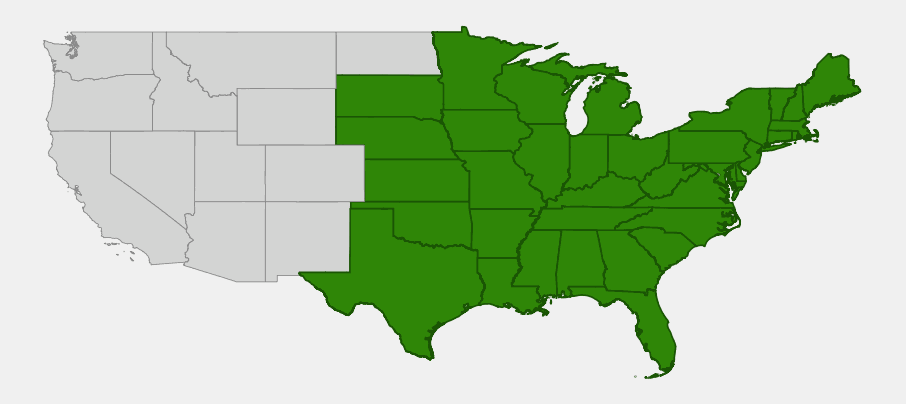
USDA PLANTS lists autumn coralroot as native in 36 states, from Maine, Vermont and Minnesota south to Florida and west to South Dakota, Nebraska, Kansas, Oklahoma and Texas. It is also native in southern Ontario and Quebec in Canada, and it occurs in the mountains of Mexico and Central America.
It is most widespread in the Appalachian region, the Piedmont, the Ohio Valley, the Ozarks and the Midwest. It is scattered and uncommon at the edges of its range, including the Great Plains states, northern New England and much of the Gulf Coast, where it is listed as rare or of conservation concern in several states. Variety pringlei, with open flowers, is scattered through much of the same range and also occurs in Mexico.
Autumn coralroot grows in dry to moist deciduous and mixed woods, especially oak-hickory and beech forests, as well as wooded ravines, slopes and sometimes pine stands and old fields growing up to forest. It is often found in thick leaf litter, and because it is small and brownish it is probably overlooked in many places.
📋 Regional plant lists featuring Autumn Coralroot: New York, Pennsylvania & Northern New Jersey · Ohio & Indiana · Michigan, Wisconsin & Eastern Minnesota · Kentucky & Tennessee · Nebraska, Kansas & Eastern Colorado · Connecticut, Massachusetts & Rhode Island · New Hampshire, Maine & Vermont · Maryland, Virginia & West Virginia · Delaware, Southern New Jersey & Long Island · Illinois, Iowa & Missouri · Alabama, Georgia & Mississippi · North & South Florida · North & South Carolina · Arkansas, Louisiana, Eastern Oklahoma & Eastern Texas · North Dakota, South Dakota & Western Minnesota
Can You Grow It?
No. Autumn coralroot cannot be grown in gardens. No nursery propagates it, and plants that are dug up die, because they are cut off from the fungi that feed them. It should never be dug up, transplanted or bought from anyone selling wild-collected plants. The best way to enjoy it is to find it in the woods in late summer and fall and to protect the forest where it grows.
Light
It does not need sunlight to grow, since it has no green leaves. Look for it in shady woods rather than open ground.
Soil & Water
It grows in forest soil under a layer of fallen leaves, where its fungal partners live. Stems are more numerous after a wet summer, and plants may not appear at all in a dry year. Avoid trampling, raking or clearing the leaf litter where it grows.
Planting Tips
Do not try to plant, transplant or sow autumn coralroot. If it appears in a wooded yard, leave the leaves on the ground, avoid soil disturbance and protect the surrounding trees, especially oaks, since its fungal partners also form mycorrhizae with tree roots.
Pruning & Maintenance
None is needed. Do not pick the stems: each one carries that year’s seed crop.
Propagation
It reproduces by dust-like seed, which can germinate and grow only with the right fungus. Research has found that autumn coralroot is closely tied to fungi in the genus Tomentella, which are partners of forest trees. There is no practical way for gardeners to propagate it. Conserving intact forests and their soils is the way to help it.
Where to See It
- Oak and beech woods: late-summer and fall walks in eastern deciduous forest
- Wooded parks and preserves: often along trails through mature or second-growth woods
- Shady, leafy yards: occasionally appears where leaf litter is left in place under oaks
- Macro photography: the tiny spotted lips are best appreciated up close
- Nature education: a striking example of a plant fed by fungi linked to trees
Wildlife & Ecological Value
Autumn coralroot is a small, visible sign of the hidden network of fungi that links forest trees and soil.
For Pollinators
Most plants pollinate themselves inside closed flowers, so they set seed reliably even late in the year when insects are scarce. The open flowers of variety pringlei may be visited by small insects, but they too are largely self-pollinating.
For Birds
It has no direct value as food for birds. Its presence indicates a healthy forest floor that also supports insect-eating and ground-nesting birds.
For Mammals
The small stems are occasionally eaten by deer, rodents or slugs, but the plant offers little food for mammals.
Ecosystem Role
As a mycoheterotroph, autumn coralroot takes carbon from fungi that are themselves connected to tree roots, so it is indirectly fed by the surrounding trees. Its presence is a sign of intact forest soil with healthy fungal networks.
Cultural & Historical Uses
The genus name Corallorhiza means “coral root,” from the branched, coral-like underground rhizome. The species name odontorhiza means “tooth root,” referring to the toothed look of the rhizome.
Leafless orchids such as coralroots were long a puzzle to botanists. Modern research has shown that they are not parasites on trees directly, but take their food from fungal partners that also form mycorrhizae with tree roots, an arrangement now studied as an example of how nutrients move through forest fungal networks.
Autumn coralroot is one of the last native orchids to flower each year in eastern North America, and its tiny, often closed flowers make it a prize for orchid enthusiasts who search the leaf litter in September and October.
Frequently Asked Questions
Can I grow autumn coralroot?
No. It has no green leaves and depends completely on soil fungi for food. Plants that are dug up die, and it is not available from nurseries. It should never be dug from the wild.
Is autumn coralroot a parasite?
Not directly. It is mycoheterotrophic: it gets its food from fungi in the soil, which are connected to the roots of trees.
When does autumn coralroot bloom?
From August to October, later than almost all other coralroots and most native orchids.
Why don’t the flowers open?
In the common form, variety odontorhiza, the flowers usually stay closed and pollinate themselves. Variety pringlei has flowers that open and show a white, purple-spotted lip.
Where can I find autumn coralroot?
In dry to moist deciduous woods, especially oak and beech forests, from New England and the Great Lakes south to Florida and Texas. Look closely in the leaf litter in late summer and fall.

Looking for a nursery that carries Autumn Coralroot?
Browse our native plant nursery directory: Alabama & Arkansas · Connecticut, Delaware, Florida & Georgia · Illinois, Indiana, Iowa & Kansas · Kentucky, Louisiana, Maine, Maryland, Massachusetts, Michigan, Minnesota, Mississippi & Missouri · Nebraska, New Hampshire, New Jersey, New York, North Carolina, Ohio & Oklahoma · Pennsylvania, Rhode Island, South Carolina, South Dakota, Tennessee, Texas, Vermont & Virginia · West Virginia & Wisconsin

