
Hairy Clustervine (Jacquemontia tamnifolia)
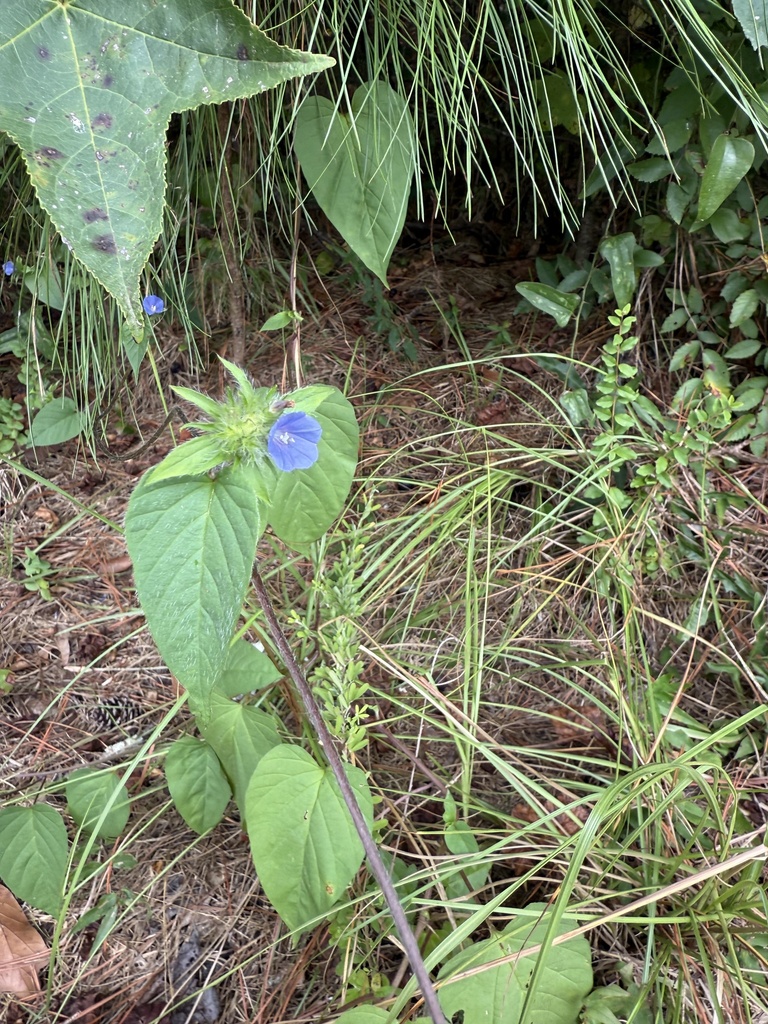
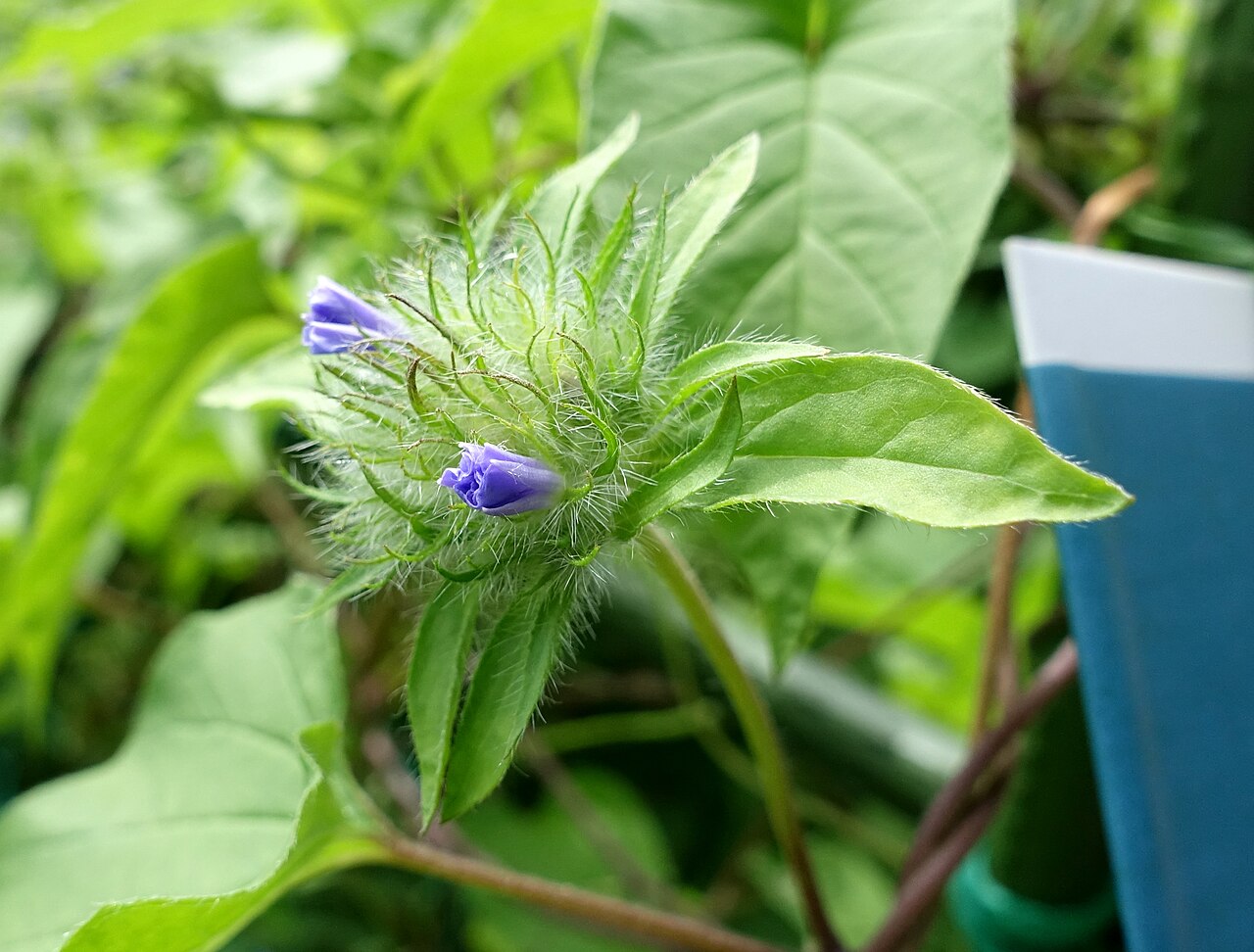
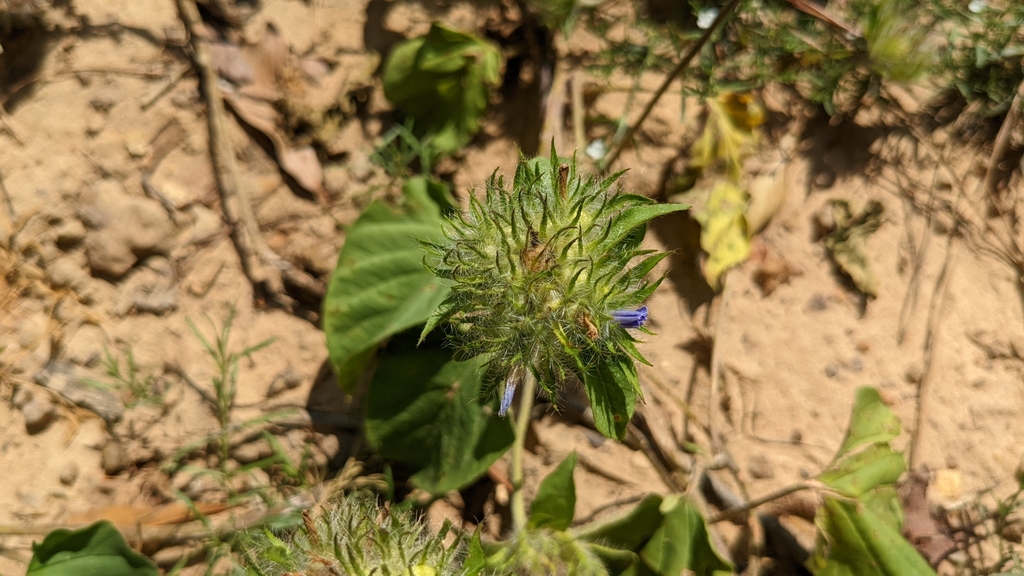
Jacquemontia tamnifolia, known as Hairy Clustervine, is an annual twining vine in the morning glory family (Convolvulaceae). It has broad, heart-shaped leaves and small, sky-blue, funnel-shaped flowers that open from dense, ball-like heads wrapped in long, tawny-haired bracts. The fuzzy flower heads are the easiest way to recognize it, and in fruit the vine looks as if it has a small puffball at every node. It is also called smallflower morning glory and common jacquemontia.
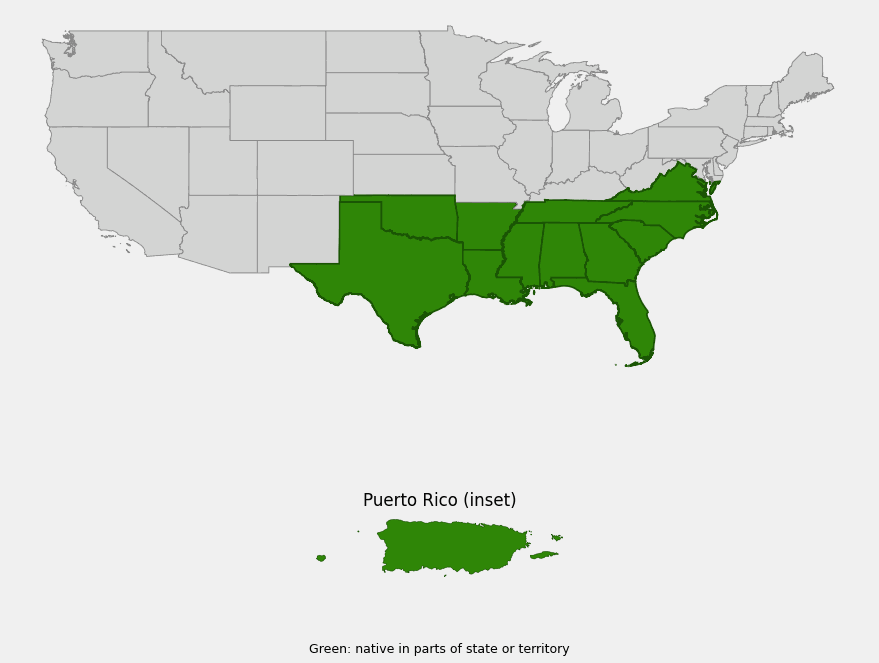
It is native across the warmer parts of the Americas, from the southeastern United States through Mexico, Central America and the West Indies to South America. In the United States it grows from southeastern Virginia south to Florida and west to Arkansas, Oklahoma and Texas, and it is also native in Puerto Rico and the U.S. Virgin Islands.
Hairy clustervine grows in sunny, disturbed places: sandy fields, roadsides, field edges, pine openings and waste ground. It blooms from early summer until frost and is a well-known weed of cotton, soybean and peanut fields in the Southeast, but in a wild garden or meadow edge it is an attractive native annual with true-blue flowers.
Identification
Look for a twining vine with heart-shaped leaves and small blue morning-glory flowers that come from dense, very hairy, leafy-bracted heads on long stalks.
Growth Habit
Hairy clustervine is a summer annual that comes up from seed in late spring. Its slender, hairy stems twine around other plants, fences and crops, reaching about 3 to 10 feet long, sometimes more. Where nothing is available to climb, the stems sprawl across the ground. Plants die with the first hard frost, and the dead stems and fuzzy fruiting heads often remain visible into winter.
Leaves
The leaves are alternate, simple and untoothed, about 2 to 5 inches long, oval to broadly egg-shaped, with a pointed tip and a heart-shaped or rounded base. They are soft and sparsely to moderately hairy, on long leaf stalks.
Flowers
The flowers appear from June to October, or year-round in frost-free areas. They are borne in dense, headlike clusters about 1 inch across at the ends of long stalks that come from the leaf axils. Each cluster is surrounded by several leafy, pointed bracts, and the bracts and narrow sepals are covered with long, yellowish-tawny hairs. The flowers are funnel-shaped, about 1/2 to 3/4 inch across, and a clear sky-blue to violet-blue. Only a few flowers in each head open at a time, and each lasts a single morning.
Fruit & Seeds
The fruit is a small, round capsule about 1/4 inch across, hidden among the hairy sepals and bracts. Each holds a few smooth, dark brown to black seeds. A mature plant produces many seeds, which can remain alive in the soil for years. This is one reason it is so persistent in fields.
Look-alikes
The related skyblue clustervine (Jacquemontia pentanthos) of South Florida is a perennial with larger, open sprays of flowers on smooth, long stalks rather than tight, hairy heads. Native morning glories such as tievine (Ipomoea cordatotriloba) have larger, pink to lavender flowers that are not crowded into hairy heads. Introduced ivyleaf and entireleaf morning glories have larger blue flowers with a white throat and much longer sepals.
Quick Facts
| Scientific Name | Jacquemontia tamnifolia |
| Family | Convolvulaceae (morning glory family) |
| Plant Type | Annual twining vine |
| Mature Height | Climbs or sprawls 3–10 ft |
| Mature Spread | 3–6 ft |
| Growth Rate | Fast |
| Sun Exposure | Full sun to part shade |
| Water Needs | Low to moderate |
| Soil Type | Sandy, loamy or clay; disturbed soils |
| Soil pH | Acidic to neutral (about 5.0–7.5) |
| Bloom Time | June–October |
| Flower Color | Sky-blue to violet-blue |
| Fall Color | None; dies at frost |
| Fruit | Small round capsules in fuzzy, hairy heads |
| Deer Resistant | Unknown |
| USDA Hardiness Zones | Annual; grows as a summer annual in zones 6–11 |
Native Range
Hairy clustervine is native throughout much of tropical and warm-temperate America, from the southeastern United States through Mexico, Central America and the Caribbean to South America. In the U.S., USDA PLANTS lists it as native in the lower 48 states, Puerto Rico and the U.S. Virgin Islands. The Flora of the Southeastern United States describes its native range as southeastern Virginia south to Florida and west to Arkansas and Texas.
This page maps it as native in Alabama, Arkansas, Florida, Georgia, Louisiana, Mississippi, North Carolina, Oklahoma, South Carolina, Tennessee, Texas and Virginia, plus Puerto Rico. Its Oklahoma and Tennessee records lie at the inland edge of that range. USDA also lists it from Illinois, Missouri, Ohio and Pennsylvania, but those are scattered, recent occurrences in crop fields and waste ground, mostly brought in with crop seed and farm equipment. Missouri’s flora treats it as introduced there, and the northern records are left off the map. It is not found in Canada.
It grows in full sun in sandy fields, fallow farmland, field edges, roadsides, railroad banks, pine and oak openings, coastal plain sandhills and waste places. It is most abundant on the Coastal Plain, where it is often seen climbing over crops, fences and other weeds in late summer and fall.
📋 Regional plant lists featuring Hairy Clustervine: North & South Florida · Alabama, Georgia & Mississippi · North & South Carolina · Maryland, Virginia & West Virginia · Kentucky & Tennessee · Arkansas, Louisiana, Eastern Oklahoma & Eastern Texas · Puerto Rico
Growing & Care Guide
Hairy clustervine is not usually sold, but it is easy to grow from seed and can be a pretty native annual for a sunny fence or wild meadow edge. Keep in mind that it is a serious weed in row crops, so do not grow it near farm fields or vegetable gardens, and remove seed heads if you do not want it to spread.
Light
Full sun gives the most flowers. It tolerates light shade but blooms less.
Soil & Water
It grows in almost any soil, but does best in warm, well-drained sandy or loamy soil. It is drought tolerant once growing and needs water only in long dry spells. Rich, irrigated soil makes it grow larger and more weedy.
Planting Tips
Sow seed outdoors after the soil warms in late spring, where you want the vine to grow, and give it a fence, trellis, tall grasses or a shrub to twine on. Nicking or soaking the hard seed overnight speeds germination. It does not transplant well once large.
Pruning & Maintenance
No pruning is needed. Pull the dead vines after frost. To limit spread, cut or pull plants before the fuzzy heads mature in fall, because each plant drops many long-lived seeds.
Propagation
Grow it from seed. Collect ripe, dry heads in fall, separate the seeds from the hairy bracts, and store them dry until spring. Self-sown seedlings usually appear in the same spot each year.
Landscape Uses
- Wild gardens: a native annual with true-blue flowers for a sunny, informal corner
- Fences and trellises: quick summer cover on a light support
- Meadow edges: twines through tall grasses and wildflowers
- Pollinator gardens: late summer and fall flowers for small bees
- Children’s gardens: fun fuzzy flower heads and easy, fast-growing seedlings
Wildlife & Ecological Value
Hairy clustervine flowers late in the season, adding small blue flowers to field edges and roadsides when many other plants have finished blooming.
For Pollinators
The small, open, funnel-shaped flowers are visited by bees, including small native bees and bumblebees, as well as some butterflies and flies, during the morning hours when they are open.
For Birds
Seed-eating birds such as doves, quail and sparrows feed in the weedy fields and field edges where this vine grows, and may eat the small seeds.
For Mammals
Rabbits and deer may browse the leaves and stems, especially where the vine grows among crops.
Ecosystem Role
Hairy clustervine is an annual of open, disturbed ground. In the natural landscape it moves into openings created by fire, floods or soil disturbance. Its persistent seed bank lets it appear quickly whenever soil is disturbed, and it has adapted well to farm fields across the Southeast.
Cultural & Historical Uses
The genus Jacquemontia honors Victor Jacquemont, a French naturalist who explored India in the early 19th century. The species name tamnifolia means “with leaves like Tamus,” a genus of Old World vines related to yams with similar heart-shaped leaves.
In weed science it is usually called smallflower morning glory. It became a common weed of Southeastern cotton, soybean and peanut fields during the 20th century, partly because its hard seeds survive in the soil for years.
The genus contains more than 100 species, most of them in the American tropics. Hairy clustervine is one of the most widespread, ranging from the southeastern United States deep into South America, and it is one of only a handful of species in the genus that reach the continental United States.
Frequently Asked Questions
Is hairy clustervine a morning glory?
Yes. It is in the morning glory family (Convolvulaceae), and its blue, funnel-shaped flowers open in the morning, but it belongs to the genus Jacquemontia, not Ipomoea.
Is hairy clustervine native?
Yes. It is native to the southeastern United States, Puerto Rico and the U.S. Virgin Islands, and to much of tropical America. Records farther north, in states such as Illinois, Missouri, Ohio and Pennsylvania, are introductions in crop fields.
How is it different from skyblue clustervine?
Skyblue clustervine is a South Florida perennial with open, loose sprays of flowers. Hairy clustervine is an annual with flowers in tight heads wrapped in long, tawny-haired bracts.
When does hairy clustervine bloom?
From June until frost, usually peaking in late summer and fall.
Is hairy clustervine a weed?
It can be. It is a well-known weed of row crops in the Southeast, so grow it only away from farm fields and gardens, and remove seed heads if needed.

Looking for a nursery that carries Hairy Clustervine?
Browse our native plant nursery directory: Alabama & Arkansas · Florida & Georgia · Louisiana & Mississippi · North Carolina & Oklahoma · South Carolina, Tennessee, Texas & Virginia

