
Native False Cypresses (Chamaecyparis)
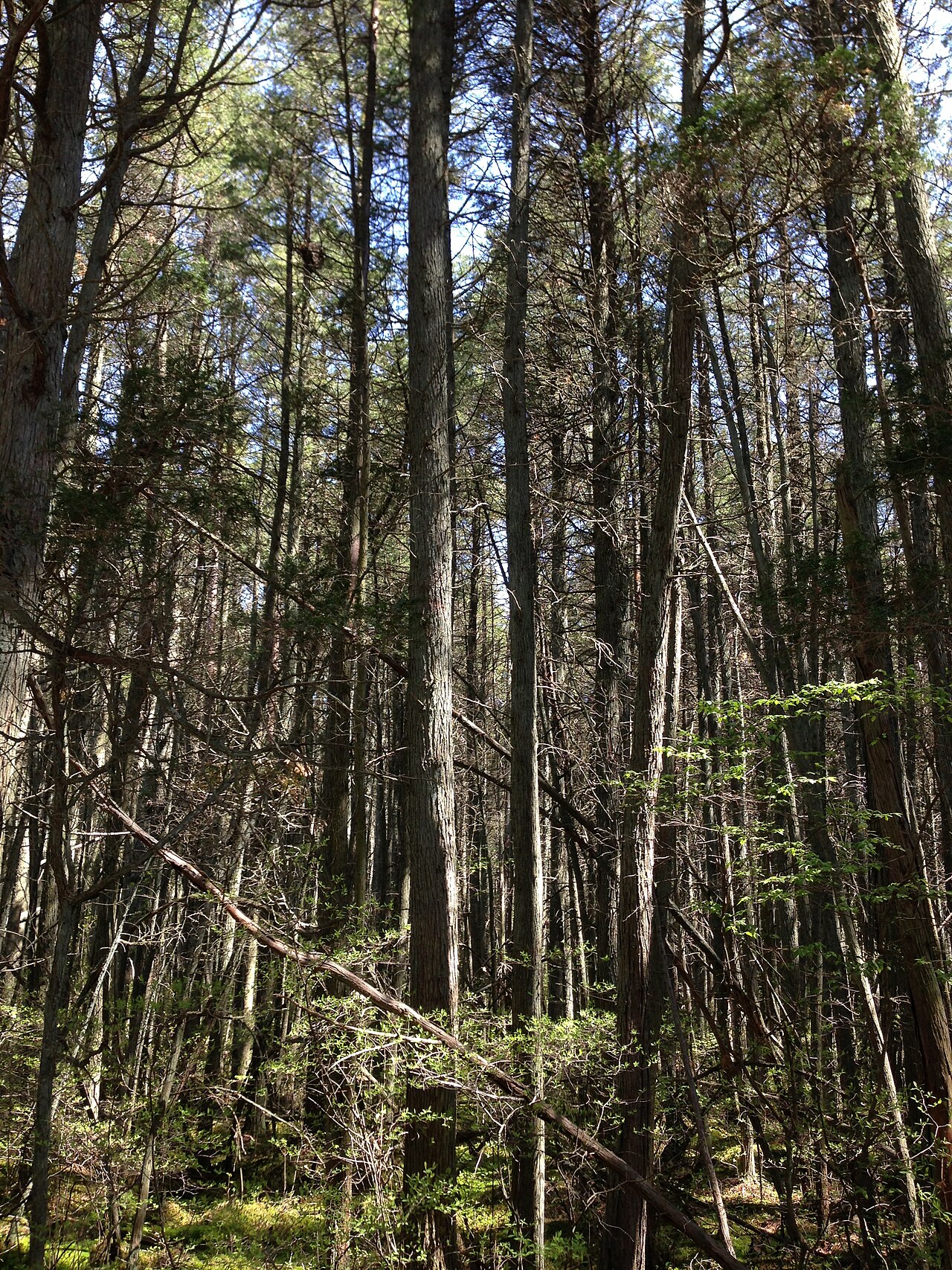
False cypresses (Chamaecyparis) are evergreen conifers in the cypress family with tiny, scale-like leaves pressed flat against the twigs in soft, ferny sprays, and small round cones. In garden centers the name usually means one of the hundreds of dwarf, golden, thread-leaved and blue cultivars of two Japanese species, Hinoki and Sawara false cypress. Those are not native. But the genus also has native American species, and they are some of the most distinctive trees on the continent.
Two false cypresses are native to the United States. Atlantic white cedar (Chamaecyparis thyoides) is a slender swamp tree of the Atlantic and Gulf coastal plains from southern Maine to Florida and Mississippi. Port Orford cedar (Chamaecyparis lawsoniana) is a towering forest giant of southwestern Oregon and northwestern California. A third tree, Alaska cedar or yellow cedar of the Pacific Northwest and Alaska, was long placed in Chamaecyparis, and many nurseries and books still list it that way, though botanists now usually treat it in a separate genus.
This guide is for gardeners who see “false cypress” on an evergreen list and want to know whether a native option exists for their region, how to grow it, and how to tell native false cypresses from the common Japanese cultivars and from Leyland cypress. The honest answer for much of the country, including Minnesota and the rest of the interior, is that no false cypress is native there, and other native evergreens are better choices.
Identification
False cypresses share features with their close relatives, the arborvitaes (Thuja), true cypresses and junipers. Looking at the foliage sprays, the undersides of the leaves and the cones is the easiest way to sort them out.
Foliage
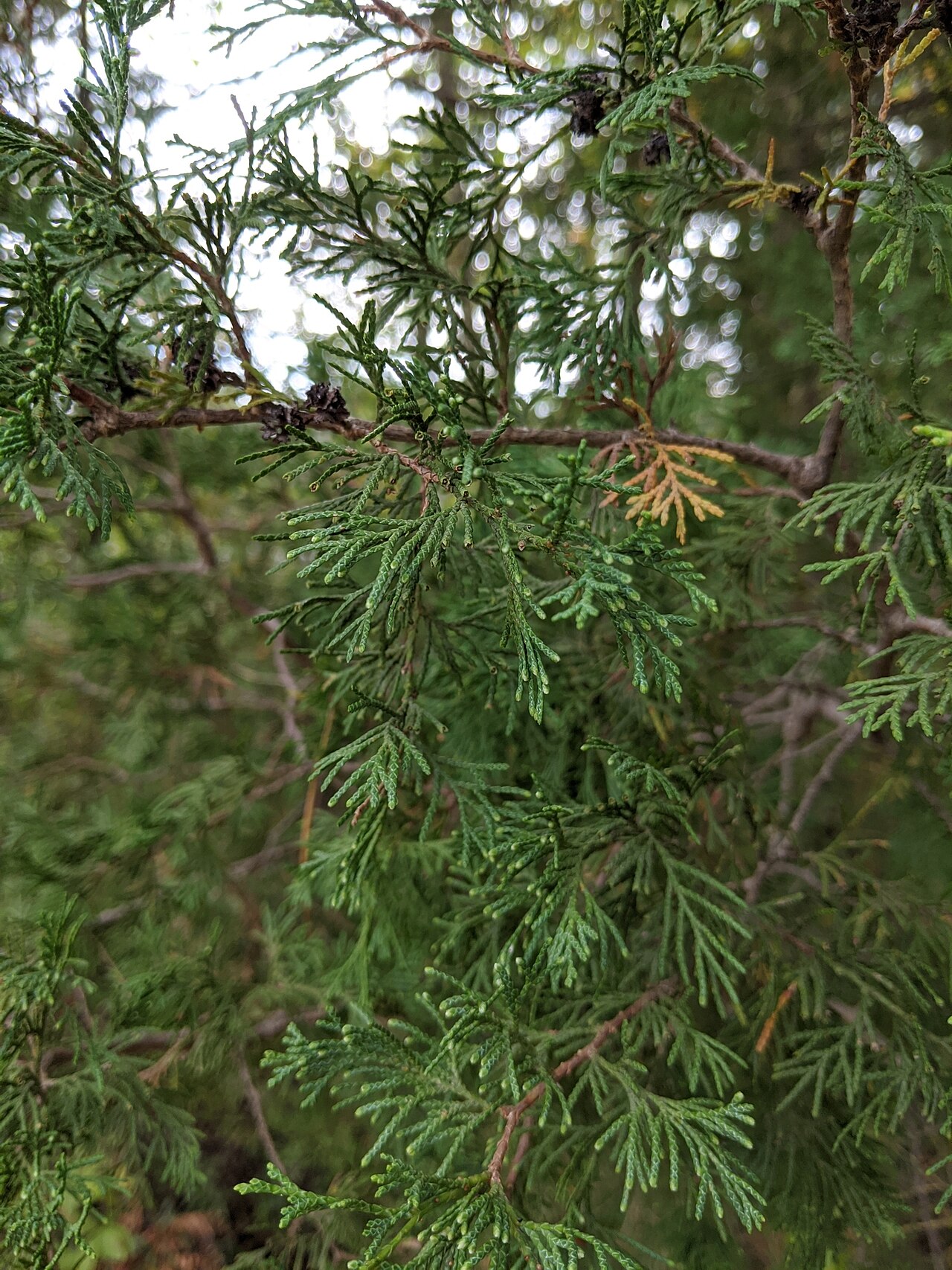
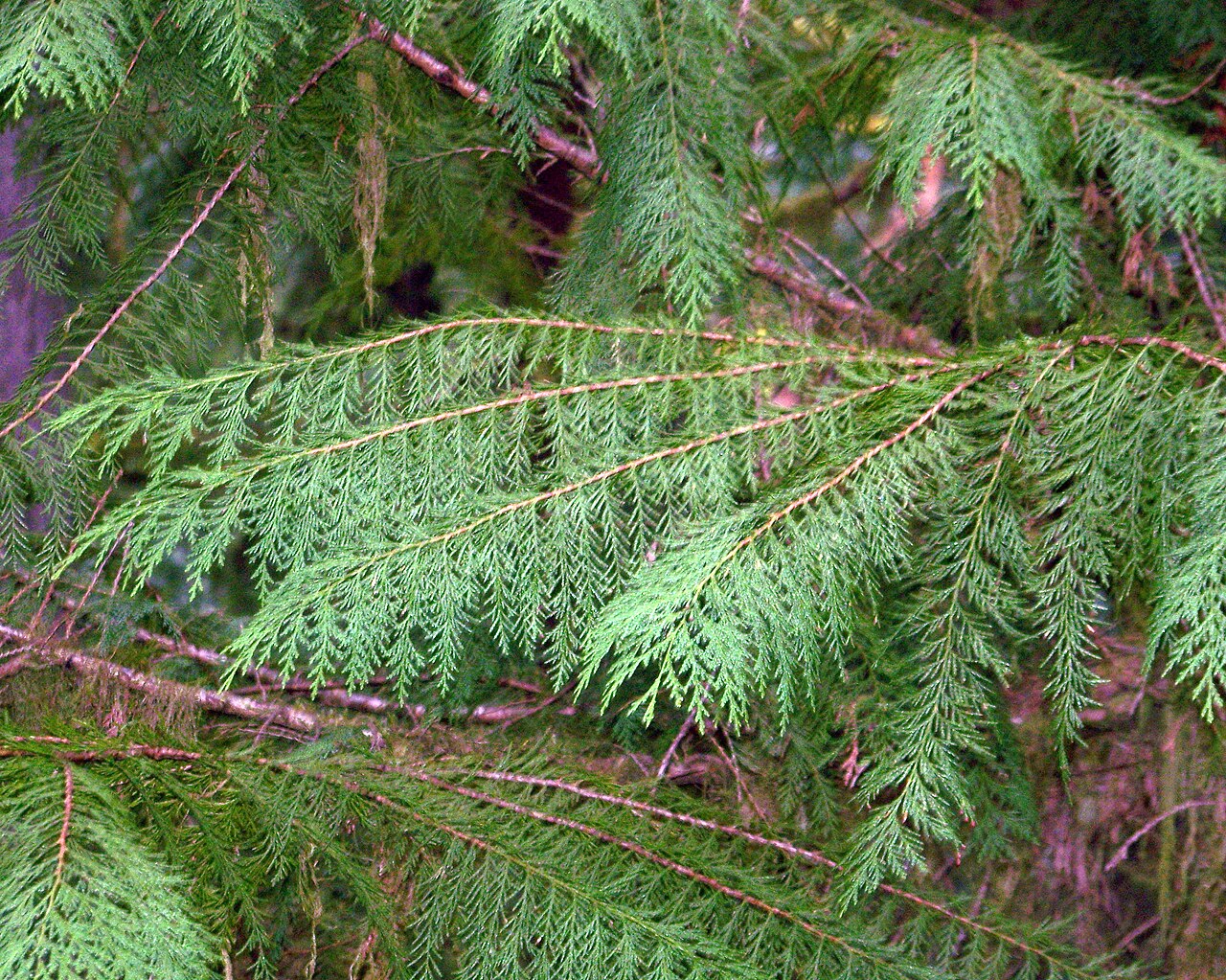
The leaves are tiny scales, usually 1/16 to 1/8 inch long, arranged in opposite pairs that overlap tightly along the twig. The twigs branch in one plane, forming flattened, feathery or fern-like sprays. In Port Orford cedar the sprays are very flat and lacy, and the undersides show faint whitish markings where the scale leaves meet. Atlantic white cedar has finer, less flattened, slightly irregular sprays of bluish-green to gray-green foliage. Crushed foliage has a resinous scent; in Port Orford cedar it is often described as pungent or ginger-like.
Bark & Form
Both native species have reddish-brown to gray bark that peels in long, fibrous strips and becomes deeply furrowed on old trees. Atlantic white cedar grows as a narrow, spire-like tree, usually 40 to 60 feet tall, often in dense, even-aged stands where the trunks stand like poles. Port Orford cedar is a much larger tree, commonly 100 to 180 feet tall, with a buttressed base and a drooping leader.
Cones
False cypress seed cones are small and round, usually 1/4 to 3/8 inch across, made of a few shield-shaped scales that fit together like a tiny soccer ball. They start out green or bluish with a waxy bloom and ripen brown in their first autumn, opening to release small winged seeds. The tiny pollen cones appear at the twig tips in early spring and are often reddish. Arborvitae cones, by contrast, are oblong with overlapping scales, and juniper “berries” are fleshy.
Quick Facts
| Genus | Chamaecyparis (false cypresses) |
| Family | Cupressaceae (Cypress) |
| US-Native Species | 2 (Atlantic white cedar and Port Orford cedar); Alaska cedar is often included in older references |
| Plant Type | Evergreen coniferous trees |
| Mature Height | Atlantic white cedar 40–60 ft (to 80 ft); Port Orford cedar 100–180 ft in the wild |
| Mature Spread | 10–20 ft (Atlantic white cedar); 20–40 ft (Port Orford cedar) |
| Growth Rate | Moderate |
| Sun Exposure | Full Sun to Part Shade |
| Water Needs | Moist to wet (Atlantic white cedar); average to moist (Port Orford cedar) |
| Soil Type | Acidic peat, muck or sand (Atlantic white cedar); well-drained loam, including serpentine (Port Orford cedar) |
| Soil pH | Acidic to neutral |
| Cones | Small round woody cones, about 1/4–3/8 in, ripen in fall |
| Fall Color | None (evergreen); Atlantic white cedar may bronze in winter |
| Deer Resistant | No; deer browse young trees heavily |
| Non-Native Relatives | Hinoki (C. obtusa) and Sawara (C. pisifera) cultivars; Leyland cypress (hybrid) |
| USDA Hardiness Zones | Atlantic white cedar 4–9; Port Orford cedar 6–8 |
Native Range
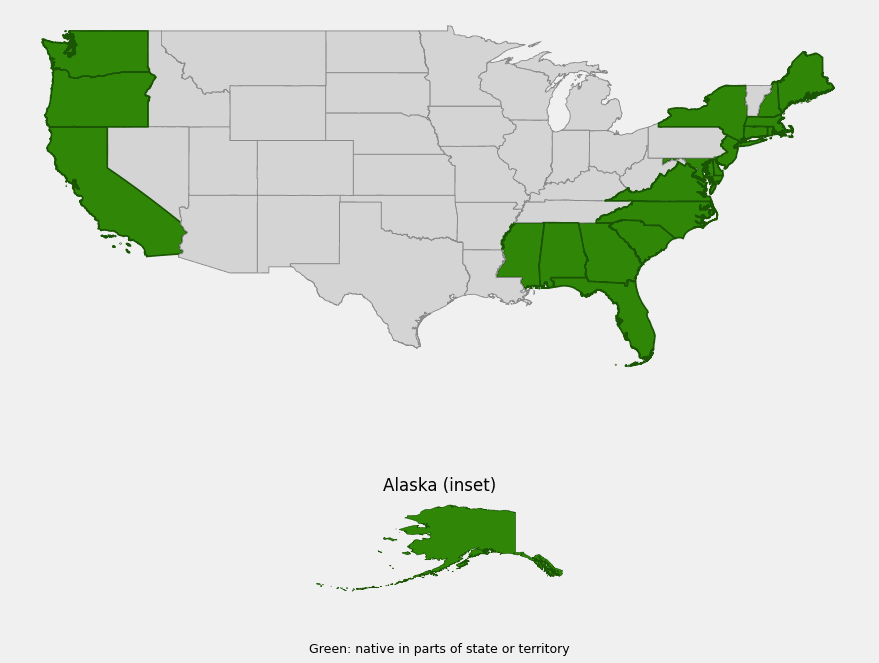
Atlantic white cedar grows in a narrow band along the Atlantic and Gulf coasts, rarely more than about 130 miles from the sea. Its range runs from southern Maine and New Hampshire through Massachusetts, Rhode Island, Connecticut and southeastern New York, across New Jersey, where the Pine Barrens hold some of the finest remaining stands, and south through Delaware, Maryland, Virginia, the Carolinas and Georgia to northern Florida. A Gulf Coast form, sometimes called Henry’s or Gulf white cedar (subspecies henryae), grows along blackwater streams in the Florida panhandle, southern Alabama and Mississippi.
Port Orford cedar has one of the smallest ranges of any major North American timber tree. It is native only to the Klamath-Siskiyou region of southwestern Oregon and northwestern California, from around Coos Bay south to the Klamath River and inland to the Mount Shasta area, usually on moist slopes, along streams and on serpentine soils where other large conifers grow poorly. Alaska cedar grows from southeastern Alaska through coastal British Columbia, the Olympic and Cascade mountains of Washington and Oregon, and a few sites in far northern California.
None of these trees is native to the interior of the country. There are no native false cypresses in the Midwest, the Great Plains, the Rocky Mountains or the inland Southeast, and Atlantic white cedar does not range north into Vermont or into Minnesota and the Great Lakes. In those regions, the native evergreens that fill a similar role are northern white cedar (arborvitae), eastern red cedar and other junipers.
📋 Regional plant lists featuring Native False Cypresses: New Hampshire, Maine & Vermont · Connecticut, Massachusetts & Rhode Island · Delaware, Southern New Jersey & Long Island · Maryland, Virginia & West Virginia · North Carolina & South Carolina · Georgia, Alabama & Mississippi · Western Oregon & Western Washington · California & Nevada · Alaska
Native Species
Because the genus has so few American members, this section covers the two native species, Alaska cedar, and the closest native relatives that gardeners can use where no false cypress is native.
Native False Cypresses
- Atlantic white cedar (Chamaecyparis thyoides): Also called Atlantic white cypress or swamp cedar. A narrow, 40- to 60-foot tree of acidic peat swamps and bog edges along the coast from Maine to Florida and Mississippi. Fine bluish-green foliage, peeling reddish bark and tiny round cones. The best native false cypress for wet sites and rain gardens in the East, and a narrow screen for tight spaces. Cultivars such as ‘Red Star’ and ‘Heatherbun’ are sold for gardens.
- Port Orford cedar (Chamaecyparis lawsoniana): Also called Lawson cypress. A huge tree of southwestern Oregon and northwestern California with flat, lacy foliage sprays. Its wood is aromatic, strong and rot-resistant. It has been planted widely in Europe, where hundreds of cultivars were selected, but in its native range it is threatened by an introduced root disease (see below).
Alaska Cedar (formerly Chamaecyparis)
- Alaska cedar (Callitropsis nootkatensis, also listed as Cupressus or Xanthocyparis nootkatensis; formerly Chamaecyparis nootkatensis): Also called yellow cedar or Nootka cypress. A slow-growing tree of cool, wet coastal and mountain forests from southeast Alaska to northern California, with distinctly drooping branchlets and cones that take two years to mature. The weeping cultivar ‘Pendula’ is a popular garden tree in the Northwest. In southeast Alaska, yellow-cedar decline linked to reduced winter snow cover has killed many trees.
Native Relatives for Other Regions
- Northern White Cedar (Thuja occidentalis): The native arborvitae of the Northeast, Great Lakes and Minnesota, with flat sprays of scale leaves. The best native substitute for false cypress in New England, New York and the upper Midwest.
- Western Redcedar (Thuja plicata): The giant native arborvitae of the Pacific Northwest and northern Rockies.
- Incense Cedar (Calocedrus decurrens): A columnar native conifer of Oregon, California and western Nevada with flat foliage sprays, often used where Port Orford cedar is too large or disease-prone.
- Eastern Red Cedar (Juniperus virginiana): A tough native juniper found across the eastern and central US, suited to dry, sunny sites where Atlantic white cedar would fail.
Non-Native Look-Alikes
Most “false cypress” plants sold in nurseries are cultivars of two Japanese species. They are popular, slow-growing and generally not invasive, but they are not native and offer little to native wildlife compared with native conifers.
Hinoki False Cypress (Chamaecyparis obtusa)
Hinoki cypress has thick, rounded, blunt scale leaves in cupped, shell-like sprays, with distinct white Y- or X-shaped markings underneath. Dwarf cultivars such as ‘Nana Gracilis’, golden ‘Crippsii’ and ‘Fernspray Gold’ are common in foundation plantings and rock gardens. In its native Japan it is a large, sacred timber tree.
Sawara False Cypress (Chamaecyparis pisifera)
Sawara cypress has pointed scale leaves and comes in several foliage types: thread-leaved forms (‘Filifera’, ‘Golden Mop’, ‘Gold Thread’), soft, feathery juvenile forms (‘Boulevard’, ‘Squarrosa’) and plume-like forms (‘Plumosa’). The golden “mop” cypresses common in mixed borders are Sawara cultivars. Older plants often show brown inner foliage, which is normal.
Leyland Cypress and Other Hybrids
Leyland cypress (× Cuprocyparis leylandii) is a hybrid between Alaska cedar and Monterey cypress that arose in British gardens. It grows very fast and is heavily planted as a privacy screen, but in the humid East and South it is prone to canker diseases and bagworms and often declines after 15 to 25 years. It is not a native species. For a fast native screen in the mid-Atlantic and Southeast, consider Atlantic white cedar on moist sites or eastern red cedar on dry ones.
Other Trees Called Cedar or Cypress
Common names in this family are confusing. “Atlantic white cedar” and “Port Orford cedar” are false cypresses, northern white cedar is an arborvitae, eastern red cedar is a juniper, and “Lawson cypress” is just another name for Port Orford cedar. None of them is a true cedar (Cedrus), which is an Old World pine-family tree with needles in clusters. Bald cypress (Taxodium), a deciduous Southern swamp tree, is also unrelated to false cypress despite sometimes growing in the same swamps as Atlantic white cedar.
Growing & Care Guide
The two native false cypresses have very different needs. Atlantic white cedar is a wetland tree for the East; Port Orford cedar is a mountain forest tree best grown in the Pacific Northwest and in areas free of its root disease.
Light
Both grow best in full sun to light shade. Atlantic white cedar is intolerant of heavy shade and in the wild regenerates mainly after fire, storms or logging open the canopy. In shade it becomes thin and loses lower branches.
Soil & Water
Atlantic white cedar needs consistently moist to wet, acidic soil: peat, muck or sandy soils with a high water table are ideal, and it tolerates standing water for part of the year. It does poorly in dry, alkaline or clay soils. Port Orford cedar prefers moist, well-drained soil and handles a range of soil types, including poor serpentine soils, but it is very vulnerable to root rot in poorly drained or infested ground.
Planting Tips
Plant container-grown trees in spring or early fall and water deeply through the first two growing seasons. Space Atlantic white cedars 6 to 8 feet apart for a screen or plant them in groups, which mimics the dense stands they form in the wild. Protect young trees from deer with fencing or tree shelters; deer browsing is one of the main reasons Atlantic white cedar fails to regenerate. Do not plant Port Orford cedar near streams or roads in its native range unless the stock is certified disease-resistant.
Pruning & Maintenance
False cypresses need little pruning. Remove dead or damaged branches and lightly shape in late spring if needed, but avoid cutting back into old, bare wood, which does not resprout. Mulch with pine needles or leaf litter to keep soil moist and acidic. Watch for bagworms on Atlantic white cedar in the South, and avoid overhead irrigation, which can encourage fungal blight.
Propagation
Both native species grow from seed collected from ripe cones in fall. Atlantic white cedar seed germinates best after cold, moist stratification and needs moist, open, peaty soil; seedlings grow slowly at first. Cultivars are propagated from semi-hardwood cuttings taken in late summer through winter, which root fairly readily with rooting hormone.
Landscape Uses
- Wet-site screens and windbreaks with Atlantic white cedar in the coastal East
- Rain gardens and pond edges with red maple, black gum, highbush blueberry and swamp azalea
- Coastal and Pine Barrens restorations with pitch pine
- Large-property specimen trees in the Pacific Northwest with Port Orford or Alaska cedar
- Native conifer gardens with western hemlock, mountain hemlock and Sitka spruce in the Northwest
Wildlife & Ecological Value
Native false cypresses support specialized wildlife and form some of the most distinctive forest communities in the country.
For Pollinators & Insects
Like all conifers, false cypresses are wind-pollinated and offer nothing to nectar-feeding insects. Atlantic white cedar, however, is the only larval host plant of Hessel’s hairstreak, a small, green, uncommon butterfly found almost exclusively in Atlantic white cedar swamps. Protecting and planting Atlantic white cedar directly supports this specialist.
For Birds
The dense evergreen crowns of Atlantic white cedar stands provide year-round shelter and nesting cover for warblers, thrushes and other songbirds, and winter roosting cover for birds such as owls. Siskins and other finches eat the small seeds. In the Northwest, mature Port Orford and Alaska cedar forests provide habitat for many forest birds.
For Mammals
White-tailed deer browse Atlantic white cedar seedlings and saplings heavily, and the dense stands give deer and other mammals winter shelter. Small mammals such as squirrels and mice eat the seeds.
Ecosystem Role
Atlantic white cedar swamps are a globally rare forest type, with acidic, tea-colored water, sphagnum moss carpets and specialized plants such as pitcher plants and orchids. Much of their original extent was lost to logging, drainage and development, and many states now work to restore them. Port Orford cedar plays an important role in cooling and stabilizing streams in the Klamath-Siskiyou region, where its decline from disease affects stream habitats.
Cultural & Historical Uses
Atlantic white cedar was one of the most valuable trees of colonial America. Its light, straight-grained, rot-resistant wood was used for shingles, barrels, boats, fence posts, organ pipes and decoys. In New Jersey, buried logs preserved in swamps were “mined” in the 1700s and 1800s for shingles. Heavy cutting eliminated many original stands.
Port Orford cedar was prized for its fragrant, durable, fine-grained wood, which was used for arrow shafts, boat building, venetian blind slats and battery separators, and was later exported in large quantities to Japan as a substitute for Hinoki. Since the 1950s an introduced root pathogen, Phytophthora lateralis, has spread along roads and streams in its range, killing many trees; foresters now plant disease-resistant stock and use road closures and washing stations to slow the spread.
Alaska cedar’s very durable yellow wood has long been used by Indigenous peoples of the Northwest Coast for canoe paddles, bentwood boxes and carving, and its inner bark was woven into textiles. Today it remains a valued wood for boat building and fine woodwork.
Frequently Asked Questions
Is false cypress native to the United States?
Some false cypresses are. Atlantic white cedar (Chamaecyparis thyoides) is native to the East and Gulf coasts, and Port Orford cedar (Chamaecyparis lawsoniana) is native to southwestern Oregon and northwestern California. Most false cypress cultivars sold in garden centers, however, are Japanese Hinoki or Sawara cypress.
Is there a native false cypress for Minnesota or the Midwest?
No. No false cypress is native to Minnesota, the Midwest or the interior of the country. Northern white cedar (Thuja occidentalis) is the closest native equivalent and is far hardier there; eastern red cedar is a good choice for dry, sunny sites.
Can Atlantic white cedar grow in a regular garden?
It can, if the soil stays moist and is acidic. It performs best in damp or wet spots, rain gardens and pond edges, and struggles in dry, alkaline or heavy clay soil. Protect young trees from deer.
Is Leyland cypress a false cypress?
Leyland cypress is a hybrid between Alaska cedar (formerly classified as a Chamaecyparis) and Monterey cypress. It is not a native species, and in the humid East and South it is often short-lived because of canker diseases.
Why are Port Orford cedars dying?
Most deaths are caused by Phytophthora lateralis, an introduced water-mold root disease that spreads through infested soil and water, often along roads and streams. Planting resistant seedlings and avoiding moving mud between sites helps protect native stands.

Looking for a nursery that carries Native False Cypresses?
Browse our native plant nursery directory: Alabama & Alaska · California · Connecticut, Delaware, Florida & Georgia · Maine, Maryland, Massachusetts & Mississippi · New Hampshire, New Jersey, New York & North Carolina · Oregon · Rhode Island, South Carolina & Virginia · Washington

