
Native Magnolias (Magnolia)
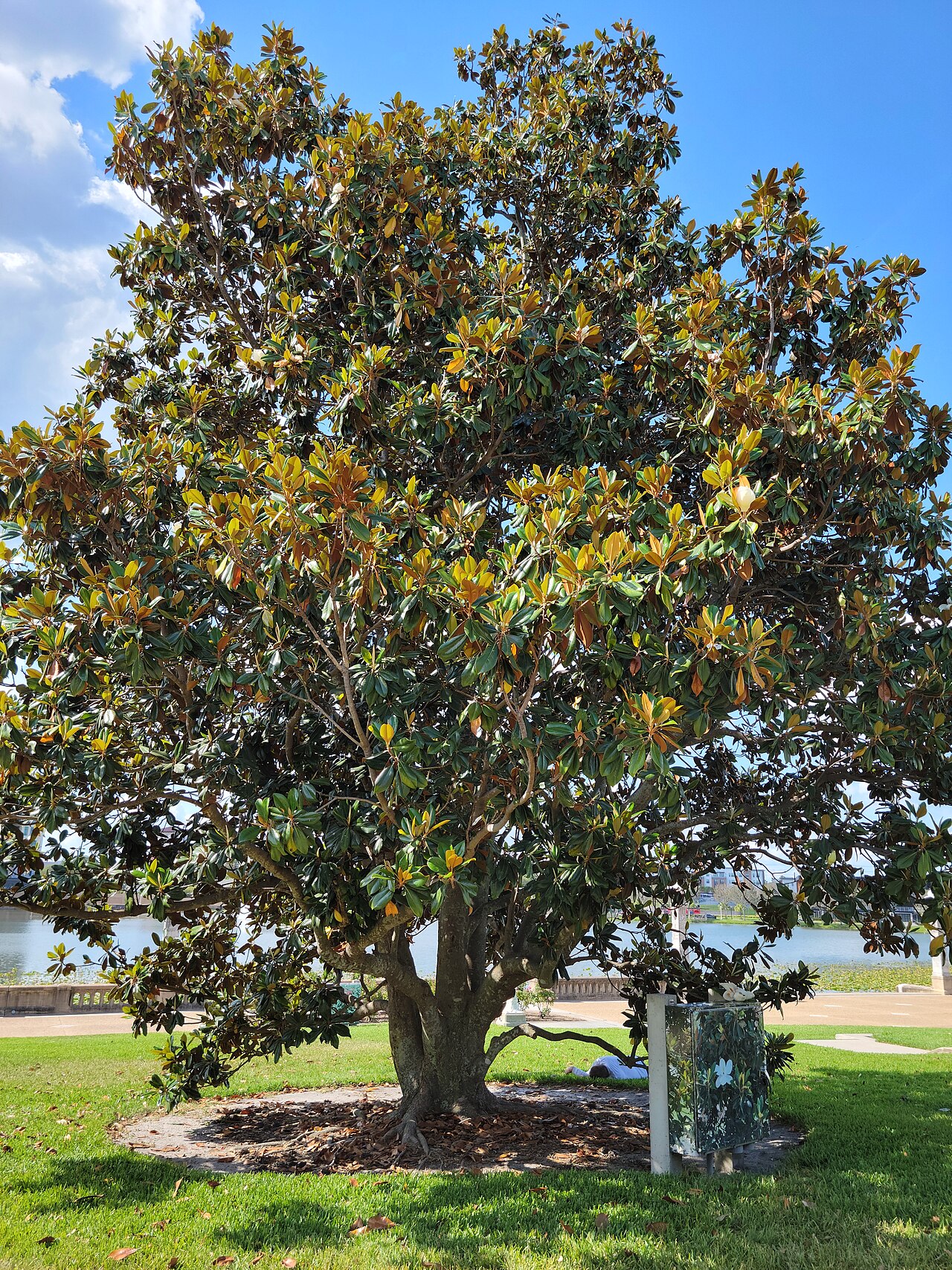
Magnolias (genus Magnolia) are among the oldest flowering plants on Earth, a lineage that was already blooming when dinosaurs were alive. Their large, waxy, often fragrant flowers and bold leaves make them some of the most recognizable trees in American gardens. The genus has more than 200 species, most of them in eastern and southeastern Asia, but the eastern United States has its own group of magnolias, and they are some of the finest native trees in the country.
Eight magnolias are native to the continental United States, all in the East and South: the evergreen southern magnolia, the semi-evergreen sweetbay, the towering cucumber tree, and five deciduous “big-leaf” magnolias of southern forests, including umbrella magnolia, bigleaf magnolia, Fraser magnolia, pyramid magnolia and Ashe magnolia. Puerto Rico has several more, including the endemic laurel sabino. Native magnolias range from shrubby understory trees to giants of 80 feet or more, and their leaves include the largest simple leaves of any native North American tree.
Many of the magnolias that bloom on bare branches in early spring, however, are Asian: saucer magnolia, star magnolia and their hybrids are the pink and white magnolias of northern suburbs. This guide explains which magnolias are native, where each grows, how to tell them from the Asian species, and how to grow them well. In New Jersey and the mid-Atlantic, sweetbay is the most widely native magnolia, with cucumber tree and umbrella magnolia native just to the west and south.
Identification
Magnolias are woody plants with a few features that mark them anywhere: large, simple, smooth-edged leaves, big flowers with many petal-like parts, and cone-like fruits that open to show bright red seeds.
Bark & Twigs
Magnolia bark is usually smooth and gray, becoming slightly scaly on old trunks. A ring-shaped scar circles the twig at each leaf node, left by the stipule that protected the young leaf. The end buds are large and covered in a single cap-like scale, often silky or fuzzy, and the twigs and bark have a spicy, sometimes lemony smell when crushed.
Leaves
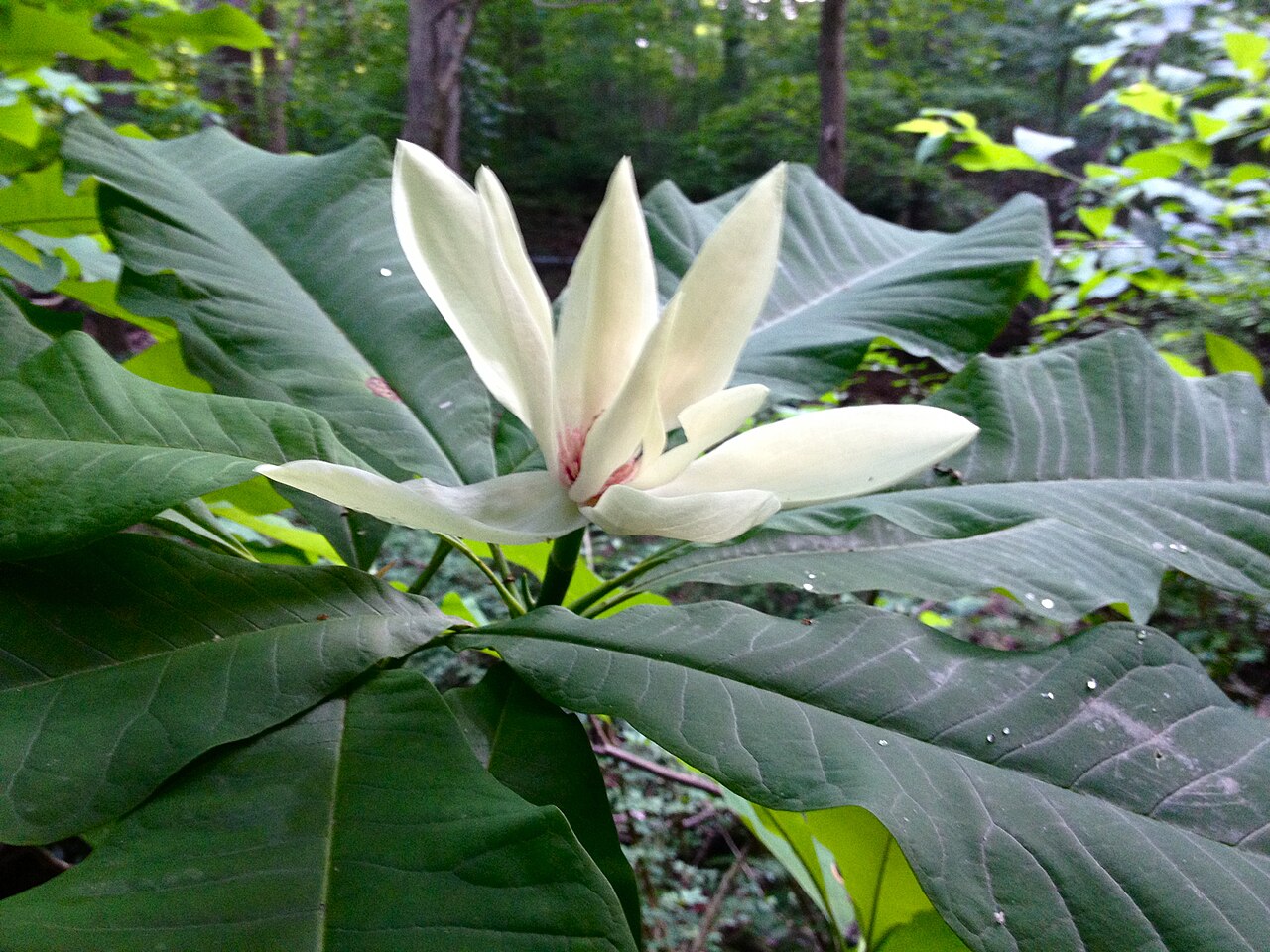
Leaves are alternate, simple and untoothed. Southern magnolia has thick, leathery, glossy evergreen leaves 5 to 10 inches long with rusty-brown fuzz beneath. Sweetbay has smaller leaves, 3 to 6 inches, that are bright green above and strikingly silver-white beneath. Cucumber tree has thin, oval leaves. The big-leaf group has huge leaves clustered at the ends of the branches: up to 24 inches in umbrella magnolia, often 20 to 30 inches or more in bigleaf magnolia, and with small “ear” lobes at the base in Fraser, pyramid and bigleaf magnolia.
Flowers
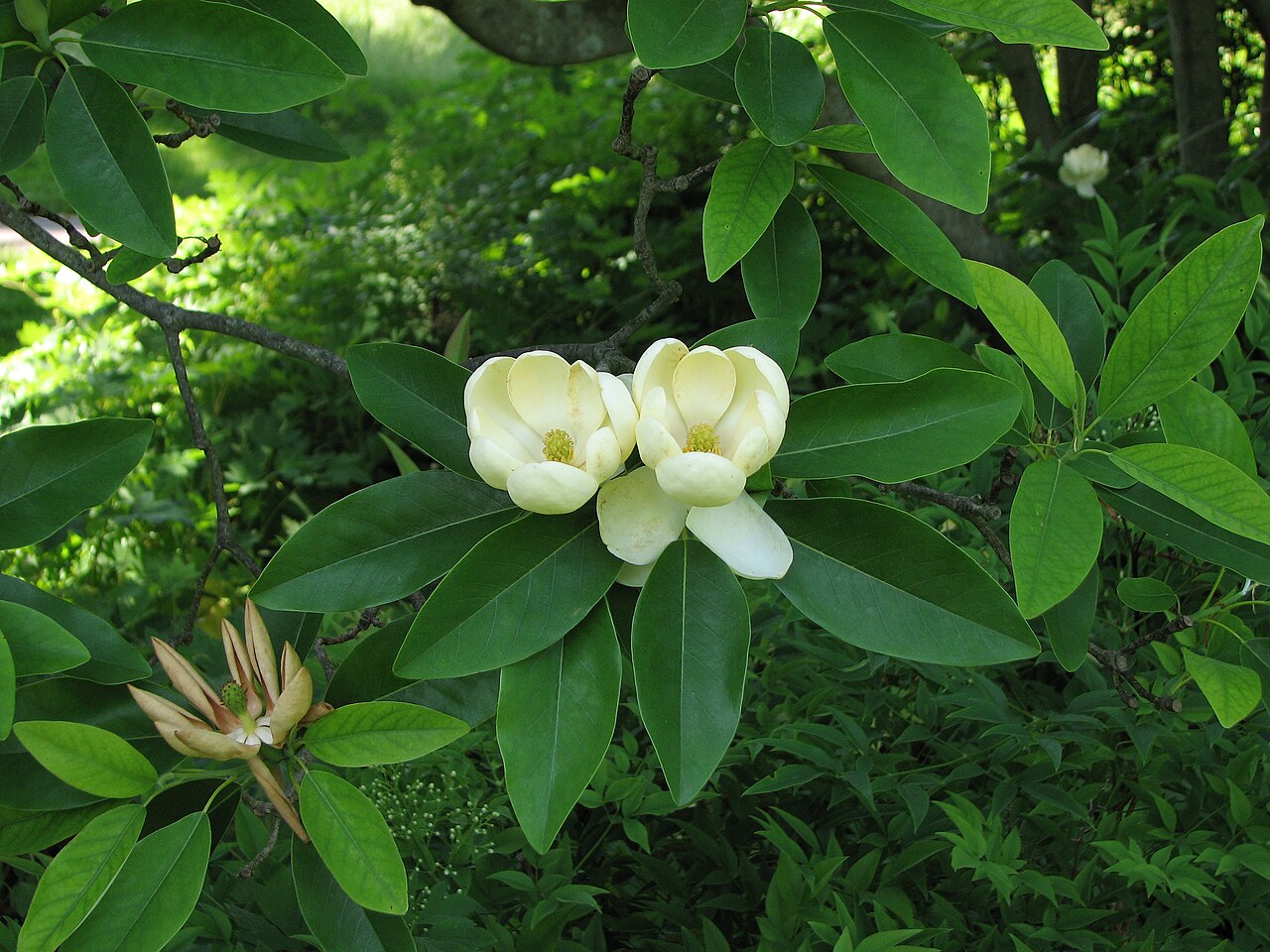
Magnolia flowers are large and solitary, with six to twelve or more petal-like tepals around a cone of stamens and pistils. Native species mostly bloom after the leaves appear, from April into summer. Southern magnolia has creamy white, lemon-scented flowers 8 to 12 inches across. Sweetbay has small, cup-shaped, creamy white flowers with a sweet lemon scent. Cucumber tree has greenish-yellow flowers held high in the tree, and the big-leaf magnolias have cream-white flowers 6 to 12 inches or more across, some with a purple blotch at the base.
Fruit & Seeds
The fruit is a cone-like cluster of follicles, 2 to 8 inches long, green ripening to pink, red or brown. In late summer or fall each follicle splits to reveal one or two bright red or orange-red seeds that hang on silky threads before birds pick them off. Young cucumber tree fruits are green and knobby, like a small cucumber, which gives the tree its name.
Quick Facts
| Scientific Name | Magnolia (8 species native to the continental US, plus several in Puerto Rico) |
| Family | Magnoliaceae (Magnolia family) |
| Plant Type | Evergreen, semi-evergreen and deciduous trees and large shrubs |
| Mature Height | 15–30 ft (sweetbay, umbrella, Ashe) to 60–80 ft or more (southern magnolia, cucumber tree) |
| Mature Spread | 15–40 ft |
| Growth Rate | Moderate |
| Sun Exposure | Full sun to part shade (big-leaf species prefer shelter and part shade) |
| Water Needs | Average to moist; sweetbay tolerates wet soil |
| Soil Type | Deep, rich, moist but well-drained loam; sweetbay in swampy, acidic soils |
| Soil pH | Acidic to near neutral (about 5.0–7.0) |
| Bloom Time | April – June (sweetbay sporadically into late summer) |
| Flower Color | Creamy white; greenish-yellow to yellow in cucumber tree |
| Fall Color | Evergreen (southern magnolia); yellow to brown in deciduous species |
| Fruit | Cone-like aggregates with bright red seeds, late summer–fall |
| Deer Resistant | Moderately; young trees and sweetbay are browsed |
| USDA Hardiness Zones | About 4–10 across the native species (cucumber tree to zone 4; southern magnolia 6b/7–10) |
Native Range
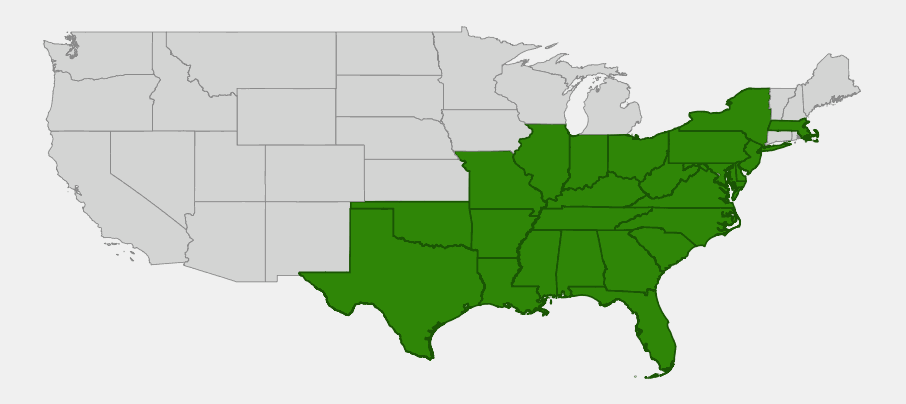
Native magnolias are trees of the eastern and southern United States. Southern magnolia grows on the coastal plain from southeastern North Carolina to central Florida and west to east Texas, in rich bottomland and slope forests with beech, oaks and spruce pine. Sweetbay grows in swamps, bays and wet woods along the Atlantic and Gulf coastal plain from Long Island and New Jersey south to Florida and west to Texas, with a famous outlying population near Gloucester, Massachusetts, the northernmost native magnolia stand in the country.
Cucumber tree is the most northern and widespread species, native from western New York and Pennsylvania through the Ohio Valley and Appalachians to Georgia and west to Missouri, Arkansas, Oklahoma and Louisiana, and it reaches southern Ontario. The deciduous big-leaf magnolias are mostly southern: umbrella magnolia from Pennsylvania and Ohio south to Georgia and west to Arkansas and Oklahoma, Fraser magnolia in the southern Appalachians, bigleaf magnolia scattered from Ohio and Kentucky to the Gulf states, and pyramid and Ashe magnolias in a few areas of the Gulf coastal plain.
Magnolias are widely planted outside these areas. Southern magnolia is a familiar street and lawn tree north to New Jersey and in the Pacific Northwest and California, and cucumber tree and umbrella magnolia grow wild in parts of New England and New Jersey as escapes from cultivation. Those are planted or naturalized trees, so the map shows only states where at least one magnolia is native.
📋 Regional plant lists with native magnolias: Delaware, Southern New Jersey & Long Island · New York, Pennsylvania & Northern New Jersey · Maryland, Virginia & West Virginia · North Carolina & South Carolina · Georgia, Alabama & Mississippi · Kentucky & Tennessee · Ohio & Indiana · Illinois, Iowa & Missouri · Arkansas, Louisiana, Eastern Oklahoma & Eastern Texas · Connecticut, Massachusetts & Rhode Island
Native Species
These are the native magnolias of the United States. Each name links to our full growing guide.
Southern magnolia (Magnolia grandiflora) is the classic evergreen magnolia of the South, growing 60 to 80 feet tall with a broad pyramidal crown, thick glossy leaves with rusty undersides and huge, fragrant white flowers in late spring and early summer. It is native to the coastal plain from North Carolina to Texas and is hardy to about zone 6b or 7 in sheltered sites. Compact cultivars such as ‘Little Gem’ and hardier ones such as ‘Bracken’s Brown Beauty’ and ‘Edith Bogue’ suit smaller and colder gardens.
Sweetbay magnolia (Magnolia virginiana) is a graceful, often multi-stemmed tree 10 to 35 feet tall (taller in the Deep South), with leaves that flash silver underneath and small, lemon-scented, creamy flowers from late spring into summer. It is evergreen in the South and partly deciduous in the North, tolerates wet soil and part shade, and is the best magnolia for small gardens and rain gardens in the mid-Atlantic, including New Jersey.
Cucumber tree (Magnolia acuminata) is the hardiest and tallest native magnolia, a straight-trunked, deciduous shade tree 60 to 80 feet tall, hardy to zone 4. Its greenish-yellow flowers are easy to miss high in the canopy, but its yellow-flowered southern form (sometimes called var. subcordata) is a parent of the yellow hybrid magnolias. It grows in rich, moist forests from New York to Georgia and west to Missouri and Oklahoma.
Umbrella magnolia (Magnolia tripetala) is an understory tree 15 to 30 feet tall whose 12- to 24-inch leaves are clustered in whorls at the branch tips like the ribs of an umbrella. Its creamy flowers, 6 to 10 inches across, have a strong, somewhat unpleasant odor. It grows in rich, moist woods and ravines from Pennsylvania and Ohio to Georgia and west to Arkansas and Oklahoma.
Bigleaf magnolia (Magnolia macrophylla) has the largest simple leaves of any native North American tree, often 20 to 30 inches long and silvery beneath, and flowers up to a foot or more across. It grows in scattered sheltered ravines from Ohio and Kentucky to the Gulf states and needs protection from wind, which shreds its leaves.
Ashe magnolia (Magnolia ashei), often treated as a subspecies of bigleaf magnolia, is a small, shrubby tree 10 to 20 feet tall found only in a few counties of the Florida panhandle, where it is listed as endangered by the state. It blooms young and fits small gardens far better than bigleaf magnolia.
Fraser magnolia (Magnolia fraseri) is a tree of the southern Appalachian mountains, 30 to 50 feet tall, with leaves that have two small “ears” at the base and fragrant, creamy flowers in spring. It grows in cove forests and along streams from Virginia and West Virginia to Georgia and Alabama.
Pyramid magnolia (Magnolia pyramidata) is a smaller, rarer coastal-plain relative of Fraser magnolia, found in rich ravine forests from South Carolina to Florida and west to east Texas, with eared leaves and a narrow crown.
Laurel sabino (Magnolia splendens) is an evergreen magnolia endemic to the mountain forests of Puerto Rico, with glossy leaves covered in silky hairs beneath. It is one of several magnolias native to Puerto Rico, many of them rare.
Non-Native Look-Alikes
Most magnolias that bloom pink, purple or white on bare branches in early spring are Asian species or hybrids. They are beautiful garden trees and are not considered invasive in the US, but they are not native, and their early flowers are often browned by late frosts.
- Saucer magnolia (Magnolia × soulangeana): The most common spring-blooming magnolia, a hybrid of two Chinese species made in France in the 1820s. It forms a low, broad tree 20 to 25 feet tall with large, goblet-shaped flowers, pink to purple outside and white inside, before the leaves.
- Star magnolia (Magnolia stellata): A shrubby Japanese magnolia with many narrow white or pink petals, blooming very early on bare branches. Often grown as a large shrub.
- Kobus, yulan and lily magnolias (M. kobus, M. denudata, M. liliiflora): Asian species behind many hybrids, including the “Little Girl” series (‘Ann’, ‘Betty’, ‘Jane’) and ‘Elizabeth’.
- ‘Butterflies’ and other yellow magnolias: ‘Butterflies’, ‘Yellow Bird’ and similar yellow-flowered hybrids come from crossing native cucumber tree with Asian species such as yulan magnolia. They are part native in parentage but are garden hybrids, not native trees.
- Banana shrub (Magnolia figo, formerly Michelia figo): An evergreen Chinese shrub grown in the South for its small, banana-scented flowers.
A quick rule: a magnolia that blooms on bare branches in March or April with pink or purple flowers is Asian or hybrid. Native magnolias, except in the far South, bloom after their leaves have emerged, and their flowers are white, cream or yellow-green.
Growing & Care Guide
Native magnolias are long-lived, pest-resistant trees once established. The keys are choosing a species hardy in your area, giving it room, and planting it well.
Light
Southern magnolia and cucumber tree flower best in full sun. Sweetbay grows in sun to part shade. The big-leaf magnolias (umbrella, bigleaf, Fraser, Ashe) are understory trees that prefer part shade and shelter from wind, which tears their large leaves.
Soil & Water
Plant in deep, rich, moist but well-drained, slightly acidic soil. Magnolias have thick, fleshy roots that resent drought, compaction and waterlogging, except sweetbay, which thrives in wet and even swampy soil. Water regularly for the first two or three years and during dry spells after that. A wide ring of mulch keeps roots cool and avoids mower damage.
Planting Tips
Plant in spring, when the fleshy roots regrow quickly; fall planting is riskier. Choose container-grown or balled-and-burlapped trees and set them at or slightly above the original soil level. Give southern magnolia and cucumber tree plenty of space, at least 30 to 40 feet, and remember that southern magnolia’s dense evergreen shade and shallow roots make it hard to grow anything under it. In zones 6 and colder, choose hardy southern magnolia cultivars and a site sheltered from winter wind.
Pruning & Maintenance
Magnolias need little pruning. Remove dead or crossing branches right after flowering. Southern magnolia drops leathery leaves year-round, especially in spring; many gardeners let lower branches sweep the ground to hide the litter. Magnolia scale, a sap-feeding insect, can occasionally weaken trees; healthy, unstressed trees usually outgrow it.
Propagation
Collect fruit in fall as the red seeds appear, remove the oily red coat, and sow seeds outdoors in fall or stratify them in moist sand in the refrigerator for about three months before spring sowing. Never let the seeds dry out. Seedlings of most species take 7 to 15 years to bloom; named cultivars are grown from cuttings or grafts.
Landscape Uses
- Specimen and shade trees: southern magnolia and cucumber tree on large lots
- Small gardens and rain gardens: sweetbay, with summersweet and black gum
- Woodland gardens: umbrella, Fraser and Ashe magnolia under tall trees such as tuliptree, their magnolia-family relative
- Evergreen screens: southern magnolia and sweetbay in the South, with loblolly bay and red bay
- Coastal-plain landscapes: southern magnolia with live oak
- Fragrance gardens, near patios and windows
Wildlife & Ecological Value
Native magnolias feed a range of insects, birds and mammals, and they are living links to some of the earliest flowering plants.
For Pollinators
Magnolias evolved before bees, and their sturdy flowers are pollinated mainly by beetles, which crawl into the flowers to eat pollen and flower tissue. Bees and flies also visit. The flowers warm slightly and release strong scents, which help attract their beetle pollinators.
Butterflies & Moths
Sweetbay is a host plant for the eastern tiger swallowtail and for the sweetbay silkmoth, a large moth of the southeastern coastal plain. Several other moths feed on magnolia leaves.
For Birds & Mammals
The bright red seeds are rich in fat and eaten by many birds, including vireos, mockingbirds, thrushes, woodpeckers and wild turkeys, as well as squirrels and opossums. Dense southern magnolias provide year-round nesting and roosting cover. Deer browse sweetbay and young trees of other species.
Ecosystem Role
Southern magnolia is a characteristic tree of mature southern hardwood forests, and sweetbay helps define the “bay” swamps of the coastal plain. Big-leaf magnolias add a distinctive layer to Appalachian and southern ravine forests, and their large leaves build rich leaf litter on the forest floor.
Cultural & Historical Uses
The genus is named for Pierre Magnol, a 17th-century French botanist. Native magnolias were among the first American trees sent to Europe: sweetbay was grown in England by the late 1600s, and southern magnolia became a sensation in European gardens in the 1700s. The southern magnolia is the state tree of Mississippi and the state flower of Mississippi and Louisiana, and it has become a lasting symbol of the American South.
Several Native American peoples and early settlers used magnolia bark in traditional remedies, and the wood of cucumber tree, which resembles tuliptree, has been used for furniture, boxes and interior trim. These historical uses are not recommendations; magnolia bark should not be used as a home remedy.
In the 20th century, American breeders crossed native cucumber tree with Asian magnolias to create yellow-flowered hybrids, starting with ‘Elizabeth’ at the Brooklyn Botanic Garden, followed by ‘Butterflies’ and many others. These have broadened the color range of magnolias while bringing native genes into the garden.
Frequently Asked Questions
Which magnolias are native to New Jersey?
Sweetbay magnolia (Magnolia virginiana) is New Jersey’s characteristic native magnolia, common in the Pine Barrens and other wet, acidic woods of the southern and central part of the state. Cucumber tree and umbrella magnolia are native just to the west in Pennsylvania, and southern magnolia is native from North Carolina south, though it is widely planted in New Jersey. Saucer and star magnolias are Asian.
How big do native magnolias get?
It varies widely. Southern magnolia and cucumber tree reach 60 to 80 feet or more with spreads of 30 to 50 feet. Sweetbay is usually 10 to 35 feet in the North, and umbrella and Ashe magnolias stay under about 30 feet. Choose the species to fit your space.
Can southern magnolia grow in the North?
Hardy cultivars such as ‘Bracken’s Brown Beauty’ and ‘Edith Bogue’ grow in protected sites in zone 6b and warmer, including much of New Jersey and coastal New York. In colder areas, sweetbay or cucumber tree are safer native choices.
Are magnolias messy?
Southern magnolia drops large, leathery leaves throughout the year, plus seed cones in fall. Deciduous native magnolias drop their leaves in autumn like other trees. Planting southern magnolia in a mulched bed or letting its lower branches reach the ground hides most of the litter.
Are magnolias poisonous?
Magnolias are generally considered non-toxic to people and pets, but no part of the tree should be eaten, and the seeds and bark contain bitter compounds. Enjoy the flowers by sight and scent.

Looking for a nursery that carries Native Magnolias?
Browse our native plant nursery directory: Alabama & Arkansas · Delaware, Florida & Georgia · Illinois & Indiana · Kentucky, Louisiana, Maryland, Massachusetts, Mississippi & Missouri · New Jersey, New York, North Carolina, Ohio & Oklahoma · Pennsylvania, South Carolina, Tennessee, Texas & Virginia · West Virginia

