
Oysterleaf (Mertensia maritima)
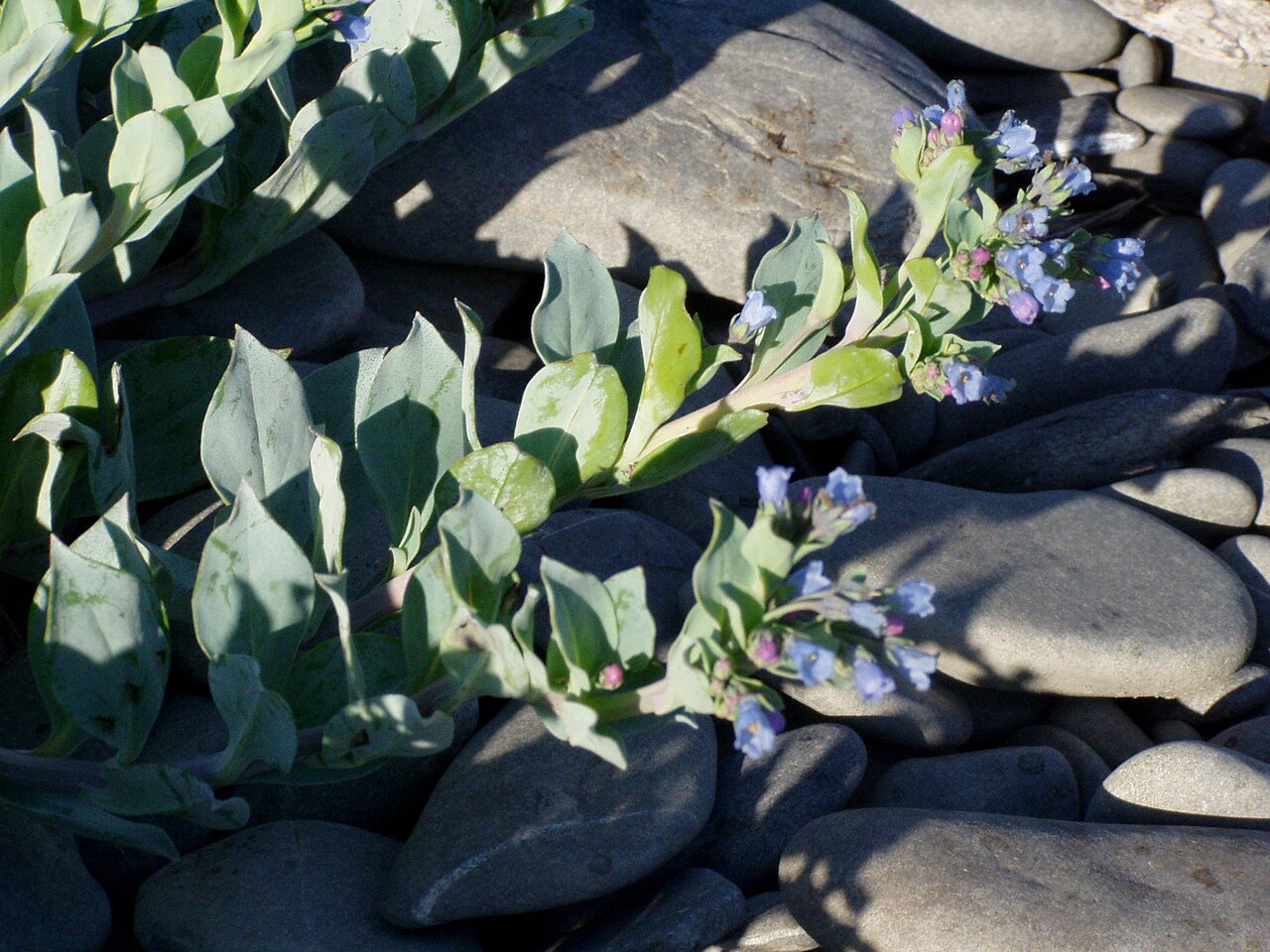
Mertensia maritima, known as Oysterleaf, oyster plant or seaside bluebells, is a low, sprawling perennial of cold northern beaches. It forms mats of trailing stems with thick, waxy, blue-green leaves, and from early summer it bears clusters of small, bell-shaped flowers that open pink and turn sky blue. It belongs to the borage family (Boraginaceae), the same family as Virginia bluebells.
Its leaves are famous for tasting like oysters. They are edible raw, and Alaska Native peoples ate both the leaves and roots. In recent years chefs have made “oyster leaf” a fashionable garnish, and it is grown commercially for restaurants.
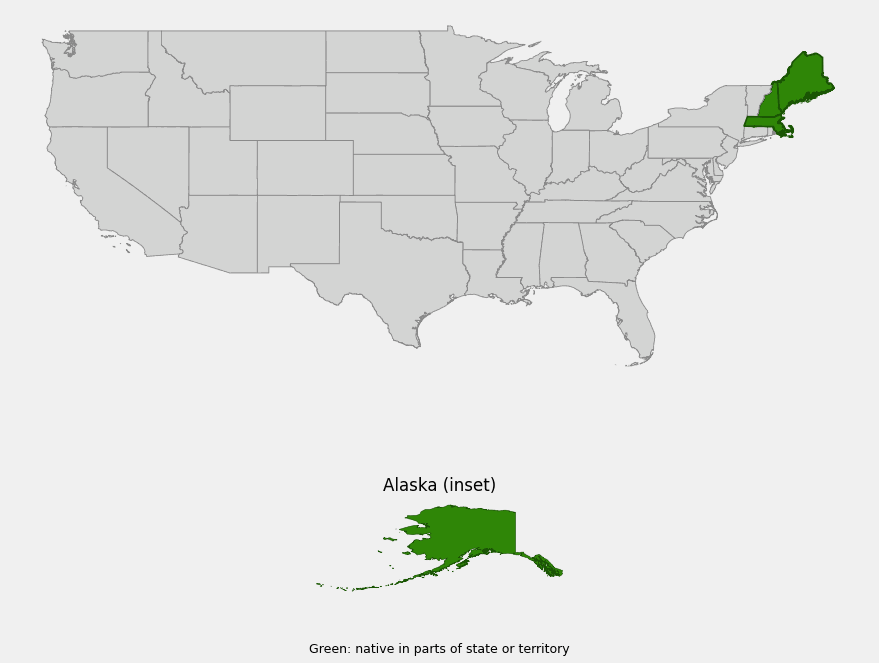
In the United States, oysterleaf grows on the coasts of Alaska and on the Atlantic coast of New England, where it is fairly common on beaches in eastern Maine but very rare farther south. It is a plant of gravel and shingle beaches above the high-tide line. Never dig or pick wild plants: they are slow to recover, and in Massachusetts the species is endangered.
Identification
Look for prostrate mats of fleshy, blue-green, oval leaves on a cold-water gravel or sand beach, with small clusters of pink buds and blue, bell-shaped flowers in summer.
Growth Habit
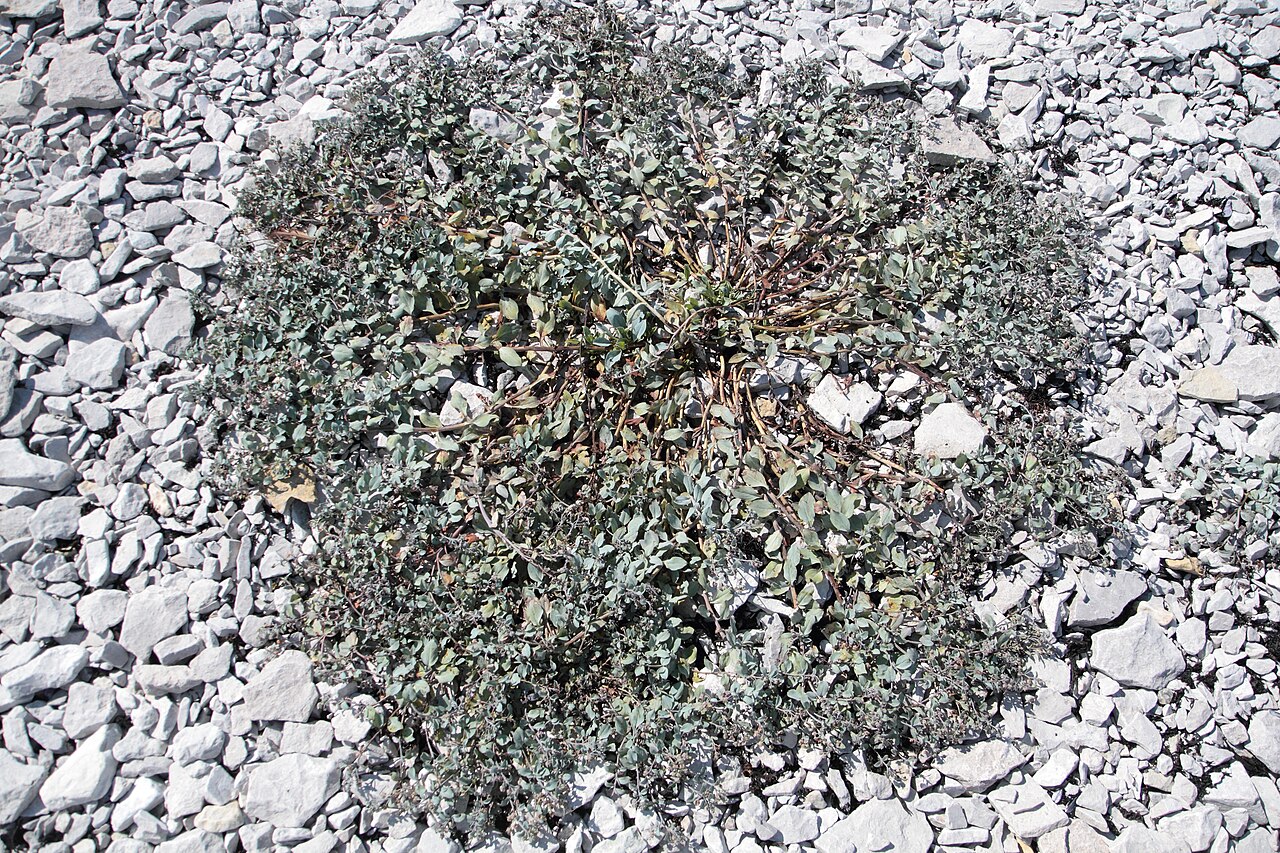
Oysterleaf is a hairless perennial from a deep, fleshy taproot. Its stems lie flat on the ground and spread outward 1 to 3 feet, forming a low mat only a few inches high. The whole plant has a whitish, waxy bloom, which makes it look blue-gray.
Leaves
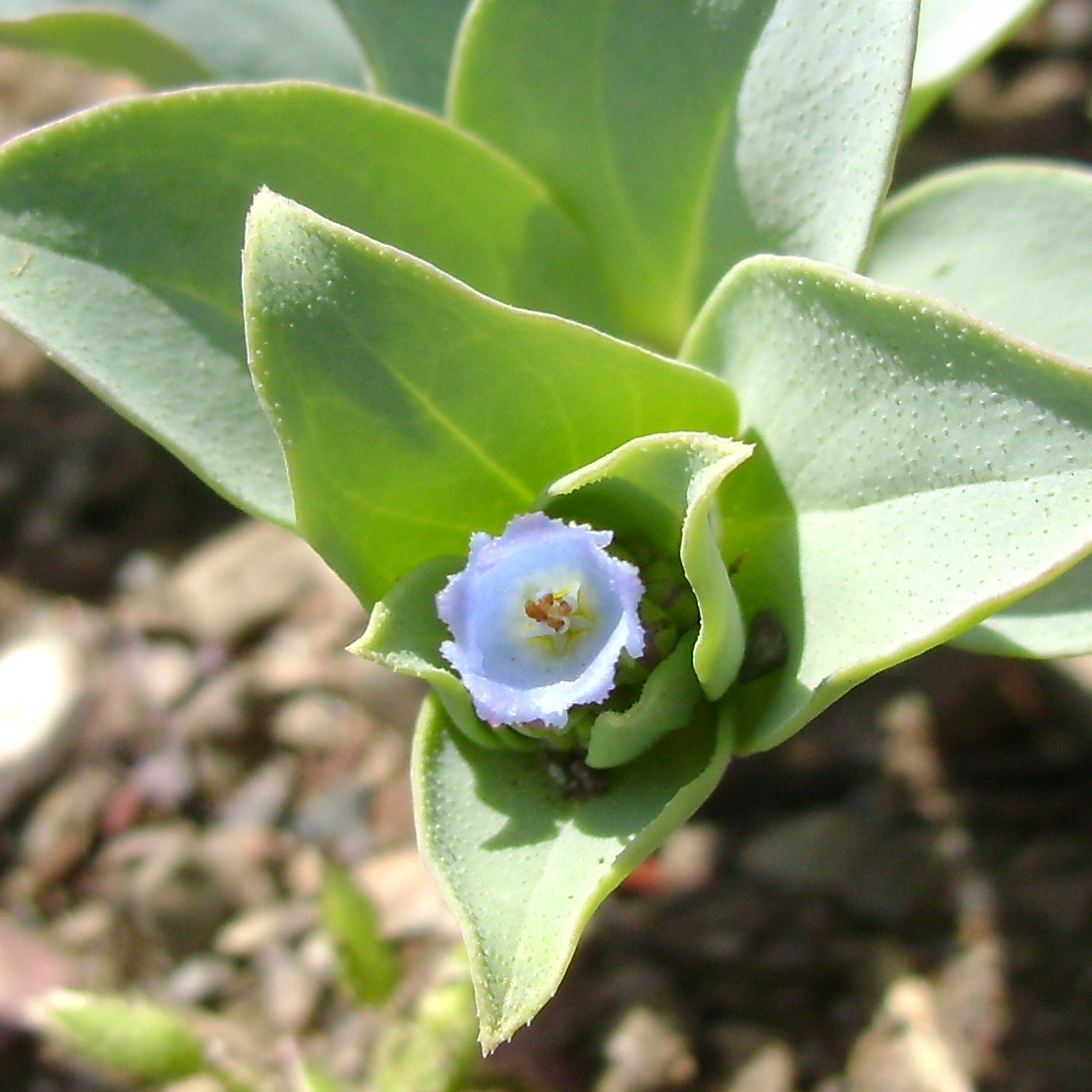
The leaves are alternate, oval to spoon-shaped, about 1/2 to 2 1/2 inches long, thick and fleshy, and smooth-edged. They are blue-green, often dotted with tiny pale spots on the upper surface. The lower leaves have short stalks; the upper ones clasp the stem. Crushed or chewed, they have a mild, salty taste often compared to oysters.
Flowers
The flowers grow in small, curled clusters at the ends of the stems. Each is a narrow bell about 1/4 to 3/8 inch long with five short lobes. They open pink and turn blue as they age, so a cluster usually shows both colors, like other Mertensia species. It blooms from June to August, with a few flowers later.
Fruit & Seeds
Each flower produces up to four smooth, flattened nutlets with a fleshy outer layer. The nutlets can float, and are thought to be spread by seawater along the coast, which helps explain the plant’s patchy distribution on beaches.
Look-alikes
Few beach plants look like it. Sea sandwort also forms fleshy mats on the upper beach, but its leaves are yellow-green, paired and pointed, and its flowers are small, greenish-white stars. Beach pea has compound leaves with tendrils and purple pea flowers. Oysterleaf’s blue-gray, waxy leaves and pink-and-blue bells are distinctive.
Quick Facts
| Scientific Name | Mertensia maritima |
| Family | Boraginaceae (borage family) |
| Plant Type | Herbaceous perennial; prostrate, mat-forming |
| Mature Height | 2–6 in |
| Mature Spread | 1–3 ft |
| Growth Rate | Moderate |
| Sun Exposure | Full sun |
| Water Needs | Moderate; sharply drained |
| Soil Type | Gravel, shingle or coarse sand; very well drained |
| Soil pH | Neutral to alkaline (about 6.5–8.0) |
| Bloom Time | June–August |
| Flower Color | Pink buds opening blue |
| Fall Color | None notable; dies back in winter |
| Fruit | Four flattened, floating nutlets |
| Deer Resistant | Unknown; grazed by sheep and geese |
| USDA Hardiness Zones | 3–6 (cool, maritime summers) |
Native Range
Oysterleaf grows on cold northern coasts of North America, Greenland, Iceland, northern Europe and northeastern Asia. In North America it ranges along the Arctic coast and Hudson Bay, through Labrador, Newfoundland, the Gulf of St. Lawrence and the Maritimes, and along the Pacific coast of British Columbia. Plants of the Pacific and Bering coasts are sometimes treated as a separate subspecies or variety, asiatica.
In the United States, USDA PLANTS lists it as native in Alaska, Maine, New Hampshire and Massachusetts. It grows on beaches around much of coastal Alaska. In New England, Go Botany (Native Plant Trust) describes it as common on Atlantic beaches in Maine, especially eastern Maine, and very rare elsewhere: it is considered extirpated in New Hampshire, and in Massachusetts, at the southern edge of its range, it is extremely rare (S1) and listed as endangered.
It grows on gravel, cobble and shingle beaches and sometimes coarse sand, on the upper beach just above the high-tide line where storm waves occasionally rearrange the stones. Its southern limit is set by warm water and summer heat, and in Europe it has declined at the southern edge of its range.
📋 Regional plant lists featuring Oysterleaf: Alaska · New Hampshire, Maine & Vermont · Connecticut, Massachusetts & Rhode Island
Growing & Care Guide
Oysterleaf is grown as a gourmet herb and as an unusual blue-gray groundcover in cool climates, and plants are sold by some herb and specialty nurseries. It is fussy about drainage and heat. Grow nursery-raised plants or seed; never dig wild plants from beaches.
Light
Full sun in cool, coastal climates. In warmer gardens, give it light afternoon shade.
Soil & Water
It needs very sharply drained, gritty soil: a mix of coarse sand, gravel and a little compost works well, or a raised bed or deep container. Water regularly in dry spells but never let it sit wet; the taproot rots easily in heavy or soggy soil. It grows best where summers are cool, and struggles in hot, humid climates.
Planting Tips
Plant it in a gravel garden, a raised bed or a deep pot, about 12 inches apart, and mulch with gravel rather than bark. Because of its long taproot, choose its spot carefully; established plants don’t transplant well. Slugs and snails love the soft leaves, so protect young plants.
Pruning & Maintenance
Harvest leaves a few at a time once the plant is well established, and leave plenty to keep it growing. The stems die back in winter and regrow in spring from the root.
Propagation
Grow it from seed, which germinates best after a period of cold, moist stratification; sow in fall outdoors or chill the seed for several weeks before sowing in spring. Germination can be slow and uneven. Root cuttings are possible but tricky.
Landscape Uses
- Edible gardens: leaves with an oyster-like flavor, eaten raw
- Gravel and coastal gardens: a blue-gray, sprawling groundcover for sharply drained soil
- Containers: a deep pot of gritty mix suits its taproot
- Beach restoration: part of the native upper-beach plant community on northern coasts
Wildlife & Ecological Value
Oysterleaf is one of a small group of plants that can live on exposed gravel beaches, where salt spray, wind and storm waves keep most plants away.
For Pollinators
The pink-and-blue bells are visited by bumblebees and other bees, and by flies, which reach the nectar at the base of the tube.
For Birds
Geese and other waterfowl graze the leaves on northern beaches. Shorebirds forage among the mats for insects and small invertebrates.
For Mammals
Grazing animals relish the leaves; in Britain, sheep grazing has eliminated it from some beaches. In the wild it is not a major food for any particular mammal.
Ecosystem Role
Its mats trap sand and fine gravel and add organic matter to the bare upper beach, giving a foothold to other strandline plants. Because it depends on cold water and cool summers, its retreat from southern beaches is watched as a sign of a warming climate.
Cultural & Historical Uses
The genus Mertensia honors Franz Carl Mertens, a German botanist of the late 18th and early 19th centuries. Maritima means “of the sea.”
Oysterleaf has long been eaten in the North. Go Botany notes that Alaska Native peoples ate its roots and leaves, and its fresh, salty leaves were gathered in other northern coastal cultures too. Today chefs serve it as a garnish for seafood dishes, sometimes calling it a vegan oyster.
In Britain it is a rare and declining plant of northern Scottish shingle beaches, and its decline is linked to grazing, visitor trampling and warmer conditions at the southern edge of its range. On New England beaches it reaches its own southern limit in Massachusetts.
Frequently Asked Questions
Does oysterleaf really taste like oysters?
Many people say yes: the thick leaves have a mild, salty, mineral flavor often compared to oysters. They are eaten raw, usually as a garnish.
Is oysterleaf native to the United States?
Yes. It is native to the coasts of Alaska and New England, mainly Maine. It is very rare in Massachusetts and no longer found in New Hampshire.
Can I grow oysterleaf at home?
Yes, in cool climates, in very well-drained, gritty soil or a deep pot. It dislikes heat, humidity and wet soil. Buy plants or seed; never dig wild plants.
Why are the flowers both pink and blue?
Like Virginia bluebells, oysterleaf flowers open pink and turn blue as they age, so clusters usually show both colors at once.
Where does oysterleaf grow?
On gravel and shingle beaches just above the high-tide line, on cold northern coasts of North America, Greenland, Europe and Asia.

Looking for a nursery that carries Oysterleaf?
Browse our native plant nursery directory: Alaska · Maine & Massachusetts · New Hampshire

