
Shrubby Indigo (Indigofera suffruticosa)
Indigofera suffruticosa, known as Shrubby Indigo, anil, añil, Guatemalan indigo or West Indian indigo, is the native American indigo plant. For thousands of years people in Mexico, Central America, the Caribbean and South America soaked its leaves to make a deep blue dye, and the Maya combined it with a special clay to make the famous turquoise pigment known as Maya blue. In colonial times it became one of the most valuable export crops of the Americas.
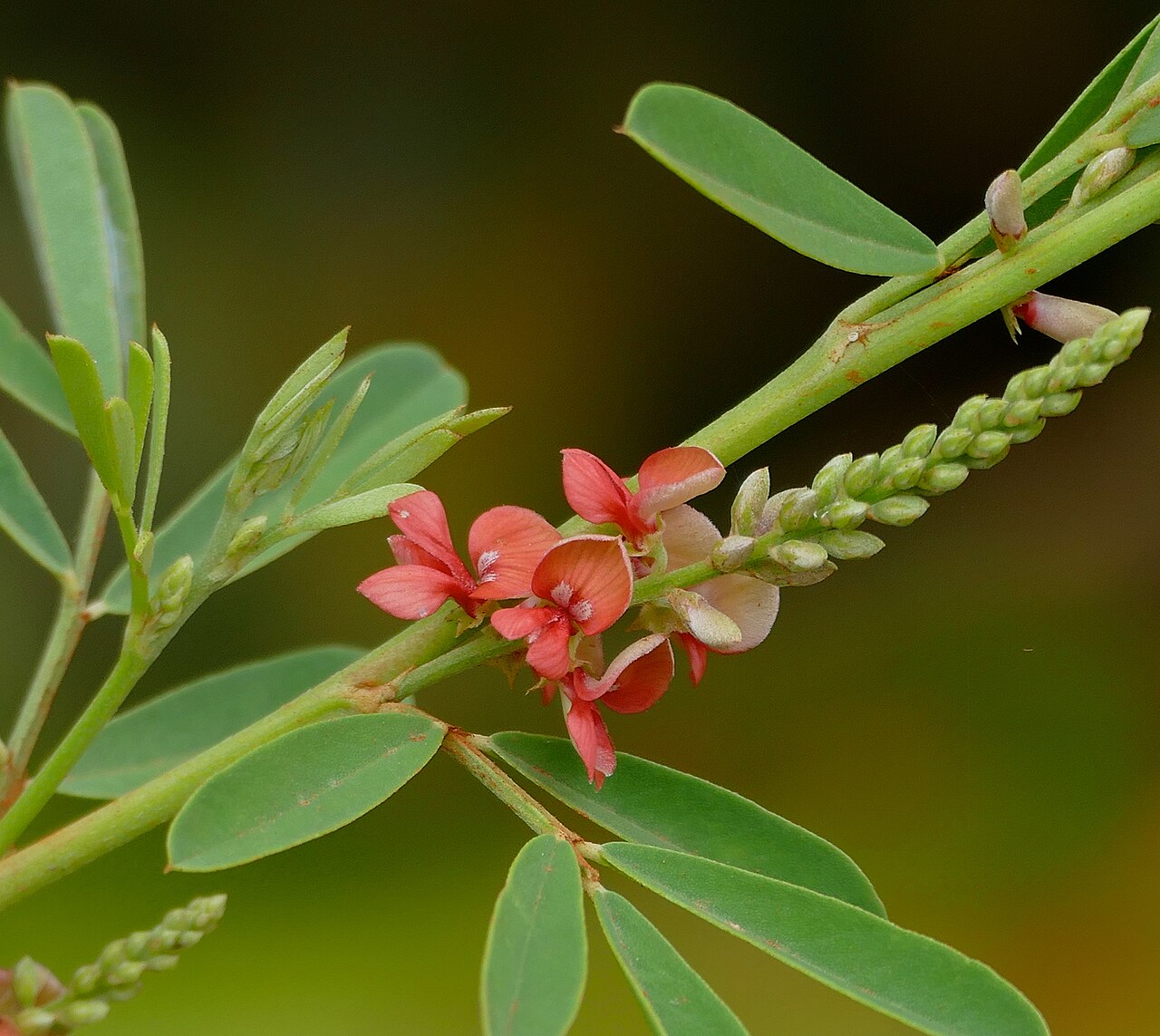
It is a branching, short-lived shrub or subshrub, usually 3 to 6 feet tall, with feathery, gray-green compound leaves, slender spikes of small salmon-red to orange pea flowers, and dense clusters of short, curved seed pods. It is a plant of open, sunny, disturbed ground: roadsides, pastures, field edges and coastal thickets.
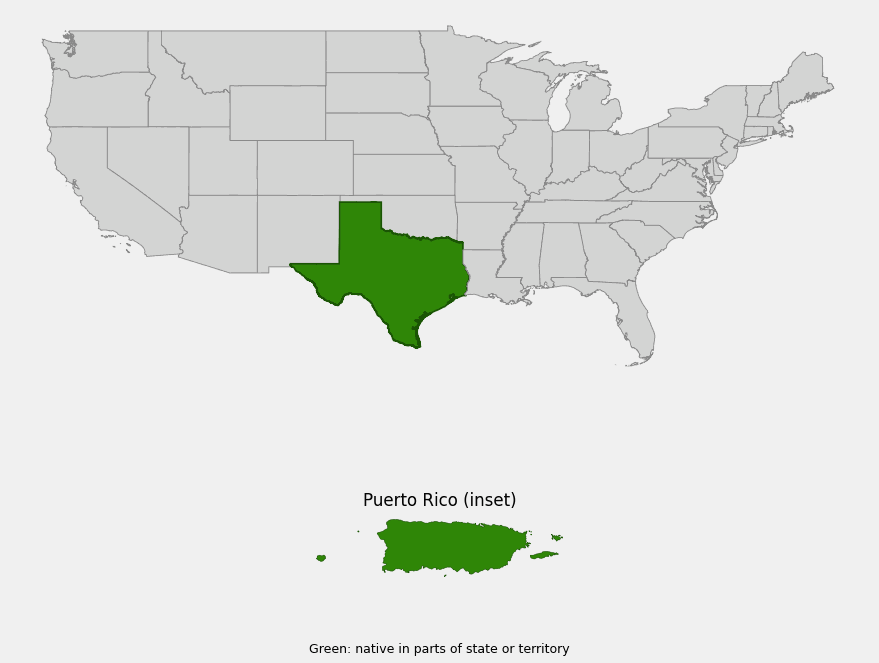
USDA PLANTS lists it as native in the lower 48 states and in Puerto Rico and the Virgin Islands. In the mainland United States the native populations are in Texas, while plants in Florida and the old indigo-growing states of the Southeast are generally treated as escapes from cultivation. This guide covers identification, range, growing anil for dye, its historical importance, and a caution about toxicity to livestock.
Identification
Shrubby indigo looks like many other members of the pea family at first glance. The combination of tiny salmon-red flowers in narrow spikes, feathery leaves with many small leaflets, and crowded clusters of short, sickle-curved pods is the best clue.
Growth Form
It is an erect, much-branched shrub or subshrub, usually 3 to 6 feet tall, woody at the base and soft toward the tips. The stems are covered with flat, pale hairs that are attached at the middle (a feature of the genus), which give young growth a grayish sheen. In frost-free places it lives for a few years; where frost kills it back, it may behave like an annual.
Leaves
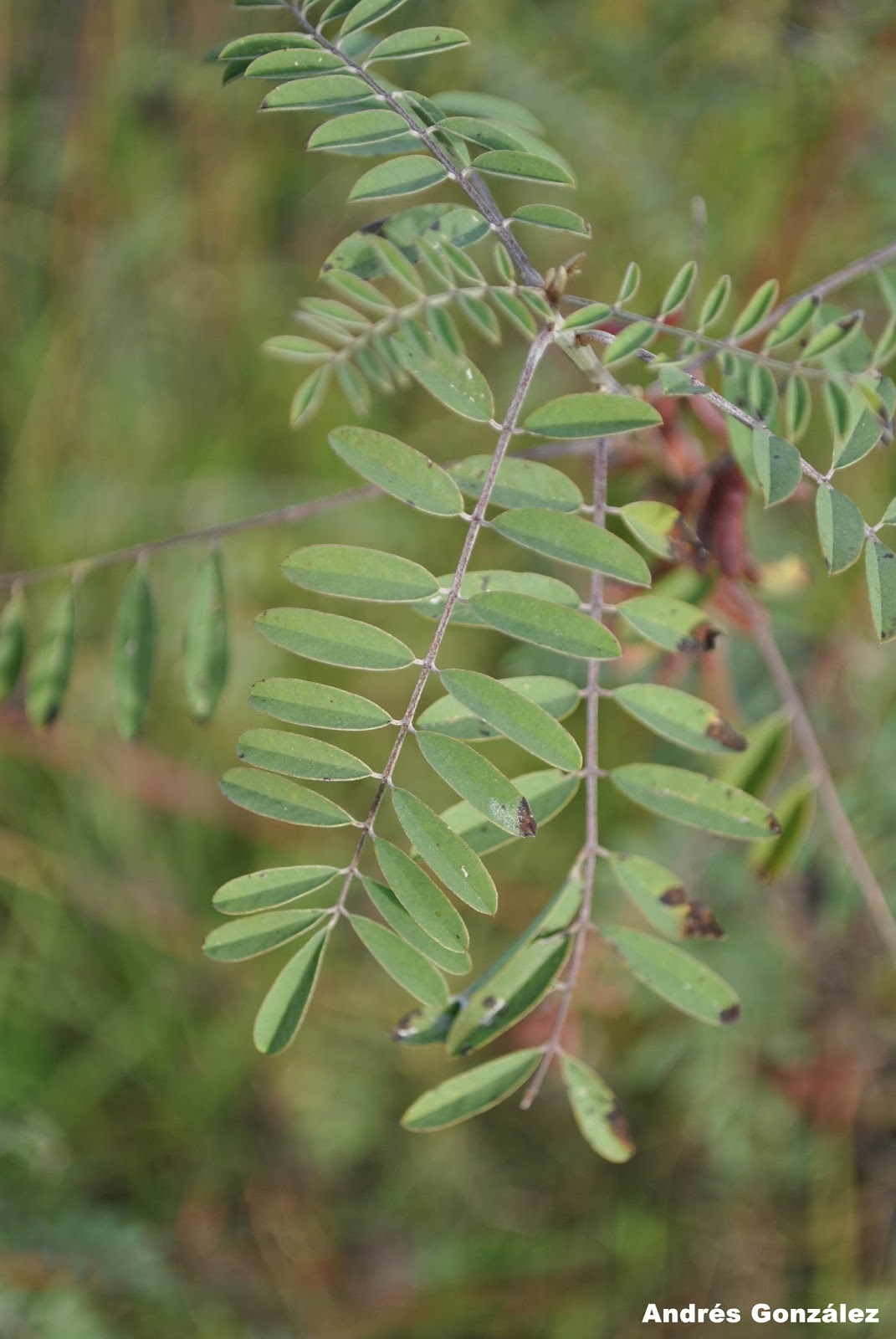
The leaves are alternate and pinnately compound, about 2 to 4 inches long, with roughly 9 to 15 oval to oblong leaflets arranged in pairs plus one at the tip. The leaflets are about half an inch to an inch long, green above and paler and hairy below. Crushed leaves turn bluish as they dry, a hint of the indigo they contain.
Flowers
The flowers are borne in narrow spikes (racemes) shorter than the leaves, arising from the leaf axils. Each flower is only about a quarter inch long, a typical pea flower with a salmon, coral-red or orange banner and keel. In the tropics it can bloom almost all year; in Texas it flowers mainly from late spring into fall.
Seed Pods & Similar Species
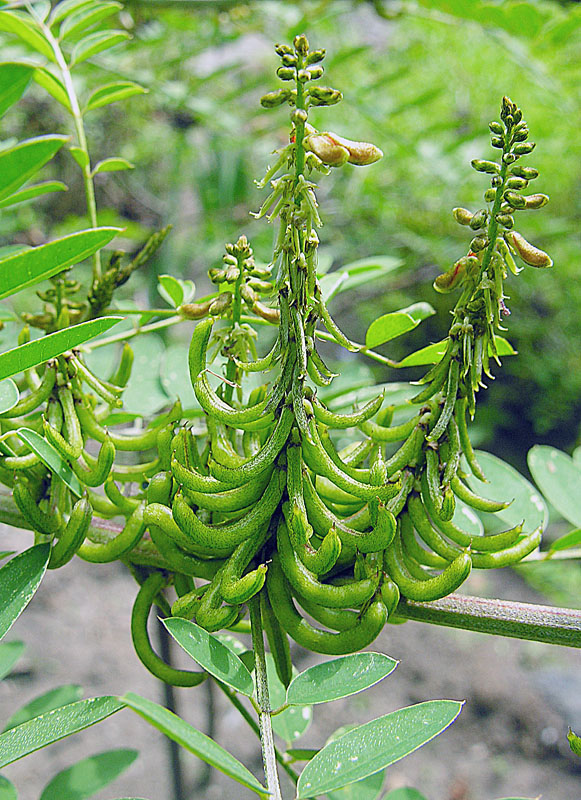
The pods are short, about half an inch to three-quarters of an inch long, strongly curved like a sickle or a fishhook, and packed tightly along the spike so that they hang down in dense clusters. They turn from green to dark brown and split to release a few small, squarish seeds. True indigo (Indigofera tinctoria), an Old World species also grown for dye, has straight pods. The native Scarlet Pea (Indigofera miniata) is a low, sprawling perennial with larger, brighter flowers.
Quick Facts
| Scientific Name | Indigofera suffruticosa Mill.; syn. Indigofera anil L. |
| Family | Fabaceae (pea or legume family) |
| Plant Type | Short-lived shrub or subshrub |
| Mature Height | 3–6 ft |
| Mature Spread | 2–4 ft |
| Growth Rate | Fast |
| Sun Exposure | Full sun |
| Water Needs | Low to moderate; drought tolerant once established |
| Soil Type | Sandy, loamy or gravelly well-drained soil; tolerates poor, disturbed soils |
| Soil pH | About 6.0–8.0 |
| Bloom Time | Late spring to fall in Texas; nearly year-round in the tropics |
| Flower Color | Salmon, coral-red or orange |
| Fall Color | None |
| Fruit | Short, sickle-curved brown pods in dense clusters |
| Deer Resistant | Unknown; caution, may be harmful to livestock |
| USDA Hardiness Zones | 9–11 (grown as an annual in colder zones) |
Native Range
Shrubby indigo is native to the warm parts of the Americas, from Texas and Mexico through Central America and the Caribbean to northern Argentina. It has been carried around the world as a dye crop and is now naturalized in tropical Africa, Asia, Australia and the Pacific, including Hawaii and Guam, where USDA classes it as introduced.
USDA PLANTS lists it as native in the lower 48 states and records it in Texas, Florida, Georgia, Louisiana, Mississippi, North Carolina and South Carolina. In Texas it is accepted as native and grows in the southern part of the state. In the Southeast, the picture is different: the Atlas of Florida Plants lists it as not native in Florida, and Southeastern floras generally treat the scattered plants of the Carolinas, Georgia and the Gulf states as escapes from colonial indigo plantations. Following our range rule, this page maps only Texas and Puerto Rico as native.
In Puerto Rico and the U.S. Virgin Islands, where USDA lists it as native, anil is a common plant of pastures, roadsides, dry coastal thickets and abandoned fields.
📋 Regional plant lists featuring Shrubby Indigo: South & West Texas · Puerto Rico
Growing & Care Guide
Shrubby indigo is easy to grow in hot, sunny gardens, and it is the plant to choose if you want to try making indigo dye from a species native to the Americas. Because it can harm grazing animals and reseeds readily, keep it out of pastures.
Light
Plant in full sun. In shade it grows leggy and produces fewer flowers and less leaf for dye.
Soil & Water
Any well-drained soil works, from sand to loam, and it does well in poor soil because, like most legumes, it partners with nitrogen-fixing bacteria in its roots. Water young plants regularly; established plants tolerate dry spells, but steady moisture produces more leaf if you plan to harvest for dye. Avoid soggy soil.
Planting Tips
Grow it from seed in spring once the soil is warm. Nick or soak the hard seeds overnight in warm water to speed germination, then sow a quarter inch deep. Space plants about 2 to 3 feet apart. In south Texas, Florida and Puerto Rico it can grow as a perennial; elsewhere grow it as a warm-season annual and harvest before the first frost.
Pruning & Maintenance
For dye, cut the leafy stems when the plants begin to flower, leaving 6 to 12 inches of stem so they can regrow for a second harvest. Trim plants after flowering to keep them bushy. Remove seed pods before they split if you do not want seedlings, and do not plant it where livestock graze.
Propagation
Seed is the usual method; scarify the hard seed coat for best results. Softwood cuttings can also be rooted in warm weather. Fresh plants are best obtained from native seed suppliers or dye-plant specialists.
Landscape Uses
- Dye gardens: the native American indigo, harvested for blue dye in a warm climate
- Heritage and educational gardens: a living link to Maya blue and colonial indigo history
- Pollinator plantings: small flowers visited by bees and butterflies over a long season
- Wildflower and roadside plantings: a fast, drought-tolerant legume for poor soils in Texas and the Caribbean
- Soil improvement: a nitrogen-fixing cover in disturbed ground, away from grazing animals
Wildlife & Ecological Value
Like many legumes, shrubby indigo feeds pollinators and improves soil, which makes it a useful pioneer plant on open, disturbed ground within its native range.
For Pollinators
Small bees, including native bees and honeybees, visit the pea flowers for nectar and pollen. Small butterflies and wasps also stop at the flowers.
For Birds
The dense, branching shrubs give cover to small birds in open fields, and seed-eating birds may take the small seeds from split pods.
For Mammals
Grazing animals should not eat it. Several Indigofera species contain compounds that are toxic to livestock, and shrubby indigo has been reported to cause poisoning, including anemia, in cattle in South America.
Ecosystem Role
Through its root nodules it adds nitrogen to poor, disturbed soils, helping other plants establish. It is a pioneer that colonizes bare ground quickly and is gradually replaced as woody plants grow up around it.
Cultural & Historical Uses
Indigo dye from anil has a long history in the Americas. Mesoamerican peoples used it to dye cloth and paint, and the Maya mixed it with palygorskite clay and heated it to make Maya blue, a brilliant turquoise pigment that has lasted for centuries on murals and pottery. Under Spanish rule, añil from Guatemala and El Salvador became a major export.
In the 1700s, indigo was a leading cash crop in South Carolina and Georgia. Eliza Lucas Pinckney is famous for helping establish indigo cultivation in South Carolina in the 1740s, and the crop was grown by the forced labor of enslaved Africans, many of whom brought skills in indigo processing from West Africa. Planters grew both American anil and the Old World true indigo. When the crop declined after the American Revolution, plants escaped and persisted in old fields, which is why scattered populations still turn up in the Southeast.
Safety note: shrubby indigo is not a food or medicinal plant. Several Indigofera species are toxic to livestock, and this species has been linked to poisoning in grazing animals. Do not plant it in pastures, keep pets and children from chewing it, and wear gloves when processing leaves for dye.
Frequently Asked Questions
Is shrubby indigo the same as true indigo?
No. True indigo (Indigofera tinctoria) is native to the Old World. Shrubby indigo, or anil (Indigofera suffruticosa), is the American species. Both produce indigo dye and both were grown in colonial plantations.
Is Indigofera suffruticosa native to the United States?
USDA PLANTS lists it as native in the lower 48 states and in Puerto Rico. Native populations occur in Texas. In Florida and the Southeast it is generally considered an escape from colonial indigo cultivation; the Atlas of Florida Plants lists it as not native there.
Can I make blue dye from shrubby indigo?
Yes. Fresh leaves are soaked in water to ferment, then the liquid is aerated and treated to extract the indigo pigment, or the leaves are used in a fermentation vat. Several dye-plant guides describe the process in detail. Harvest leaves when the plants begin to flower.
Is shrubby indigo poisonous?
It should be treated as harmful to livestock. Several Indigofera species are toxic to grazing animals, and anil has been reported to poison cattle in South America. Do not eat it or use it as medicine, and keep it out of pastures.
Does shrubby indigo come back every year?
In frost-free climates such as south Texas and Puerto Rico it lives for a few years and reseeds. In colder areas grow it as an annual from seed each spring.

Looking for a nursery that carries Shrubby Indigo?
Browse our native plant nursery directory: Texas

