
Puaʻakuhinia (Astelia menziesiana)
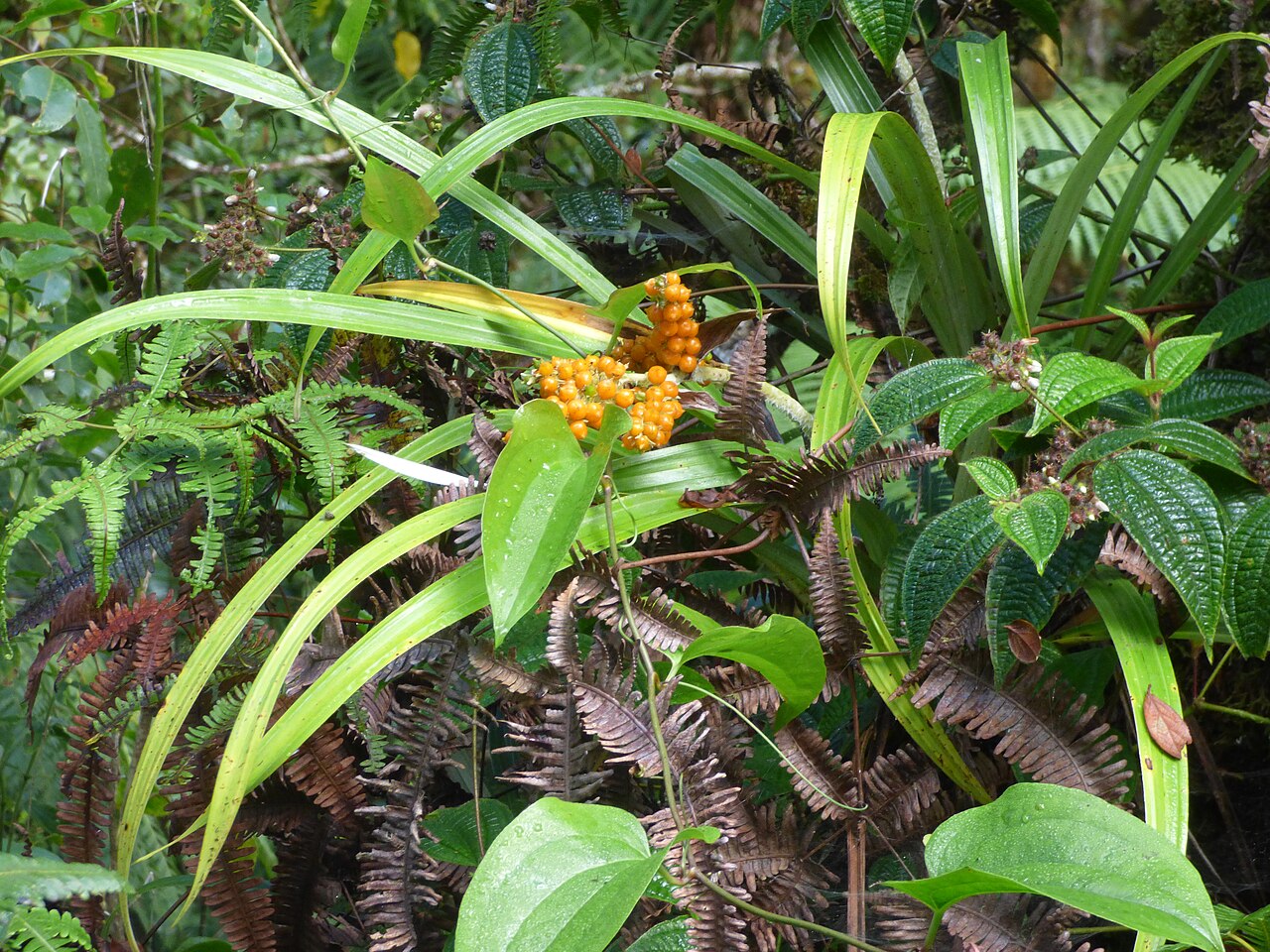
Astelia menziesiana, known in Hawaiian as Puaʻakuhinia, Kaluaha or Paʻiniu, and in English as Menzies’ astelia, is a clumping, lily-like plant found only in the Hawaiian Islands. It forms fountains of long, strap-shaped leaves that are green to silvery-green above and often silvery, white or golden underneath, and female plants carry showy clusters of orange berries. It grows in the cool, misty mesic and wet forests of all the main islands, from about 2,000 feet to above 7,000 feet.
Puaʻakuhinia is one of the few native Hawaiian flowering plants that commonly grows as an epiphyte. It perches on the trunks and branches of ʻōhiʻa and on the trunks of tree ferns, though it also grows on rocks and on the ground. In forests with feral pigs, which eat it, it is most often seen up in the trees, out of reach.
The silvery leaves are a traditional lei material that is still used today. In the garden, paʻiniu is a slow but rewarding plant for cool, shady, humid spots in upland Hawaiʻi, and it can be grown in containers or mounted on a hāpuʻu trunk much like an orchid or bromeliad. This guide covers how to recognize it, where it grows, how to grow it, and its cultural and ecological importance.
Identification
Hawaiʻi has three endemic Astelia species. Astelia menziesiana is by far the most widespread and the one most often seen in cultivation; the other two are restricted to Kauaʻi. Formerly placed in the lily family (Liliaceae), the genus now belongs to its own family, Asteliaceae.
Growth Habit
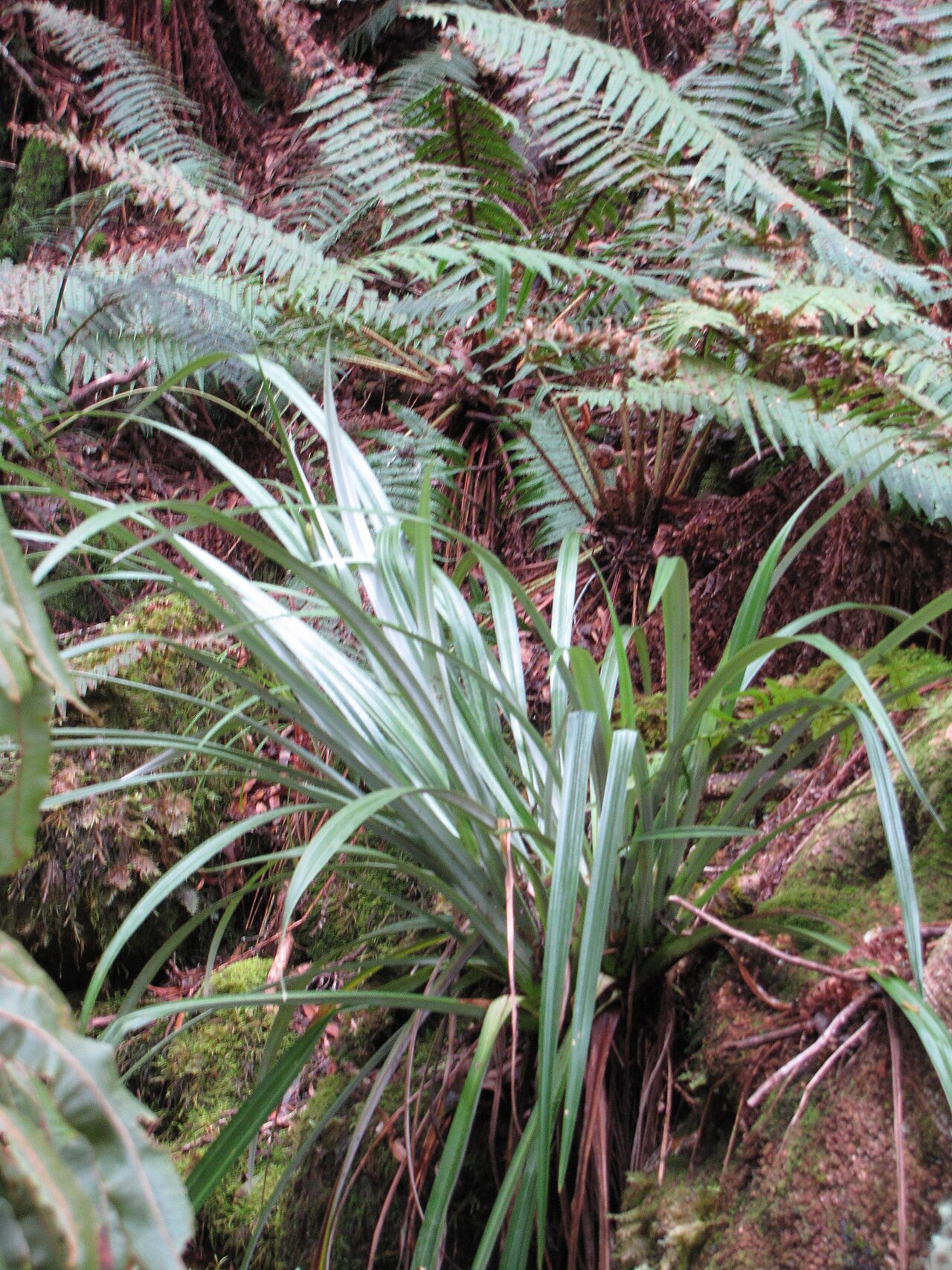
Puaʻakuhinia grows as a stemless or very short-stemmed rosette that forms a clump about 1 to 3 feet tall and wide, sometimes larger. The genus name Astelia comes from Greek words meaning “without a column,” a reference to this nearly stemless habit. Plants grow on tree trunks and branches (epiphytic), on rocks (lithophytic) or in the ground.
Leaves
The leaves are long, narrow and strap-like, from about 8 inches to about 4 feet long and ½ to 3 inches wide, with a waxy texture and parallel veins. The upper surface is green to silvery-green, and the underside is often covered with silvery, white or golden scales that give the clump a shimmering look. The leaf bases overlap and hold small pockets of water. The plant can look a little like a bromeliad, but it is not related.
Flowers
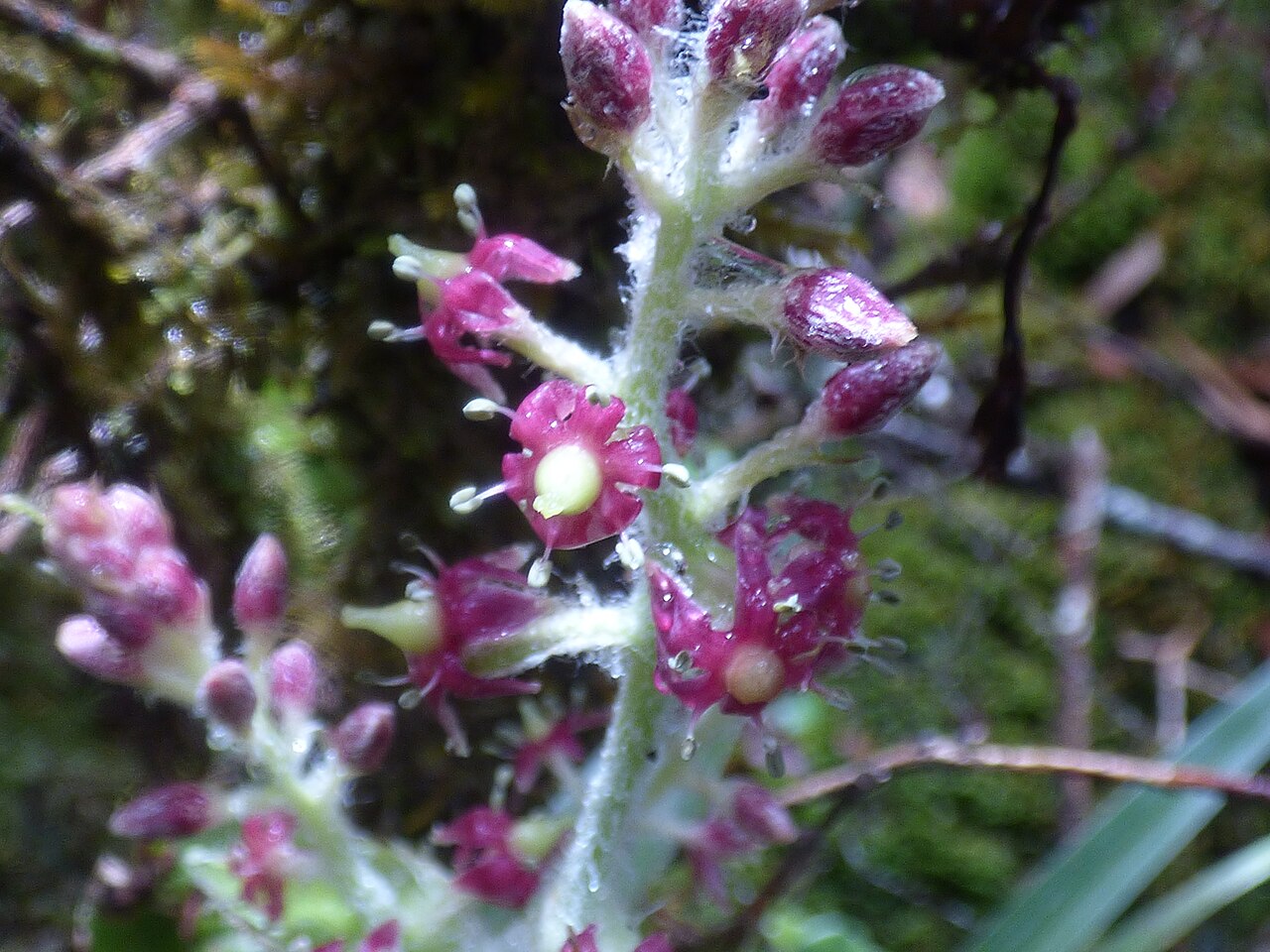
Male and female flowers grow on separate plants. They are small and star-shaped, borne in long, branched spikes with woolly stalks that rise from the center of the rosette. Flower color is variable, from yellowish or greenish to purple and red. Flowering is mainly in spring, around April to June.
Fruit
Female plants produce dense clusters of small, round, juicy berries that ripen bright orange to orange-yellow. They are very ornamental and are eaten by birds, which disperse the tiny seeds. Nursery-grown female plants can begin fruiting after about 2 to 3 years, as long as a male plant is nearby.
Similar Species
Astelia argyrocoma and the federally endangered A. waialealae grow only on Kauaʻi; A. waialealae is a small plant of the Alakaʻi bogs. The native climbing ʻIeʻie has similar long leaves but grows as a woody climber with stems that wrap around trees. Introduced bromeliads have stiffer, often spiny leaves and lack the silvery undersides and orange berry clusters.
Quick Facts
| Scientific Name | Astelia menziesiana Sm. |
| Family | Asteliaceae (astelia family) |
| Plant Type | Clumping evergreen perennial, epiphytic or terrestrial; endemic to Hawaiʻi |
| Mature Height | 1–3 ft (leaves occasionally to about 4 ft long) |
| Mature Spread | 1–3 ft |
| Growth Rate | Slow to moderate |
| Sun Exposure | Part shade to shade |
| Water Needs | Medium to high; keep evenly moist |
| Soil Type | Very well-drained, moisture-retentive organic media; cinder, orchid mix or tree-fern fiber |
| Soil pH | Acidic, about 5.0–6.5 |
| Bloom Time | Mainly spring (April–June) |
| Flower Color | Yellowish, purple or red |
| Fall Color | None; evergreen |
| Fruit | Clusters of small orange to orange-yellow berries on female plants |
| Deer Resistant | No; eaten by feral pigs and browsed by other ungulates |
| USDA Hardiness Zones | 10–12 (needs cool, humid upland conditions) |
Native Range
Puaʻakuhinia is endemic to the Hawaiian Islands. USDA PLANTS records it only from Hawaiʻi, and it grows on Kauaʻi, Oʻahu, Molokaʻi, Lānaʻi, Maui and Hawaiʻi Island. It is common to fairly common on most of these islands but rare on Oʻahu, where most forests above 2,000 feet lie close to the Koʻolau and Waiʻanae summits.
It grows in mesic and wet forests from about 2,000 feet to above 7,000 feet elevation, in areas that receive from about 50 to well over 100 inches of rain a year. Typical settings are mossy ʻŌhiʻa Lehua and Koa forest with a tree-fern understory, cloud forest, stream gulches and wet rock faces. It perches on branches and tree-fern trunks or grows on the ground and on rocks.
The species is not federally listed; on the USFWS ECOS database the only listed Hawaiian Astelia is the Kauaʻi bog species A. waialealae. Feral pigs, which dig up and eat terrestrial plants, and the loss of native forest to invasive plants are the main threats to puaʻakuhinia, and fenced, pig-free forest reserves are where it is most abundant on the ground.
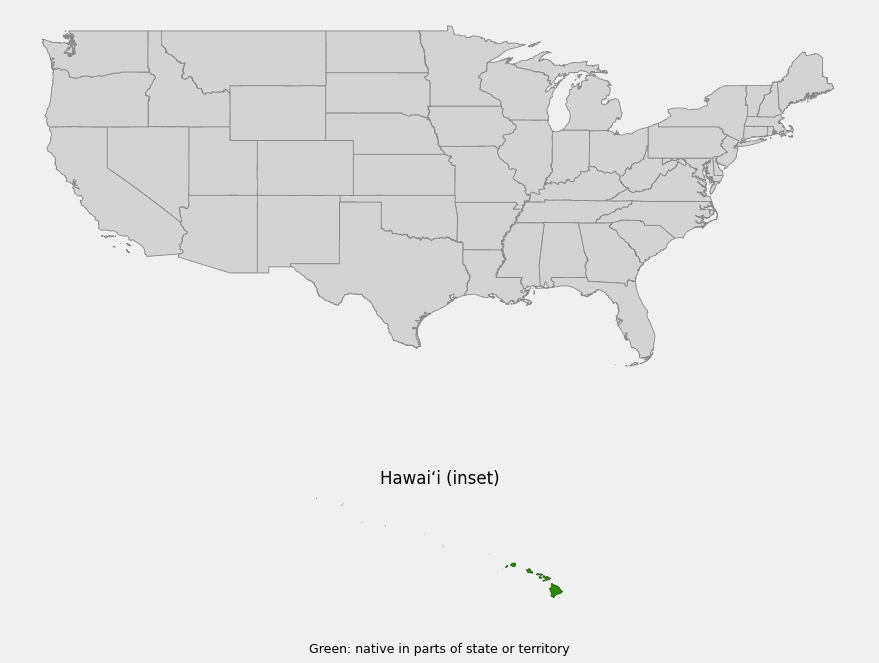
📋 Regional plant lists featuring Puaʻakuhinia: Hawaii
Growing & Care Guide
Puaʻakuhinia grows best in cool, humid, shady conditions, ideally in upland Hawaiʻi gardens above about 2,000 feet, and it struggles in hot, dry, windy or salty lowland sites. It is slow, but long-lived and well worth the patience. Buy nursery-propagated plants from Hawaiian native plant nurseries and never take plants from the forest. Gardeners outside Hawaiʻi should know that Hawaiʻi restricts plants brought in from other states, and Hawaiian native plants are rarely offered on the mainland; outside frost-free, cool, humid climates it is a plant for a cool greenhouse at best.
Light
Give it part shade to shade, such as the dappled light under trees or on the shady side of a building. Experienced growers report that it can take full sun as low as about 2,000 feet in a drier climate if it is watered regularly, but leaf scorch is common in strong sun at low elevations.
Soil & Water
Use a very well-drained mix that still holds moisture: orchid bark mix, cinder with added organic matter, or hāpuʻu (tree-fern) fiber all work. Keep the roots evenly moist and water whenever the medium begins to dry; it should never sit in soggy, airless soil. It has no tolerance for salt spray and grows poorly in windy spots. Feed lightly but regularly, for example with a dilute fish emulsion foliar feed every few months.
Planting Tips
Grow puaʻakuhinia the way you would an epiphytic orchid or bromeliad. It does well in 1- to 5-gallon containers of orchid mix, and it can be “planted” directly onto a living or cut hāpuʻu trunk, as it grows in the wild. In the ground, space plants 2 to 3 feet apart in a raised, well-drained bed under trees. For berries you need both a male and a female plant, so buy several.
Pruning & Maintenance
Little pruning is needed. After fruiting, trim off spent flower stalks and any old, brown leaves for a cleaner look. Check the leaf bases and undersides for mealybugs and spider mites, which are the main pests in cultivation, especially in drier, warmer gardens.
Propagation
Seed is the preferred method: clean the pulp from ripe orange berries and sow the tiny seeds on the surface of a fine, moist mix in shade. Seedlings adapt better to the elevation and climate of the garden than divisions moved from higher, cooler sites. Large clumps can also be carefully divided. Growth from seed is slow, and plants take a few years to reach flowering size.
Landscape Uses
- Shade and upland gardens: a silvery, fountain-shaped accent for cool, humid, shady beds
- Epiphyte plantings: mounted on hāpuʻu trunks or tree branches like an orchid
- Containers: a long-lived patio or lanai plant in orchid mix
- Lei plantings: silvery leaves are a classic lei material
- Forest restoration: understory and epiphyte layer in upland native forest
Wildlife & Ecological Value
Puaʻakuhinia is a small but important part of the Hawaiian upland forest, feeding birds and sheltering one of Hawaiʻi’s rare native insects.
For Pollinators
The small flowers are visited by insects, including native flies and other small insects of the upland forest. Because male and female flowers are on separate plants, insects must carry pollen between plants for fruit to set.
For Birds
The bright orange berries are eaten by birds, which spread the tiny seeds to new perches on trunks and branches. This bird dispersal is how an epiphyte reaches the high, mossy branches where it grows.
For Mammals
Hawaiʻi has only one native land mammal, the Hawaiian hoary bat, which hunts insects over the forests where puaʻakuhinia grows. Introduced feral pigs eat the plant and uproot it, which is why it survives mostly on trunks and branches in pig-infested forests.
Ecosystem Role
Water collects in the overlapping leaf bases, forming tiny aquatic habitats. On Oʻahu, Lānaʻi, Molokaʻi, Maui and Hawaiʻi Island, these pockets, along with those of ʻieʻie, are breeding sites for the endemic Kōʻele Mountain damselfly or pinao ʻula (Megalagrion koelense), whose nymphs live in the water held between the leaves. Epiphytic clumps also trap moisture and organic matter in the forest canopy.
Cultural & Historical Uses
Native Hawaiians used the silvery leaves of paʻiniu in lei. They were occasionally used for thatch, and hats were braided from the shiny outer leaves, sometimes combined with other plant materials, as a sign that the wearer had visited Kīlauea Crater on Hawaiʻi Island.
Paʻiniu leaves are still used in modern lei for the head, neck, wrist and ankle, and in lei for horses, especially in upland communities. Lei makers value the way the silvery undersides catch the light.
The species name honors Archibald Menzies (1754–1842), the Scottish surgeon and naturalist who sailed with George Vancouver and collected plants in Hawaiʻi in the 1790s. The plant is a reminder of the many native Hawaiian flowering plants that evolved to live in the moss-laden canopy of the islands’ cloud forests.
Frequently Asked Questions
Is puaʻakuhinia the same as paʻiniu?
Yes. Astelia menziesiana is known by several Hawaiian names, including puaʻakuhinia, kaluaha and paʻiniu. Paʻiniu is the name most often used by lei makers and is sometimes applied to all Hawaiian Astelia species.
Is puaʻakuhinia native to Hawaiʻi?
Yes. It is endemic to the Hawaiian Islands, which means it grows wild nowhere else. It is found on Kauaʻi, Oʻahu, Molokaʻi, Lānaʻi, Maui and Hawaiʻi Island, mainly from about 2,000 to over 7,000 feet.
Can I grow puaʻakuhinia in a lowland garden?
It is difficult. It prefers cool, humid, shady conditions. In warm lowland gardens it may survive in deep shade with regular watering, but it grows best above about 2,000 feet or in a cool, shaded container setting.
Why doesn’t my plant have berries?
Male and female flowers grow on separate plants, and only females produce berries. You need at least one male plant nearby, and plants usually take a few years to reach flowering size.
Is it endangered?
Astelia menziesiana is not federally listed and is still fairly common in upland forests on most islands, though rare on Oʻahu. Its relative A. waialealae of Kauaʻi is federally endangered.

Looking for a nursery that carries Puaʻakuhinia?
Browse our native plant nursery directory: Hawaii

