Designing a Native Grass Border Without Blocking Windows or Walkways
Last updated: November 6, 2026
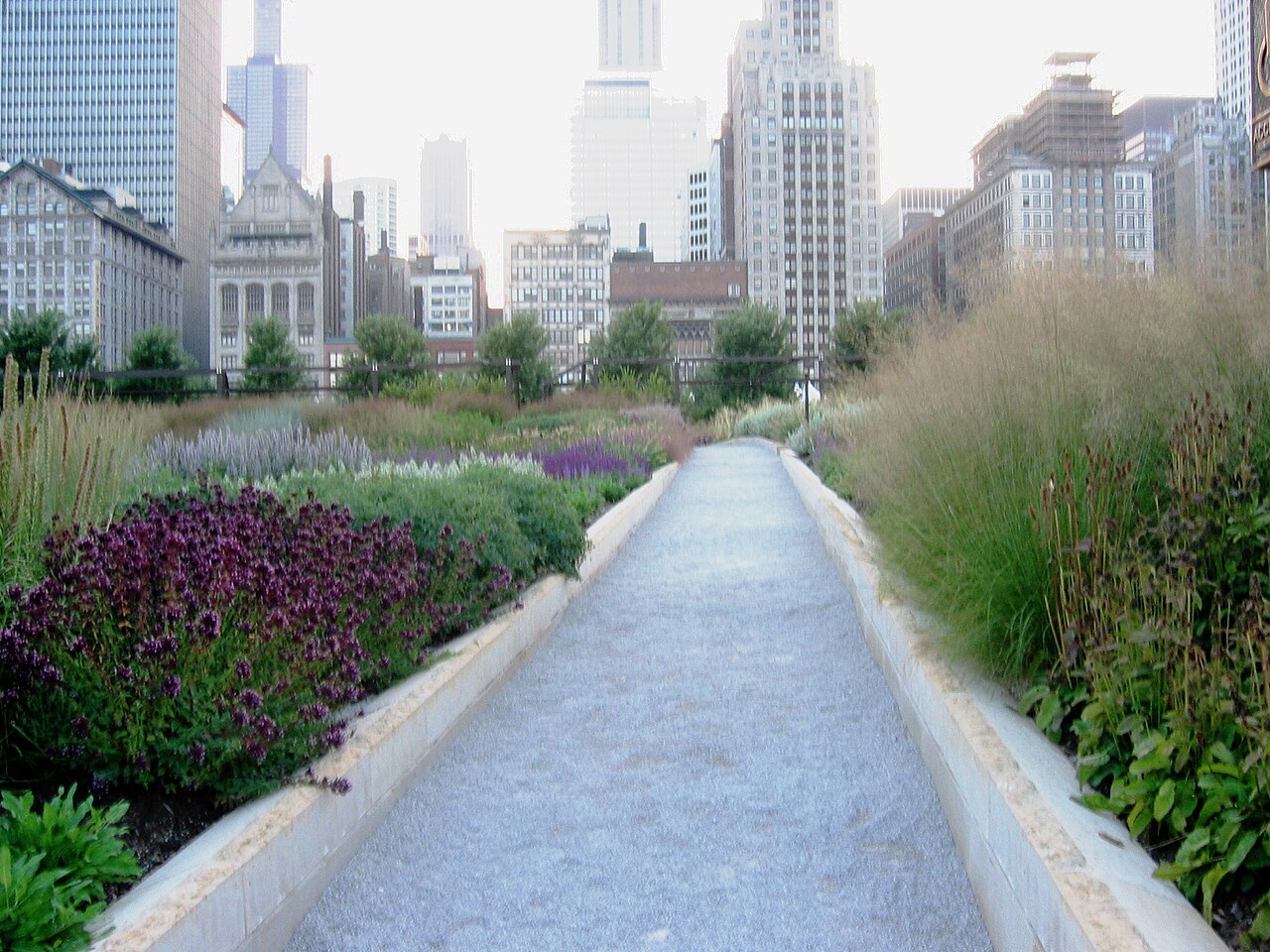
Native grasses look their best in late summer and fall, which is exactly when they are tallest. A border that looked tidy in June can be leaning over the front walk by September and filling the bottom half of a window by October.
The fix is not to give up on grasses near the house. It is to match each grass to the space it will have at full size, seed heads included, and to set the plants back far enough that their natural lean stays inside the bed.
This plan shows how to measure a foundation bed or walkway strip, which native grasses fit under windows and beside paths, how far apart to plant them, and how to keep the border neat through the first three years.
Plan at a Glance
| Site | Foundation bed under windows, or a strip along a front walk or driveway |
| Size | 4 to 6 feet deep; the sample plan is 5 × 24 feet |
| Sun | Full sun for the best habit; most of these grasses lean or flop in shade |
| Soil | Average to dry, well-drained soil; skip compost and fertilizer |
| Maintenance | Low: one late-winter cutback and a crisp edge along the walk |
| Best regions | Eastern and central U.S. as written; western and southern swaps are listed below |
Measure the Space Before You Choose a Grass
Most blocked windows and crowded walks come from one mistake: choosing grasses by the height printed on a nursery tag in spring. Measure the bed first, then shop.
Take four measurements and write them down:
- Sill height: the distance from the soil to the bottom of each window. Low basement or ranch-house windows may sit only a couple of feet above grade.
- Bed depth: from the house wall to the walk or lawn edge, not counting any edging strip.
- Walk width: narrow walks lose more usable space when grass leans into them.
- Sightlines: where the walk meets the driveway, and where the driveway meets the street.
Also note sun. A foundation bed on the north side of a house gets far less light than one on the south side, and grasses that stand upright in full sun often lean toward the light in partial shade.
The Two Rules That Keep a Grass Border Out of the Way
Rule 1: size the grass to the window, not the other way around. The mature height that matters is the height of the seed heads in fall, not the leaves in summer. As a working rule, pick grasses whose full fall height stays several inches below the sill. Cornell Cooperative Extension notes that foundation plantings are expected to cover the foundation but not hide windows or doors.
Rule 2: keep the height in proportion to the bed. The same Cornell Extension article passes on a landscape designer’s rule of thumb: choose plants whose mature height is no more than half the bed width. A 5-foot-deep bed can carry plants up to about 2½ feet; a 3-foot strip should stay lower.
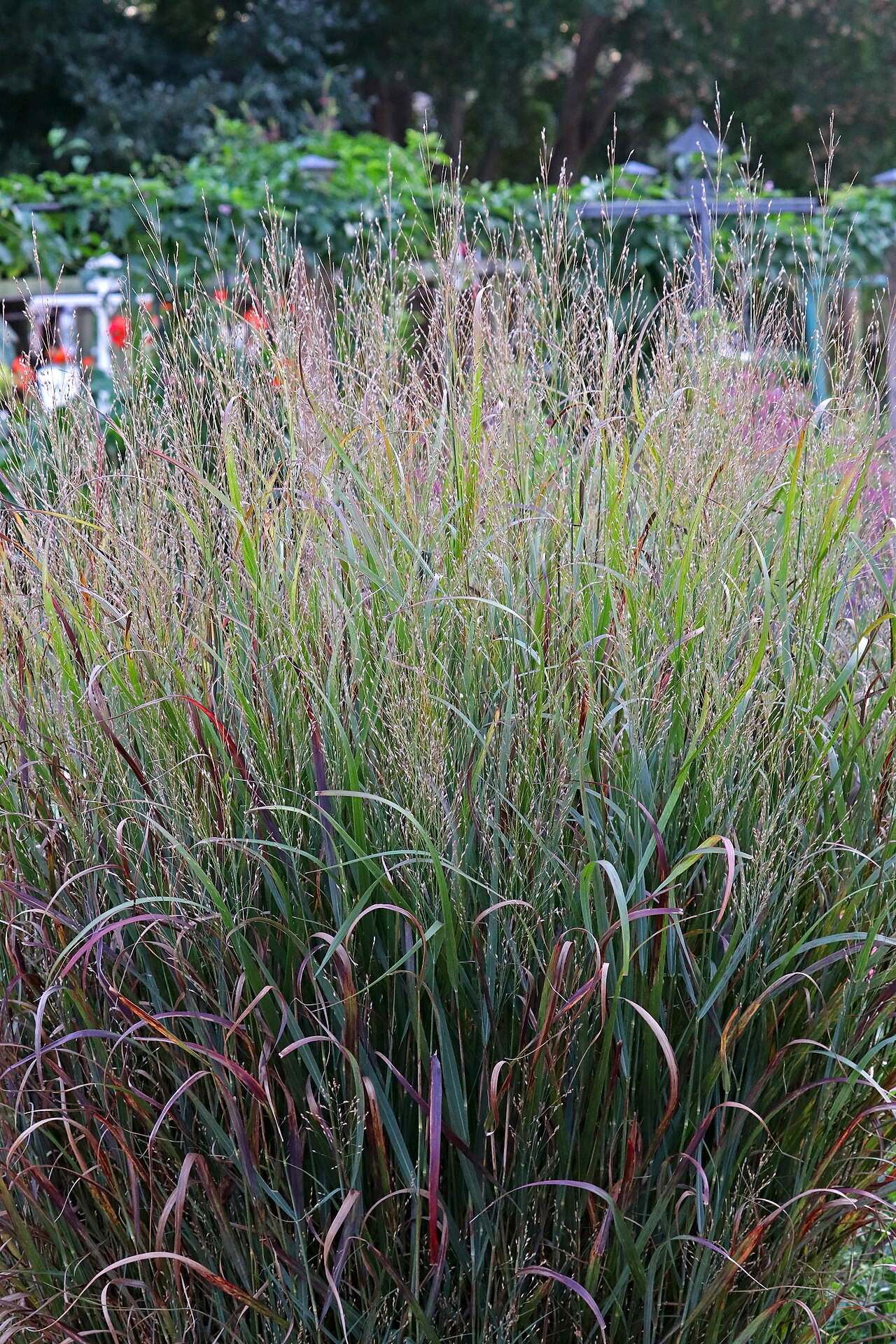
These rules also explain why switchgrass rarely belongs under a window. NC State Extension lists it at 3 to 7 feet tall, and the Lady Bird Johnson Wildflower Center notes it can reach about 10 feet. It is a screening grass, not a foundation grass; see switchgrass as a seasonal screen for where it does fit.
Setbacks: Planting Back From the Walk
Bunchgrasses grow outward as well as up, and many arch over as their seed heads ripen. A clump planted right at the walk edge will be in the walk by fall.
Set each plant back from the paving by at least half of its mature width, then add a little extra for lean. A prairie dropseed that grows 2 to 3 feet wide should have its center at least 1½ feet from the walk edge, and a bit more along a narrow walk.
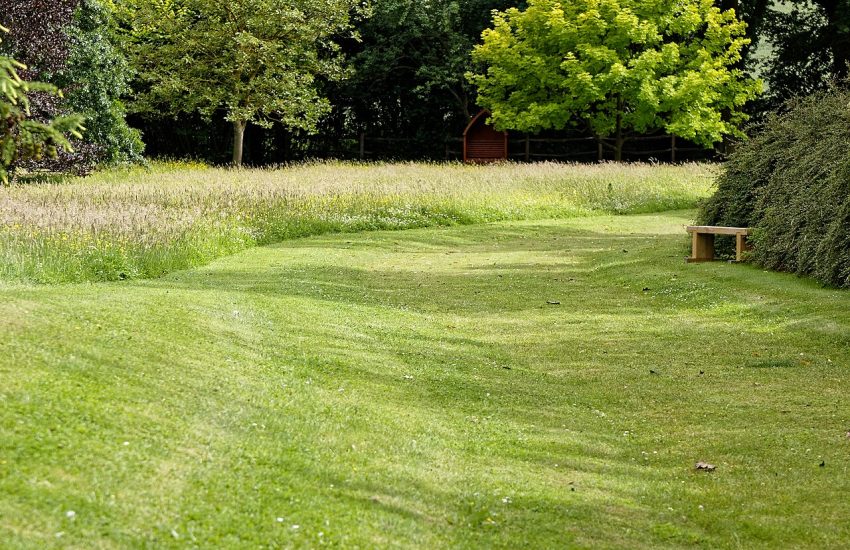
Cornell Extension also recommends a clear edge between walkways and natural plantings: plants spilling into a walk can brush people’s legs and reduce visibility for pedestrians and drivers. A strip of mown turf, a stone edge or a cut edge all work.
Layering the Border: Low at the Walk, Taller at the Wall
In a foundation bed, the walk side is the front and the house wall is the back. Grade the heights so the lowest grasses meet the walk and the tallest stand between windows, never directly beneath them.
Front edge: low, soft grasses
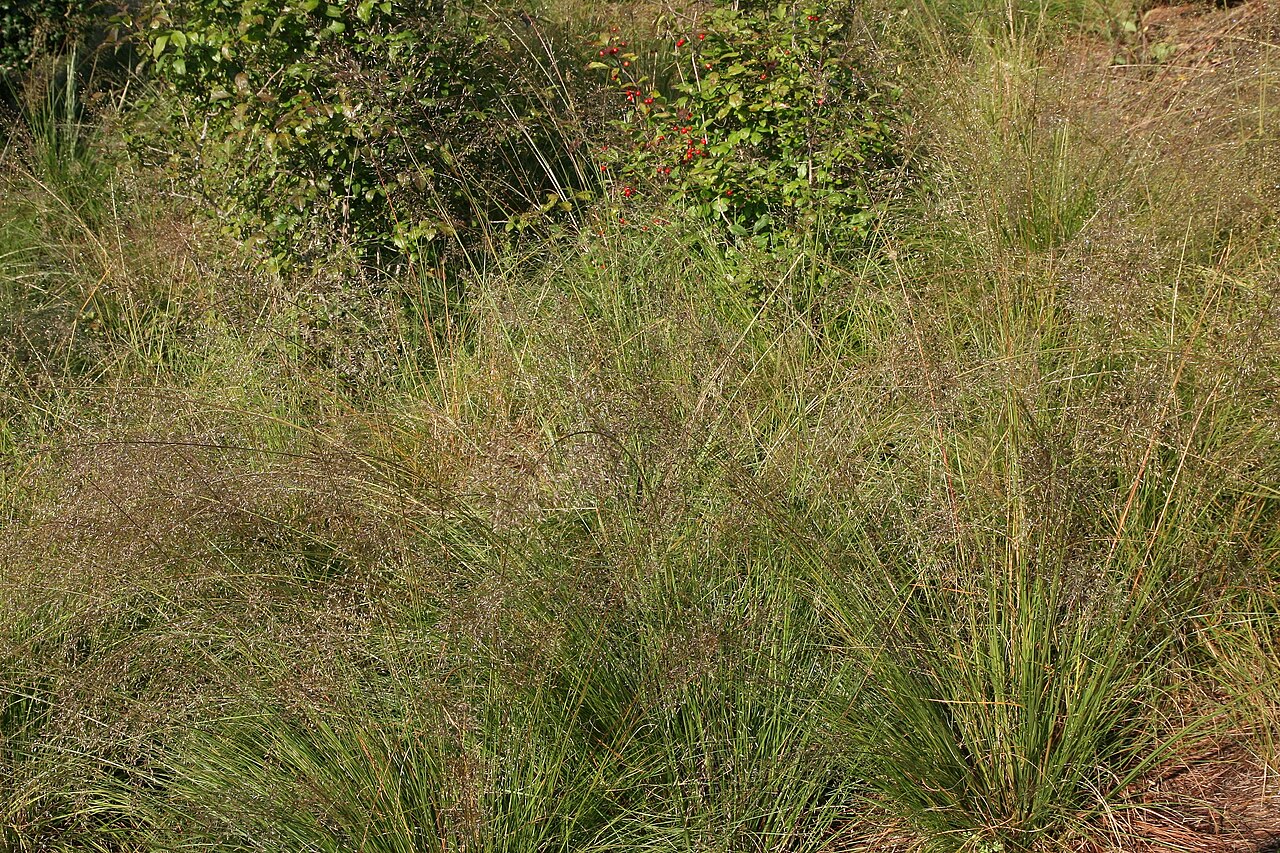
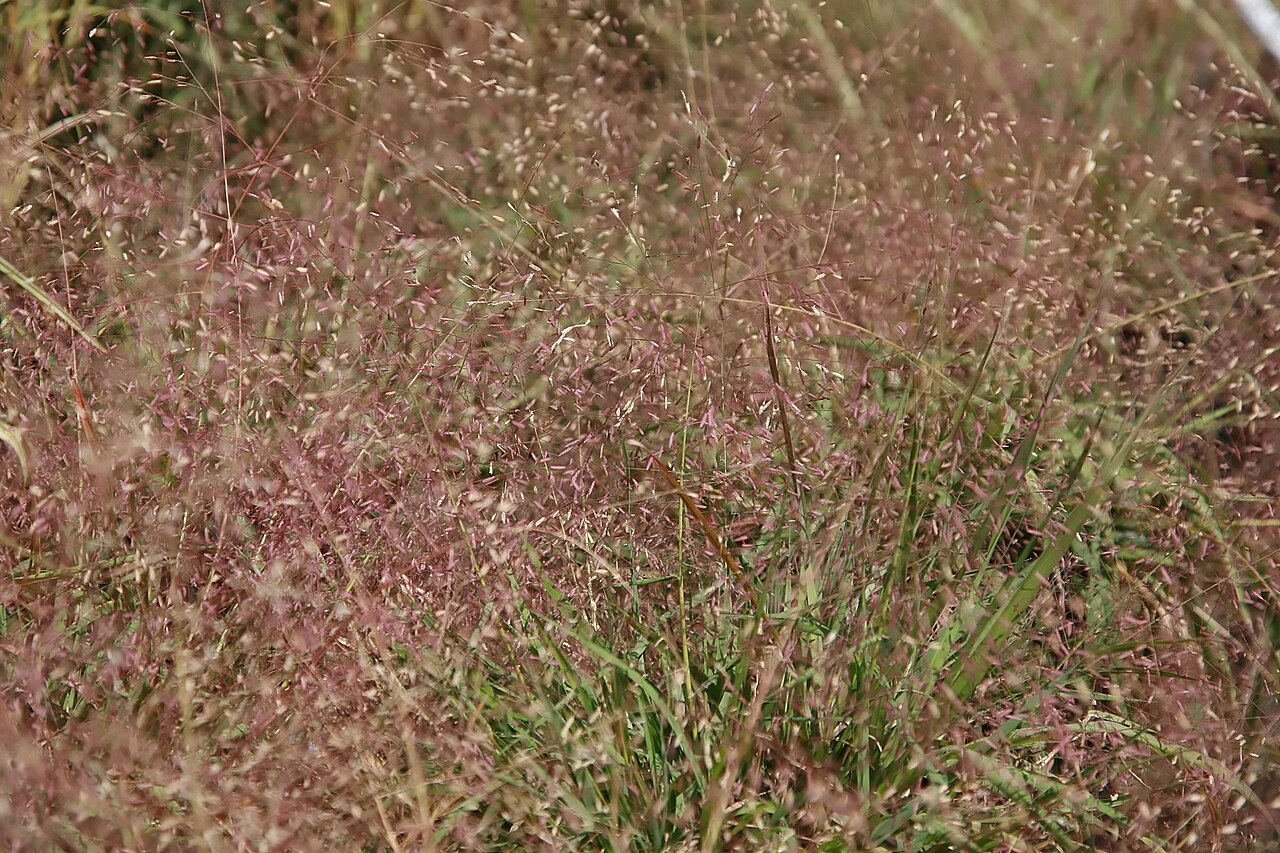
Purple lovegrass is the lowest option here. NC State lists it at 8 to 14 inches tall and 10 to 16 inches wide, with a purple-red haze of flowers in late summer. It suits the very front of the bed, at step landings and at driveway corners where you need to see over the planting.
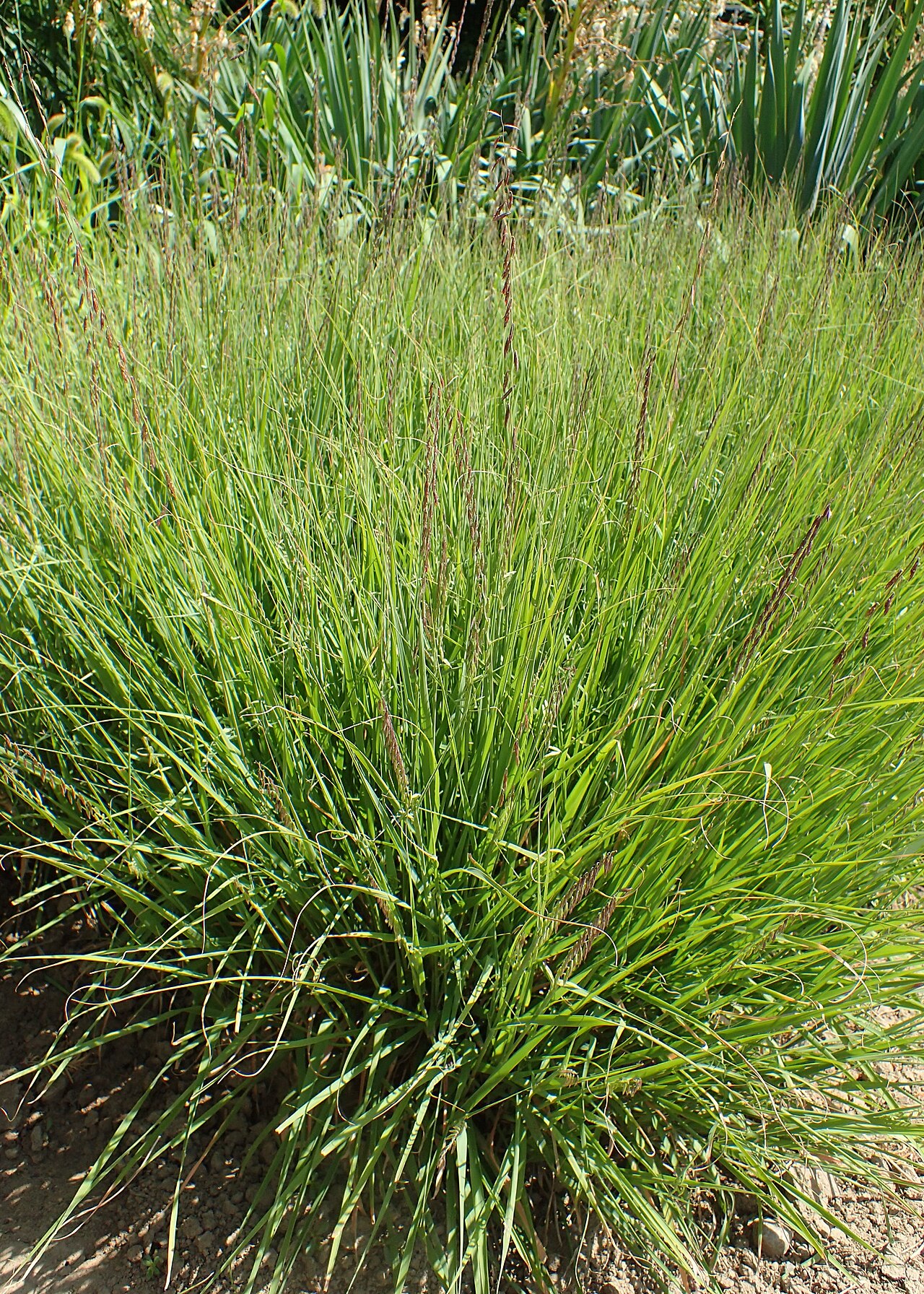
Prairie dropseed is the classic edge grass. NC State gives 2 to 3 feet in both height and width, and the Wildflower Center describes golden-orange fall color fading to light bronze in winter. Its fine leaves make a soft mound that reads as neat.
Under windows: medium, upright grasses
Sideoats grama grows 1 to 3 feet tall, rarely higher, according to the Wildflower Center, with small oat-like seeds hanging along one side of each stem. It is a good under-window grass where the sill is roughly 3 feet or higher.
For low sills, use prairie dropseed or purple lovegrass beneath the window instead, and save the taller grasses for the wall space between windows.
Between windows: the taller accents
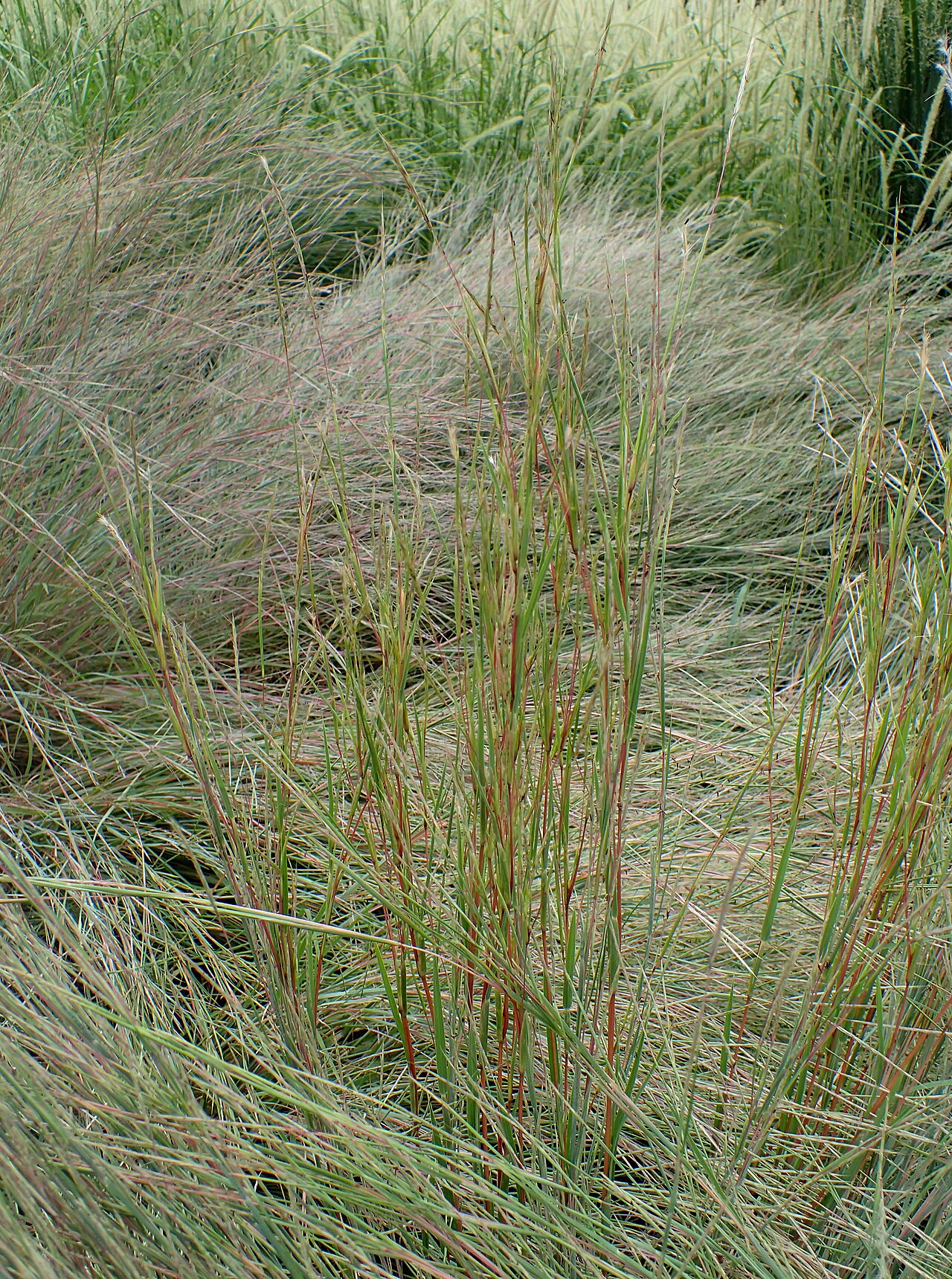
Little bluestem is the backbone grass for most eastern and central borders. NC State lists it at 2 to 4 feet tall and 1½ to 3 feet wide, and the Wildflower Center notes the blue-green summer foliage turning golden with fluffy seed heads.
Because its fall height can reach a typical sill, place little bluestem in the wall space between windows, at the corners of the house and at the far end of a walk. Repeat it at even intervals so the border reads as planned. Our plan for little bluestem in a front-yard border goes deeper on repetition and spacing.
Little bluestem leans when the soil is too rich or the light too low. If clumps are already opening up in your bed, see our guide to little bluestem flopping over before adding support.
Plant Palette
Heights include fall seed heads. Sources are noted; ranges are from the Lady Bird Johnson Wildflower Center. Confirm each grass is native to your state.
| Plant | Role | Height | Sun / moisture | Native range |
|---|---|---|---|---|
| Purple lovegrass (Eragrostis spectabilis) | Front edge, corners, steps | 8–14 in (NC State) | Sun / well-drained | ME to MN, south to FL and AZ |
| Prairie dropseed (Sporobolus heterolepis) | Front row, low windows | 2–3 ft (NC State) | Sun / dry | Que. to Sask., locally south to NC, KY, e. TX and CO |
| Sideoats grama (Bouteloua curtipendula) | Under higher windows | 1–3 ft | Sun to part shade / dry to moist | South-central Canada and much of the U.S. |
| Little bluestem (Schizachyrium scoparium) | Between windows, corners | 2–4 ft (NC State) | Sun to part shade / dry | Que. and ME to Alb. and ID, south through much of the U.S. east of the Rockies |
| Blue grama (Bouteloua gracilis) | Western front edge | Leaves to about 4 in; seed heads 1–2 ft | Sun / dry | Western North America, east into the Great Plains |
| Gulf muhly (Muhlenbergia capillaris) | Southern accent, away from low sills | Up to about 5 ft, often shorter | Sun / dry to moist, sandy | MA to s. IL and se. KS, south to FL and e. TX |
Sample Plan: 5 × 24-Foot Bed Along a Front Walk
This layout assumes a 5-foot-deep bed between the house and a front walk, with two windows and a door step. Adjust the counts for your own length.
- Back line (about 1½ to 2 feet out from the wall): little bluestem in the wall spaces between and beside the windows, 2 to 2½ feet apart. Sideoats grama or prairie dropseed directly under each window, depending on sill height. About 9 plants.
- Front line (about 1½ feet back from the walk): prairie dropseed, 2½ feet apart and offset from the back line so the clumps zigzag. About 8 plants.
- Step and corner pockets: 3 plants of purple lovegrass at each side of the step and at the driveway corner. About 9 plants.
If your strip is only about 3 feet deep and you want flowers among the grasses, our narrow sunny border plan with blazing star scales this idea down.
Spacing close to each grass’s mature width gives a full look in two to three growing seasons without crowding. NC State’s width ranges are the guide: about 2 to 3 feet for prairie dropseed and up to 3 feet for little bluestem.
Setback Quick Reference
- Purple lovegrass: center about 8 to 10 inches back from paving.
- Prairie dropseed: center at least 1½ feet back; more along narrow walks.
- Little bluestem: keep at least 1½ feet back from paving, and only between windows or at corners.
- Switchgrass, big bluestem, Indiangrass: not for foundation beds under windows or beside narrow walks. Use them as a screen at the back of the yard instead.
Setbacks are half the mature width (NC State) plus a small allowance for lean. Widen them in partial shade or rich soil.
Regional Alternates
The palette above fits much of the eastern and central U.S. Native ranges differ, so check each grass against your state before buying.
- Great Plains and the West: blue grama is a natural front-edge grass. The Wildflower Center notes its foliage normally stays under 4 inches with seed heads 1 to 2 feet tall, and it prefers well-drained, low-organic soils.
- Southeast and Gulf Coast: purple lovegrass and little bluestem both reach the Southeast. Gulf muhly adds pink fall color, but at up to about 5 feet it belongs between windows or at corners, not under a low sill.
- Northern prairie states: prairie dropseed and little bluestem are both native across much of the region; sideoats grama extends north into south-central Canada.
- Northeast coast: prairie dropseed is only local in the East, so lean on little bluestem and purple lovegrass, and check your state’s native status for sideoats grama.
Installation Steps
- Mark the windows and setbacks. Lay a hose or string along the walk setback line and flag the center of each window on the soil.
- Remove turf and weeds. Strip the sod or smother it for a season. Do not add compost; most of these grasses grow best in lean soil.
- Set out pots before planting. Place the back line, then the front line in a zigzag, then the corner pockets. Stand at the window and on the walk to check the layout.
- Plant at the same depth as the pot. Firm the soil and water deeply.
- Mulch lightly and set the edge. A thin layer of shredded mulch between clumps and a cut or stone edge along the walk complete the look.
The First Three Years
- Year 1: Water weekly in dry spells through the first summer. Weed between clumps. Expect small plants; most growth is underground. Leave the dried grass standing over winter.
- Year 2: Cut the old growth back in late winter or early spring, before new shoots appear. Water only in long droughts. Note any clump that leans into the walk and plan to move it back in fall or spring.
- Year 3: The border should look full. Keep the walk edge crisp, pull tree seedlings, and adjust any plants that are taller than expected near a window.
- Every year after: One late-winter cutback, a crisp edge and an occasional division of declining clumps.
Mistakes to Avoid
- Planting by summer height. Fall seed heads add height. Measure against the full fall size.
- Putting the tallest grass under the widest window. Put tall grasses in wall space, not in front of glass.
- Planting right at the walk edge. The clump will be in the walk by its second fall.
- Feeding the bed. Rich soil makes bunchgrasses taller and floppier.
- Ignoring sightlines. Keep the lowest grasses where the driveway meets the walk or street. Some towns regulate plant height near driveways and corners, so check local rules.
- Dry grass against the house in fire-prone areas. NC State rates switchgrass as highly flammable. Where wildfire is a concern, follow local guidance on what to plant next to the house.
📋 Find plants for your region: see our native plant lists for Maryland, Virginia & West Virginia, Delaware, Southern New Jersey & Long Island, Arkansas, Louisiana, Eastern Oklahoma & Eastern Texas, North Dakota, South Dakota & Western Minnesota, and South and West Texas.
Frequently Asked Questions
What native grass can I plant under a low window?
Purple lovegrass, at 8 to 14 inches tall per NC State, is the safest choice for very low sills. Prairie dropseed, at 2 to 3 feet, works under sills that sit a bit higher.
Is little bluestem too tall for a foundation bed?
Not if you place it well. At 2 to 4 feet, it fits the wall space between windows and the corners of the house, but it can reach a low sill, so don’t put it directly beneath one.
How far from a sidewalk should I plant grasses?
At least half the grass’s mature width, plus a little for lean. For prairie dropseed, that means its center sits at least 1½ feet back from the edge.
Can I use switchgrass along a driveway?
Only where height doesn’t matter. NC State lists it at 3 to 7 feet, so it can block sightlines at the street end of a driveway. Use it as a screen farther from traffic.
When should I cut a grass border back?
In late winter or early spring, before new growth starts. Leaving the dry grass up over winter keeps the border’s structure and gives cover to insects and birds.
Sources
- Cornell Cooperative Extension, Putnam County, Is Your Pollinator Garden Messy? “Cues to Care” Can Help: foundation plantings and windows, mowed borders along walkways, height-to-bed-width rule.
- Pennsylvania DCNR, Request Help Converting Your Lawn to a Meadow: shorter plants and mowed edges along paths and sidewalks.
- NC State Extension Gardener Plant Toolbox: little bluestem, prairie dropseed, purple lovegrass, switchgrass: heights, widths, light, fire-risk rating.
- Lady Bird Johnson Wildflower Center plant database: little bluestem, prairie dropseed, sideoats grama, purple lovegrass, blue grama, Gulf muhly, switchgrass: native ranges, habitats, sizes and fall color.