
Antilles Hohenbergia (Hohenbergia antillana)
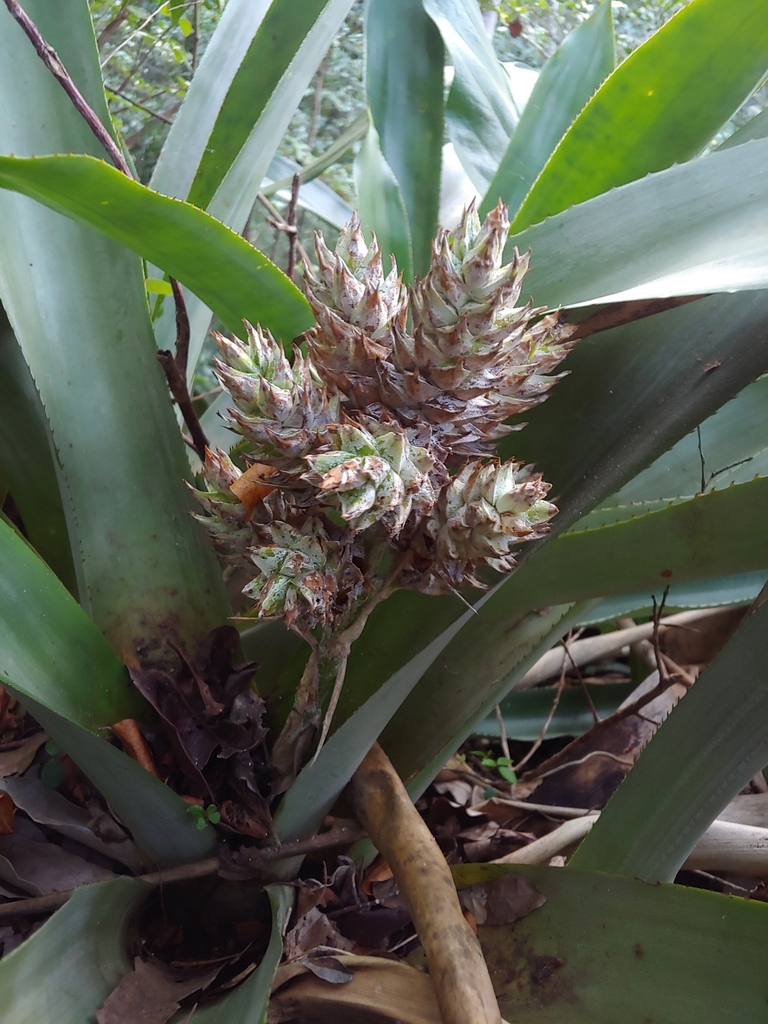
Hohenbergia antillana, here called Antilles Hohenbergia and listed by USDA PLANTS as Antilles lacebark, is a large, rare bromeliad of Puerto Rico’s limestone hills and dry to moist forests. It forms big, vase-shaped rosettes of broad, gray-green, spiny-edged leaves, and from the center rises a branched cluster of cone-like spikes covered in pale, sharp-tipped bracts. It belongs to the pineapple family, Bromeliaceae. Many botanists now place it in the genus Wittmackia as Wittmackia antillana, and a form described from the peaks of Las Tetas de Cayey as Hohenbergia tetaensis is treated as the same species.
This bromeliad is nearly endemic to the Puerto Rico Bank. The Smithsonian’s Flora of the West Indies records it from Puerto Rico and the Virgin Islands, and the Institute for Regional Conservation describes it as endemic to the Puerto Rico Platform, with records from the island of Puerto Rico and Guana Island in the British Virgin Islands. On Puerto Rico it is a rare terrestrial or epiphytic plant at low to middle elevations, best known from the haystack hills (mogotes) of the northern karst.
It grows on limestone rocks and outcrops, on the ground in rocky forest, and on the lower trunks and branches of trees. Puerto Rico’s Department of Natural and Environmental Resources (DRNA) has tracked it as a Critical Element. This guide covers how to identify it, where it grows, how it can be grown from nursery-propagated plants, and why wild populations deserve protection.
Identification
Several large tank bromeliads grow in Puerto Rico’s dry and karst forests, including species of Aechmea, Tillandsia and Hohenbergia/Wittmackia. Antilles hohenbergia is recognized by its broad, gray-green, spiny-margined leaves and its branched flower cluster of short, cone-like spikes held close to the rosette.
Growth Habit
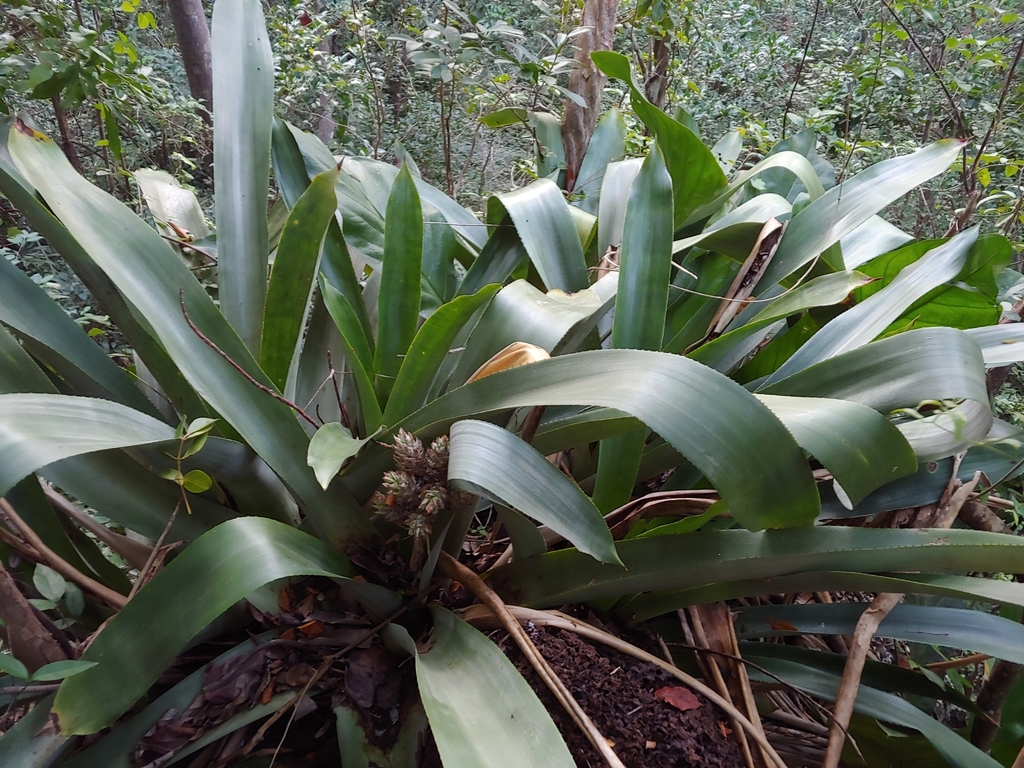
Antilles hohenbergia is an evergreen, stemless perennial that grows as a large rosette, roughly 2 to 4 feet across, often forming colonies of several rosettes from offsets. It grows on the ground among limestone rocks, on rock outcrops, and as an epiphyte on the lower trunks and branches of trees. Each rosette flowers once, then produces offsets (pups) at its base before slowly dying back.
Leaves
The leaves are strap-shaped, broad and thick, up to about 3 feet long, and arch outward from the center. They are gray-green to yellowish green, often with a fine, pale scaly coating, and their margins are lined with small, sharp, forward-pointing spines. The broad leaf bases overlap to form a central tank that holds rainwater and leaf litter.
Flowers
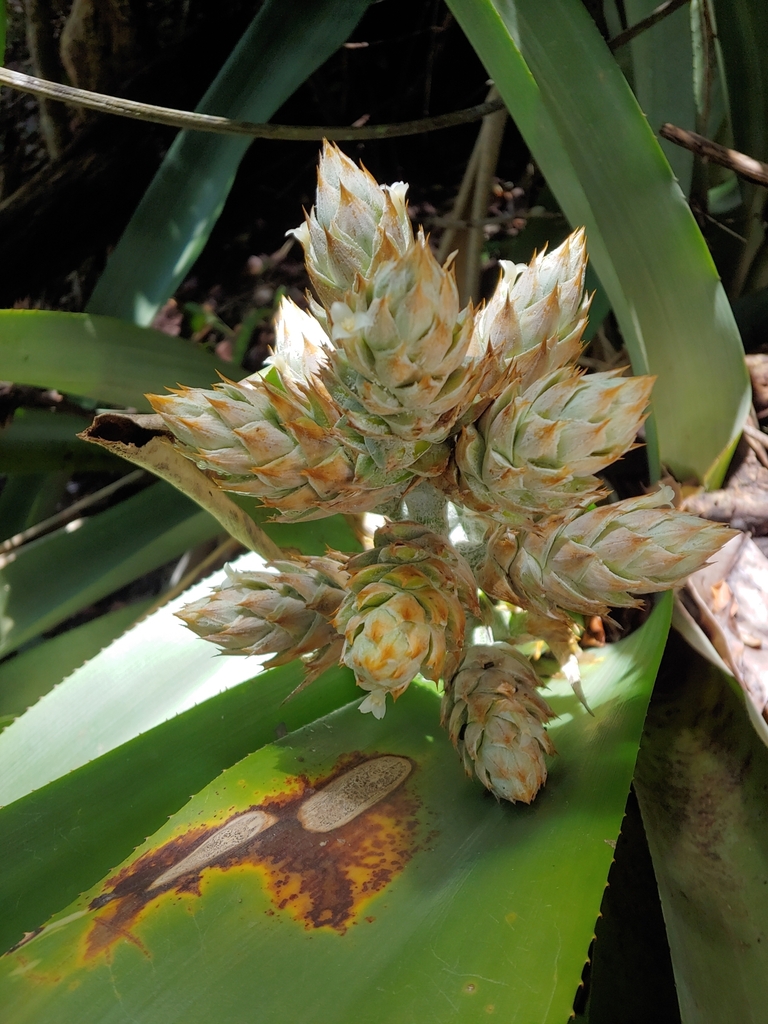
The inflorescence rises from the center of the rosette on a stout, pale stalk and is branched, with several to many short, dense, cone-shaped spikes. Each spike is covered in overlapping, stiff, sharp-tipped bracts, pale green to whitish and often tipped with orange-brown. The small flowers emerge between the bracts. The cones look a little like small pineapples, a reminder of the plant’s family.
Fruit & Seeds
As in other bromeliads of its group, the fruits are small berries that develop within the spikes. They hold small seeds that are dispersed by birds and other animals. Seedlings establish in crevices of limestone rock, in leaf litter and on rough bark.
Quick Facts
| Scientific Name | Hohenbergia antillana Mez (syn. Wittmackia antillana, Hohenbergia tetaensis) |
| Family | Bromeliaceae (pineapple or bromeliad family) |
| Plant Type | Evergreen terrestrial or epiphytic tank bromeliad; USDA common name “Antilles lacebark” |
| Mature Height | About 2–3 ft including the flower cluster |
| Mature Spread | About 2–4 ft per rosette; forms colonies |
| Growth Rate | Slow |
| Sun Exposure | Part shade to bright filtered light |
| Water Needs | Low to moderate; tolerates dry spells once established |
| Soil Type | Rocky, fast-draining limestone soil; very coarse mix or bark |
| Soil pH | Neutral to alkaline (limestone) |
| Bloom Time | Irregular; individual rosettes flower once when mature |
| Flower Color | Pale green to whitish bracts with orange-brown tips |
| Fall Color | None; evergreen |
| Fruit | Small berries within the flower spikes |
| Deer Resistant | Not applicable in Puerto Rico; leaves are spiny |
| USDA Hardiness Zones | 10b–12 (frost-free) |
Native Range
Antilles hohenbergia is endemic to the northeastern Caribbean. The Smithsonian’s Flora of the West Indies lists it from Puerto Rico and the Virgin Islands, and the Institute for Regional Conservation records it on the island of Puerto Rico and on Guana Island in the British Virgin Islands; herbarium specimens summarized by GBIF also come from Anguilla. Within the United States it is native only in Puerto Rico, where USDA PLANTS lists it as native.
In Puerto Rico most records come from the northern karst belt: the limestone hills of Aguadilla, Isabela, Quebradillas, San Sebastián, Arecibo (including the Mata de Plátano Natural Reserve), Barceloneta, Manatí, Vega Baja, Dorado and Bayamón, and from Río Abajo State Forest. Older collections came from trees around Cayey, and it has been found on rocks near the summit of Las Tetas de Cayey in Salinas, at about 830 m (2,700 ft). The Institute for Regional Conservation also lists it from the Cidra area of the eastern Cordillera and from the southwestern coastal lowlands at Punta Guaniquilla Natural Reserve in Cabo Rojo.
Collectors describe its habitat as limestone outcrops and rocks in shaded karst hills, remnant moist forest on mogotes, mature secondary forest, coastal woods and rocky thickets. It grows in the leaf litter among rocks and on the lower parts of trees. Most sites are at low to middle elevations, from near sea level to a few hundred meters, with the Tetas de Cayey population an exception.
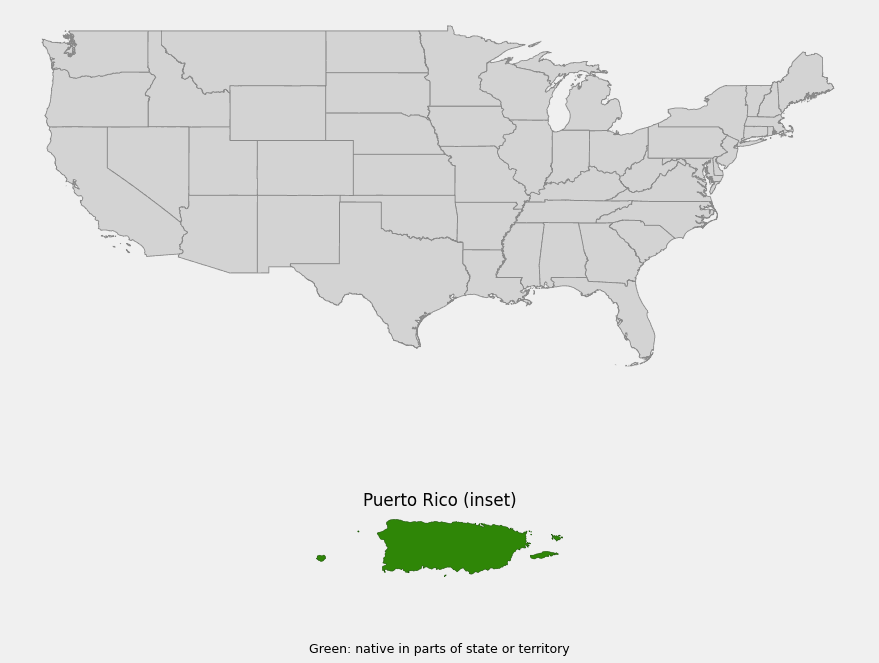
📋 Regional plant lists featuring Antilles Hohenbergia: Puerto Rico
Growing & Care Guide
Antilles hohenbergia is rare in the wild and rarely offered for sale. It is not listed under the U.S. Endangered Species Act or as a legally protected species in Puerto Rico, but the DRNA has tracked it as a Critical Element, and a 2012 assessment by Miller and colleagues gave it a provisional global rank of Vulnerable under IUCN criteria, based on about ten known locations. Buy only nursery-propagated plants and never collect from the wild. Where available, it is a tough, handsome plant for gardens in Puerto Rico’s lowlands and karst country. On the U.S. mainland it can be grown outdoors only in frost-free South Florida (and in Hawaii); elsewhere grow it in a container that can be moved into a bright greenhouse or sunroom for winter.
Light
Give it bright, filtered light or part shade, like the dappled light under a karst forest canopy. It tolerates morning sun; harsh midday sun in the open can yellow or scorch the leaves.
Soil & Water
It needs excellent drainage. In the ground, plant it among rocks or in a raised bed of coarse, gravelly or limestone-based soil; in a pot, use a very coarse bromeliad or orchid mix of bark, grit and perlite. Keep the central tank partly filled with rainwater and flush it occasionally. Water the roots when the mix has dried somewhat; established plants tolerate dry spells, but soggy soil rots the base.
Planting Tips
Set the base of the rosette at the soil surface, not buried, and anchor it with rocks until roots grip. Rosettes can also be tied to a rough-barked tree or a large rock with a pad of moss. Give it room and keep it away from paths, since the leaf margins are spiny.
Pruning & Maintenance
Remove dead outer leaves and the spent flower stalk with gloves on. After flowering, the old rosette will produce pups; leave them to form a colony or separate them when they are a third to half the size of the parent. Feed very lightly, if at all.
Propagation
Separate offsets with a sharp knife once they have a few roots, and pot them in coarse mix. Seed from ripe berries can be cleaned and sown on the surface of moist, fine, sterile mix in bright shade; seedlings grow slowly and take years to flower. Propagate only from cultivated stock.
Landscape Uses
- Rock and karst gardens in Puerto Rico: among limestone rocks under trees, in lowland and karst gardens
- Specimen plant: a bold, architectural rosette for containers and dry, shaded beds
- Conservation collections: botanical gardens and growers keeping rare Puerto Rican bromeliads
- Wildlife habitat: its water-filled tank supports frogs and invertebrates
Wildlife & Ecological Value
Like other tank bromeliads, Antilles hohenbergia holds water and leaf litter in its rosette, providing small pools of water in karst forests where surface water is scarce.
For Pollinators
The pollinators of this species have not been studied in detail. Its small flowers emerging from the bracts are likely visited by insects, and hummingbirds visit many related bromeliads in Puerto Rico.
For Birds
The berries of bromeliads in its group are eaten by birds, which may also spread the seeds. Birds also forage for insects and drink from bromeliad tanks.
For Mammals
Puerto Rico has few native land mammals other than bats, and none are known to depend on this plant.
Ecosystem Role
In the dry, porous limestone of the karst, where rain drains quickly into the rock, bromeliad tanks provide some of the few small, lasting pools of water. Studies of Puerto Rican bromeliads have found that their tanks support aquatic insect larvae and other invertebrates, and coquí frogs and lizards use them for shelter. Large terrestrial rosettes also trap leaf litter and help build soil on bare rock.
Cultural & Historical Uses
Carl Mez, a German botanist and one of the great bromeliad specialists of his time, described Hohenbergia antillana in 1896 in his monograph of the family. Earlier, the Spanish botanist Domingo Bello y Espinosa had reported this plant from Puerto Rico in 1883 under a misapplied name, Aechmea distans. In 1999 the botanists Proctor and Cedeño-Maldonado described Hohenbergia tetaensis from Las Tetas de Cayey, a population now considered part of the same species.
Recent studies of the group by the botanist Juan Aguirre-Santoro have separated the Caribbean species into the genus Wittmackia, named for the German botanist Ludwig Wittmack, so this plant is often listed today as Wittmackia antillana. USDA PLANTS still uses Hohenbergia antillana, the name used here.
The English names for this plant are bookish: “Antilles lacebark” is the USDA PLANTS name, and it does not appear to have a widely used Spanish name in Puerto Rico. It is a plant known mainly to botanists, bromeliad growers and those who explore the island’s karst forests.
Frequently Asked Questions
Is it Hohenbergia or Wittmackia?
Both names refer to the same plant. USDA PLANTS lists it as Hohenbergia antillana, while many bromeliad specialists now use Wittmackia antillana, following a revision of the Caribbean species of Hohenbergia.
Where does it grow?
Mainly in the limestone (karst) hills of northern Puerto Rico, from Aguadilla and Isabela east to Bayamón, with scattered populations around Cayey, Las Tetas de Cayey, Cidra and Cabo Rojo. Outside Puerto Rico it is known from Guana Island in the British Virgin Islands and from Anguilla.
Is it endangered?
It is not listed under the U.S. Endangered Species Act or as a legally protected species in Puerto Rico. However, it is rare: the DRNA has tracked it as a Critical Element, and it has been provisionally assessed as Vulnerable. Buy only nursery-propagated plants and never collect from the wild.
Can I grow it on the U.S. mainland?
Outdoors only in frost-free areas such as South Florida or Hawaii. Elsewhere, grow it in a container in a bright greenhouse or sunroom over winter.
Does it harm the trees it grows on?
No. When it grows on trees it uses them only for support and gathers water and nutrients from rain and debris. It is not a parasite.

Looking for a nursery that carries Antilles Hohenbergia?
Our nursery directory does not yet include Puerto Rico. Browse the native plant nursery directory by state: Alabama–Arkansas · California · Colorado–Hawaii · Idaho–Kansas · Kentucky–Montana · Nebraska–Oklahoma · Oregon · Pennsylvania–Virginia · Washington · West Virginia–Wyoming