
Baja Pitcher Sage (Lepechinia hastata)
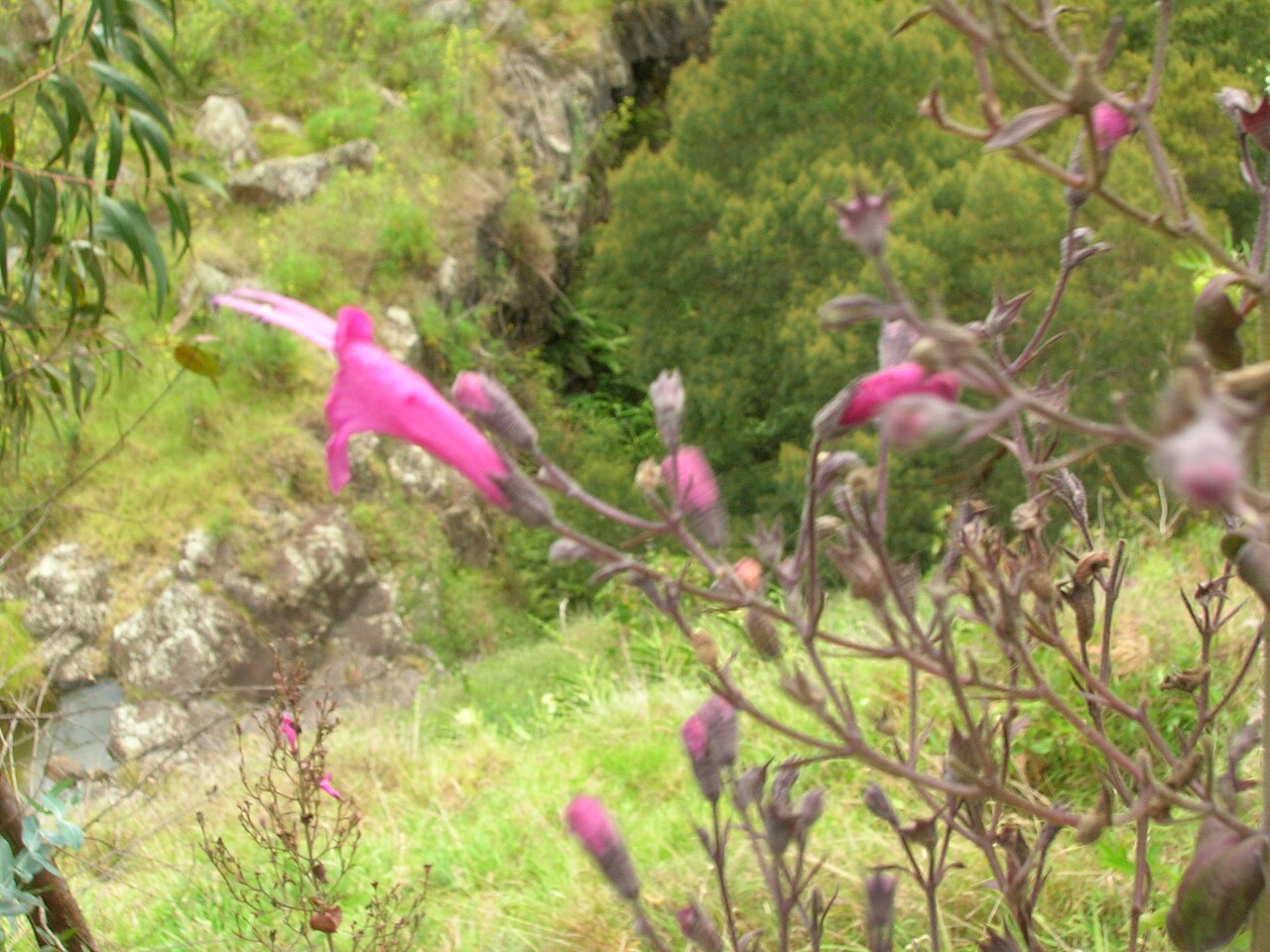
Lepechinia hastata, known as Baja Pitcher Sage, Cape pitcher sage, and in Hawaii as pakaha, is an aromatic shrub in the mint family with large, velvety, arrowhead-shaped leaves and branched sprays of magenta to purple-pink flowers. It grows 1 to 7 feet tall and blooms over a long season, attracting hummingbirds and bees wherever it is grown.
It has one of the most unusual ranges of any U.S. native plant. In the United States it grows wild only on the island of Maui, on the slopes of Haleakalā, while its other wild populations are about 3,000 miles away in Mexico: in the pine-oak forests of the Sierra de la Laguna in Baja California Sur, and on Socorro Island in the Pacific. USDA PLANTS lists it as native to Hawaii, and the University of Hawai’i Botany Department’s list of Hawaiian native plants treats pakaha as indigenous. Some botanists have questioned this: a 2011 taxonomic study of the genus suggested that the Hawaiian plants may have been introduced by people long ago. We follow USDA and the Hawaiian sources here, and note the question.
In gardens, especially in California and other mild, dry-summer climates, it is a popular, easy, drought-tolerant shrub. This guide covers how to identify it, its strange distribution, and how to grow it in Hawaii (zones 10–13) and other warm regions.
Identification
Baja pitcher sage is easy to recognize by its big, soft, arrowhead-shaped leaves, its strong sage-like scent, and its magenta flowers on tall, woolly stalks.
Leaves & Growth Habit
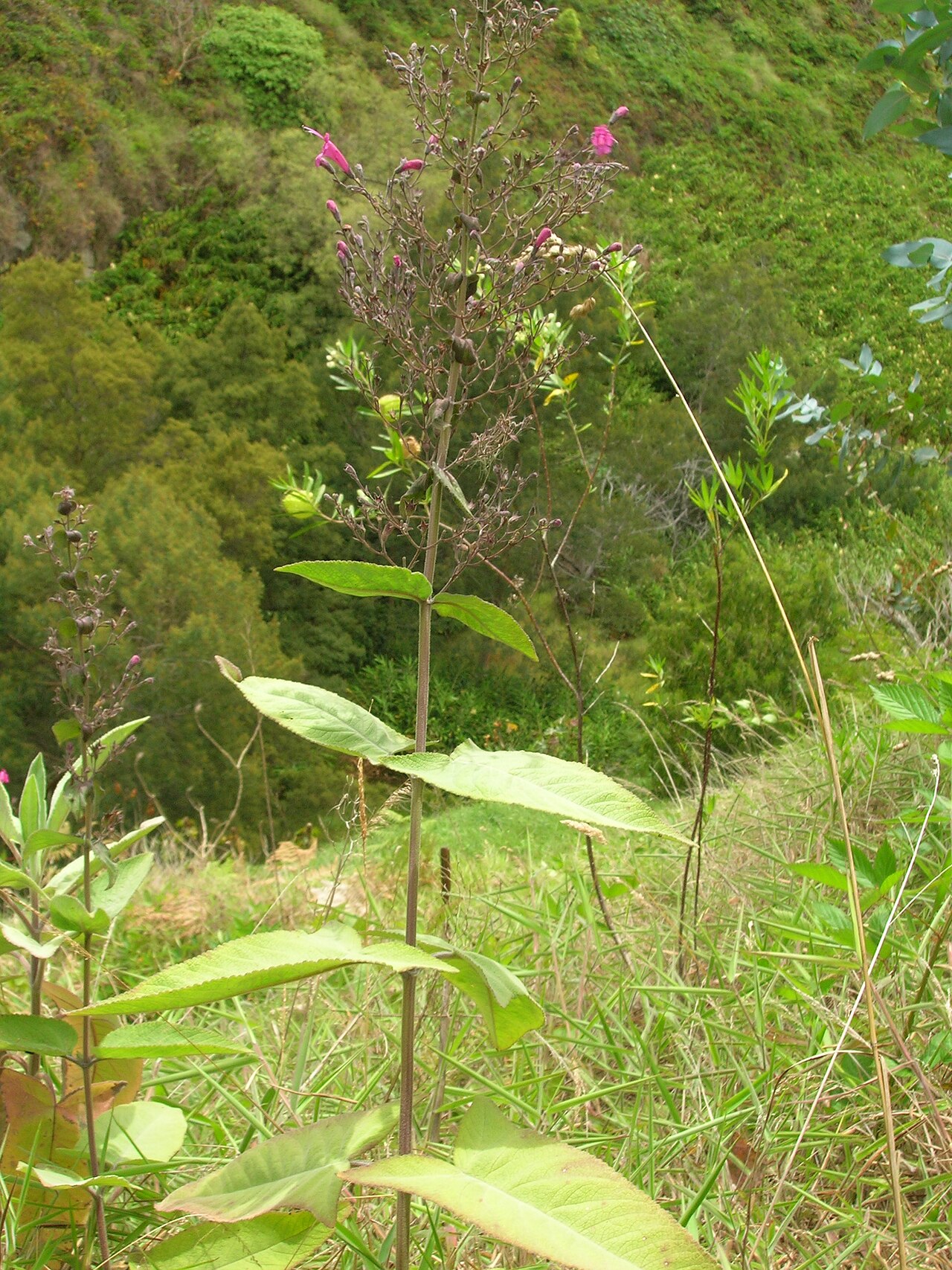
An upright, few-stemmed shrub, usually 1 to 7 feet tall, with stout, densely hairy stems. As in most of the mint family, the leaves are arranged in opposite pairs. The lower leaves are large, up to about 13 inches long and 6 inches wide, on stalks up to about 2½ inches long. They are hastate (arrowhead-shaped), with two flaring lobes at the base, a pointed tip, raised veins and a soft, velvety covering of hairs. The upper leaves near the flowers are smaller, oval and stalkless. Crushed leaves have a strong, pleasant, sage-like fragrance.
Flowers
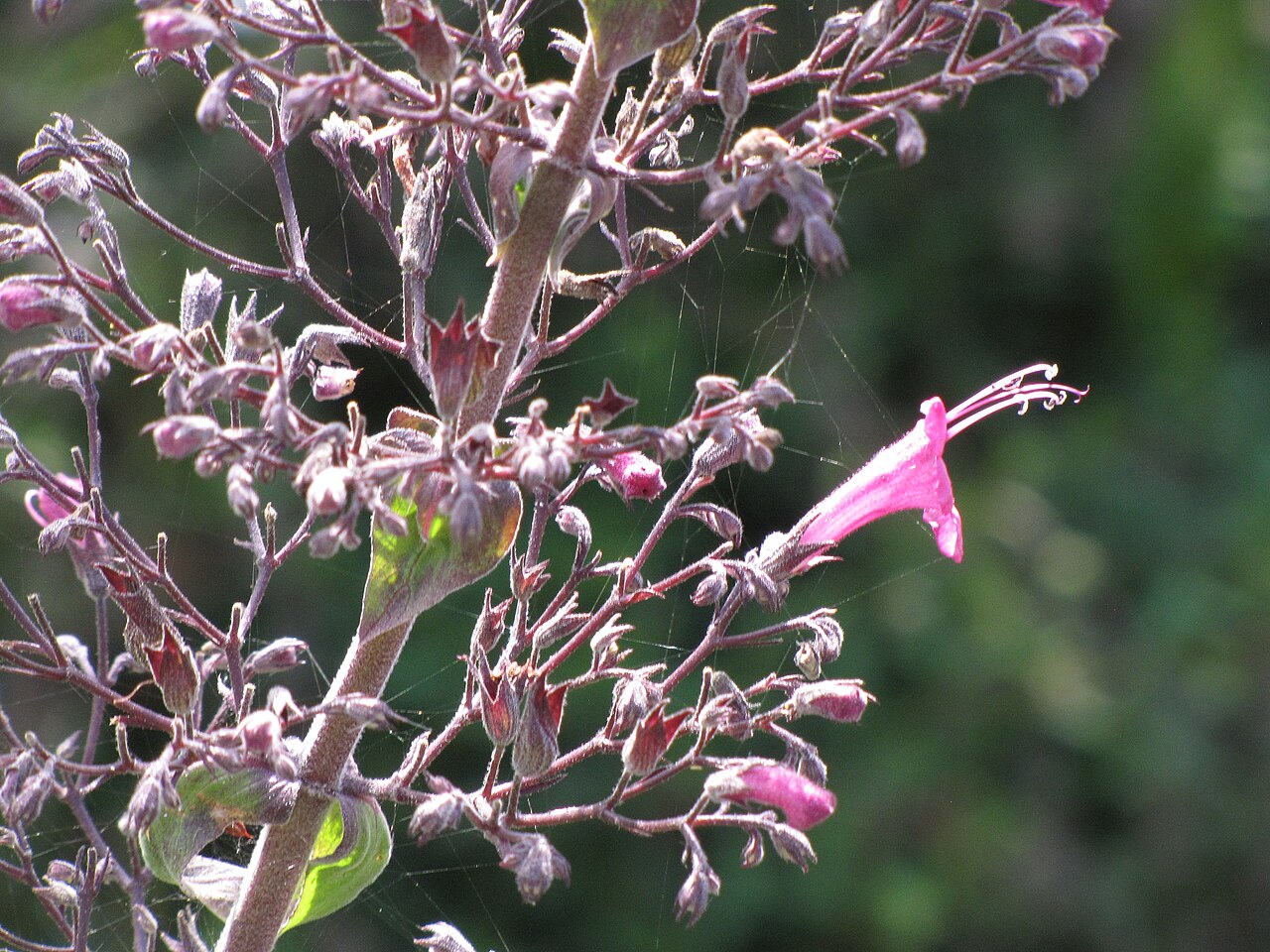
The flowers are borne in a large, open, branched cluster at the top of the stems. Each flower is tubular and two-lipped, about ½ to ⅞ inch long, and magenta to purple-pink, held in a woolly, often reddish calyx. In Hawaii and in gardens, flowering can continue for much of the year, with a peak in late spring to fall.
Fruit
As the fruit develops, the calyx enlarges and forms a small cup or “pitcher” around four glossy black nutlets, each about ⅕ inch long. This papery, inflated calyx gives the pitcher sages their common name.
Look-alikes
California’s California Pitcher Sage and Fragrant Pitcher Sage have smaller, narrower leaves without the arrowhead lobes, and white to pale lavender flowers. True sages (Salvia) have only two fertile stamens with a distinctive lever mechanism, while pitcher sages have four. In Hawaii, no other native shrub combines arrowhead leaves, a strong sage scent and magenta, two-lipped flowers.
Quick Facts
| Scientific Name | Lepechinia hastata (A. Gray) Epling; syn. Sphacele hastata A. Gray |
| Family | Lamiaceae (mint family) |
| Plant Type | Aromatic evergreen shrub |
| Mature Height | 1–7 ft |
| Mature Spread | 3–6 ft |
| Growth Rate | Fast |
| Sun Exposure | Full sun to partial shade |
| Water Needs | Low to moderate; drought tolerant once established |
| Soil Type | Well-drained loam, gravel or volcanic soils |
| Soil pH | Slightly acidic to neutral |
| Bloom Time | Spring through fall; nearly year-round in mild climates |
| Flower Color | Magenta to purple-pink |
| Fall Color | Evergreen |
| Fruit | Four glossy black nutlets in an enlarged, cup-like calyx |
| Deer Resistant | Usually avoided because of its strong aroma |
| USDA Hardiness Zones | About 9–13 (outdoors in Hawaii zones 10–13; tolerates light frost) |
Native Range
USDA PLANTS lists Baja pitcher sage as native in the United States only in Hawaii, where it grows wild on the island of Maui. The species was first described from Maui: Asa Gray named it Sphacele hastata in 1862 from plants collected on Haleakalā by the U.S. Exploring Expedition. On Maui it grows on the slopes of Haleakalā at middle elevations, in open shrubland, gulches, forest edges and pastures, in areas such as the Kula and Olinda uplands. NatureServe ranks it as critically imperiled (S1) in Hawaii because it is known from so few places.
Outside Hawaii, the typical subspecies grows in the Cape region of Baja California Sur, Mexico, in shaded canyons and pine-oak forests of the Sierra de la Laguna. A second subspecies, ssp. socorrensis, with white flowers and grayer, woollier foliage, grows on Socorro Island in the Revillagigedo Islands, where it is often the dominant shrub on the island’s upper southern slopes.
How one species came to grow on Maui and in southern Baja California, with nothing in between, is still debated. The Maui plants may have arrived naturally, perhaps carried by a bird, as the University of Hawai’i’s native plant list suggests. Others, including a 2011 study of the genus, have suggested an early human introduction. Either way, pakaha has been part of Maui’s flora since at least the first botanical collections there.
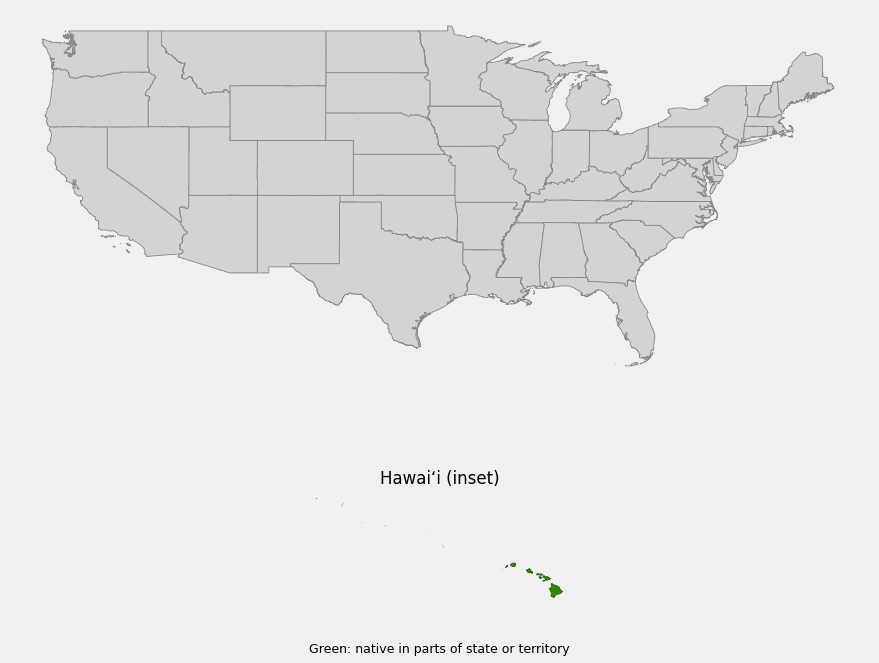
📋 Regional plant lists featuring Baja Pitcher Sage: Hawaii
Growing & Care Guide
Baja pitcher sage is one of the easier native shrubs to grow in mild climates. In Hawaii, use plants grown from Maui sources where possible, and buy from a nursery rather than collecting from the few wild populations. It is widely sold by native and Mediterranean-climate nurseries in California.
Light
Full sun to partial shade. In hot, dry inland gardens it appreciates afternoon shade; in cool coastal or upland climates such as Kula, full sun gives the most compact plants and best flowering.
Soil & Water
It needs well-drained soil and does well in volcanic cinders, gravelly loam or ordinary garden soil that does not stay soggy. Water regularly the first year, then deeply but infrequently. Established plants tolerate dry spells, though occasional summer water keeps them blooming longer.
Planting Tips
In Hawaii it grows best at cooler upland elevations, roughly 2,000 feet and above; in hot, humid lowlands it can be short-lived. Elsewhere, it is hardy outdoors in about zones 9 to 11 and survives light frosts. Give it room: it can spread 3 to 6 feet. In colder regions it can be grown in a large container and moved to a bright, frost-free place for winter.
Pruning & Maintenance
Cut back the old flower stalks and shorten leggy stems after the main bloom, or cut the whole plant back by about a third in late winter, to keep it bushy. It can spread by suckers and self-sow in favorable spots; pull unwanted seedlings. It is rarely bothered by pests, though whiteflies can appear on stressed plants.
Propagation
It roots easily from softwood or semi-hardwood stem cuttings and can also be grown from fresh seed. Rooted suckers can be dug and replanted from garden plants. In Hawaii, propagate from cultivated plants or from material collected with permission.
Landscape Uses
- Hummingbird and pollinator gardens: long-blooming magenta flowers for hummingbirds and bees
- Hawaiian upland native gardens: a fragrant, colorful pakaha for Maui and other upland gardens
- Dry-summer and Mediterranean gardens: drought tolerant once established in California and similar climates
- Fragrance gardens: plant near paths where the aromatic leaves can be brushed
Wildlife & Ecological Value
With its long flowering season and nectar-rich tubular flowers, Baja pitcher sage is a reliable food source for pollinators.
For Pollinators
The magenta, tubular flowers are visited by bees, including bumblebees and carpenter bees, and by hummingbirds where they occur, in California and Mexico. In Hawaii, which has no hummingbirds, bees are the most frequent visitors.
For Birds
Hummingbirds are among its most frequent visitors in gardens on the U.S. mainland. Seed-eating birds may take the small nutlets, and the shrubs offer cover for small birds.
For Mammals
Its strongly aromatic, hairy foliage is generally avoided by deer and other browsers. On Socorro Island, the plant thrived even when the island had introduced sheep, which suggests grazing animals find it distasteful.
Ecosystem Role
On Maui it is a rare component of upland shrublands and forest edges on Haleakalā. Its puzzling distribution makes it an interesting case for botanists studying how plants reached the remote Hawaiian Islands.
Cultural & Historical Uses
Asa Gray of Harvard described the plant in 1862 as Sphacele hastata, from specimens collected on Haleakalā by the U.S. Exploring Expedition (1838–1842) under Charles Wilkes. The mint-family specialist Carl Epling later moved it to Lepechinia, a genus named for the 18th-century Russian naturalist Ivan Lepekhin. Epling noted that the same species grows in the Sierra de la Laguna of Baja California Sur.
The species name hastata means “spear-shaped,” for the arrowhead-like leaves. The Hawaiian name pakaha is recorded by USDA PLANTS and the University of Hawai’i. The common names Baja pitcher sage and Cape pitcher sage refer to the Cape region of Baja California, where most wild plants grow.
Today it is better known as a garden plant than as a wild one. Botanic gardens and nurseries in California have grown it for decades for its large, fragrant leaves and long-lasting magenta flowers, and it appears in many hummingbird and water-wise gardens.
Frequently Asked Questions
Is Baja pitcher sage native to Hawaii?
USDA PLANTS lists it as native to Hawaii, and the University of Hawai’i Botany Department’s list of Hawaiian native plants treats pakaha as indigenous. Its wild range is split between Maui and Baja California, and some botanists, including a 2011 study of the genus, have suggested the Maui plants were introduced by people long ago. The question has not been settled.
Where does it grow on Maui?
On the slopes of Haleakalā at middle elevations, in open shrubland, gulches, forest edges and pastures. It is rare in the wild; NatureServe ranks it as critically imperiled in Hawaii.
Why is it called pitcher sage?
After flowering, the calyx enlarges into a cup or “pitcher” that surrounds the developing nutlets. The leaves also have a sage-like scent, although it is not a true sage (Salvia).
Does it attract hummingbirds?
Yes. On the U.S. mainland, its magenta, tubular flowers are a favorite of hummingbirds, and bees visit them as well.
How hardy is it?
It grows outdoors in about zones 9 to 13. It tolerates light frost but not hard freezes. In colder areas, grow it in a large container and bring it into a bright, frost-free place for winter.

Looking for a nursery that carries Baja Pitcher Sage?
Browse our native plant nursery directory: Hawaii

