
Bristly Greenbrier (Smilax tamnoides)
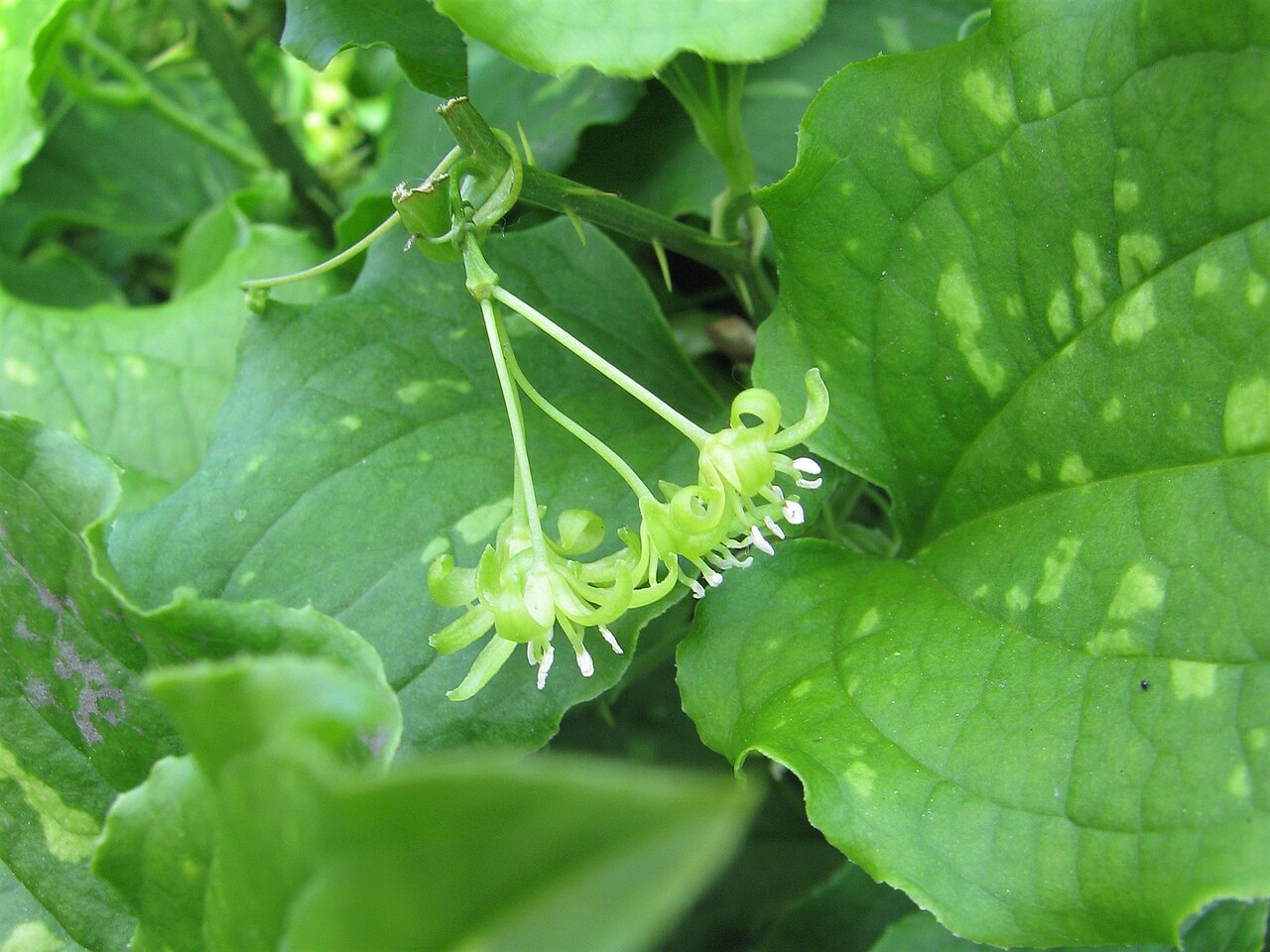
Smilax tamnoides, known as Bristly Greenbrier, bristly catbrier or hispid greenbrier, is a woody native vine of eastern and central North America. It climbs over shrubs, fences and small trees with paired tendrils, reaching 10 to 20 feet or more, and its lower stems are densely covered with slender, needle-like, dark bristles rather than the stout thorns of most greenbriers. In late spring it bears small clusters of yellow-green flowers, and in fall the female plants carry round clusters of blue-black berries that often stay on the vine into winter.
Greenbriers (Smilax) belong to their own family, Smilacaceae, which is related to the lilies. Like other monocots, they have leaves with several curved, parallel main veins rather than a network of branching veins, an unusual feature for a woody vine. For many years this species was better known as Smilax hispida, a name still common in older field guides and state floras.
Bristly greenbrier ranges from New England and southern Ontario west to Minnesota, South Dakota and Nebraska, and south to Florida and Texas. It is a plant of moist woods, floodplains, thickets and woodland edges. Few gardeners plant it on purpose, but it is a valuable wildlife plant, and recognizing it helps in managing and appreciating natural areas. This guide covers identification, range, wildlife value, and how to manage it.
Identification
Bristly greenbrier is a climbing vine with tendrils, parallel-veined leaves and bristly stems. Several greenbriers grow in the same areas, so look closely at the prickles, the leaves and the flower stalks.
Stems & Prickles
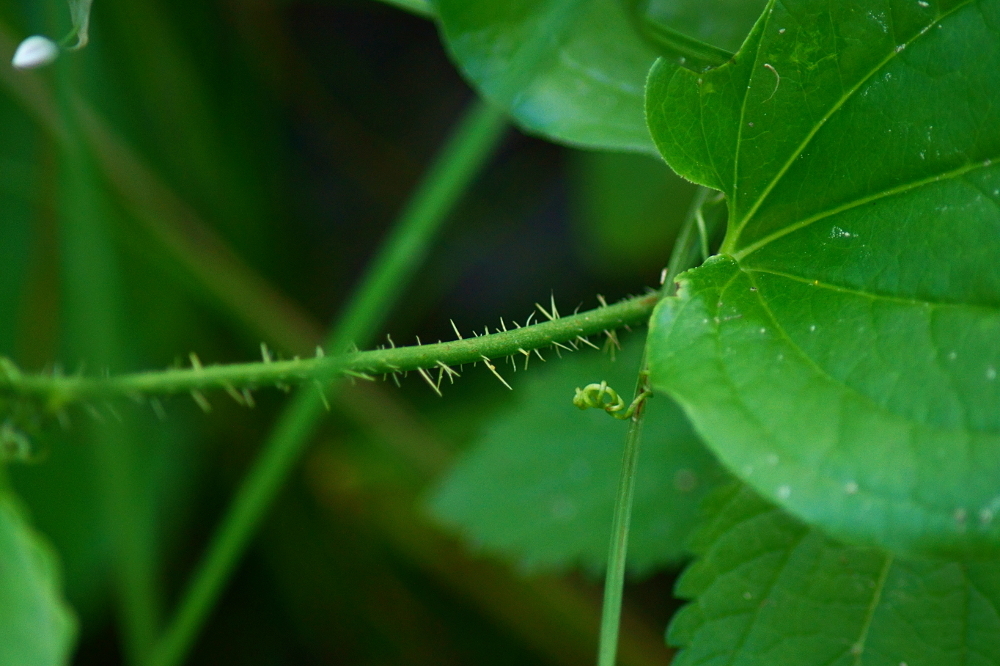
Stems are green, round and slender to moderately stout, growing from a knotty, woody rhizome. The lower stems, especially, are covered with numerous straight, thin, needle-like bristles, often blackish or dark brown, which give the plant its name. Higher up, the stems have fewer bristles and may be nearly smooth. These dense, fine bristles are quite different from the scattered, stout, flattened thorns of round-leaf greenbrier. Stems are green throughout the year and can persist for several years.
Leaves
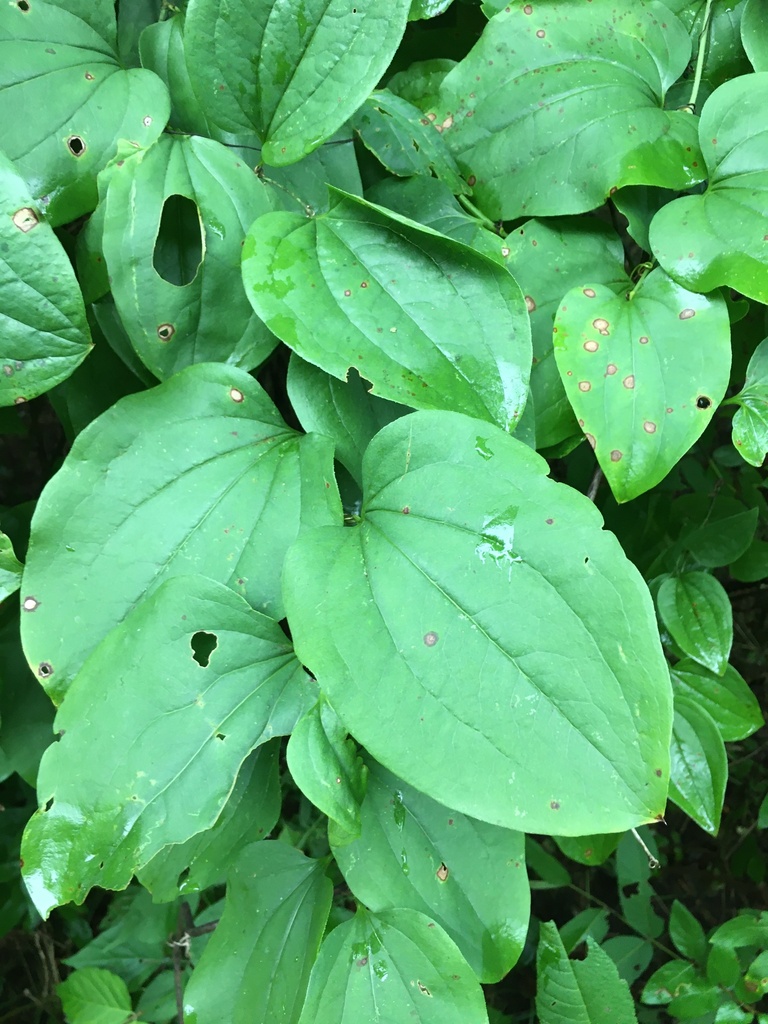
Leaves are alternate, deciduous, thin and broadly oval to heart-shaped, about 2 to 5 inches long, with a pointed tip and a rounded or slightly heart-shaped base. They are green on both sides, not whitened beneath, and have three to seven prominent veins that curve from base to tip. A pair of tendrils arises from the base of each leaf stalk and coils around any support. The leaves turn yellow in fall.
Flowers
Bristly greenbrier is dioecious: each plant has either male or female flowers. The flowers are small, about a quarter inch across, with six yellow-green to greenish tepals, borne in rounded umbels of many flowers. The flower stalk (peduncle) of each umbel is usually clearly longer than the stalk of the leaf beside it, a useful clue for identification. Flowering is in May and June.
Fruit
Female plants produce round, blue-black to black berries about a quarter inch across, often with a slight bloom, in rounded clusters. Each berry contains one to three hard seeds. The berries ripen in early fall and often persist on the vines through winter.
Look-alikes
Round-leaf Greenbrier has thick, glossy leaves and scattered, stout, flattened thorns, and its flower stalks are about as long as the leaf stalks. Glaucous-leaf Greenbriar has leaves that are whitish beneath. Smooth Carrionflower and its relatives are herbaceous, die back each winter, and have no prickles at all.
Quick Facts
| Scientific Name | Smilax tamnoides (syn. Smilax hispida) |
| Family | Smilacaceae (catbrier family) |
| Plant Type | Woody climbing vine with tendrils; spreads by rhizomes |
| Mature Height | 10–20 ft or more as a climbing vine |
| Mature Spread | Forms thickets several feet to many feet wide |
| Growth Rate | Moderate to fast |
| Sun Exposure | Full sun to part shade |
| Water Needs | Moderate; prefers moist soil |
| Soil Type | Moist loam, alluvial and clay soils; also sandy soils in thickets |
| Soil pH | About 5.5–7.5 |
| Bloom Time | May–June |
| Flower Color | Yellow-green |
| Fall Color | Yellow |
| Fruit | Blue-black berries in round clusters (female plants), fall into winter |
| Deer Resistant | No; deer browse young shoots and leaves |
| USDA Hardiness Zones | 4–9 |
Native Range
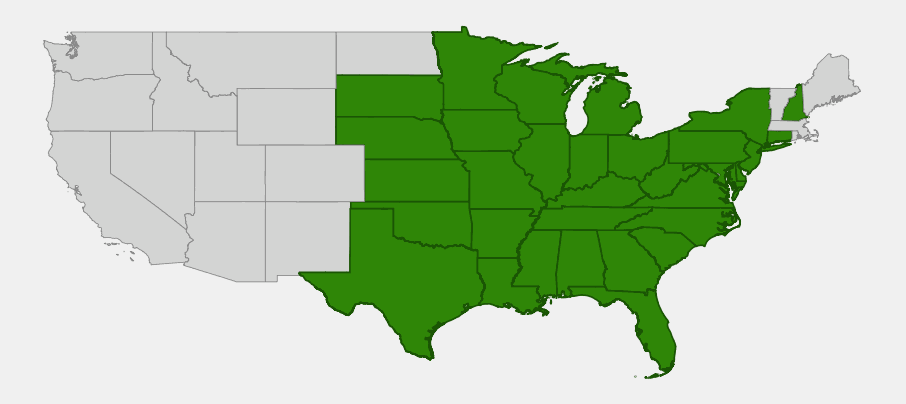
Bristly greenbrier is widespread in the eastern half of North America. USDA PLANTS records it as native in 32 states and the District of Columbia, from Connecticut, New Hampshire and New York west through the Great Lakes states to Minnesota, South Dakota and Nebraska, and south to Florida, Louisiana, Oklahoma and Texas. In Canada it grows in southern Ontario.
It is most common in the Midwest, the Ohio and Mississippi valleys and the interior Southeast, where it grows in floodplain forests, moist upland woods and thickets. It becomes scarcer toward the Atlantic coast and the northeastern edge of its range in New England, and at the western edge in the Great Plains it is limited to river valleys and wooded draws.
Its typical habitats are moist to mesic deciduous forests, bottomland woods, stream banks, woodland edges, thickets, fencerows and old fields grown up to brush. Because birds spread its seeds and it resprouts from rhizomes after cutting, it often becomes common at the edges of woods and in disturbed second-growth forest.
📋 Regional plant lists featuring Bristly Greenbrier: New York, Pennsylvania & Northern New Jersey · Ohio & Indiana · Michigan, Wisconsin & Eastern Minnesota · Kentucky & Tennessee · Nebraska, Kansas & Eastern Colorado · Connecticut, Massachusetts & Rhode Island · New Hampshire, Maine & Vermont · Maryland, Virginia & West Virginia · Delaware, Southern New Jersey & Long Island · Illinois, Iowa & Missouri · Alabama, Georgia & Mississippi · North & South Florida
Growing & Care Guide
Bristly greenbrier is rarely sold by nurseries, and most people meet it as a wild vine on their land rather than as a garden plant. Where it already grows, it is worth keeping in hedgerows, woodland edges and wildlife areas. It is not suitable near paths or play areas because of its bristles.
Light
It grows in full sun to part shade. In sunny edges it forms dense, fruitful thickets, while in shady forest interiors it grows more sparsely and fruits less.
Soil & Water
It prefers moist, fertile soils such as floodplain loams and clays, but it adapts to a wide range of soils. Once established it tolerates periodic flooding and moderate drought. It needs no fertilizer or watering in its native range.
Planting Tips
If you want to establish it for wildlife, plant rhizome sections or nursery seedlings along a fence, a brush pile or a woodland edge where it can climb and where its bristles will not be a problem. Because the plants are male or female, several plants are needed to make sure berries are produced.
Pruning & Maintenance
Wear heavy gloves and long sleeves when working with it. To keep it in bounds, cut stems back to the ground in late winter; it will resprout from the rhizomes, so repeated cutting over several years is needed to reduce a patch. Where it is wanted, simply let it grow over brush and fences, and remove only stems that reach into paths.
Propagation
Seeds have hard coats and dormant embryos. Sow cleaned seed outdoors in fall and expect germination in the first or second spring. Dividing rhizomes in early spring is quicker. Wild plants spread readily on their own because birds disperse the seeds.
Landscape Uses
- Wildlife hedgerows and edges: dense, bristly cover and winter berries for birds
- Natural area management: a native vine to recognize and retain in floodplain and woodland edges
- Living barriers: a bristly vine on a fence discourages people and animals from passing
- Brush piles and fencerows: quickly covers brush and wire fences with leafy cover
- Foraging: the tender young shoot tips can be eaten in spring like other greenbrier shoots
Wildlife & Ecological Value
Like other greenbriers, bristly greenbrier is one of the most useful native vines for wildlife, providing food and protected cover throughout the year.
For Pollinators
The small flowers produce nectar and pollen and are visited mainly by flies, small bees and other small insects. Caterpillars of several moths feed on greenbrier leaves, including the turbulent phosphila (Phosphila turbulenta), which is a greenbrier specialist.
For Birds
The berries are eaten by many birds, especially in late fall and winter when other food is scarce. Gray catbirds, thrushes, cardinals, mockingbirds, wild turkeys and ruffed grouse are among the species that eat greenbrier fruits. The dense, bristly tangles also give songbirds safe nesting and roosting sites, protected from predators.
For Mammals
White-tailed deer browse the tender shoots and leaves, and greenbriers can be an important part of their diet in some areas. Rabbits use the thickets for cover, and raccoons, opossums and other small mammals eat the berries.
Ecosystem Role
Bristly greenbrier forms thickets at forest edges and in openings, where it provides protected cover and helps stabilize soil on stream banks and floodplains. Birds that eat the berries spread the seeds through the forest, and the long-lived rhizomes let the plant persist and resprout after cutting, fire or flood.
Cultural & Historical Uses
Linnaeus named this greenbrier Smilax tamnoides in 1753. The species name means “like Tamus,” a genus of Old World climbing plants (black bryony) with similar heart-shaped leaves. For much of the 19th and 20th centuries it was known as Smilax hispida, from the Latin for “bristly,” and that name appears in many older references. Some botanists still recognize a separate variety, S. tamnoides var. hispida.
Greenbriers in general have a long history of human use. Indigenous peoples of the eastern United States used greenbrier rhizomes as a source of starch and in traditional medicines, and young shoots were eaten in spring. Today foragers still eat the tender tips of greenbrier shoots raw or lightly cooked, with a taste like mild asparagus.
For hikers and landowners, greenbriers are better known as obstacles: the common name “catbrier” reflects how easily they snag clothing and skin. Yet they are an important part of eastern woodlands, and naturalists often point to greenbrier thickets as some of the best places to find wintering birds.
Frequently Asked Questions
How do I tell bristly greenbrier from round-leaf greenbrier?
Look at the prickles. Bristly greenbrier has many thin, straight, needle-like bristles, especially on the lower stems. Round-leaf greenbrier has fewer, stout, flattened thorns. Bristly greenbrier also has thinner leaves and flower stalks clearly longer than the leaf stalks.
Is bristly greenbrier invasive?
No, it is native. It can become dense at woodland edges and in disturbed areas, but it is an important wildlife plant and part of natural eastern forests. Where it is unwanted, repeated cutting over several years weakens it.
Are bristly greenbrier berries edible?
The berries are eaten by birds and mammals, but they are not a valued human food. The young shoot tips of greenbriers, however, are widely foraged in spring and eaten raw or cooked. Be sure of your identification before eating any wild plant.
Are the bristles dangerous?
The bristles are thin and sharp. They can scratch skin and snag clothing, but they are not venomous. Wear gloves and long sleeves when working near the vine.
Why doesn’t my greenbrier have berries?
Greenbriers are dioecious, so only female plants produce berries, and only if a male plant grows nearby to provide pollen. Shade also reduces flowering and fruiting.

Looking for a nursery that carries Bristly Greenbrier?
Browse our native plant nursery directory: Alabama & Arkansas · Connecticut, Delaware, Florida & Georgia · Illinois, Indiana, Iowa & Kansas · Kentucky, Louisiana, Maryland, Michigan, Minnesota, Mississippi & Missouri · Nebraska, New Hampshire, New Jersey, New York, North Carolina, Ohio & Oklahoma · Pennsylvania, South Carolina, South Dakota, Tennessee, Texas & Virginia · West Virginia & Wisconsin