Coahuila Juniper (Juniperus coahuilensis)
Juniperus coahuilensis, the Coahuila Juniper, is a shrubby, multi-trunked evergreen tree of the Chihuahuan and Sonoran desert borderlands, found in the United States only in a few disjunct pockets of Trans-Pecos Texas, southwestern New Mexico and southern Arizona. It belongs to the same group of “red-fruited” junipers as the more widespread Pinchot’s juniper (Juniperus pinchotii), and the two are frequently confused in the field and in nursery catalogs — both carry the common name “redberry juniper.” Coahuila juniper is distinguished by its slightly larger, sweeter cones, somewhat more open growth habit, and its restriction to higher, rockier ground than its lowland relative.
In the wild, Coahuila juniper grows as a large shrub or small tree to about 20–26 feet tall, usually with several trunks rising from a woody base and exfoliating, strip-like reddish-brown bark. The scale-like foliage is aromatic when crushed, and mature female plants produce abundant small, round, coppery-red to orange-red berry-like cones that mature in a single season — a trait that helps separate it from the two-year cones of oneseed juniper (Juniperus monosperma) growing nearby. These cones are an important late-season and winter food source for desert wildlife.
Coahuila juniper is not common in cultivation, and most nursery “redberry junipers” sold in the Southwest are actually the more widespread Pinchot’s juniper. For gardeners in its native range who want to grow the true species, it offers the same tough, low-water, wildlife-friendly qualities as its better-known cousin: evergreen structure, extreme drought tolerance, and reliable winter fruit for birds, in a plant well suited to rocky, alkaline soils that few other trees tolerate.
Identification
Coahuila juniper is usually seen as a rounded, many-stemmed large shrub or small tree 10–26 feet tall and often as wide, though old individuals on exposed rocky sites can be considerably more gnarled and compact. It hybridizes occasionally with Pinchot’s juniper where the two overlap, particularly in Big Bend National Park, which can blur field identification.
Bark & Stems
The bark is thin, reddish-brown to gray-brown, and peels away in long, shreddy strips, exposing a lighter underbark — a classic juniper trait shared with most of its relatives. Young twigs are slender and four-angled, becoming rounder and woodier with age. Multiple trunks commonly arise from the base, giving older plants a clumped, shrubby silhouette rather than a single clean trunk.
Leaves
Foliage consists of tiny, overlapping, scale-like leaves pressed closely against the twigs, typical of mature juniper growth (awl-shaped juvenile foliage appears on young seedlings and vigorous shoots). The scales are a dull blue-green to gray-green and strongly aromatic when bruised, releasing the resinous, “cedar” scent typical of junipers.
Flowers & Fruit
Like all junipers, Coahuila juniper is dioecious — separate male and female plants. Male plants produce small, inconspicuous pollen cones in late winter that can cause a brief flush of allergy symptoms when they shed pollen on the wind. Female plants bear round, berry-like cones about ¼–⅜ inch across that ripen from green to a distinctive coppery, orange-red to brick-red color in their first autumn — unlike the blue-black, two-season cones of oneseed or alligator juniper. The sweetish, fleshy cones are relished by birds and small mammals, which disperse the hard seeds inside.
Quick Facts
| Scientific Name | Juniperus coahuilensis |
| Family | Cupressaceae (Cypress) |
| Plant Type | Evergreen shrub / small tree |
| Mature Height | 10–26 ft |
| Mature Spread | 10–20 ft, multi-trunked and rounded |
| Growth Rate | Slow |
| Sun Exposure | Full Sun |
| Water Needs | Low; excellent drought tolerance once established |
| Soil Type | Rocky, caliche or limestone-derived; well-drained |
| Soil pH | Neutral to alkaline (7.0–8.5) |
| Bloom Time | Late winter (pollen cones, wind-pollinated) |
| Flower Color | Not applicable (conifer; inconspicuous pollen cones) |
| Fall Color | Evergreen; no fall color change |
| Fruit | Round, coppery-red to orange-red berry-like cones, ripening the first fall |
| Deer Resistant | Yes, generally avoided by deer |
| USDA Hardiness Zones | 7–9 |
Native Range
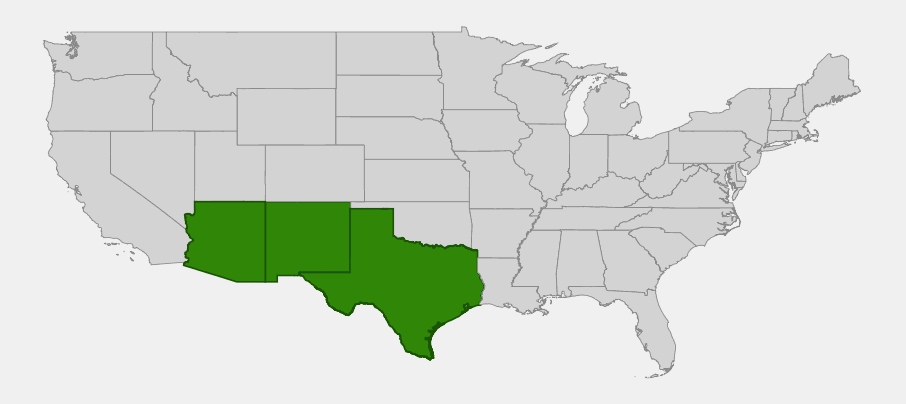
In the United States, Coahuila juniper occurs only in a handful of disjunct, mostly mountainous or rocky desert sites: the Trans-Pecos region of far western Texas (including the Big Bend country), scattered ranges of southwestern New Mexico, and parts of central and southeastern Arizona. From there its range continues south into the states of Coahuila, Chihuahua and neighboring parts of northern Mexico, for which it is named. Because its U.S. range is so limited and fragmented, it is a plant most gardeners will only encounter — or plant — in the borderlands counties of these three states.
It typically grows on dry, rocky slopes, limestone or volcanic outcrops, and desert grassland-to-woodland transition zones, often at middle elevations where it can mix with oneseed juniper, alligator juniper, and various oaks. It tolerates thin, poor soils that would challenge most trees, relying on an extensive root system to find scarce groundwater.
Because Coahuila juniper and Pinchot’s juniper overlap in parts of the Trans-Pecos and occasionally hybridize, correctly identifying which species is present on a given property is worthwhile before buying nursery stock sold simply as “redberry juniper” — ask the grower for the scientific name to be sure you are getting Juniperus coahuilensis rather than the more commonly offered J. pinchotii.
📋 Regional plant lists featuring Coahuila Juniper: Arizona & New Mexico · South & West Texas
Growing & Care Guide
Coahuila juniper is not widely available in the nursery trade, but where a correctly identified plant can be found, it makes an exceptionally tough, long-lived landscape tree for hot, dry, rocky sites in its native range.
Light
Give it full sun. Like most junipers of the arid Southwest, it is adapted to intense, unfiltered sunlight and will become thin and weak in significant shade. For more low-water companion trees and shrubs that pair well with it in an Arizona landscape, see our guides to drought-tolerant plants for Arizona and best plants for an Arizona backyard.
Soil & Water
This juniper thrives in thin, rocky, alkaline soils — including caliche and limestone-derived ground that frustrates many other landscape trees. Drainage is essential; it does not tolerate standing water or heavy, poorly drained clay. Once established (generally after the first one to two years), it needs little or no supplemental irrigation, drawing on deep roots to survive long dry spells.
Planting Tips
Plant from containers in fall or early spring to allow roots to establish before the heat of summer. Because male and female flowers occur on separate plants, only female individuals will produce the ornamental, wildlife-feeding cones; if fruiting is a priority, confirm sex with the nursery or wait for berries to appear on a young plant. Avoid amending the planting hole heavily with organic matter, which can encourage roots to stay shallow instead of reaching out into native soil.
Pruning & Maintenance
Prune only to remove dead or crossing branches, ideally in late winter. Coahuila juniper’s natural multi-trunked, rounded form is part of its appeal and rarely needs shaping. Avoid shearing into formal shapes, which stresses the plant and ruins its character. It is essentially pest- and disease-free in the dry climates where it is native.
Landscape Uses
Good choices for Coahuila juniper include:
- Xeriscape and rock garden specimen for borderland Southwest gardens
- Wildlife hedgerow planted with other junipers, mesquite and agarita
- Erosion control on dry, rocky slopes
- Windbreak or screen in low-water desert landscaping
- Evergreen winter structure among deciduous desert shrubs
Wildlife & Ecological Value
Coahuila juniper plays the same supporting role in desert wildlife communities as its better-known juniper relatives, offering year-round cover and a reliable late-season food source in a landscape where food can be scarce in winter.
For Birds
The bright, berry-like cones are eaten by a range of desert and woodland birds, including American robins, cedar waxwings, various thrushes, and quail, which help disperse the seeds across the landscape. The dense, scaly foliage also provides nesting sites and shelter from both weather and predators.
For Mammals
Small mammals such as foxes, coyotes and rodents consume the fleshy cones, and javelina and other browsers may feed lightly on foliage in lean years. The thick, structural growth form offers cover for rabbits and other small animals moving through open desert grassland.
Ecosystem Role
As one of the few evergreen trees able to persist on thin, rocky Chihuahuan Desert soils, Coahuila juniper helps stabilize slopes against erosion and provides a rare patch of year-round shade and cover in otherwise open desert grassland and scrub. Its roots also help bind soil on the steep, rocky terrain it favors.
Cultural & Historical Uses
Like other junipers of the Southwest borderlands, Coahuila juniper and its close relatives have long been used by Indigenous peoples of the region, whose traditional uses of “redberry” and related junipers included burning the aromatic wood and foliage, and using fibrous bark for cordage and other practical purposes. Because Coahuila juniper was historically lumped together with Pinchot’s juniper and other red-fruited junipers under shared common names, it is difficult to separate historical references to this exact species from its close relatives.
The wood of junipers in this group has traditionally been valued locally for fence posts and firewood, prized for its rot resistance and aromatic smoke — see our broader look at whether juniper makes good firewood for more on how these woods burn. Today, Coahuila juniper remains primarily of interest to native-plant gardeners, botanists and conservationists in its limited U.S. range rather than being a significant commercial species.
Because it is uncommon and easily confused with its more widespread relatives, Coahuila juniper is best appreciated in place, on the rocky hillsides where it naturally grows, or grown from nursery stock whose identity has been confirmed — rather than collected from the wild.
Frequently Asked Questions
Is Coahuila juniper the same as redberry juniper?
“Redberry juniper” is a common name shared by both Coahuila juniper (Juniperus coahuilensis) and the more widespread Pinchot’s juniper (Juniperus pinchotii). They are distinct species that overlap and occasionally hybridize in parts of the Trans-Pecos, so always check the scientific name if you want the true Coahuila juniper.
How much water does Coahuila juniper need?
Very little once established. Give young plants regular water for their first one to two years, then taper off; mature plants are highly drought tolerant and suited to unirrigated desert landscaping.
Will Coahuila juniper produce berries in my garden?
Only if you have a female plant, since junipers carry male and female cones on separate individuals. A male plant will never fruit, no matter how well it is grown.
Is Coahuila juniper easy to find at nurseries?
No — it is uncommon in the trade, and plants sold generically as “redberry juniper” in Southwest nurseries are far more often Pinchot’s juniper. Specialty native-plant nurseries in its native range are the most likely source for correctly identified stock.
Does Coahuila juniper cause allergies?
Like most junipers, male plants release wind-borne pollen in late winter that can trigger seasonal allergy symptoms in sensitive people, though it is a less significant regional allergen source than more common junipers such as Ashe juniper.

Looking for a nursery that carries Coahuila Juniper?
Browse our native plant nursery directory: Arizona · New Mexico · Texas