
Coastal Germander (Teucrium cubense)
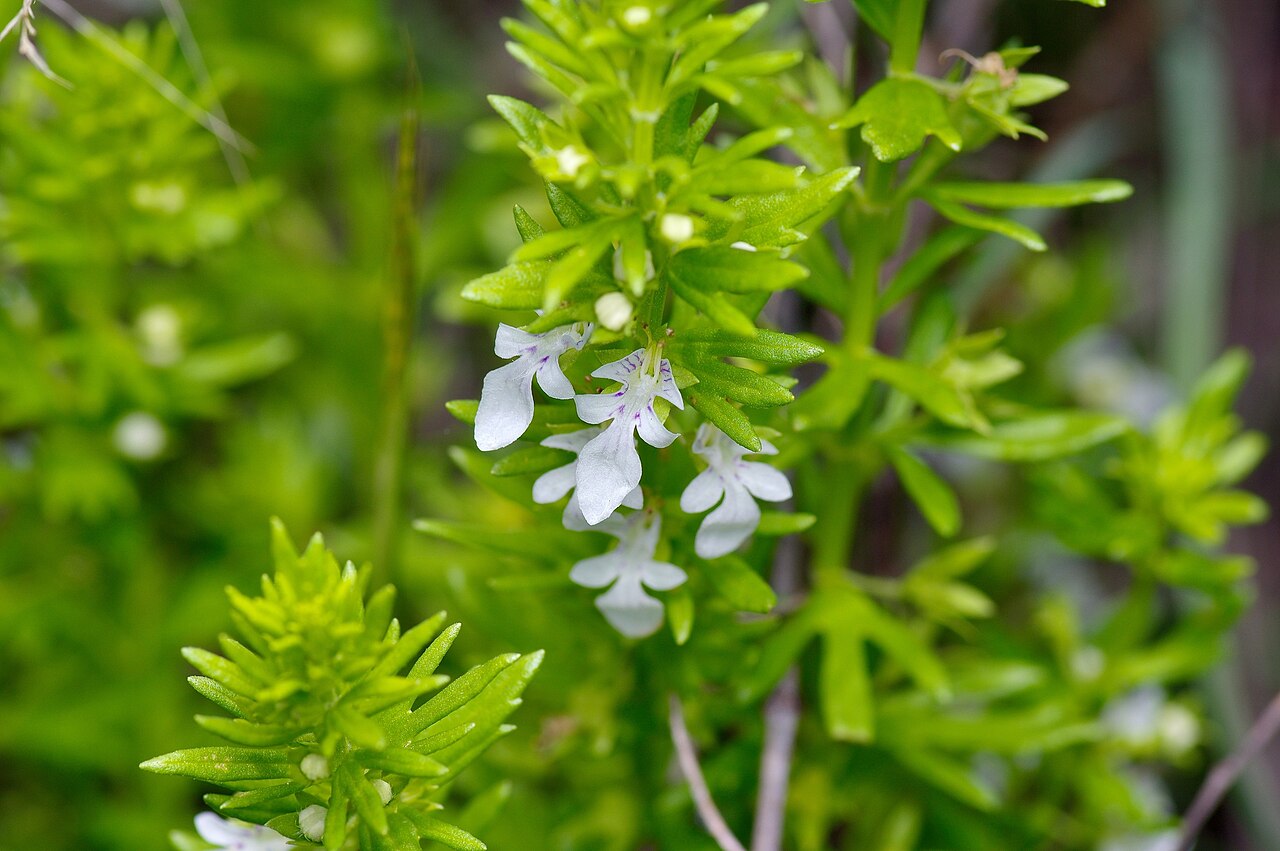
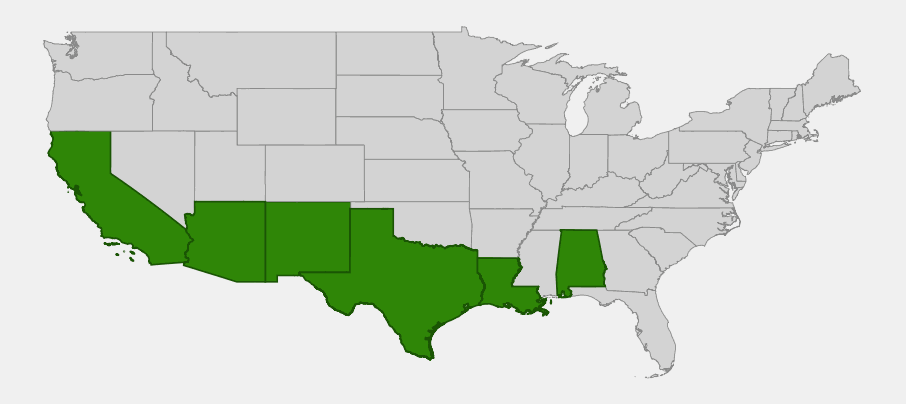
Teucrium cubense, known as Coastal Germander (also small coastal germander or dwarf germander), is a low, delicate member of the mint family (Lamiaceae) native to the southern United States, Mexico, the Caribbean and parts of South America. It forms a bushy little plant, usually 4 to 16 inches tall, with finely lobed leaves and a long season of small white flowers, each with the broad, spoon-shaped lower lip typical of germanders. In the United States it grows from the Gulf Coast of Alabama and Louisiana across Texas to New Mexico, Arizona and southern California.
Unlike most mints, coastal germander is not strongly aromatic, and its flowers look as if they are missing their upper lip. In germanders the two small upper lobes are pushed to the sides, so the flower is almost all lower lip, a white landing pad often marked with fine purple or blue lines. The Lady Bird Johnson Wildflower Center notes that this “delicate, herbaceous mint relative with multitudes of small white blossoms often grows adjacent to prickly pear,” and in south Texas it is a familiar sight in open brush, coastal prairie and along roadsides.
Coastal germander is an annual or short-lived perennial that blooms from early spring into fall in warm climates. It is rarely grown on purpose, but it is a pleasant, low-maintenance native for wildflower meadows, dry borders and rough ground across the Southwest and Gulf Coast, and its flowers attract small bees. This guide covers how to identify it, where it grows, how to grow it from seed, and its role in southern grasslands.
Identification
Only a few germanders are native to the United States. Coastal germander is easily separated from the tall, pink-flowered American Germander by its small size, white flowers borne singly in the leaf axils, and deeply lobed or divided leaves.
Stems & Growth Habit
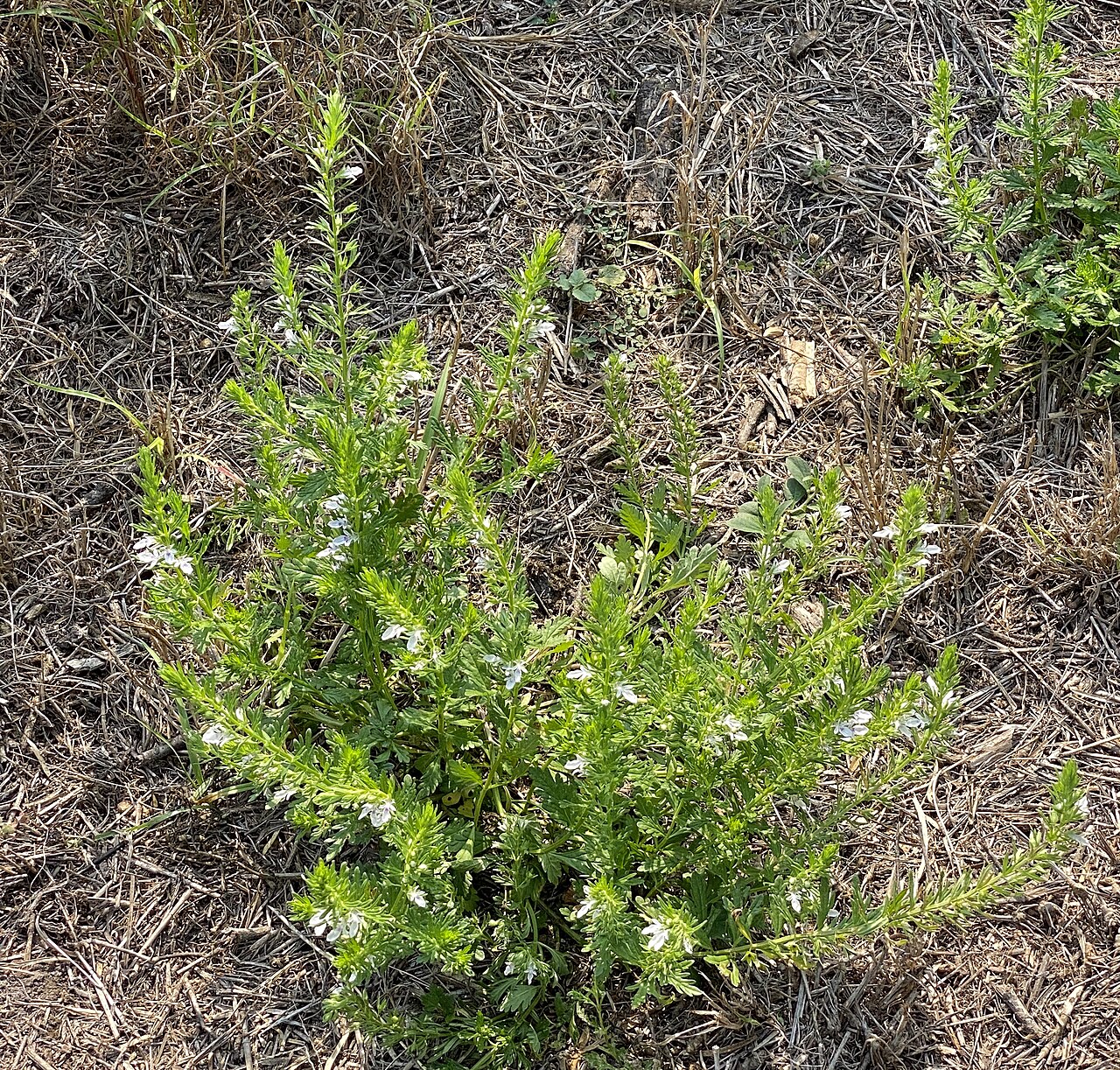
Plants are usually 4 to 16 inches tall, sometimes taller in good conditions, with many slender branches from the base that make a loose, bushy or spreading clump. The stems are square in cross-section, like other mints, and lightly to moderately hairy. In the desert Southwest the low, often sprawling form known as subsp. depressum (sometimes treated as a separate species, Teucrium depressum) hugs the ground.
Leaves
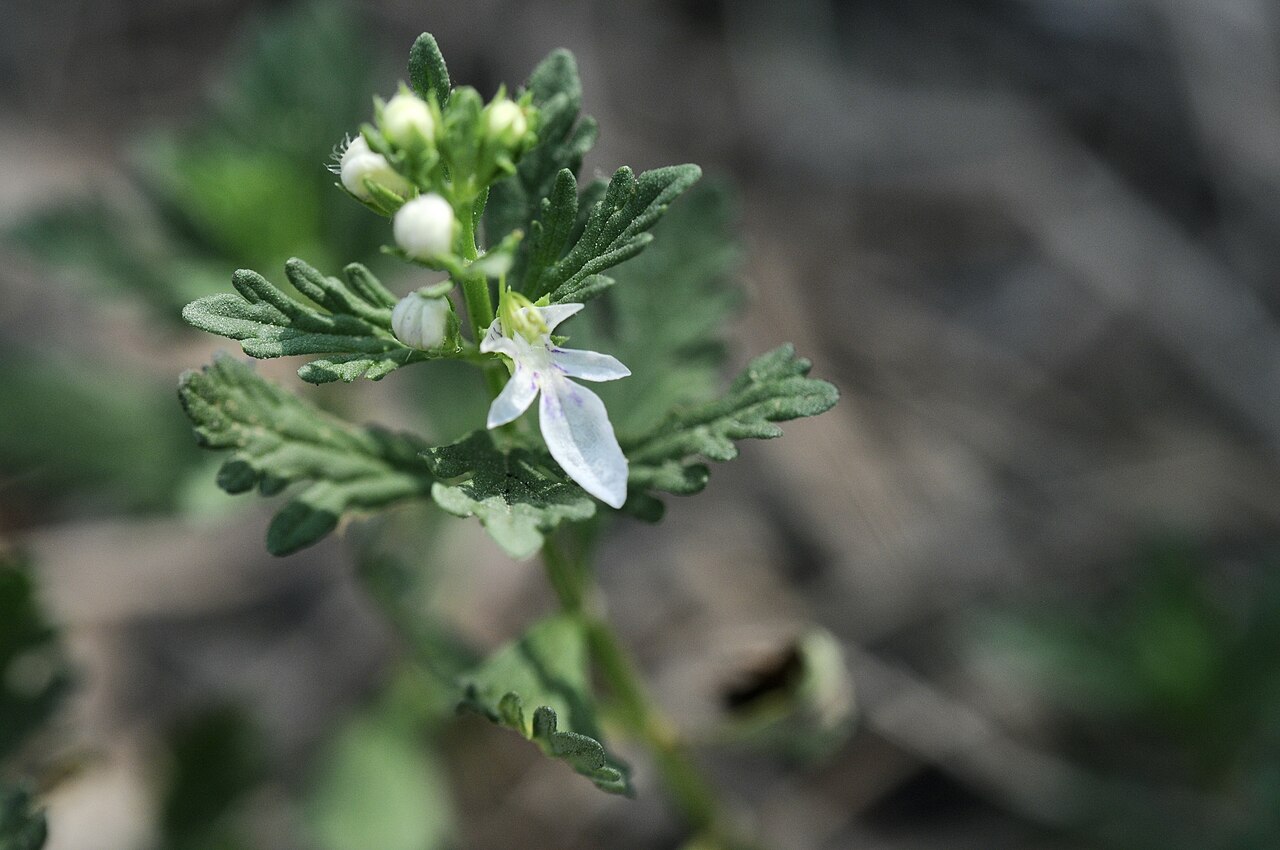
The leaves are opposite, ½ to 1½ inches long, and deeply cut into three to seven narrow lobes or segments, giving the plant a fine, lacy texture. Upper leaves are smaller and less divided and grade into the leafy bracts that hold the flowers. They are bright to grey-green and mildly hairy, with little of the strong mint scent of related plants.
Flowers
The flowers are borne one at a time in the axils of the upper leaves and bracts, forming leafy, elongated sprays. Each is about ⅓ to ½ inch long, white or very pale lavender, with a large, rounded lower lip often marked with fine purple or bluish lines near the throat. The upper lobes are small and spread to the sides, and the four stamens arch up and out of the flower. Coastal germander blooms from about March to October, with a strong flush in spring.
Fruit & Seeds
After flowering, each bell-shaped calyx holds four small, rounded, net-veined nutlets. They fall near the parent plant, and the plant reseeds lightly where it finds open ground.
Quick Facts
| Scientific Name | Teucrium cubense (incl. subsp. depressum) |
| Family | Lamiaceae (mint family) |
| Plant Type | Annual or short-lived herbaceous perennial |
| Mature Height | 4–16 in (occasionally to about 20 in) |
| Mature Spread | 6–18 in |
| Growth Rate | Fast |
| Sun Exposure | Full sun to partial shade |
| Water Needs | Low; drought tolerant, also grows in seasonally moist spots |
| Soil Type | Sandy, loamy or clay soils, including alkaline and slightly saline soils |
| Soil pH | About 6.5–8.5 |
| Bloom Time | March–October |
| Flower Color | White, often with fine purple or bluish lines |
| Fall Color | None |
| Fruit | Four small, net-veined nutlets |
| Deer Resistant | Moderately; seldom browsed heavily |
| USDA Hardiness Zones | 8–11 |
Native Range
Coastal germander has a wide range in the warm parts of the Americas. In the United States, USDA PLANTS records it as native in six states: Alabama, Arizona, California, Louisiana, New Mexico and Texas. The Biota of North America Program (BONAP) also maps it in southern Oklahoma. Beyond the United States it grows through much of Mexico, in the Caribbean (the species was first described from Cuba, hence cubense), in Central America, and in southern South America in Argentina, Uruguay and southern Brazil.
Texas is the heart of its U.S. range. The typical form is common on the Coastal Plain and in the Rio Grande Valley, the South Texas brush country and the Edwards Plateau, and it extends east along the Gulf Coast into Louisiana and to scattered sites in Alabama. West of Texas, the low, sprawling desert form, subsp. depressum, grows in the Chihuahuan and Sonoran Deserts of southern New Mexico and Arizona and reaches the Colorado Desert of southeastern California, often in dry lake beds, washes and low, seasonally wet flats.
Across this range coastal germander favors open, sunny ground: coastal prairies, brushland openings, grassland, pastures, roadsides, field edges, lawns and disturbed soils, and in the desert, playas and swales that hold water after summer rains. It tolerates clay, alkaline and slightly salty soils.
📋 Regional plant lists featuring Coastal Germander: Alabama, Georgia & Mississippi · Arizona & New Mexico · California & Nevada · Arkansas, Louisiana, Eastern Oklahoma & Eastern Texas · South & West Texas
Growing & Care Guide
Coastal germander is an easygoing plant that usually arrives on its own, but it can be grown deliberately from seed in Gulf Coast and Southwestern gardens. It needs sun, open soil and very little care, and it blooms for months with no help.
Light
Give it full sun to partial shade. It flowers most heavily in sun, but in the hottest desert gardens it appreciates some afternoon shade or the light cover of nearby shrubs, much as it grows beside prickly pear and mesquite in the wild.
Soil & Water
It grows in almost any well-drained to seasonally moist soil, from sand to heavy clay, and tolerates alkaline and slightly saline conditions, which makes it useful near the coast. Once established it is drought tolerant. In desert gardens, an occasional deep watering during dry spells keeps it blooming longer. No fertilizer is needed.
Planting Tips
Sow seed in fall or late winter on bare, open soil, pressing it lightly into the surface. Use it along path edges, in gravel or dry gardens, between stepping stones, or mixed with other low natives in a wildflower meadow. Because the plants are small and airy, group them or let them self-sow into drifts for the best effect.
Pruning & Maintenance
Very little maintenance is needed. Trimming leggy plants by about a third in midsummer encourages a fresh flush of bloom. Leave some plants to set seed so the colony continues, since individual plants are short-lived.
Propagation
Grow it from seed collected from dried flower stalks in summer or fall. Seed germinates readily on the soil surface in warm, moist conditions. Plants also self-sow lightly in open ground. Cuttings of young, non-flowering shoots can be rooted in moist sand in spring.
Landscape Uses
- Wildflower meadows and prairie plantings: a low, long-blooming filler among grasses and taller wildflowers
- Dry and gravel gardens: tolerates heat, drought and poor, alkaline soils across the Southwest
- Coastal gardens: handles sandy, slightly salty soils along the Gulf Coast
- Pollinator gardens: its white flowers attract small native bees and other insects for months
- Naturalized areas and roadsides: fills open, disturbed ground with a native groundcover
Wildlife & Ecological Value
Coastal germander is small and easy to overlook, but its long bloom season makes it a steady food source for small pollinators in southern grasslands and brush.
For Pollinators
The flowers are visited by small native bees, including sweat bees and small carpenter and leafcutter bees, along with bee flies and small butterflies. The broad lower lip acts as a landing platform, and the arching stamens dust visiting insects with pollen. The Lady Bird Johnson Wildflower Center lists it as a nectar source.
For Birds
The small nutlets may be eaten by ground-feeding birds such as doves and sparrows, though coastal germander is not a major bird food. Its low cover and insect visitors add to the value of open grassland and brush for birds.
For Mammals
It is of little forage value to mammals. Deer and rabbits occasionally nibble it, but it is rarely browsed heavily.
Ecosystem Role
As a quick-growing, self-sowing annual or short-lived perennial, coastal germander helps cover bare soil after drought, grazing or disturbance in coastal prairie and brushland. In the desert, the low subsp. depressum is part of the short-lived flora that springs up on playas and in swales after summer monsoon rains.
Cultural & Historical Uses
The species was described by the Dutch-Austrian botanist Nikolaus Joseph von Jacquin in the eighteenth century from plants collected in Cuba, which gave it the name cubense. The genus name Teucrium is an ancient Greek plant name that has traditionally been linked to Teucer, a legendary king of Troy.
Germanders have a long history in folk medicine, and in Mexico and South America coastal germander has been used in traditional remedies, especially as a bitter tea. Laboratory studies have explored possible effects on blood sugar, but these have not established safe or effective medical use. Safety note: some germanders, notably the European Teucrium chamaedrys, have caused serious liver injury when taken as herbal supplements, so do not use coastal germander or any germander as a medicine or tea.
In gardens, coastal germander is best known in Texas, where it appears on its own in lawns, meadows and vacant lots and is appreciated by native-plant gardeners as a delicate, long-blooming wildflower. The name “dwarf germander” is also used for a European ornamental, Teucrium chamaedrys ‘Prostratum’, so the scientific name helps avoid confusion.
Frequently Asked Questions
Is coastal germander a perennial?
It can be either. In mild, frost-free areas it often lives for several years as a short-lived perennial, while in colder or drier places it behaves as an annual. Either way it reseeds lightly, so it tends to persist in open ground.
Does coastal germander smell like mint?
Not much. Although it is in the mint family and has square stems and opposite leaves, its foliage has only a faint scent, unlike strongly aromatic mints and sages.
Is coastal germander safe to use as an herbal tea?
No. It has been used in folk medicine, but some germanders are known to cause liver damage when taken internally. Grow it for its flowers and wildlife value, not as an herb.
How is coastal germander different from American germander?
American Germander is a taller perennial, 1 to 3 feet, with toothed but undivided leaves and dense spikes of pink to lavender flowers. Coastal germander is much smaller, with deeply lobed leaves and white flowers borne singly in the leaf axils.
Will coastal germander take over my garden?
No. It reseeds modestly into open, sunny ground but is easily pulled, and it does not spread by runners.

Looking for a nursery that carries Coastal Germander?
Browse our native plant nursery directory: Alabama & Arizona · California · Louisiana · New Mexico · Texas

