Creeping Sedge (Carex laxiculmis)
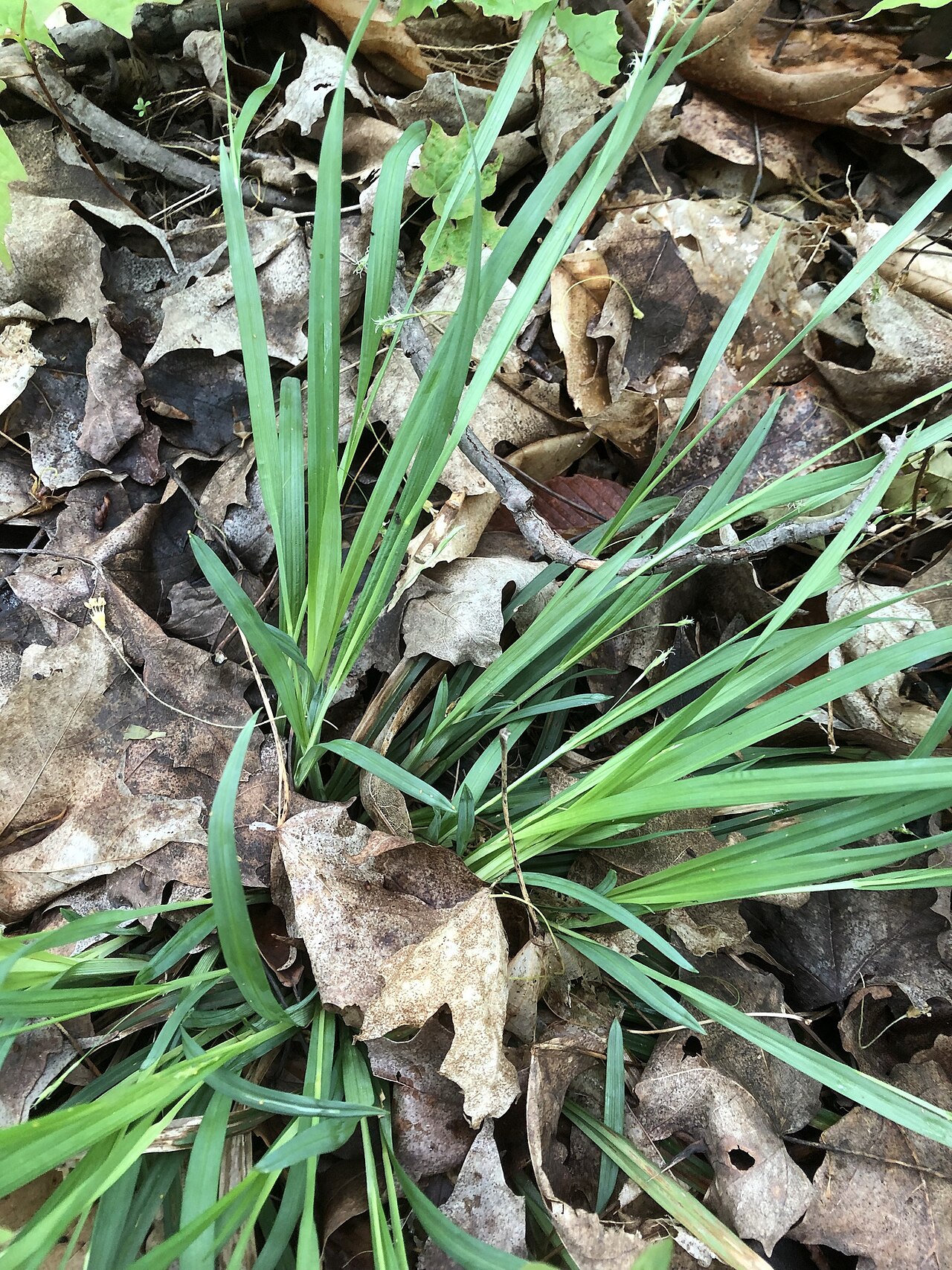
Carex laxiculmis, commonly called Creeping Sedge or Spreading Sedge, is a quiet, low-growing evergreen sedge of the eastern deciduous forest floor. It belongs to the Cyperaceae (sedge family) and spends most of the year as an unassuming mat of arching, blue-green leaves tucked beneath the shade of maples, oaks, and beeches. It will never stop traffic the way a blooming perennial does, but gardeners who work in dry shade know its value: this is one of the few native plants that actually wants to grow under a tree, in the exact spot where lawn grass gives up and hostas get chewed to lace by deer.
The name “laxiculmis” comes from the Latin for “loose-stemmed,” a nod to the lax, somewhat floppy flowering stems that arch outward from the base rather than standing stiffly upright. Unlike turf-forming sedges that spread aggressively by rhizome, Creeping Sedge is a tight, slow-spreading clump-former — the “creeping” in its common name refers more to its relaxed, trailing growth habit than to any tendency to run. It typically reaches less than knee height and keeps its grass-like foliage through winter in milder parts of its range, giving it real value as a groundcover in a four-season native garden.
Creeping Sedge is native to rich, mesic to dry-mesic forests across much of the eastern and central United States and adjoining Canada, where it is most often found on slopes, streambank terraces, and other sites with good drainage and consistent shade. It is scarce to rare at the northern and western edges of its range — in New England, Iowa, and the Ozark fringe of Arkansas and Oklahoma — so a planting there is a genuine contribution to regional biodiversity, not just a convenient groundcover.
Identification
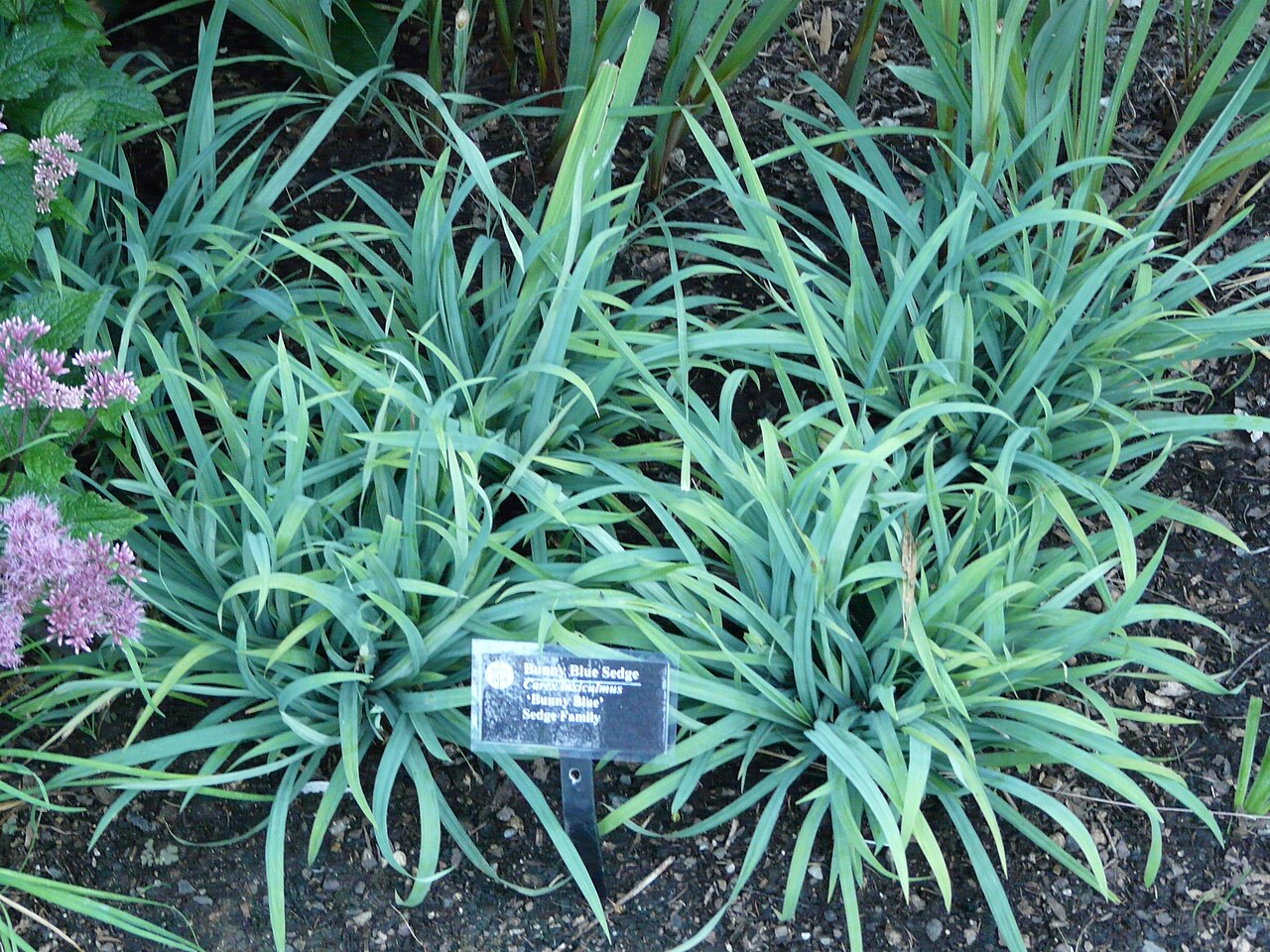
Creeping Sedge is a small, tufted, evergreen to semi-evergreen sedge that forms loose clumps 9 to 48 cm (roughly 4 inches to a foot and a half) tall, with little to no spreading rhizome — it stays where it is planted rather than running through a bed. The stems are triangular in cross-section, a classic sedge trait (“sedges have edges”), and the lowest flowering stems often arch or sprawl outward in a lax, informal way that gives the species its name.
Leaves
The leaf blades are flat, 3 to nearly 12 mm wide, smooth or slightly rough to the touch, and distinctly blue-green to glaucous (especially in the widespread var. laxiculmis), giving established clumps a soft, almost powdery look that stands out against darker forest-floor greens. Leaves are produced mostly from the base of the plant and are typically about as long as or longer than the flowering stems, so the overall look is a low, fountain-like tuft rather than a tall grass.
Flowers & Fruit
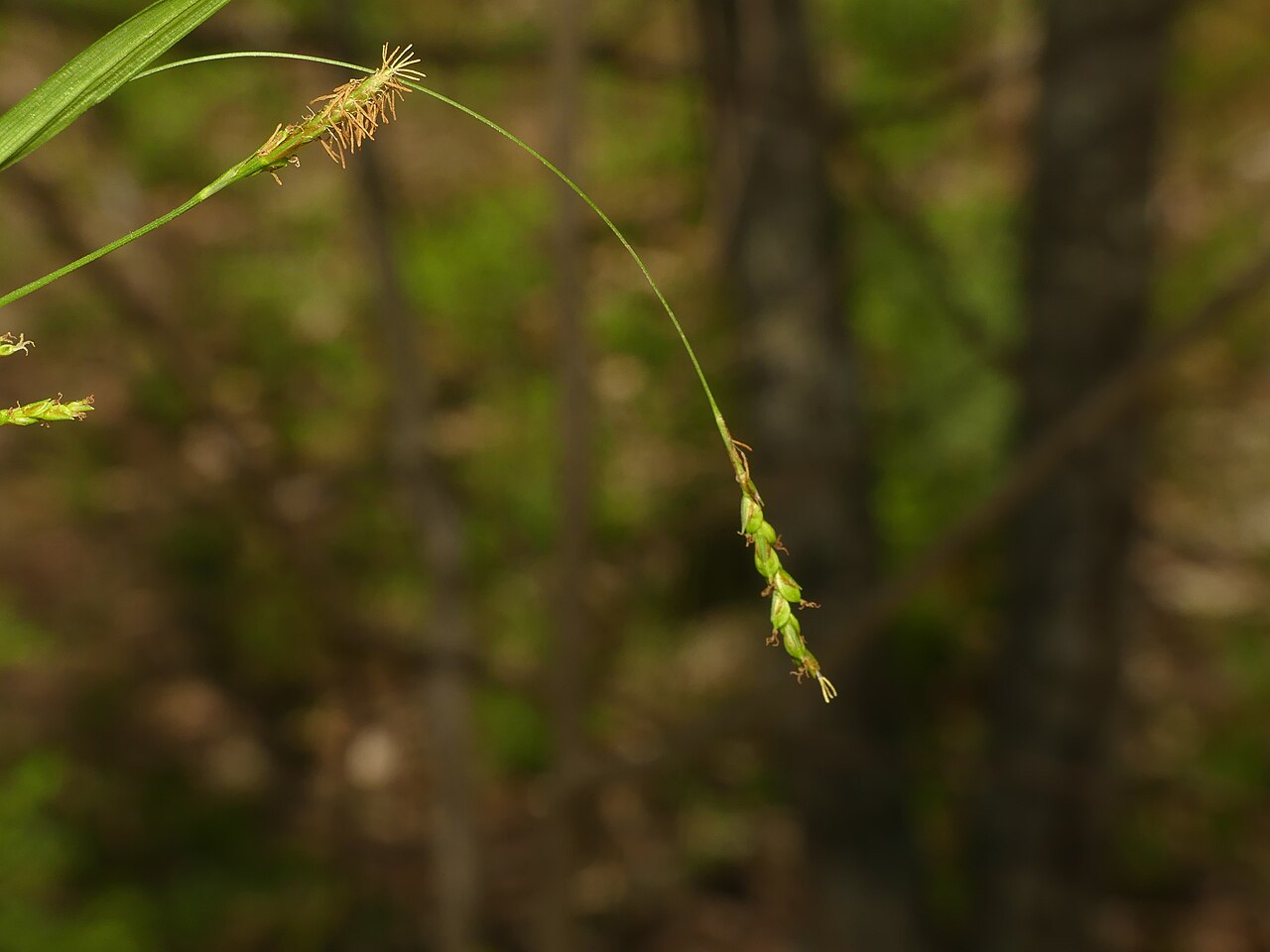
Flowering occurs in spring, from roughly April into June depending on latitude. Each plant produces two to fifteen slender spikes per stem: an uppermost spike bearing only pollen-producing (staminate) flowers, and one to several lower, seed-producing (pistillate) spikes that hang or arch downward on thin stalks. The ripe fruits (perigynia) are small — about 2.5 to 4 mm long, green, hairless, and sharply three-sided — arranged loosely along the drooping spike rather than packed into a tight head. None of this is showy from a distance; Creeping Sedge is identified at close range by its foliage color and texture as much as by its modest flowers.
Quick Facts
| Scientific Name | Carex laxiculmis |
| Family | Cyperaceae (Sedge) |
| Plant Type | Evergreen to semi-evergreen perennial sedge |
| Mature Height | 4 in – 1.5 ft (9–48 cm) |
| Mature Spread | 8–14 in, slowly expanding clump |
| Growth Rate | Slow |
| Sun Exposure | Part Shade to Full Shade |
| Water Needs | Average to dry once established |
| Soil Type | Humus-rich, well-drained loam |
| Soil pH | 5.5–7.0 (slightly acidic to neutral) |
| Bloom Time | April – June |
| Flower Color | Green (inconspicuous) |
| Fall Color | Foliage persists blue-green into winter |
| Fruit | Small three-sided green perigynia (not ornamental) |
| Deer Resistant | Yes, generally avoided by deer |
| USDA Hardiness Zones | 4–8 |
Native Range
Creeping Sedge is native to a broad swath of the eastern and central United States and southeastern Canada. Its core range runs from southern Ontario and Quebec south through New England and the Mid-Atlantic, west across the Ohio Valley and upper Midwest to Iowa and Missouri, and south through the Appalachians to the Gulf Coast states and Florida panhandle. It reaches its western and northern limits as scattered, often rare populations in New Hampshire, Vermont, Maine, Iowa, Arkansas, and the eastern edge of Oklahoma, where it should be considered a conservation-minded choice rather than an easy fill-in plant.
Within this range, Creeping Sedge is a plant of upland and slope forests rather than wetlands. It favors rich, mesic to dry-mesic deciduous and mixed deciduous-evergreen woods, often on the lower slopes of ravines, along terraces above streams, or in seepage areas where drainage stays good even with steady soil moisture. It is a reliable indicator of relatively undisturbed, mature forest floor — the kind of site where spring ephemerals like trillium and bloodroot also thrive.
Because Creeping Sedge rarely forms large rhizomatous colonies, wild populations tend to occur as scattered individual clumps rather than dense sweeps, and it can be locally uncommon even within states where it is officially native. In Maine it is tracked as a rare, state-endangered plant, and in Vermont it is considered uncommon — gardeners in those states should source nursery-propagated stock rather than ever considering wild collection.
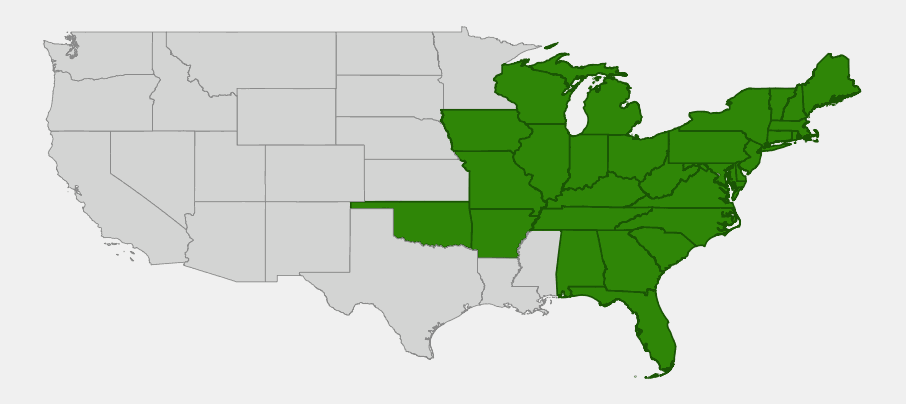
📋 Regional plant lists featuring Creeping Sedge: New Hampshire, Maine & Vermont · Connecticut, Massachusetts & Rhode Island · New York, Pennsylvania & Northern New Jersey · Delaware, Southern New Jersey & Long Island · Maryland, Virginia & West Virginia · North Carolina & South Carolina · Georgia, Alabama & Mississippi · Kentucky & Tennessee · Ohio & Indiana · Illinois, Iowa & Missouri · Michigan, Wisconsin & Eastern Minnesota · Arkansas, Louisiana, Eastern Oklahoma & Eastern Texas
Growing & Care Guide
Creeping Sedge is a patient, low-drama plant once it has the one thing it really needs: shade. Give it that, along with soil that drains and isn’t compacted, and it asks for very little else. It is best thought of as a long-term groundcover for a woodland garden rather than a quick-fix for bare ground — expect modest growth the first couple of seasons as the clump establishes a root system before it fills in.
Light
This sedge performs best in part shade to full, dappled shade, the kind of dry-to-average-moisture shade found under a mature deciduous canopy. It tolerates deeper shade better than most “shade-tolerant” perennials sold at garden centers, which makes it a genuine option for the north side of a house or under dense tree cover where little else will grow. In more open sun, especially combined with dry soil, foliage color dulls and the clump stays sparse.
Soil & Water
Creeping Sedge prefers humus-rich, well-drained soil with a slightly acidic to neutral pH, similar to the leaf-litter-covered forest floor where it grows wild. It is more drought-tolerant than many sedges once established, handling the dry shade under tree roots that stresses out moisture-loving groundcovers, though it still appreciates occasional deep watering during extended summer dry spells, particularly in its first year. Avoid heavy, poorly drained clay or sites that stay soggy — root rot, not drought, is the bigger risk for this species.
Planting Tips
Plant in spring or fall from container stock, spacing clumps 12 to 18 inches apart for a continuous groundcover effect, or further apart if used as individual accent plants among ferns and spring ephemerals. Work a couple of inches of leaf compost into the planting hole to mimic natural forest duff, and mulch with shredded leaves rather than bark, which better matches the organic litter layer this species is adapted to.
Pruning & Maintenance
Little maintenance is needed. In late winter or very early spring, before new growth emerges, you can comb or lightly shear off tattered old foliage to tidy the clump, though this is cosmetic rather than necessary — the evergreen leaves hold up reasonably well through winter in much of the range. Division is rarely needed given the slow, clumping growth habit, but older clumps can be divided in early spring if you want to propagate more plants.
Landscape Uses
Creeping Sedge fills a specific and useful niche in native landscaping:
- Dry shade groundcover under mature trees where turf and many perennials fail
- Woodland garden edging along paths through shaded beds
- Companion planting at the feet of ferns, trillium, and other spring ephemerals
- Deer-resistant foundation planting on the shaded side of a house
- Slope stabilization on shaded banks where erosion control is needed but turf grass won’t establish
- Evergreen winter interest in beds that would otherwise go bare after frost
Wildlife & Ecological Value
Like most native sedges, Creeping Sedge works quietly in the background of the forest-floor food web rather than putting on a showy display for pollinators.
For Birds
The small, hard fruits (perigynia) are eaten by ground-feeding songbirds such as sparrows and juncos, especially in fall and winter when other seed sources are scarce. The dense basal foliage also provides low cover for birds foraging on the forest floor.
For Mammals
Small mammals, including voles and chipmunks, use sedge clumps for cover and occasionally feed on the seed. As a larval host for several satyr and skipper butterflies in the broader Carex genus, the foliage also supports caterpillars that in turn feed nesting songbirds.
For Pollinators
Sedges are wind-pollinated, not insect-pollinated, so Creeping Sedge offers no nectar and little direct value to bees or butterflies as adults. Its ecological contribution comes instead from structure and larval host value rather than floral resources.
Ecosystem Role
As a long-lived, slow-spreading groundcover of mature forest, Creeping Sedge helps hold soil on slopes and stream terraces, moderates moisture at the forest floor, and contributes leaf litter and root mass that support the fungal and invertebrate communities underpinning forest soil health. Its presence is also a useful indicator of relatively undisturbed woodland, since it does not persist well in heavily logged, grazed, or otherwise disturbed sites.
Cultural & Historical Uses
Creeping Sedge has no significant documented history of use by Indigenous peoples or early settlers, unlike many showier or more abundant native plants. Sedges in general were sometimes used across various cultures for basketry, matting, or thatching material, but Carex laxiculmis specifically — being a modest, clump-forming understory plant rather than a tall, fibrous wetland sedge — does not appear in the historical record as a utilitarian species.
Its modern significance is almost entirely horticultural and ecological. As native plant gardening has grown, Creeping Sedge and its showier-leaved selections have been picked up by specialty nurseries as a low-maintenance, deer-resistant alternative to non-native groundcovers like English ivy, vinca, and pachysandra in shaded sites — plants that in many regions have become invasive problems in the very woodlands Creeping Sedge calls home.
Botanically, the species has long been of interest to taxonomists for its close relationship to similar woodland sedges such as Carex abscondita and Carex digitalis, which share its habitat and general look but differ in subtle spike and leaf characters — differences first carefully worked out in regional floras of the eastern United States.
Frequently Asked Questions
Is Creeping Sedge actually invasive or aggressive?
No. Despite the common name, Creeping Sedge spreads slowly by short rhizomes and stays in a tidy clump rather than running. “Creeping” refers to its lax, trailing stem habit, not aggressive spread.
Will Creeping Sedge grow in full sun?
It can tolerate some sun if soil moisture is adequate, but it performs best and looks its best in part to full shade. In hot, dry, sunny sites the foliage tends to bleach and the clump stays thin.
Is Creeping Sedge evergreen?
It is evergreen to semi-evergreen depending on climate, holding its blue-green leaves through mild winters in the southern and mid-Atlantic parts of its range, and dying back further in the coldest, most northern sites.
What’s the difference between Creeping Sedge and Pennsylvania Sedge?
Pennsylvania Sedge (Carex pensylvanica) spreads aggressively by rhizome to form a true lawn-like turf, while Creeping Sedge stays in discrete clumps and has notably wider, bluer-green leaves. Pennsylvania Sedge is the better choice for a sedge “lawn”; Creeping Sedge is better as an accent or edging plant.
Is Creeping Sedge rare or at risk?
It is uncommon to locally rare at the northern and western edges of its range, including a state-endangered listing in Maine and uncommon status in Vermont. Elsewhere in the Appalachians and Southeast it is more secure, but it should always be purchased as nursery-propagated stock rather than collected from the wild.

Looking for a nursery that carries Creeping Sedge?
Browse our native plant nursery directory: NE, NV, NH, NJ, NM, NY, NC, ND, OH, OK · KY, LA, ME, MD, MA, MI, MN, MS, MO, MT · PA, RI, SC, SD, TN, TX, UT, VT, VA · ID, IL, IN, IA, KS · CO, CT, DE, FL, GA, HI · AL, AK, AZ, AR · WV, WI, WY