
Desert Pepperweed (Lepidium fremontii)
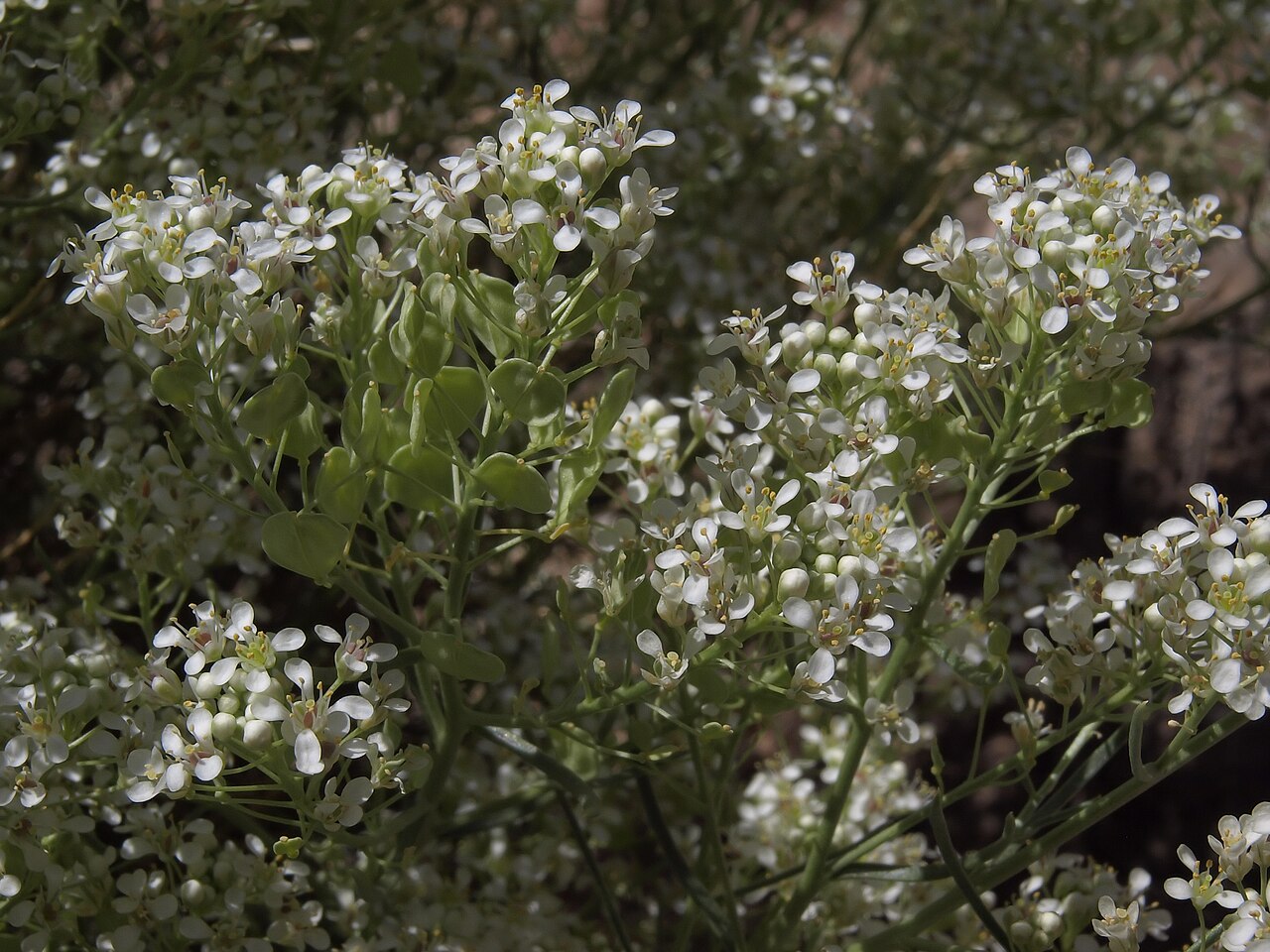
Lepidium fremontii, known as Desert Pepperweed, Fremont’s pepperweed or bush peppercress, is a rounded, many-stemmed subshrub of the Mojave Desert and neighboring deserts of the American Southwest. For most of the year it is an inconspicuous gray-green clump of slender, broom-like stems, but in spring it turns into a mound of white as thousands of tiny flowers open in dense clusters at the branch tips.
It is one of the few shrubby members of the mustard family in the region. The flowers have the four-petaled cross shape typical of mustards, and they are followed by small, flat, rounded seed pods that give the plant its common name: like other pepperweeds, its leaves and seeds have a peppery, cress-like bite.
Desert pepperweed grows in Arizona, California, Nevada and Utah, on sandy flats, washes and rocky slopes. This guide covers how to identify it, where it grows, how to use it in a desert garden, and its value to bees and other wildlife.
Identification
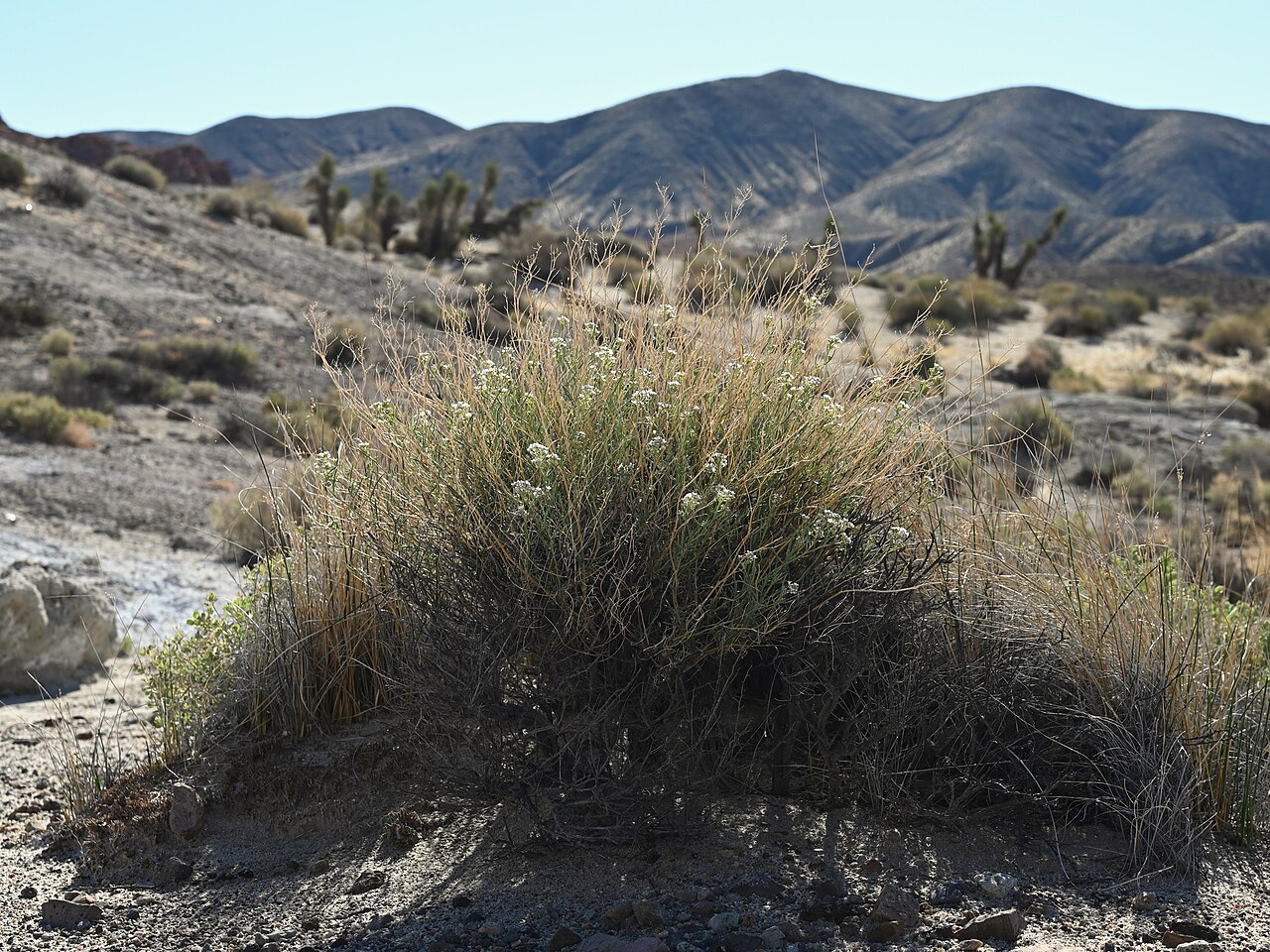
In spring, look for a rounded, 1- to 3-foot mound of thin, gray-green stems capped with crowded white flower clusters. In other seasons, the tangle of slender, nearly leafless stems and the flat, round seed pods on the old flowering branches are the best clues.
Growth Habit
It is a perennial subshrub with a woody base and many slender, branching, gray-green stems, forming a rounded or broom-like clump usually 1 to 3 feet tall and about as wide. The stems are often tangled and become somewhat woody with age.
Leaves
Leaves are narrow and linear, up to about 4 inches long, and are usually entire, though lower leaves may have a few finger-like lobes. They are sparse and often drop in drought, leaving the green stems to carry on photosynthesis.
Flowers
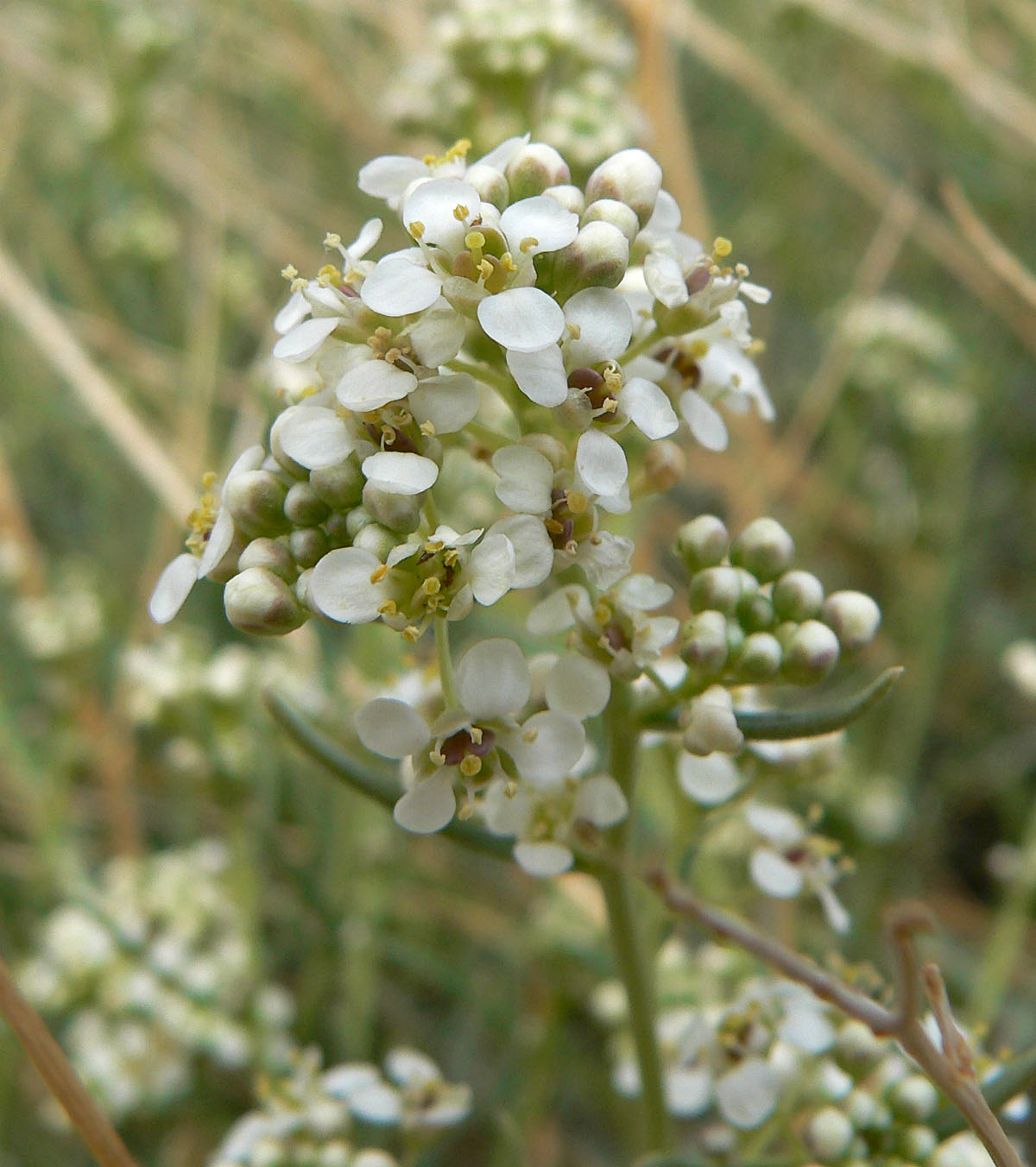
Flowers are borne in dense, rounded to elongating racemes at the ends of the branches. Each flower is only about 1/8 to 1/4 inch across, with four small, spoon-shaped white petals and green to purplish sepals. Bloom time is March to June, mainly in spring after winter rains.
Fruit & Seeds
The fruit is a small, flattened, oblong to rounded pod (silicle) less than 1/2 inch long, usually with a slight notch at the tip, holding two seeds. The pods form along the stems below the flowers and persist after drying.
Look-alikes
Princesplume, another shrubby desert mustard, has tall spikes of yellow flowers. Annual pepperweeds such as Lepidium lasiocarpum are small, short-lived plants without a woody base. Introduced perennial pepperweed (Lepidium latifolium) is a tall, invasive weed of wet, salty ground with broad leaves, not a plant of dry desert slopes.
Quick Facts
| Scientific Name | Lepidium fremontii S. Watson |
| Family | Brassicaceae (mustard family) |
| Plant Type | Perennial subshrub |
| Mature Height | 1–3 ft |
| Mature Spread | 1–3 ft |
| Growth Rate | Moderate |
| Sun Exposure | Full sun |
| Water Needs | Very low; drought tolerant |
| Soil Type | Sandy, gravelly or rocky, well-drained soils; often limestone |
| Soil pH | About 7.0–8.5 (neutral to alkaline) |
| Bloom Time | March–June |
| Flower Color | White |
| Fall Color | None; gray-green stems all year |
| Fruit | Small, flat, rounded pod (silicle) with two seeds |
| Deer Resistant | Moderately; peppery foliage is lightly browsed |
| USDA Hardiness Zones | 7–10 |
Native Range
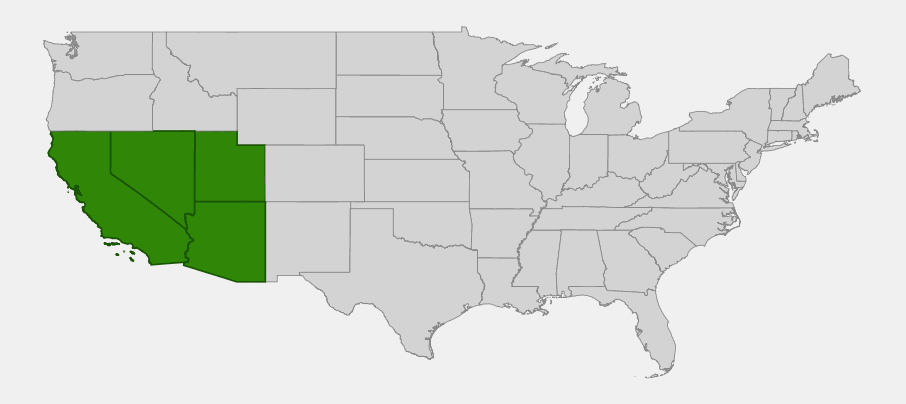
Desert pepperweed is native to the deserts of the southwestern United States. USDA PLANTS lists it in Arizona, California, Nevada and Utah. Its center of distribution is the Mojave Desert, which spans parts of all four states.
In California it grows mainly in the Mojave Desert and adjacent desert mountains, from the western Mojave and Death Valley region east to the Nevada border, with some records in the northern Sonoran (Colorado) Desert. In Nevada it is found in the southern part of the state, including the Las Vegas area and Valley of Fire; in Utah in the southwestern corner around St. George; and in Arizona in the northwestern deserts.
It grows in desert shrub communities and the lower edge of pinyon-juniper woodland, on sandy washes, gravelly flats, barren knolls, bluffs, roadsides, limestone outcrops and rocky ledges and slopes, generally from about 1,500 to 6,000 feet.
📋 Regional plant lists featuring Desert Pepperweed: Utah & Western Colorado · Arizona & New Mexico · California & Nevada
Growing & Care Guide
Desert pepperweed is a useful, low-maintenance filler shrub for desert and xeric gardens in the Mojave region, valued for its mass of spring flowers and its tolerance of heat, drought and poor, rocky soil. It is seldom sold in nurseries; look for it from desert native plant sales and seed suppliers, or grow it from seed.
Light
Plant it in full sun. It grows naturally on open, exposed desert slopes and becomes lanky in shade.
Soil & Water
It needs fast-draining sandy, gravelly or rocky soil and tolerates alkaline and limestone soils. Once established, it survives on natural rainfall in the Mojave; an occasional deep watering in a very dry winter or spring improves flowering. Overwatering, especially in summer heat, shortens its life.
Planting Tips
Plant young plants in fall or late winter so the roots can establish during the cool season. Space them 2 to 3 feet apart, and pair them with creosote bush, bursage, desert marigold and globemallows for a natural desert planting.
Pruning & Maintenance
Little care is needed. If plants become rangy, cut the old flowering stems back lightly after seed has dropped in early summer. Avoid heavy pruning during summer dormancy.
Propagation
Grow it from seed sown in fall or early winter, on or just below the surface of a sandy mix. Collect the small, dry pods in late spring and early summer. Plants may self-sow in open, gravelly ground.
Landscape Uses
- Desert and xeric gardens: a mound of white flowers in spring with no supplemental water
- Pollinator gardens: abundant small flowers for native bees and other small insects
- Rock and gravel gardens: thrives on rocky, alkaline and limestone soils
- Desert revegetation: a native subshrub for stabilizing washes, roadsides and disturbed slopes
- Wildlife habitat: shelter and food for desert insects, birds and small mammals
Wildlife & Ecological Value
Desert pepperweed’s spring bloom provides a dense source of nectar and pollen in desert shrublands, and its clumps shelter small animals.
For Pollinators
The tiny, nectar-producing flowers are visited by many small native bees, flies, wasps and small butterflies. Plants in full bloom can hum with insects on warm spring days.
For Birds
Sparrows and other seed-eating birds forage on the small seeds, and insect-eating birds hunt among the flowering branches.
For Mammals
Rodents collect the seeds, and the clumps provide cover for lizards and small mammals. Rabbits occasionally nibble the foliage.
Ecosystem Role
As a member of the mustard family, it is a potential host plant for butterflies whose caterpillars feed on mustards, such as some whites and orangetips. Its root systems help stabilize sandy washes and gravelly slopes.
Cultural & Historical Uses
The species is named for John C. Frémont, who led several exploring expeditions through the American West in the 1840s and collected plants along the way, many of which were later described by botanists. It was described by Sereno Watson, a botanist at Harvard who named many western plants.
The genus name Lepidium comes from the Greek for “little scale”, a reference to the small, flat seed pods. Pepperweeds get their common name from the sharp, peppery taste of their seeds and young leaves, and several species have been used as seasoning or greens. Desert pepperweed in the wild is best left untouched.
For desert hikers, the white mounds of desert pepperweed along washes and road shoulders in April are one of the less famous but most reliable signs of a Mojave spring.
Frequently Asked Questions
Is desert pepperweed a shrub?
It is a perennial subshrub: woody at the base with many slender, green stems, forming a rounded clump 1 to 3 feet tall.
Where does desert pepperweed grow?
It grows mainly in the Mojave Desert of California, Nevada, Arizona and southwestern Utah, on sandy washes, gravelly flats and rocky or limestone slopes.
When does desert pepperweed bloom?
It blooms from March to June, with peak flowering in spring after winter rains.
Is desert pepperweed invasive?
No. It is a native desert plant. It should not be confused with perennial pepperweed (Lepidium latifolium), an invasive weed of wet and salty ground.
How do I grow desert pepperweed?
Plant it in full sun in sandy or gravelly, well-drained soil, and water only occasionally once it is established. It can be grown from seed sown in fall.

Looking for a nursery that carries Desert Pepperweed?
Browse our native plant nursery directory: Arizona · California · Nevada · Utah

