White Ratany (Krameria grayi)
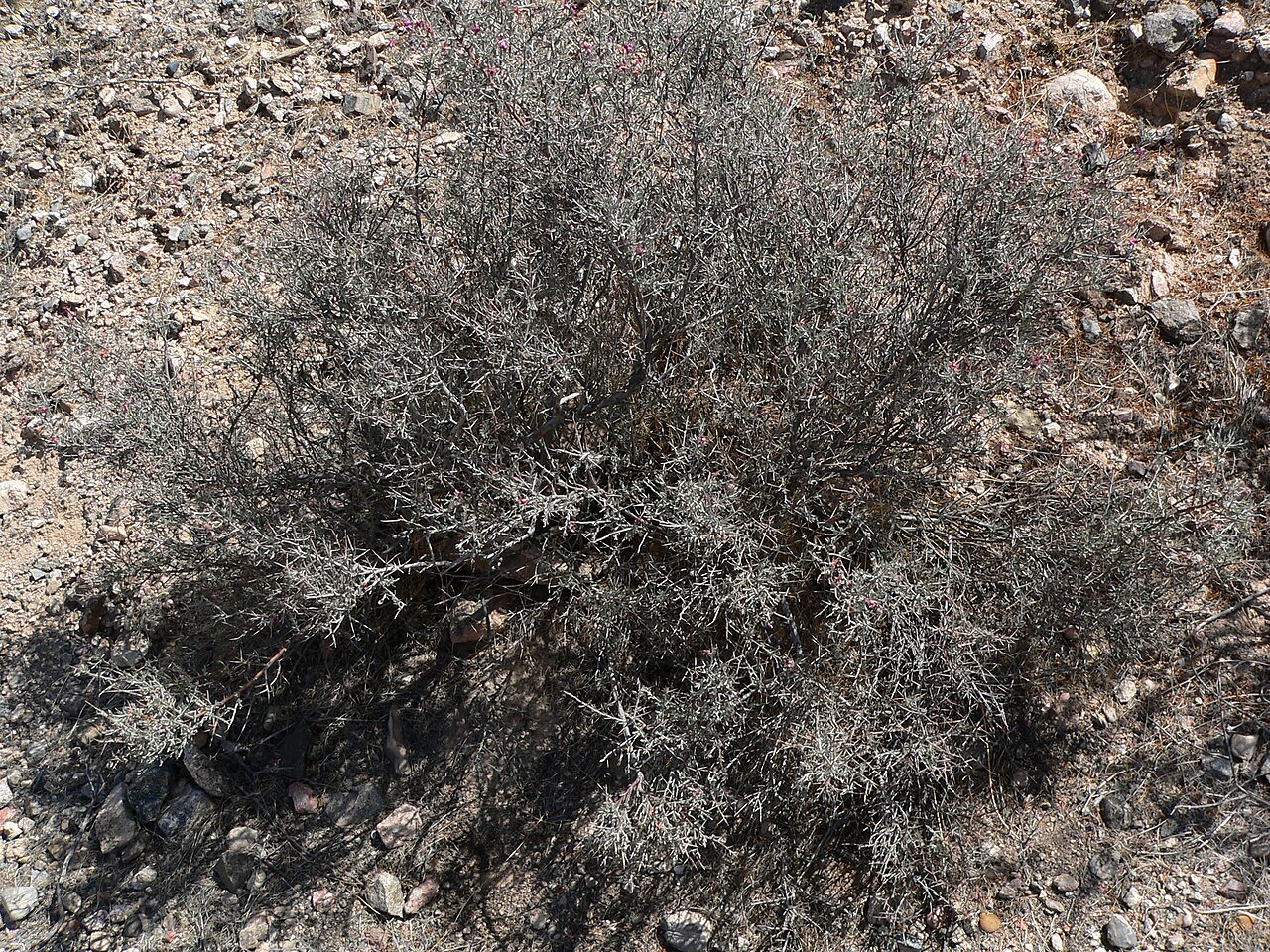
Krameria grayi (also treated as Krameria bicolor in some modern floras), commonly known as White Ratany or white rhatany, is a tough, low-growing shrub of the hottest, driest corners of the American Southwest. It belongs to Krameriaceae, a small family of root parasites found only in the Americas, and its unassuming gray-green form hides a genuinely strange biology: white ratany taps into the roots of neighboring shrubs, especially creosote bush, to help meet its water and nutrient needs. Despite — or maybe because of — this partly parasitic lifestyle, it thrives where almost nothing else can.
The shrub rarely tops 3 feet, forming a dense, rounded tangle of stiff, spine-tipped gray branches that can look dead for much of the year. Then, often after a spring or late-summer rain, it surprises visitors with small but vividly colored magenta-to-crimson flowers, followed by fuzzy, burr-like seed capsules covered in barbed spines. Those burs are the plant’s main calling card for gardeners who notice it, and for the desert wildlife that relies on it.
White ratany is not a plant for the average yard, but for xeriscape and true desert gardens in its native range, it is an excellent, nearly maintenance-free choice. It needs no supplemental water once established, tolerates rocky and alkaline soils that defeat most other shrubs, and adds textural interest and pollinator value to a landscape built around creosote bush, ocotillo, and other Sonoran and Mojave desert natives.
Identification
White ratany is most easily recognized by its tangled, spur-branched silhouette and gray-green color, which can make it nearly invisible against desert gravel until it flowers.
Bark & Stems
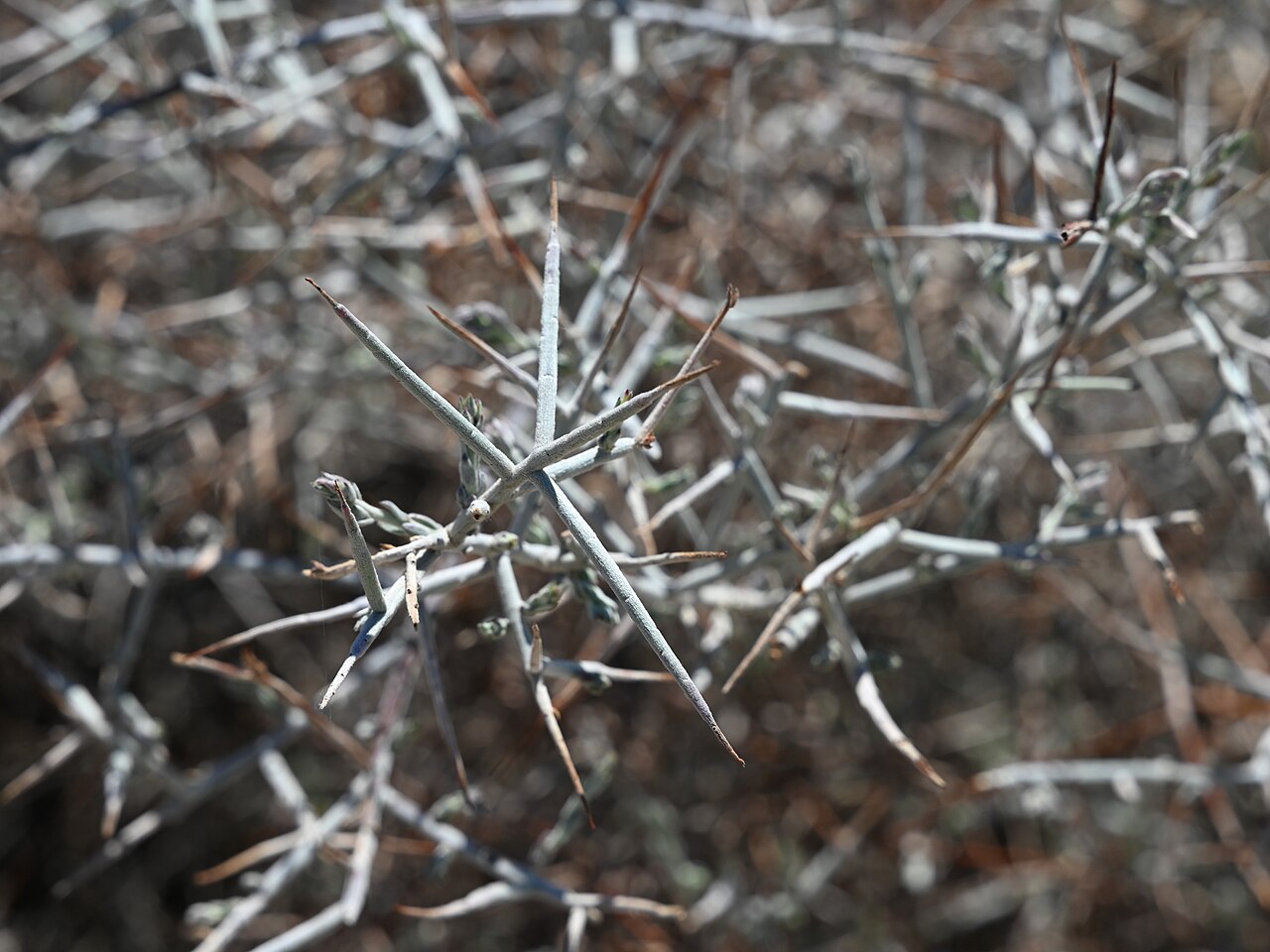
Stems are slender, rigid, and densely branched, radiating outward from a woody base to form a rounded to spreading mound 2 to 4 feet wide. Many of the smaller branchlets taper to a stiff, thorn-like point, giving the whole shrub a prickly, wiry texture. Young twigs are covered in fine, silvery hairs that fade to gray-brown with age, and the bark on older stems is pale gray and finely fissured.
Leaves
Leaves are small, simple, and narrowly oblong to linear, typically ¼ to ¾ inch long, with a gray-green to silvery cast from a dense covering of fine hairs. They are scattered thinly along the branches rather than clustered, which lets the plant’s spiny stem structure show through even in full leaf — part of why the shrub reads as gray rather than green from a distance.
Flowers
Flowers are small, roughly ½ inch across, with an irregular, orchid-like shape typical of the genus: five unequal sepals in shades of magenta to brick red surround smaller true petals and a cluster of oil-secreting glands that attract specialist bees. Flowers appear singly in the leaf axils, mostly in spring and again after summer rains, and are easy to overlook despite their saturated color because of their small size.
Fruit & Seeds
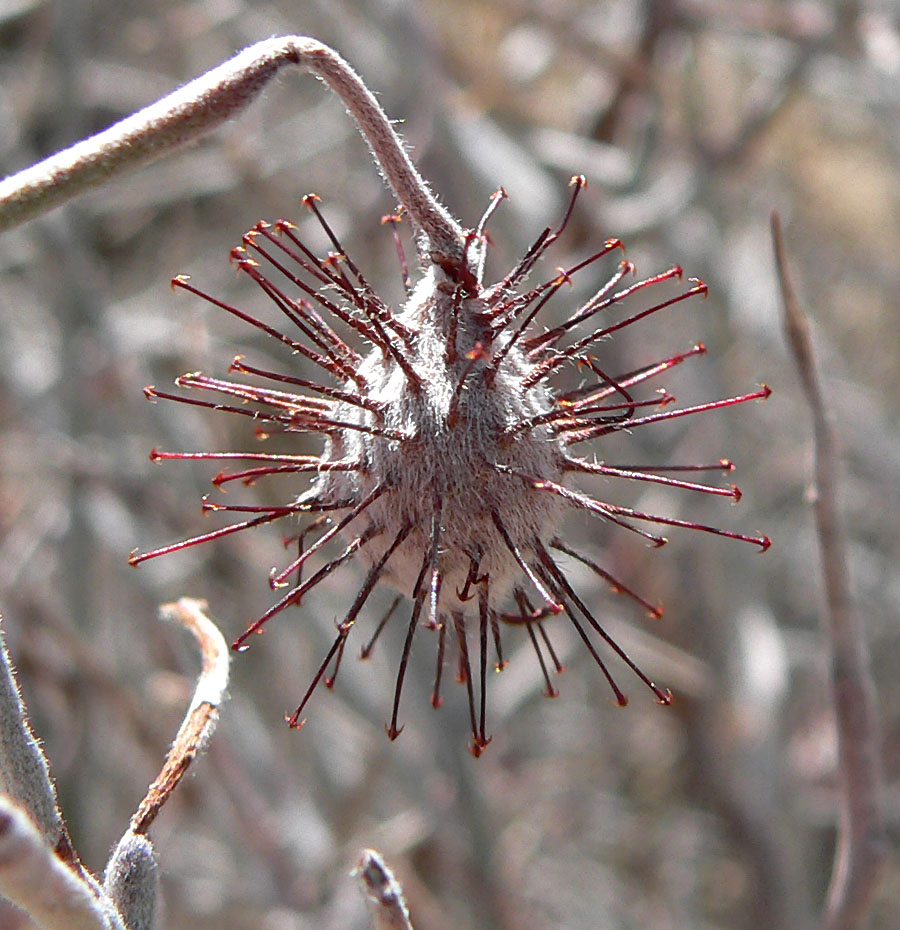
The fruit is a round, fuzzy capsule about ¼ to ⅜ inch across, densely covered in stiff, barbed, reddish spines that give it a sea-urchin appearance. These burs cling readily to fur and clothing, aiding seed dispersal, and remain on the plant long after ripening, making them a reliable identification feature even outside the bloom season.
Quick Facts
| Scientific Name | Krameria grayi (syn. Krameria bicolor) |
| Family | Krameriaceae (Ratany) |
| Plant Type | Deciduous/Semi-evergreen Shrub (hemiparasitic) |
| Mature Height | 1–3 ft |
| Mature Spread | 2–4 ft |
| Growth Rate | Slow |
| Sun Exposure | Full Sun |
| Water Needs | Very Low |
| Soil Type | Rocky, sandy or gravelly; fast-draining |
| Soil pH | 7.0–8.5 (neutral to alkaline) |
| Bloom Time | April – May, again August – September after rain |
| Flower Color | Magenta to brick red |
| Fall Color | None notable (gray-green year-round) |
| Fruit | Spiny, barbed round capsules |
| Deer Resistant | Yes |
| USDA Hardiness Zones | 8–11 |
Native Range
White ratany is native to the hot deserts of the southwestern United States and northern Mexico, occurring from the Mojave and Colorado Deserts of southeastern California across southern Nevada, a small corner of southwestern Utah, Arizona, and south-central New Mexico, into western and southern Texas. It is a defining shrub of the Sonoran and Chihuahuan Desert scrub, typically found below about 3,500 feet in elevation.
Within this range it grows on dry, rocky slopes, desert pavement, and sandy or gravelly washes and flats, often alongside creosote bush (Larrea tridentata), on whose roots it is partially parasitic, as well as ocotillo (Fouquieria splendens), bursage, and various cacti. Its hemiparasitism lets it survive in some of the driest, least fertile desert soils in North America.
White ratany is a true desert specialist and shows little tolerance for summer humidity, heavy or poorly drained soils, or hard freezes. Outside its native desert range — including in wetter or colder parts of the Southwest — it generally fails to establish or thrive, so it should be planted only within its documented low-desert range.
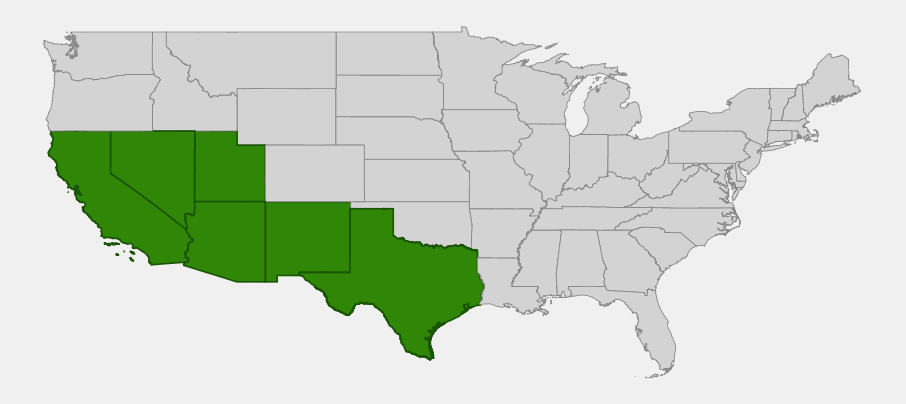
📋 Regional plant lists featuring White Ratany: California & Nevada · South & West Texas · Arizona & New Mexico · Utah & Western Colorado
Growing & Care Guide
White ratany rewards a hands-off approach. It is built for extreme heat, drought, and poor soil, and the biggest risk gardeners run is killing it with kindness — too much water or overly rich soil.
Light
Give it full, all-day sun. White ratany evolved on open desert flats and slopes with no overhead shade, and it will become leggy and weak-stemmed in anything less than full sun exposure.
Soil & Water
Fast-draining rocky, sandy, or gravelly soil is essential; heavy clay or any soil that holds moisture will quickly rot the roots. Once established, white ratany needs little to no supplemental irrigation beyond natural desert rainfall. New transplants benefit from an occasional deep watering through their first one to two summers, but mature plants should be left to rely on natural precipitation. Because it is partially root-parasitic on nearby shrubs, especially creosote bush, it tends to perform best when planted near an established host rather than in isolation.
Planting Tips
Plant in fall or early spring from container stock so roots can establish before the heat of summer. Choose the driest, sunniest, most well-drained spot available, and avoid amending the soil with organic matter, which can hold too much moisture near the roots. Siting a young plant within a few feet of an existing creosote bush or other desert shrub can improve establishment given its hemiparasitic habit.
Pruning & Maintenance
Pruning is rarely needed. Old, woody growth can be thinned in late winter if the plant becomes too dense, but white ratany’s naturally tangled, spiny form is part of its desert character and heavy shaping is neither necessary nor in keeping with its wild appearance.
Landscape Uses
White ratany fits a narrow but valuable niche in true desert landscaping:
- Xeriscape and water-wise gardens in the low desert
- Desert pollinator gardens, paired with creosote bush and other natives
- Rock gardens and gravel plantings
- Erosion control on dry, rocky slopes
- Habitat restoration in disturbed Sonoran and Mojave Desert sites
- Textural accent among cacti and other desert shrubs
Wildlife & Ecological Value
Despite its small size and sparse appearance, white ratany plays an outsized role in low desert ecosystems, both as a nectar source and as a structural element for ground-dwelling wildlife.
For Pollinators
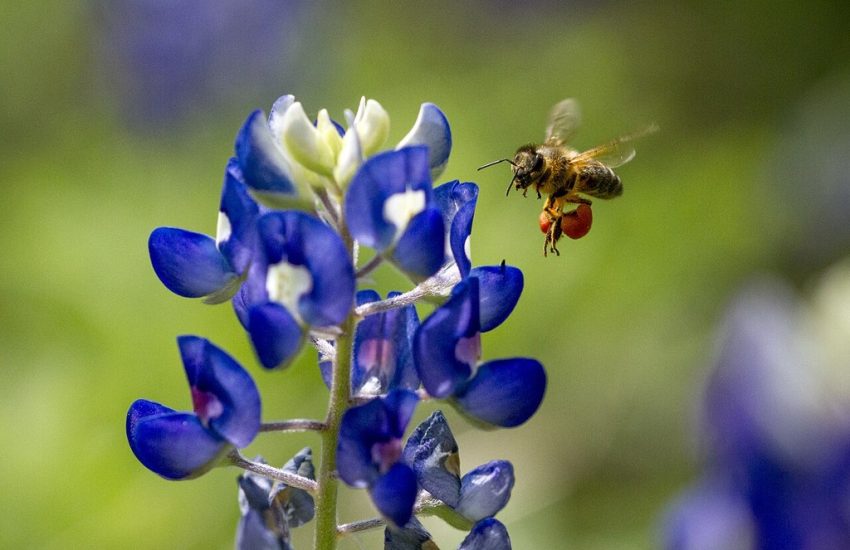
White ratany’s flowers are specialized to attract oil-collecting bees in the genus Centris, which gather floral oils from the flower’s glands rather than nectar, using the oil to provision their nests. This makes the plant an important, somewhat specialized resource for native desert bee populations, in addition to drawing other small native bees and occasional butterflies.
For Birds
The dense, spiny branch structure offers small desert birds, such as sparrows and wrens, a well-protected spot to perch and nest, sheltered from both sun and predators. Seeds within the spiny capsules provide incidental forage for some seed-eating birds.
For Mammals
Small desert rodents use the shrub’s tangled base for cover from predators and the heat of the day. The barbed seed capsules cling to the fur of passing mammals, aiding in seed dispersal across the desert landscape.
Ecosystem Role
As a root hemiparasite, white ratany is woven directly into the below-ground life of desert shrub communities, drawing water and nutrients from host plants like creosote bush while still photosynthesizing on its own. This relationship, along with its drought tolerance and low, dense form, helps stabilize open desert soils and adds a layer of structural and floral diversity to communities that might otherwise be dominated by a few larger shrub species.
Cultural & Historical Uses
Ratany species across the Southwest and Mexico, including white ratany, have a long history of use among Indigenous peoples of the Sonoran Desert, who historically used the plant’s tannin-rich roots as a reddish-brown dye for leather and basketry materials. The common name “ratany” itself derives from “ratanhia,” originally applied to South American Krameria species valued historically for their dye and tannin content.
Because of their high tannin content, the roots of various Krameria species, including this one, were historically processed by some groups as a folk astringent. This is a point of historical interest rather than a present-day recommendation; the plant has no established modern herbal use.
More recently, white ratany has drawn interest from desert landscapers and native plant enthusiasts for its toughness and its unusual, barbed seed capsules, which are sometimes used in dried floral arrangements by desert gardeners who appreciate its sculptural, spiny form.
Frequently Asked Questions
Is white ratany actually parasitic?
Yes, it is a hemiparasite — it photosynthesizes on its own but also taps into the roots of nearby shrubs, especially creosote bush, through specialized root structures to draw additional water and nutrients. This does not usually kill the host plant.
Can I grow white ratany outside the low desert?
It is not recommended. White ratany is adapted to hot, arid, well-drained conditions and generally struggles or fails in humid climates, heavy soils, or areas with hard, prolonged freezes outside its native desert range.
Does white ratany need a host plant to survive?
It can survive without one, since it still photosynthesizes independently, but it tends to grow more vigorously when planted near an established desert shrub such as creosote bush that it can parasitize.
Are the seed burs a problem for pets or people?
The spiny, barbed capsules can stick to fur, socks, and shoelaces and may cause minor skin irritation if handled carelessly, though they are not toxic. Gloves are recommended when clearing old seed heads.
How much water does white ratany need once established?
Very little. Established plants typically need no supplemental irrigation beyond natural desert rainfall and can be damaged by regular watering meant for less drought-adapted garden plants.

Looking for a nursery that carries White Ratany?
Browse our native plant nursery directory: California · Arizona · Nevada & New Mexico · Texas & Utah