Dwarf Chinkapin Oak (Quercus prinoides)
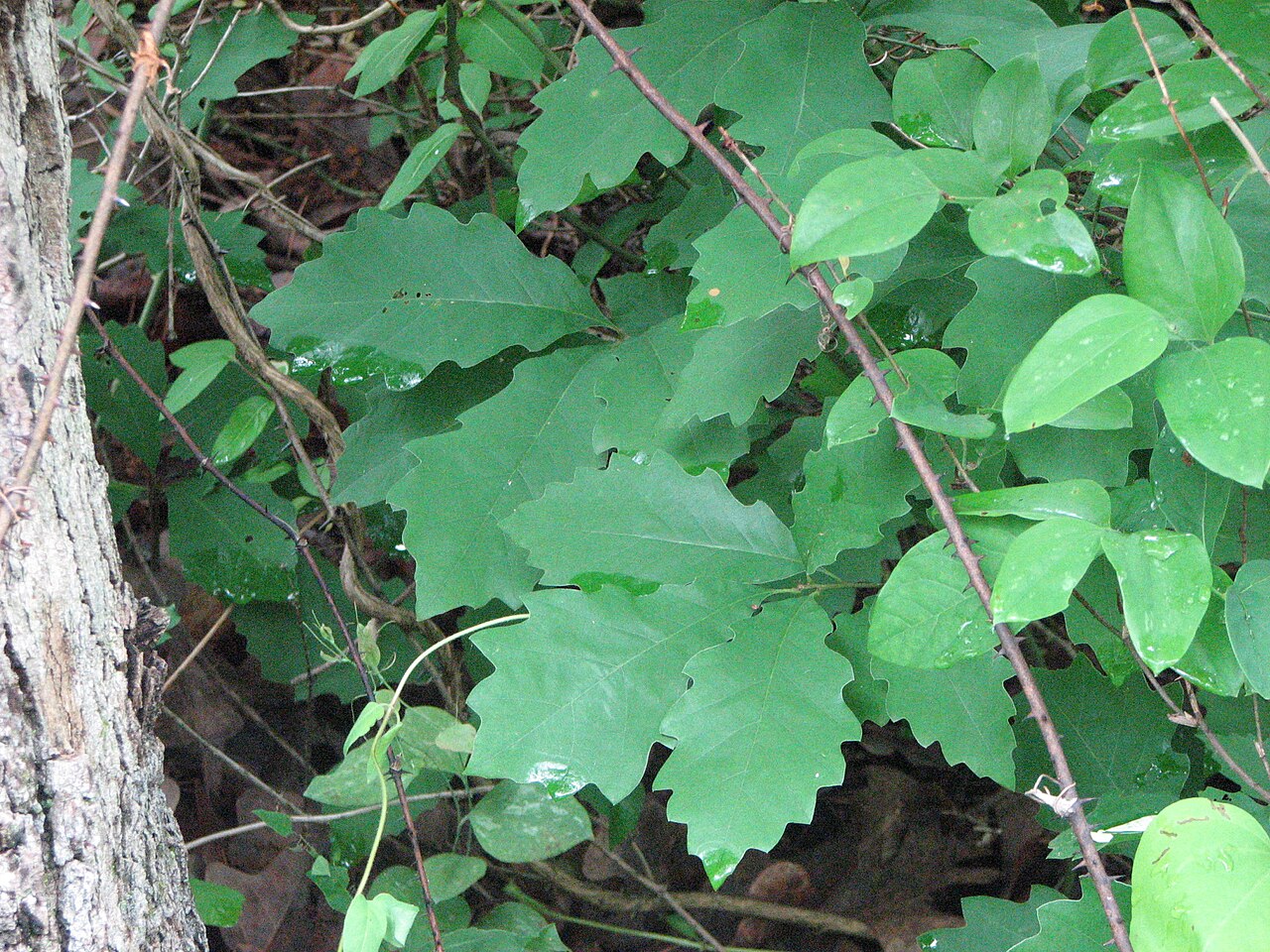
Quercus prinoides, commonly known as Dwarf Chinkapin Oak (also spelled dwarf chinquapin oak, and sometimes called dwarf chestnut oak or scrub chestnut oak), is one of North America’s smallest native oaks — a clonal, colony-forming shrub rather than a towering canopy tree. For gardeners and restoration planners working with limited space, difficult dry soils, or wildlife-focused plantings, it offers genuine oak ecology — acorns, oak-dependent insects, structural cover — in a package that fits a residential yard.
Growing just 4 to 6 feet tall and wide, Dwarf Chinkapin Oak spreads slowly by underground rhizomes to form low thickets, closely resembling its larger relative, Chinkapin Oak (Quercus muehlenbergii), in leaf shape but at a fraction of the size. Its sweet, relatively low-tannin acorns are a favorite of deer, turkeys, squirrels, and chipmunks, and because the plant begins producing acorns at a young age and small size, it delivers wildlife value faster than almost any other native oak.
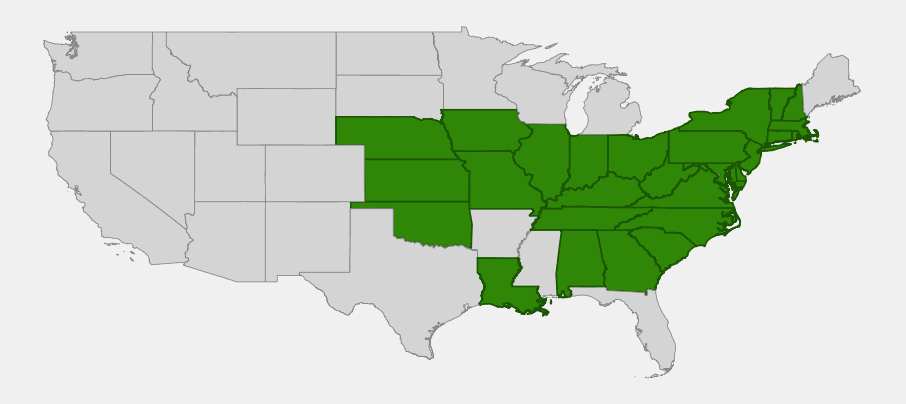
The species has a distinctly patchy, disjunct range across central and eastern North America — fairly common in New England and the Appalachian Mountains and scattered across the eastern Great Plains, but notably rare through much of the Ohio Valley in between. It thrives on the kind of dry, sandy, or rocky, often acidic sites where many other oaks struggle, making it a valuable choice for difficult, low-fertility soils where a full-sized shade tree isn’t wanted or wouldn’t survive.
Identification
Dwarf Chinkapin Oak belongs to the white oak group (section Quercus) and is most easily recognized by its small, shrubby stature combined with leaves that closely echo the shape of the much larger Chinkapin Oak. Its clonal, thicket-forming growth habit — several stems from a shared rhizome system rather than one with a single dominant trunk — further sets it apart from most other oaks gardeners encounter.
Bark & Stems
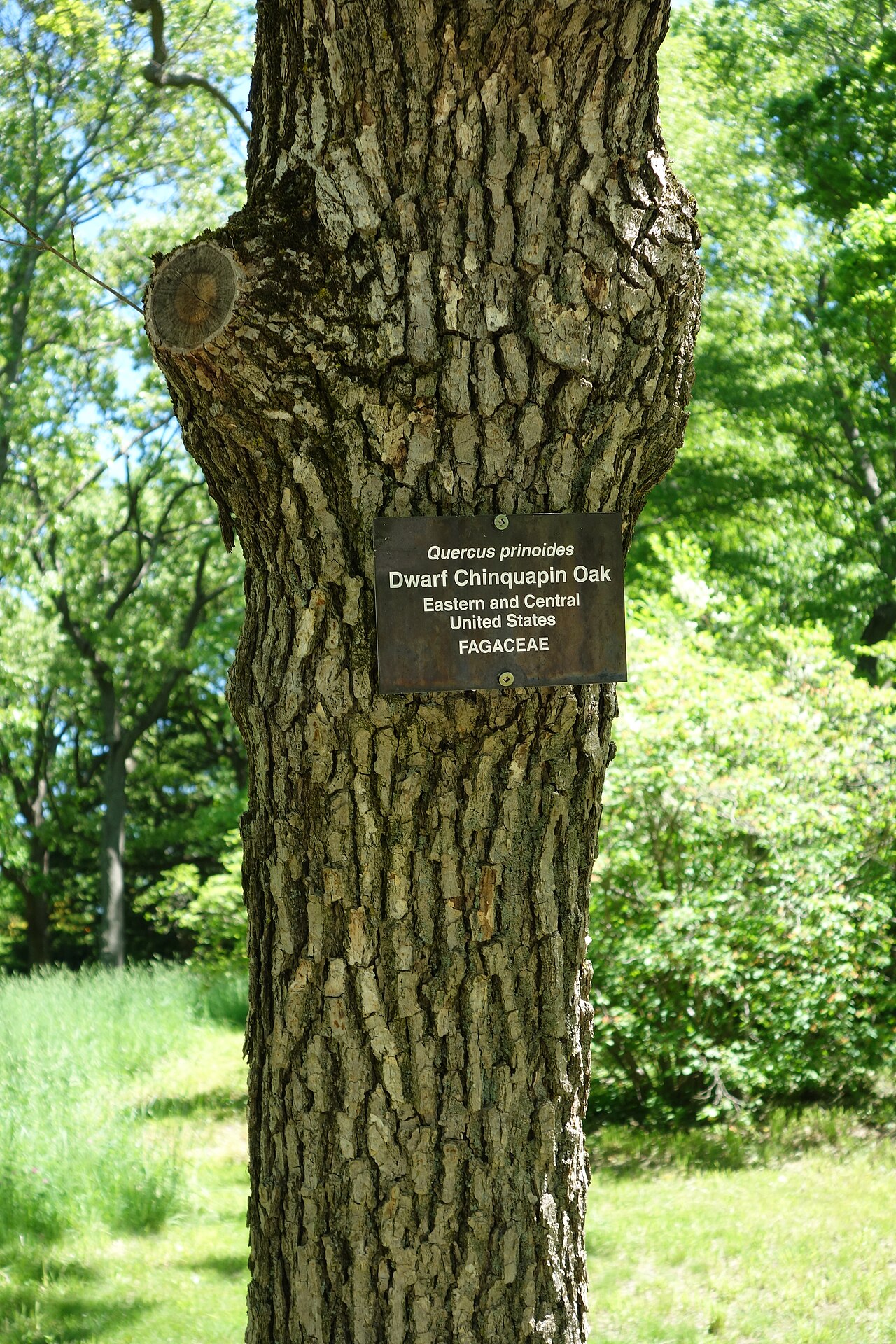
Bark on young stems and smaller branches is relatively smooth and gray-brown; on older stems it becomes finely furrowed, echoing the bark texture of its larger relatives in miniature. Because the species rarely develops a substantial trunk, prominent furrowed bark is less commonly seen than in full-sized oaks.
Leaves
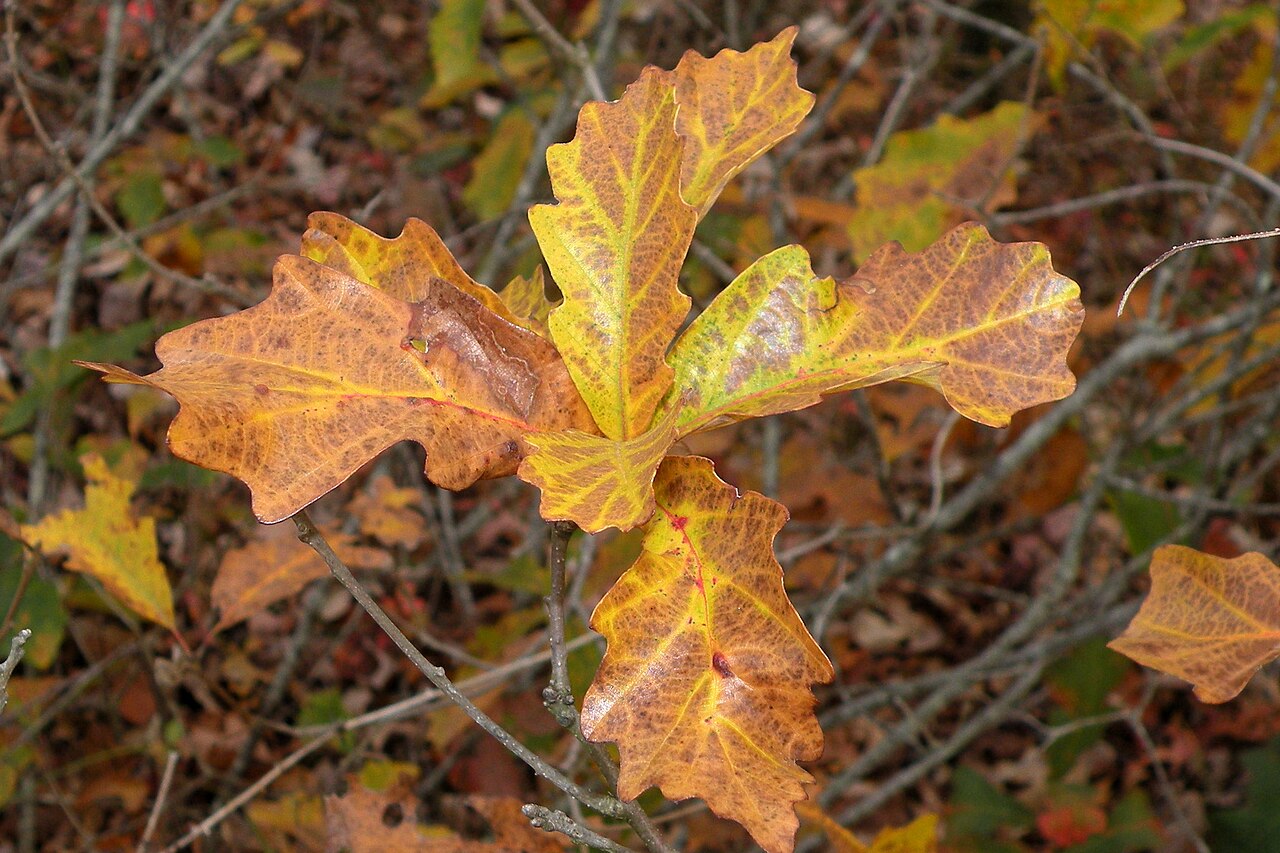
Leaves closely resemble those of Chinkapin Oak but are consistently smaller, typically 2 to 6 inches (5–15 cm) long, compared to 4 to 7 inches (10–18 cm) for Chinkapin Oak. They are oblong to obovate with shallow, rounded to slightly pointed teeth along the margin, dull to glossy green above, and paler, often finely fuzzy beneath. Fall color trends toward yellow-bronze to reddish-brown.
Flowers
Like all oaks, Dwarf Chinkapin Oak is wind-pollinated. Male flowers hang in slender, drooping yellow-green catkins in spring as the leaves emerge; female flowers are small and inconspicuous, found at the base of new growth, and develop into acorns the same season.
Acorns
Acorns are ½ to 1 inch (15–25 mm) long, with a bowl-shaped cup enclosing roughly half the nut, maturing in a single season as is typical for white oaks. The kernels are notably sweet with low tannin content compared to red oak acorns, making them palatable to wildlife — and historically to people — with little or no leaching required.
Quick Facts
| Scientific Name | Quercus prinoides |
| Family | Fagaceae (Beech/Oak) |
| Plant Type | Deciduous shrub / small clonal tree |
| Mature Height | 4–6 ft (occasionally to 20 ft on rich sites) |
| Mature Spread | 4–6 ft, spreading further over time via rhizomes |
| Growth Rate | Slow |
| Sun Exposure | Full Sun to Part Shade |
| Water Needs | Low to Moderate |
| Soil Type | Dry, sandy, or rocky; well-drained |
| Soil pH | Acidic preferred (unlike the calcareous-soil-loving Chinkapin Oak) |
| Bloom Time | April–May |
| Flower Color | Yellow-green |
| Fall Color | Yellow-bronze to reddish-brown |
| Fruit | Sweet acorn, ½–1 in, maturing in one season |
| Deer Resistant | No (browsed and acorns heavily eaten) |
| USDA Hardiness Zones | 4–8 |
Native Range
Dwarf Chinkapin Oak has one of the more unusual distribution patterns among eastern North American trees: a genuinely disjunct range that is fairly common in two separate regions — New England and the Appalachian Mountains in the east, and the eastern fringe of the Great Plains in the west — while remaining notably rare through much of the Ohio Valley that lies between them. Its overall range runs from eastern Nebraska south to Oklahoma, with an outlying population in Louisiana, east to northern Alabama and Georgia, and northeast to New Hampshire, reaching into southern Ontario in Canada.
Within this range, the species is a specialist of poor, dry sites: sandy or rocky, often acidic soils where competition from larger trees is limited. It is frequently found on sand prairies, dry upland woods, rocky ridgetops, and barrens — including the unusual serpentine barrens of southeastern Pennsylvania, where thin, mineral-stressed soils favor exactly the kind of tough, small-statured shrub that Dwarf Chinkapin Oak is built to be.
Because it tolerates dry, infertile, disturbed, or marginal sites that many other native trees cannot, Dwarf Chinkapin Oak has seen some use in reclamation plantings on poor soils within its native range. It has not become a widely planted ornamental outside that range, and gardeners outside its native states should look to regionally native shrubby oaks or other low-growing mast producers instead.
📋 Regional plant lists featuring Dwarf Chinkapin Oak: New Hampshire, Maine & Vermont, Connecticut, Massachusetts & Rhode Island, New York, Pennsylvania & Northern New Jersey, Delaware, Southern New Jersey & Long Island, Maryland, Virginia & West Virginia, North Carolina & South Carolina, Georgia, Alabama & Mississippi, Arkansas, Louisiana, Eastern Oklahoma & Eastern Texas, Kentucky & Tennessee, Ohio & Indiana, Illinois, Iowa & Missouri, Nebraska, Kansas & Eastern Colorado
Growing & Care Guide
Dwarf Chinkapin Oak is a low-maintenance, forgiving native shrub once planted in a reasonably well-drained spot — its entire evolutionary strategy is built around thriving where richer, moister soils aren’t available.
Light
Full sun produces the densest, most compact, and most fruitful plants. It also tolerates part shade, especially at the edge of open woodland, though flowering and acorn production decline as shade increases.
Soil & Water
This species is purpose-built for dry, sandy, or rocky, acidic soils of low to moderate fertility — exactly the conditions that frustrate many other landscape shrubs. It does not need supplemental irrigation once established and should be planted in well-drained soil; unlike the closely related Chinkapin Oak, which favors calcareous (limy) sites, Dwarf Chinkapin Oak generally prefers acidic conditions.
Planting Tips
Plant container-grown stock in fall or early spring. Because the species is clonal and slow-spreading, give it room — 6 to 10 feet of space, or more if you want to let a thicket form naturally — rather than crowding it as a single specimen shrub. It transplants best while young; established oaks of any kind resent root disturbance.
Pruning & Maintenance
Minimal pruning is needed. Remove dead or damaged stems as part of general upkeep; if a tidier, more tree-like single-stem form is wanted, selectively remove excess rhizome sprouts, understanding that the plant’s natural tendency toward thicket formation will continue.
Propagation
Propagate from fresh, cleaned acorns planted in fall or cold-stratified and planted in spring, following typical white-oak acorn protocol — acorns should not be allowed to dry out before sowing. Because the species spreads clonally by rhizomes, established colonies can sometimes be divided, though acorn propagation is the more reliable method for establishing new plantings.
Landscape Uses
- Dry, sandy, or rocky difficult sites where larger trees and typical shrubs struggle
- Wildlife hedgerows that deliver oak-quality mast in a compact footprint
- Native foundation or screen plantings on acidic, low-fertility soils
- Restoration and reclamation plantings on disturbed, poor-soil sites within its native range
- Naturalized thickets in meadow or barrens-style native gardens
Wildlife & Ecological Value
For its small size, Dwarf Chinkapin Oak punches well above its weight ecologically. Because it begins bearing acorns earlier and at a smaller stature than almost any other native oak, it delivers mast production to a landscape years, even decades, faster than planting a full-sized oak tree.
For Birds & Mammals
Its sweet, low-tannin acorns are readily eaten by white-tailed deer, wild turkeys, gray and fox squirrels, chipmunks, and white-footed mice, all of which rely on acorn mast as a major seasonal food source. The dense, thicket-forming growth habit also provides excellent low cover and nesting habitat for ground-nesting and shrub-nesting birds.
For Pollinators & Insects
Like other oaks, Dwarf Chinkapin Oak hosts a wide range of native caterpillar species — oaks as a genus support more Lepidoptera species than almost any other North American plant genus — making even a modest planting valuable for songbirds that rear their young on insect protein.
Ecosystem Role
In dry, fire-adapted upland communities and barrens, Dwarf Chinkapin Oak’s resprouting, rhizomatous habit allows it to persist through periodic fire, a disturbance regime that historically shaped much of its native sandy and rocky habitat. This resilience helps stabilize soil and maintain woody structure on sites too harsh for many other trees.
Cultural & Historical Uses
The sweet, low-tannin acorns of Dwarf Chinkapin Oak were historically gathered and eaten by Indigenous peoples across its range, often requiring little or no leaching compared to the bitter, high-tannin acorns of red oaks — a practical advantage that made chinkapin-type oaks a valued food source. Early botanical and natural history accounts from the 18th and 19th centuries note the sweetness of the acorns as the species’ most distinctive practical trait.
German botanist Carl Ludwig Willdenow formally described the species in 1801, based on material shared by the Pennsylvania botanist Gotthilf Heinrich Ernst Muhlenberg; the epithet prinoides references its resemblance to chestnut oak (Quercus prinus). Because of its small size and limited wood volume, Dwarf Chinkapin Oak has never had significant commercial timber value, and it has largely remained a plant of ecological and botanical interest rather than economic importance.
In recent decades, interest in Dwarf Chinkapin Oak has grown among native plant gardeners and restoration ecologists specifically because of what made it commercially uninteresting: its compact size and tolerance of poor soils make it one of the few oaks genuinely suited to small properties and challenging sites.
Frequently Asked Questions
Is Dwarf Chinkapin Oak the same species as Chinkapin Oak?
No, though they are closely related and have sometimes been treated as varieties of one species. Chinkapin Oak (Quercus muehlenbergii) is a large canopy tree favoring calcareous soils, while Dwarf Chinkapin Oak is a much smaller, clonal shrub generally preferring acidic, sandy, or rocky sites — distinguished mainly by growth habit and habitat rather than dramatic differences in leaf shape.
How long before Dwarf Chinkapin Oak produces acorns?
It is known for bearing acorns at a notably young age and small size compared to most oaks, sometimes within just a few years of planting from a container-grown specimen, making it one of the fastest routes to real oak-based wildlife value in a home landscape.
Can Dwarf Chinkapin Oak handle poor, dry soil?
Yes — this is exactly the habitat it is adapted to in the wild. It thrives on dry, sandy, or rocky, often acidic sites where many other native shrubs and trees struggle, making it one of the better native options for difficult, low-fertility ground.
Does Dwarf Chinkapin Oak stay small, or will it eventually grow into a full tree?
It typically remains a 4-to-6-foot clonal shrub, though on unusually rich sites it can occasionally reach taller, more tree-like proportions. Even then, it remains distinctly smaller than full-sized oaks like Chinkapin Oak or White Oak.
Will it spread aggressively in my garden?
It spreads slowly by underground rhizomes to form a gradually expanding thicket rather than aggressively colonizing an area. Gardeners who prefer a single, contained shrub can remove extra sprouts as they appear.

Looking for a nursery that carries Dwarf Chinkapin Oak?
Browse our native plant nursery directory: AL · CT, DE, GA · IL, IN, IA, KS · KY, LA, MD, MA, MO · NE, NH, NJ, NY, NC, OH, OK · PA, RI, SC, TN, VT, VA · WV