
Early Blue Cohosh (Caulophyllum giganteum)
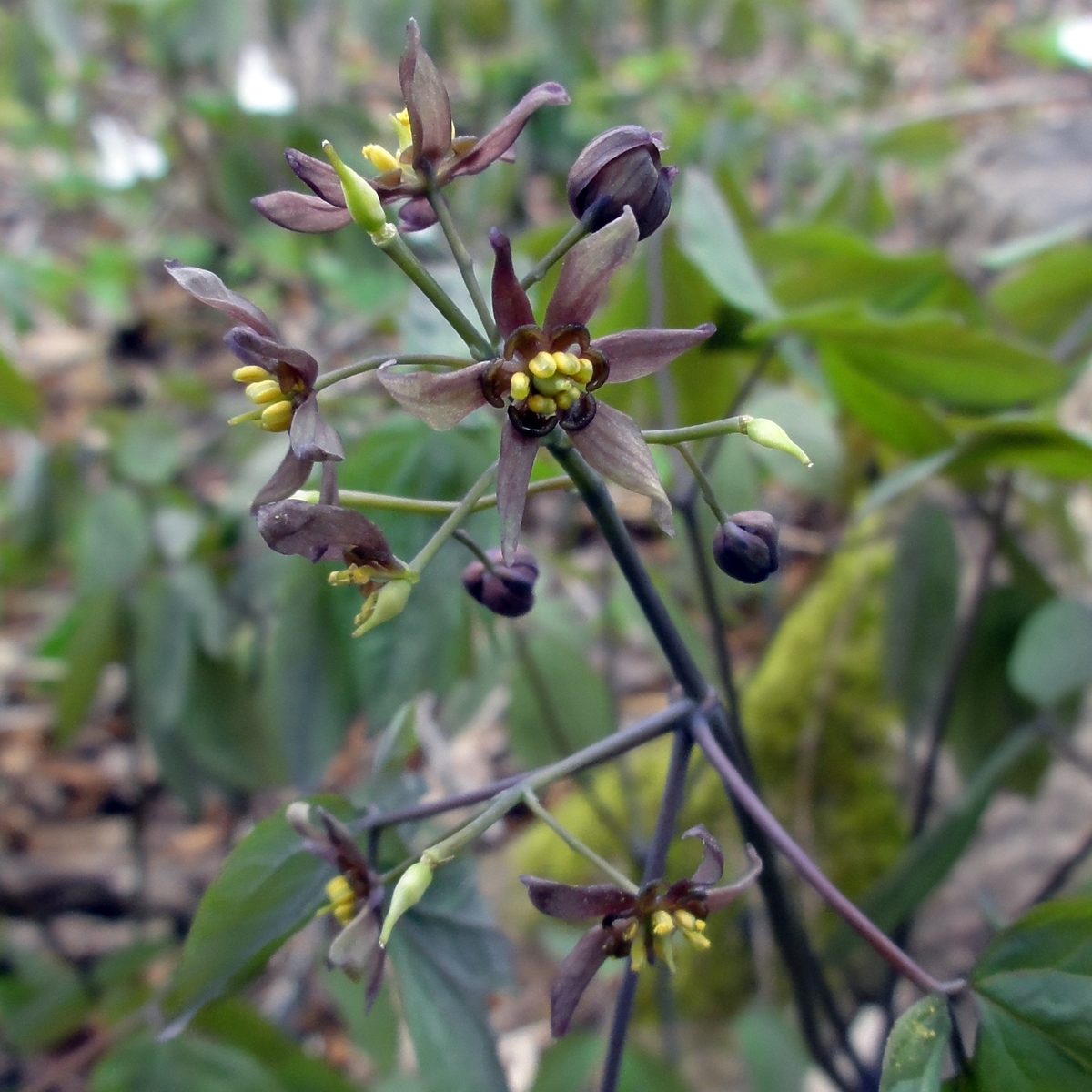
Caulophyllum giganteum, known as Early Blue Cohosh or giant blue cohosh, is a spring woodland perennial in the barberry family (Berberidaceae). It is the earlier-blooming, darker-flowered sister species of the better-known blue cohosh (Caulophyllum thalictroides). In April and early May its purplish stems push up through the leaf litter, and clusters of dark purple to maroon flowers open while the leaves are still small and folded.
Each stem carries one large, compound leaf divided into many lobed leaflets, giving the plant a lacy, meadow-rue-like look, and grows 1 to 3 feet tall. By midsummer the flowers have turned into striking deep blue, berry-like seeds on short stalks.
Early blue cohosh grows in rich, moist hardwood forests of the northeastern United States, the Great Lakes region, the Appalachians and adjacent Canada. It was long treated as a variety of blue cohosh (C. thalictroides var. giganteum) but is now recognized as a separate species. All parts of the plant, especially the seeds and roots, are toxic.
Identification
Look for a smooth, purple-tinged stem with a single large, three-times-divided leaf and a cluster of dark purple flowers that opens very early, before the leaf has fully expanded.
Growth Habit
A clump-forming perennial with a thick, knotty rhizome. Each spring a single smooth stem rises 1 to 3 feet, at first purplish and covered with a waxy bloom. The plant dies back by late summer or fall.
Leaves
Each stem has one large compound leaf near the top, divided three times into many leaflets. The leaflets are 1 1/2 to 3 inches long, with two or three lobes near the tip, and are bluish green to purplish when they first unfold, becoming green. A smaller second leaf often sits just below the flower cluster.
Flowers
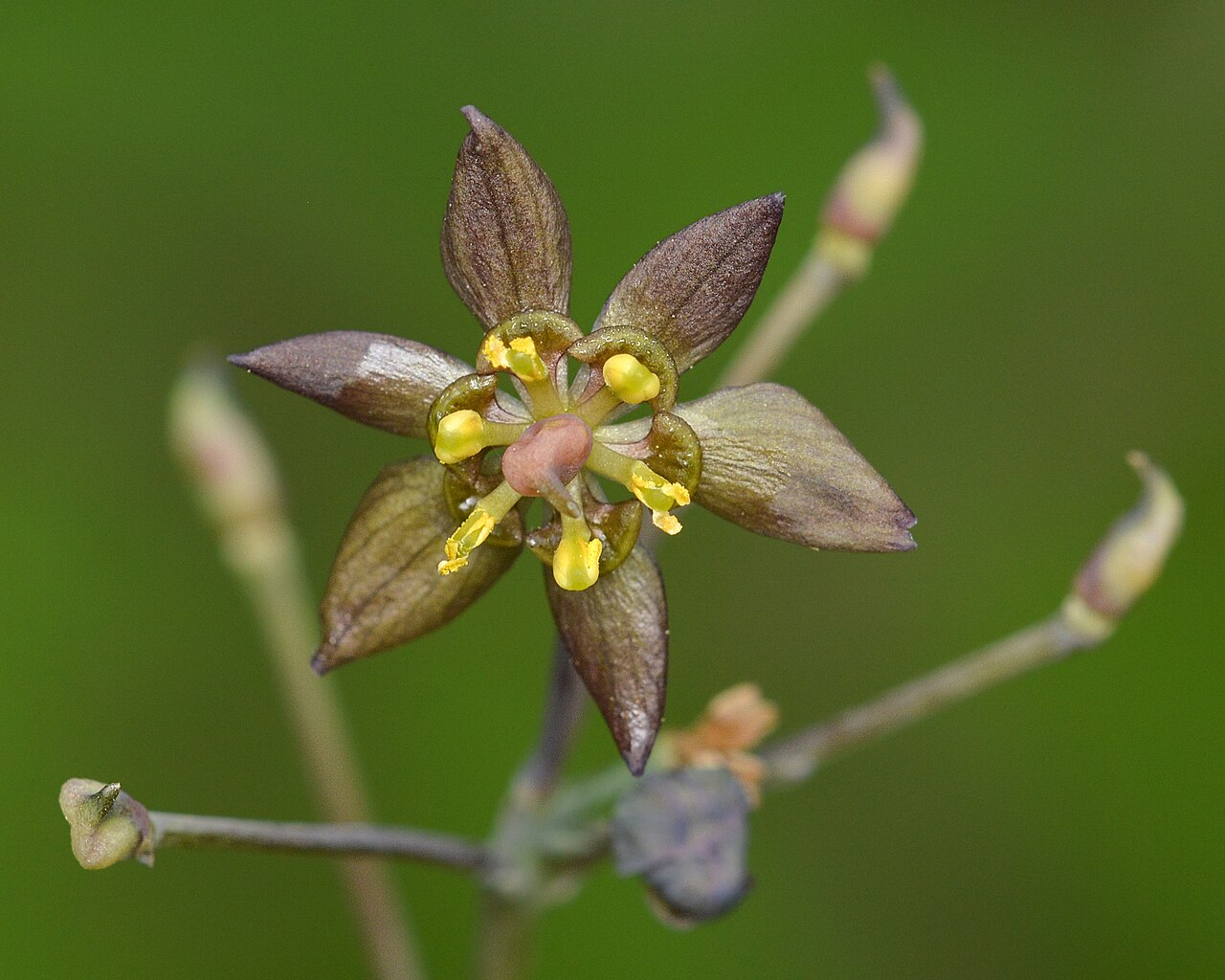
The flowers are carried in a branched cluster at the top of the stem in April and early May. They are about 1/2 inch across, with six pointed, dark purple to maroon or purple-brown sepals, six small, hood-shaped, gland-like petals and six yellow stamens. In early blue cohosh the flowers open while the leaf is still small and folded, and the flower clusters often have more flowers than those of blue cohosh.
Seeds
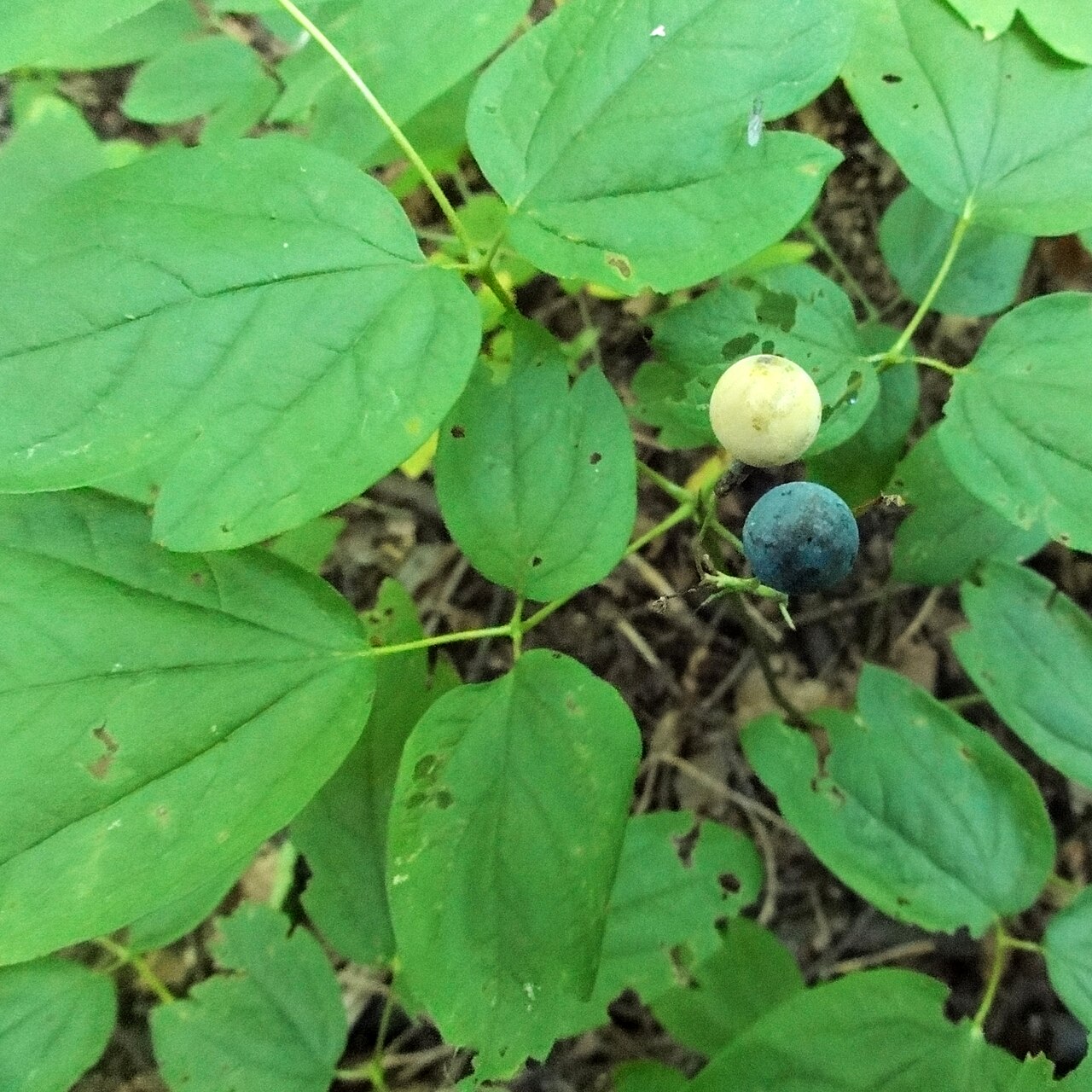
Soon after flowering, the thin ovary wall splits and falls away, and the one or two seeds grow uncovered on thickened stalks. By midsummer they are round, about 1/3 inch across, with a fleshy deep blue coat, looking like blueberries. They are poisonous.
Look-alikes
Blue cohosh (C. thalictroides) is very similar but has smaller, yellowish-green to greenish-purple flowers that open about two weeks later, after the leaf has largely expanded. Where both grow together, early blue cohosh is the one with dark purple flowers on stems that are still mostly leafless. Meadow-rues (Thalictrum) have similar leaflets, but their leaves are on long stalks and they lack the single-leaf stem and blue seeds.
Quick Facts
| Scientific Name | Caulophyllum giganteum |
| Family | Berberidaceae (barberry family) |
| Plant Type | Herbaceous woodland perennial |
| Mature Height | 1–3 ft |
| Mature Spread | 1–2 ft |
| Growth Rate | Slow |
| Sun Exposure | Part shade to full shade |
| Water Needs | Moderate; consistently moist soil |
| Soil Type | Rich, humus-rich, well-drained loam |
| Soil pH | Slightly acidic to neutral or limy (about 6.0–7.5) |
| Bloom Time | April–early May |
| Flower Color | Dark purple to maroon or purple-brown |
| Fall Color | Foliage yellows and dies back by late summer |
| Fruit | Exposed, deep blue, berry-like seeds; poisonous |
| Deer Resistant | Yes; toxic foliage is rarely browsed |
| USDA Hardiness Zones | 3–7 |
Native Range
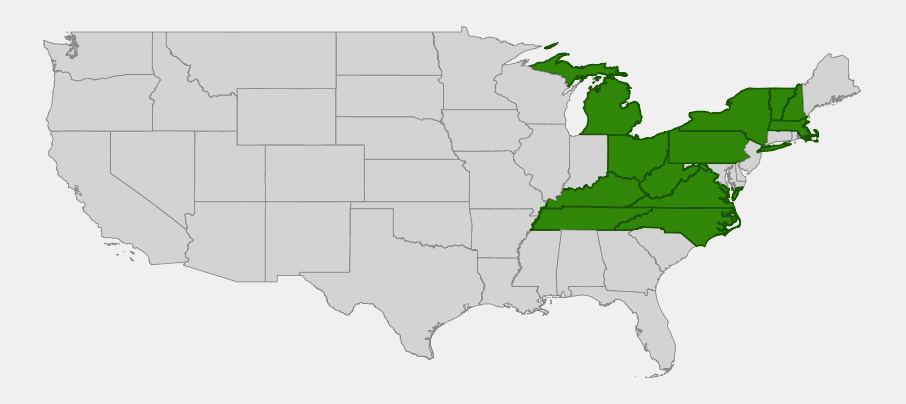
USDA PLANTS lists early blue cohosh as native in twelve states: Kentucky, Massachusetts, Michigan, North Carolina, New Hampshire, New York, Ohio, Pennsylvania, Tennessee, Virginia, Vermont and West Virginia, and in Ontario and Quebec in Canada. Because it was long lumped with blue cohosh, its distribution is still being mapped, and it has also been reported in some neighboring states.
Its range centers on the Northeast and the Great Lakes region, from New England and New York west through Pennsylvania, Ohio and Michigan, and south along the Appalachian Mountains through West Virginia, Virginia and Kentucky to the mountains of North Carolina and Tennessee.
It grows in rich, moist deciduous forests, especially on slopes, in ravines and coves and along stream terraces, often over limestone or other base-rich rock. Typical companions are sugar maple, basswood and beech, with a carpet of spring wildflowers beneath.
📋 Regional plant lists featuring Early Blue Cohosh: New York, Pennsylvania & Northern New Jersey · Ohio & Indiana · Michigan, Wisconsin & Eastern Minnesota · Kentucky & Tennessee · Connecticut, Massachusetts & Rhode Island · New Hampshire, Maine & Vermont · Maryland, Virginia & West Virginia · Delaware, Southern New Jersey & Long Island · North & South Carolina
Growing & Care Guide
Early blue cohosh is a handsome, long-lived plant for a shady woodland garden, valued for its very early purple flowers, its lacy blue-green foliage and its blue summer seeds. It is slow to establish, so start with nursery-propagated plants and never dig plants from the wild.
Light
Part shade to full shade under deciduous trees. Spring sun before the canopy leafs out is ideal; summer shade keeps the foliage from scorching.
Soil & Water
Plant it in deep, rich, humus-filled soil that stays evenly moist but drains well. It tolerates slightly acidic to limy soils. Mulch with shredded leaves and water during dry spells, especially in its first years.
Planting Tips
Plant in early spring or fall, setting the rhizome about 1 inch deep. Place it among other spring ephemerals and ferns, where its purple stems and flowers show up against the bare forest floor. Mark the spot, as the plant disappears by late summer.
Pruning & Maintenance
Very little maintenance is needed. Leave fallen leaves in place as mulch. Do not disturb established clumps; they increase slowly and are long-lived.
Propagation
Grow it from fresh seed: clean off the blue coat with gloves and sow the seed outdoors in fall. Germination is slow and can take two winters, and seedlings take several years to bloom. Established garden clumps can be divided carefully in fall. Wear gloves when handling seeds and roots.
Landscape Uses
- Woodland gardens: early purple flowers and lacy foliage in shade
- Shade borders: with ferns and spring ephemerals
- Native habitat restoration: understory of rich northern hardwood forests
- Deer-resistant plantings: toxic foliage that deer avoid
- Season-long interest: spring flowers, summer blue seeds
Wildlife & Ecological Value
Early blue cohosh is one of the first plants to bloom in rich northern forests, when few other flowers are open.
For Pollinators
Its early flowers offer nectar and pollen to early-season insects, especially small native bees such as mining bees and sweat bees, flies and bumble bee queens out on cool spring days.
For Birds
Birds such as thrushes may eat the blue seeds, but the seed coat is thin and the hard seeds are toxic, so they are not a major food.
For Mammals
The foliage and seeds are toxic, and deer and other mammals generally leave the plant alone.
Ecosystem Role
As part of the spring wildflower layer of rich hardwood forests, it helps capture nutrients early in the season, before the tree canopy closes. Its long-lived rhizomes help stabilize soil on wooded slopes.
Cultural & Historical Uses
The genus name Caulophyllum means “stem-leaf,” because the single large leaf seems to grow directly from the stem. “Cohosh” is thought to come from an Algonquian word. The species name giganteum refers to its larger flowers and plants compared with blue cohosh. It was first described in 1918 as a variety of blue cohosh and was raised to species rank in 1985, based on its earlier flowering, darker color and larger flowers.
Blue cohosh roots were used by several Indigenous peoples and later by herbal practitioners, especially to induce or ease childbirth. Modern research has found that the roots contain alkaloids and saponins that can be harmful, and use of blue cohosh during pregnancy has been linked to serious health problems in newborns.
Safety note: All parts of early blue cohosh are toxic. The bright blue seeds look like blueberries and can poison children who eat them, and the roots and foliage can irritate skin and mucous membranes. Do not eat any part of the plant or use it as a home remedy, wear gloves when handling seeds and roots, and keep children and pets away from the seeds.
Frequently Asked Questions
What is the difference between early blue cohosh and blue cohosh?
Early blue cohosh blooms about two weeks earlier, has larger, dark purple to maroon flowers that open before the leaf expands, and usually has more flowers per cluster. Blue cohosh has smaller yellowish-green to greenish-purple flowers that open after the leaf has unfolded.
Is early blue cohosh poisonous?
Yes. All parts are toxic, especially the blue seeds and the roots. Never eat the seeds, which look like blueberries, and do not use the plant medicinally.
Where does early blue cohosh grow?
In rich, moist hardwood forests of the northeastern United States, the Great Lakes region and the Appalachians south to North Carolina and Tennessee, and in Ontario and Quebec.
Can I grow early blue cohosh in my garden?
Yes, in moist, rich shade. It is slow to establish but long-lived. Buy nursery-propagated plants or grow it from seed, and never dig it from the wild.
When does early blue cohosh bloom?
In April and early May, often while the stems are still purplish and the leaves are only partly open.

Looking for a nursery that carries Early Blue Cohosh?
Browse our native plant nursery directory: Kentucky, Massachusetts & Michigan · New Hampshire, New York, North Carolina & Ohio · Pennsylvania, Tennessee, Vermont & Virginia · West Virginia