
Fendler’s Pennycress (Noccaea fendleri)
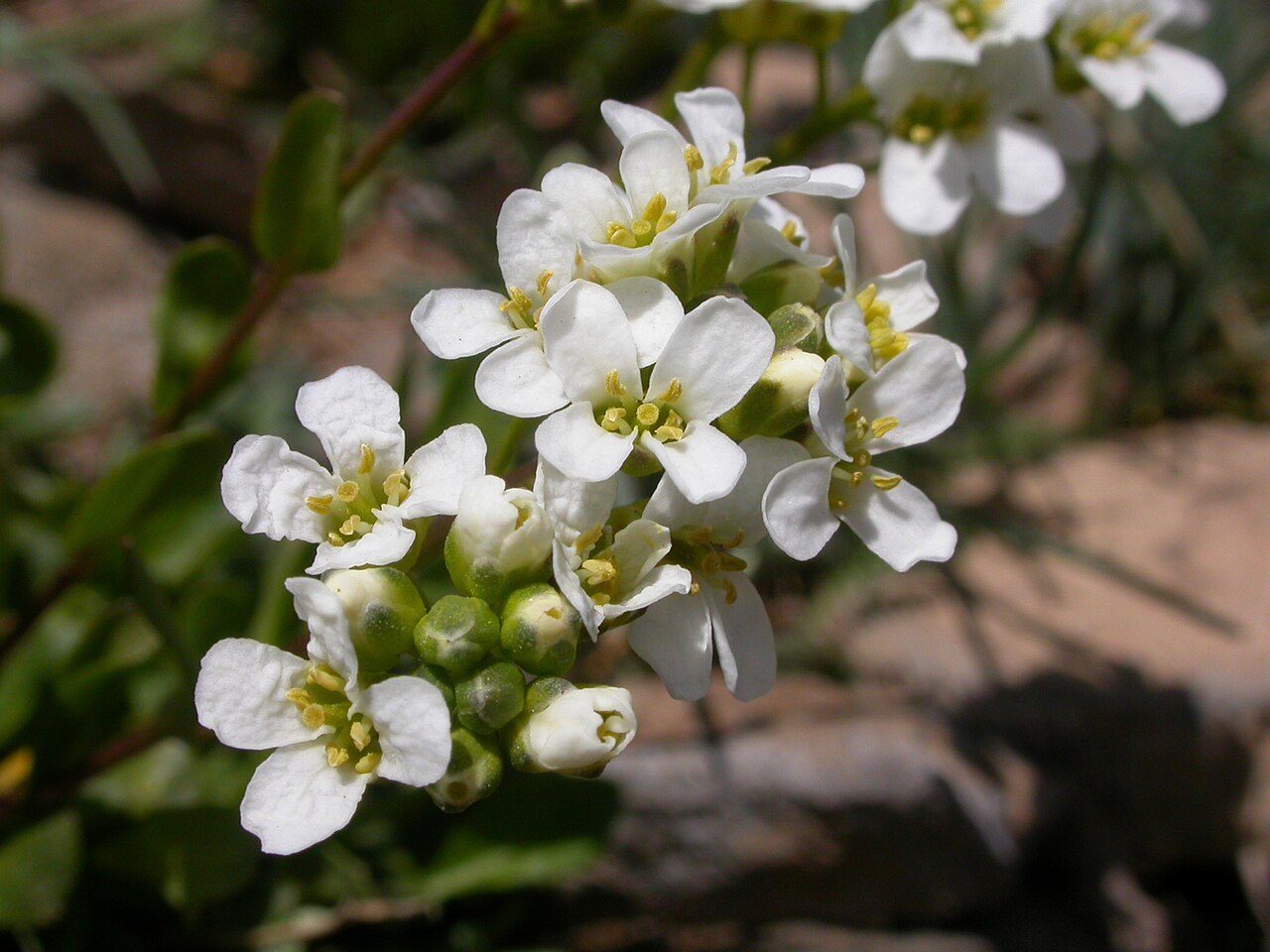
Noccaea fendleri, known as Fendler’s Pennycress, alpine pennycress, mountain pennycress or wild candytuft, is a small native wildflower of the mustard family (Brassicaceae) found throughout the mountains of the western United States. Many field guides list it under older names: Thlaspi fendleri, Thlaspi montanum or Noccaea montana.
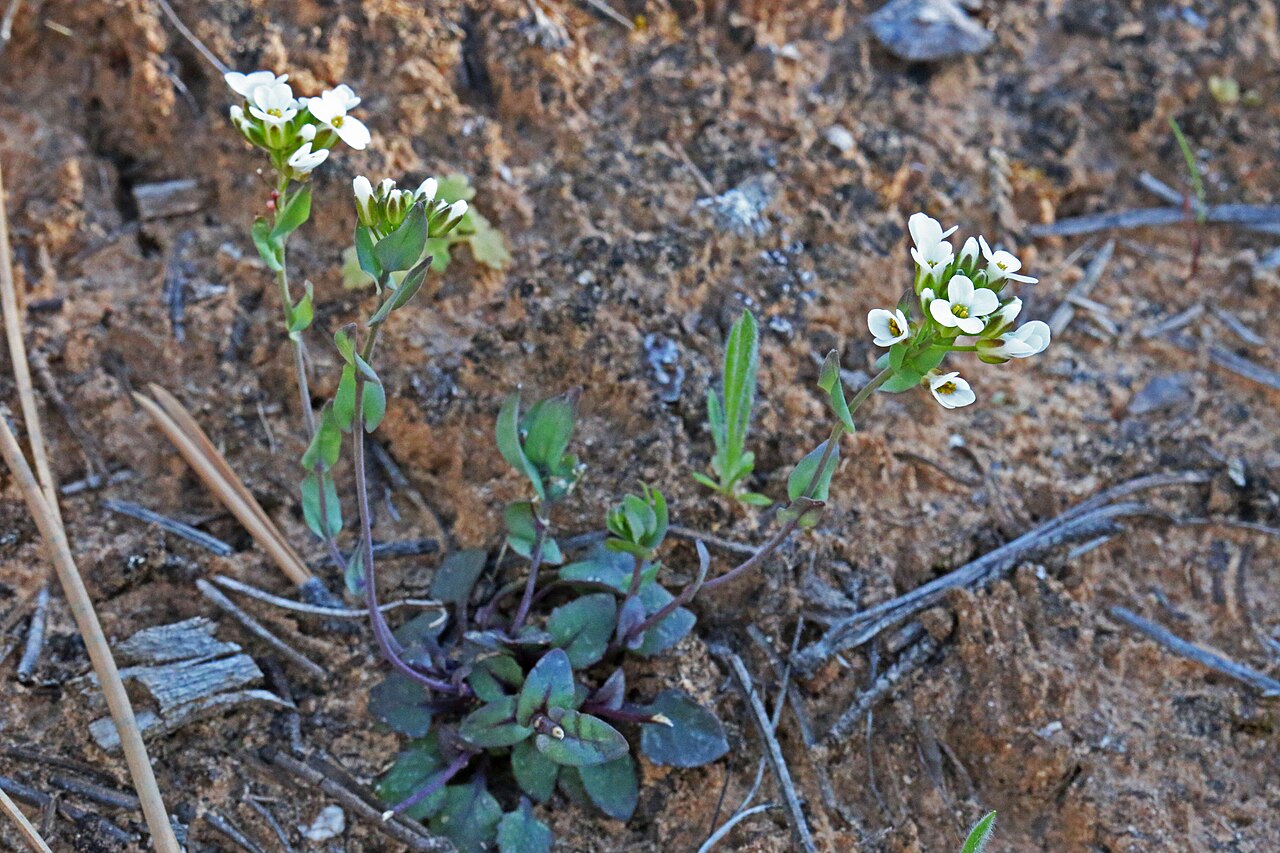
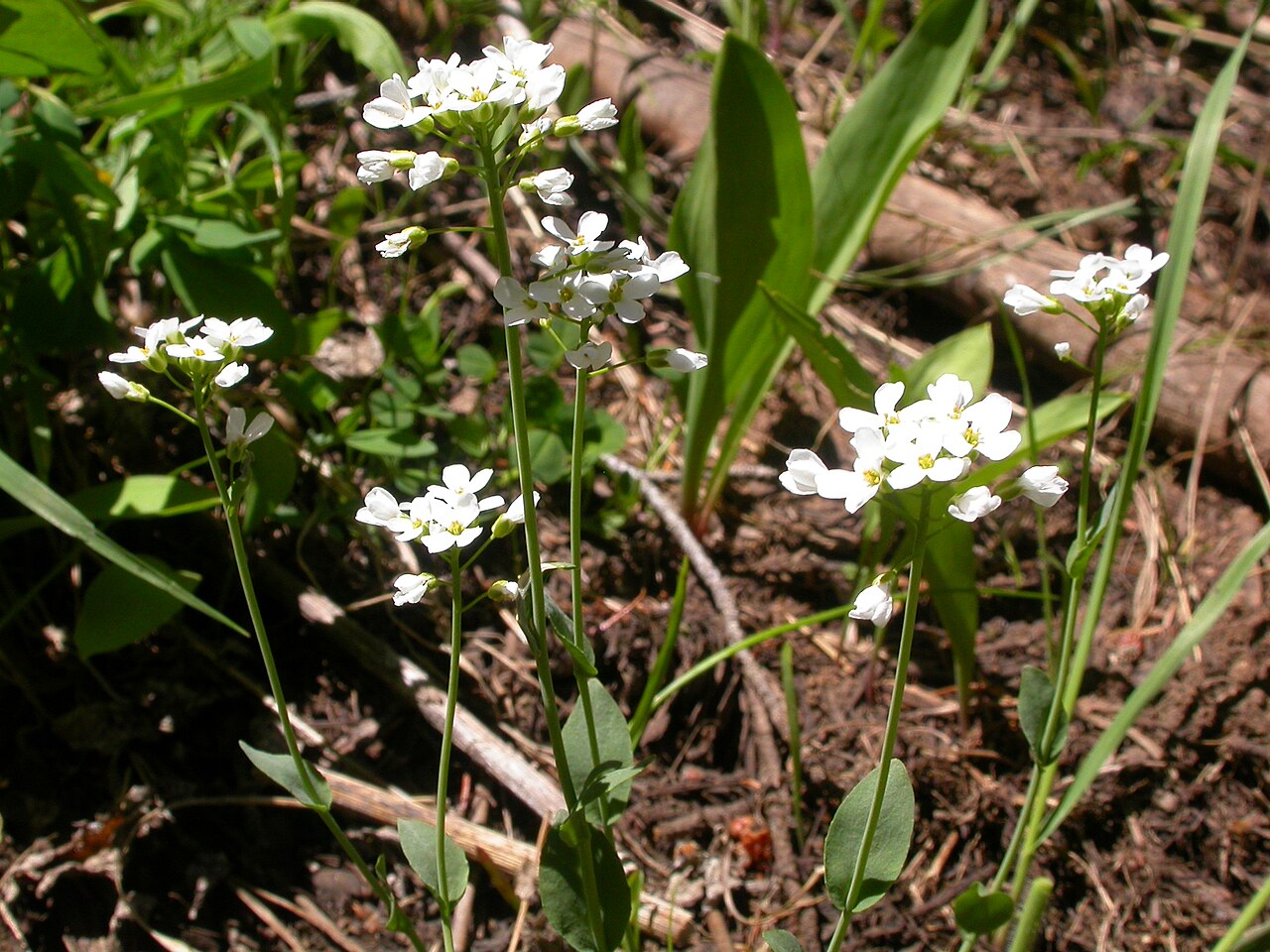
It is one of the first wildflowers to bloom after snowmelt. From a low rosette of smooth, often bluish or purple-tinged leaves, it sends up short stems topped with dense clusters of small, four-petaled white flowers, sometimes tinged pink or lavender. Most plants are only 2 to 12 inches tall, and the flower clusters stretch out as the flat, heart- or wedge-shaped seed pods develop.
Fendler’s pennycress grows from sagebrush foothills and pinyon-juniper woodland to ponderosa pine and aspen forests and alpine slopes, often on rocky or gravelly soil. One widespread form is famous among scientists for its ability to absorb large amounts of nickel from serpentine soils. In gardens it makes a tough, early-blooming plant for rock gardens and native meadows in the West.
Identification
Look for a low, hairless plant with a rosette of smooth, often bluish leaves and short stems of tiny, white, four-petaled flowers in early spring, often near melting snow.
Growth Habit
Fendler’s pennycress is a short-lived perennial that grows from a slender taproot and a branched woody base, often forming small clumps of rosettes. One to several flowering stems rise from each rosette, usually 2 to 12 inches tall, occasionally up to about 18 inches. The whole plant is hairless and often has a waxy, bluish (glaucous) coating.
Leaves
Most leaves are in the basal rosette. They are small, about 1/4 to 1 1/4 inches long, on slender stalks, and variable in shape: spoon-shaped, oval, oblong or narrow. Their edges are smooth or have a few small teeth, and they are dark green to bluish and often tinged purple. The stem leaves are smaller, alternate, and clasp the stem with small, ear-like lobes at the base.
Flowers
Flowers appear from about March at low elevations to August in the high mountains, usually soon after snowmelt. They are borne in a dense, rounded cluster (raceme) at the stem tip that lengthens as it matures. Each flower is about 1/4 to 1/2 inch across, with four white petals (sometimes tinged pink or purple) arranged in a cross, typical of the mustard family, and six yellow-tipped stamens.
Fruit & Seeds
The fruit is a small, flat pod (silicle), about 1/4 to 1/2 inch long, wedge-shaped, heart-shaped or oval, often with a small notch at the tip and a short style. Each pod holds about 2 to 6 small brown seeds. Pods ripen in early to mid summer and split open to release the seeds.
Look-alikes
Field pennycress (Thlaspi arvense) is an introduced annual weed of fields and roadsides with larger, round, broadly winged pods and a garlicky smell when crushed; it lacks the perennial rosette. Whitlow-grasses (Draba) are often hairy and have yellow or white flowers and elongated pods. Rockcresses (Boechera) have long, narrow pods rather than short, flat ones. Fendler’s pennycress combines a smooth, bluish rosette, clasping stem leaves and short, flat, wedge-shaped pods.
Safety Notes
Fendler’s pennycress is not known to be toxic, but plants on serpentine soils can contain very high levels of nickel, so they should not be eaten or used as food for livestock or pets.
Quick Facts
| Scientific Name | Noccaea fendleri (syn. Thlaspi montanum) |
| Family | Brassicaceae (mustard family) |
| Plant Type | Short-lived herbaceous perennial |
| Mature Height | 2–12 in (rarely to 18 in) |
| Mature Spread | 3–8 in |
| Growth Rate | Moderate |
| Sun Exposure | Full sun to partial shade |
| Water Needs | Low to moderate; moist in spring, dry later |
| Soil Type | Rocky, gravelly or sandy; well drained; including serpentine |
| Soil pH | About 6.0–8.0 |
| Bloom Time | March–August (soon after snowmelt) |
| Flower Color | White, sometimes tinged pink or lavender |
| Fall Color | None notable; leaves often purplish |
| Fruit | Small flat pods (silicles) |
| Deer Resistant | Not well documented |
| USDA Hardiness Zones | 3–8 |
Native Range
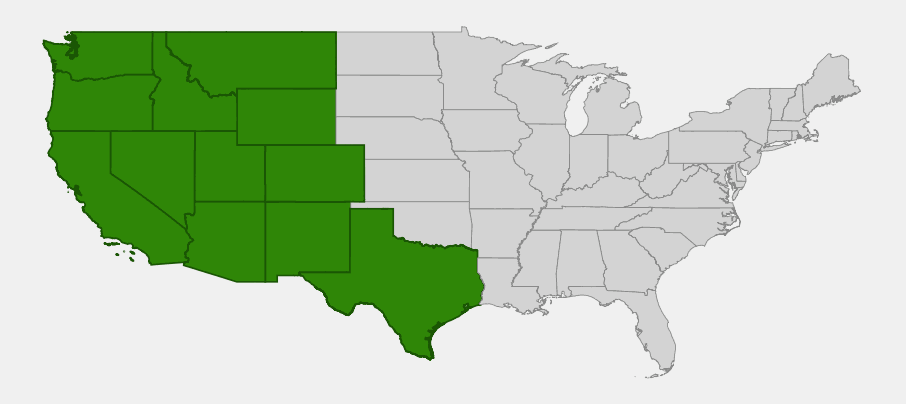
Fendler’s pennycress is native to western North America, from Washington and Montana south through the Rocky Mountains, Great Basin and Southwest to northern Mexico (Chihuahua, Coahuila and Sonora). USDA PLANTS lists it as native in Arizona, California, Colorado, Idaho, Montana, Nevada, New Mexico, Oregon, Texas, Utah, Washington and Wyoming.
The most widespread form, subsp. glauca, occurs across the Rocky Mountains, the Great Basin ranges and the Colorado Plateau, and east of the Cascades in Oregon and Washington. The typical subspecies, subsp. fendleri, grows in the mountains of Arizona, New Mexico and the Trans-Pecos of West Texas. Rare local forms are found on serpentine soils in southwestern Oregon (subsp. siskiyouensis) and in Humboldt County, California (subsp. californica), and in the high mountains of central Idaho (subsp. idahoensis).
Typical habitats are rocky slopes and outcrops, gravelly meadows, sagebrush and pinyon-juniper slopes, openings in ponderosa pine, Douglas-fir and aspen forests, subalpine meadows and alpine ridges, from about 1,000 feet to more than 13,000 feet. It favors loose, well-drained soil that is moist from snowmelt in spring.
📋 Regional plant lists featuring Fendler’s Pennycress: Idaho, Eastern Oregon & Eastern Washington · Western Oregon & Western Washington · Montana & Wyoming · Utah & Western Colorado · Arizona & New Mexico · California & Nevada · South & West Texas
Growing & Care Guide
Fendler’s pennycress is rarely sold as a plant, but native seed suppliers in the Rocky Mountain region sometimes offer it as wild candytuft. It is easy to grow from seed and suits rock gardens and dry meadows in cold-winter western climates.
Light
Grow it in full sun to partial shade. It blooms well in open sites and also tolerates the light shade of pine and aspen woods.
Soil & Water
It needs well-drained, rocky, gravelly or sandy soil and does poorly in heavy, wet clay. It likes spring moisture, as from snowmelt, and tolerates dry summers by going partly dormant after setting seed. Water seedlings until established, then water only during long dry spells in spring.
Planting Tips
Plant it in a rock garden, crevice garden, gravel bed or dry native meadow, where its early white flowers can be seen up close. Combine it with pasqueflowers, early buckwheats, penstemons and bunchgrasses. Several plants in a group make a better show than single plants.
Pruning & Maintenance
Little care is needed. Let the pods ripen so the plants can reseed, since individual plants are short-lived. Remove dead stems after seed drop if you want a tidier look. Do not fertilize.
Propagation
Sow seed outdoors in fall so it receives natural winter cold, or give it about 30 to 60 days of cold, moist stratification before spring sowing. Barely cover the seed. Seedlings often bloom in their second year. Once established, it maintains itself by self-sowing.
Landscape Uses
- Rock and crevice gardens: tiny, early white flowers above bluish rosettes
- Native meadows: early nectar in dry, rocky sites
- Butterfly gardens: spring nectar for early butterflies
- Mountain restoration: rocky slopes, forest openings and disturbed gravelly sites
- Serpentine and mine-site research: nickel-accumulating forms are studied for cleaning metal-rich soils
Wildlife & Ecological Value
Fendler’s pennycress is a small plant, but its early flowers feed insects at a time when little else is blooming in the mountains.
For Pollinators
The flowers offer nectar and pollen to small native bees, flies and early butterflies soon after snowmelt. Native mustards in general are larval hosts for white and orangetip butterflies, which lay eggs on the flower stems and young pods.
For Birds
Seed-eating birds such as finches and sparrows may eat the small seeds, and insects on the plants provide food for nesting songbirds in spring.
For Mammals
Small mammals such as ground squirrels and pikas may graze the plants and seeds. Nickel-rich plants on serpentine are less likely to be eaten.
Ecosystem Role
As an early-blooming pioneer of rocky, gravelly soils, Fendler’s pennycress helps cover bare ground. Its nickel-accumulating forms are thought to defend themselves against plant-eating insects and pathogens by storing metal in their tissues, and they have made the species important in research on how plants tolerate and absorb heavy metals.
Cultural & Historical Uses
Asa Gray described the plant as Thlaspi fendleri in 1853, naming it for Augustus Fendler, a German-born plant collector who gathered specimens around Santa Fe, New Mexico, in the 1840s. For many years North American plants were also lumped with a European species under the names Thlaspi montanum and Noccaea montana.
In 1998 the Czech botanist Josef Holub moved it to the genus Noccaea, and current floras now treat the North American plants as their own species, Noccaea fendleri, with five subspecies. The genus name honors Domenico Nocca, an Italian botanist of the late 1700s and early 1800s.
The name “pennycress” refers to the flat, round to wedge-shaped pods of the related field pennycress, which resemble coins. The name “wild candytuft” compares its clustered white flowers to the garden candytufts (Iberis), a related group in the mustard family.
Frequently Asked Questions
Is Fendler’s pennycress the same as alpine pennycress or wild candytuft?
Yes. It is known by all three names, and also as mountain pennycress. Older books call it Thlaspi montanum or Thlaspi fendleri.
Is Fendler’s pennycress a weed?
No. It is a native perennial wildflower of western mountains. The weedy pennycress of fields and roadsides is field pennycress (Thlaspi arvense), an introduced annual.
When does Fendler’s pennycress bloom?
It blooms soon after snowmelt, from about March at low elevations to as late as August in the high mountains.
Why is Fendler’s pennycress interesting to scientists?
Some forms growing on serpentine soils absorb and store large amounts of nickel in their leaves, flowers and even nectar, making it a model plant for studying heavy-metal tolerance.
Where does Fendler’s pennycress grow?
It grows on rocky slopes, meadows and forest openings across the western United States, from Washington and Montana to Arizona, New Mexico and West Texas, and in northern Mexico.

Looking for a nursery that carries Fendler’s Pennycress?
Browse our native plant nursery directory: Arizona · California · Colorado · Idaho · Montana · Nevada & New Mexico · Oregon · Texas & Utah · Washington · Wyoming

