
Florida Privet (Forestiera segregata)
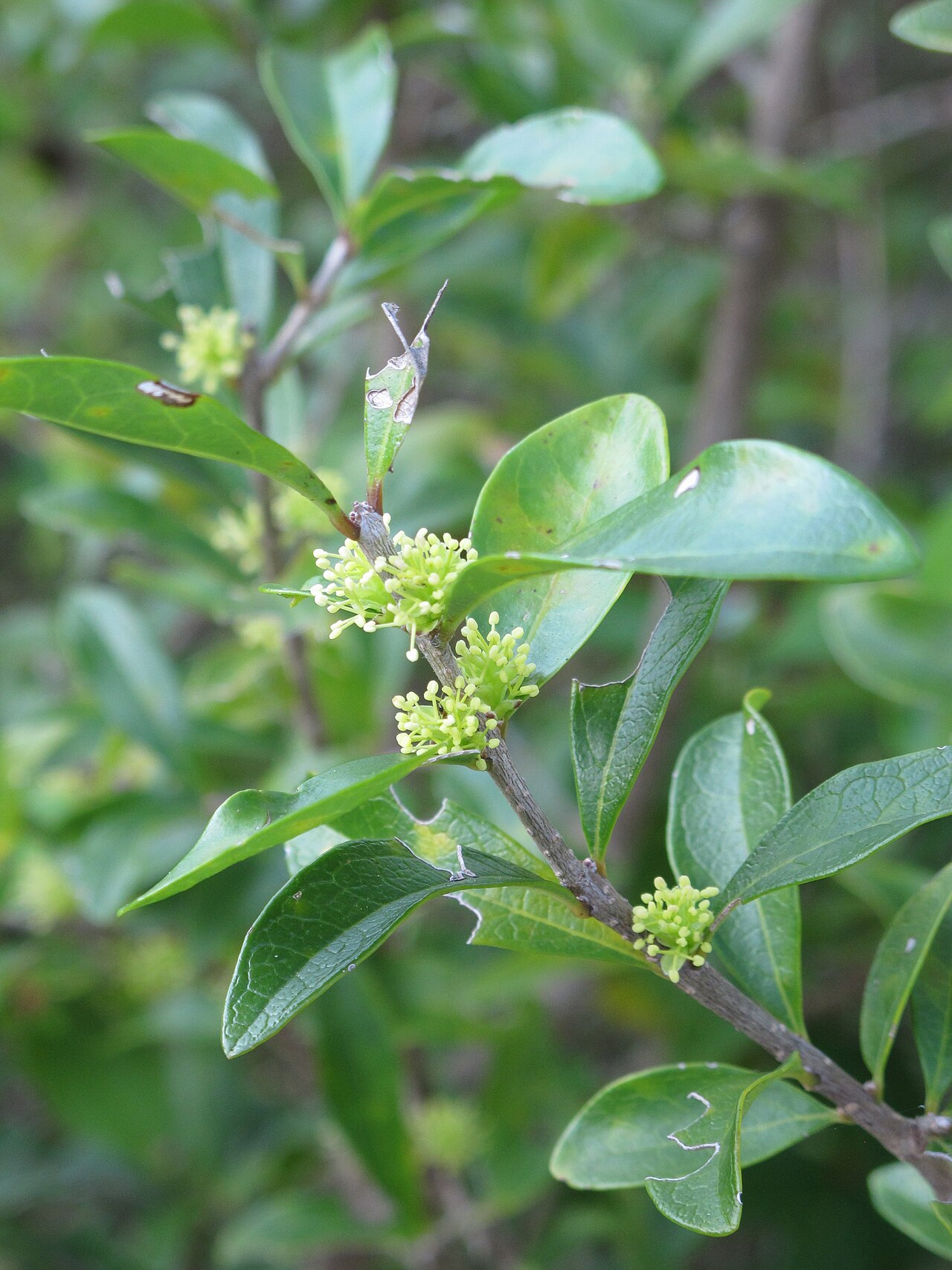
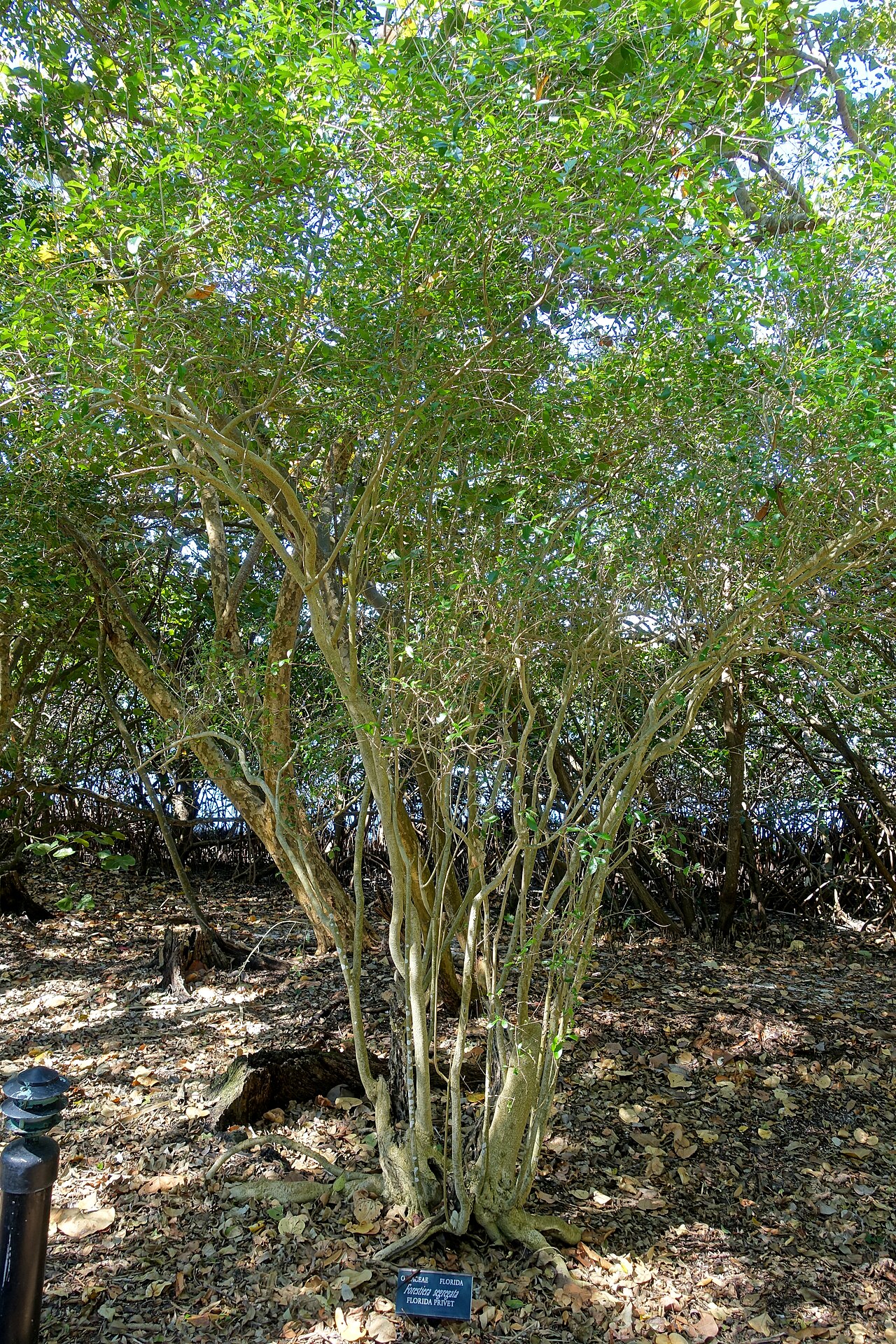
Forestiera segregata, known as Florida Privet or Florida swampprivet, is one of the most useful evergreen shrubs native to coastal Florida. It makes a dense, fine-textured, multi-stemmed shrub six to fifteen feet tall, with small glossy leaves, pale gray bark and, on female plants, heavy crops of dark blue-purple fruit that birds strip within days. In spite of the name it is not related to the invasive Asian privets of the genus Ligustrum; it only resembles them, and it belongs with olives and ashes in the family Oleaceae.
Gardeners value it for three things: it shears beautifully into a formal hedge, it tolerates salt spray and drought once established, and it feeds birds. In south Florida it has become the standard native alternative to clipped exotic hedges, and it is equally at home as a loose informal screen or, with the lower branches removed, as a small multi-trunked tree.
The species is native to Florida, the coastal plain of Georgia and South Carolina, Puerto Rico and the U.S. Virgin Islands, where it is called ink-bush, and it extends through the Bahamas and the Greater Antilles. This guide covers how to identify it, where it grows, how to use and maintain it in a landscape, and what it supports in the way of wildlife.
Identification
Florida privet is easy to pick out among native coastal shrubs by its opposite, small, glossy, untoothed leaves, its pale warty twigs, and its habit of flowering on bare or nearly bare wood in late winter. It is dioecious, so male and female flowers are on different plants, and only the females carry fruit.
Bark & Stems
The plant usually grows as a many-stemmed shrub with arching branches and a dense interior, though old specimens form small trees with several sinewy trunks. Bark is smooth and pale gray to tan, often speckled with lighter lenticels, and it stays attractive with age; limbing up an old plant reveals a genuinely handsome frame. Twigs are slender, gray and opposite, with small raised warty lenticels and occasional short spur shoots. There are no thorns.
Leaves
Leaves are opposite, simple, leathery and evergreen to nearly so, dropping briefly in cold or drought. They are oval to spoon-shaped or narrowly elliptic, three-quarters of an inch to about two and a half inches long, with a smooth untoothed margin, a blunt or rounded tip and a short stalk. The upper surface is glossy medium to dark green, the lower surface paler. The leaves are small enough that a sheared hedge keeps a fine, tidy texture rather than looking chopped.
Flowers
Florida privet is dioecious. Small yellow-green to cream flowers appear in tight clusters directly on the previous year’s twigs, usually from late winter into spring, mainly February and March, and often before the new leaves expand. Male flowers are the showier of the two, with conspicuous stamens that give the clusters a fuzzy look, and they are lightly fragrant. Female flowers are smaller and greener. The display is modest at a distance, but in bloom a large male plant hums with bees.
Fruit & Seeds
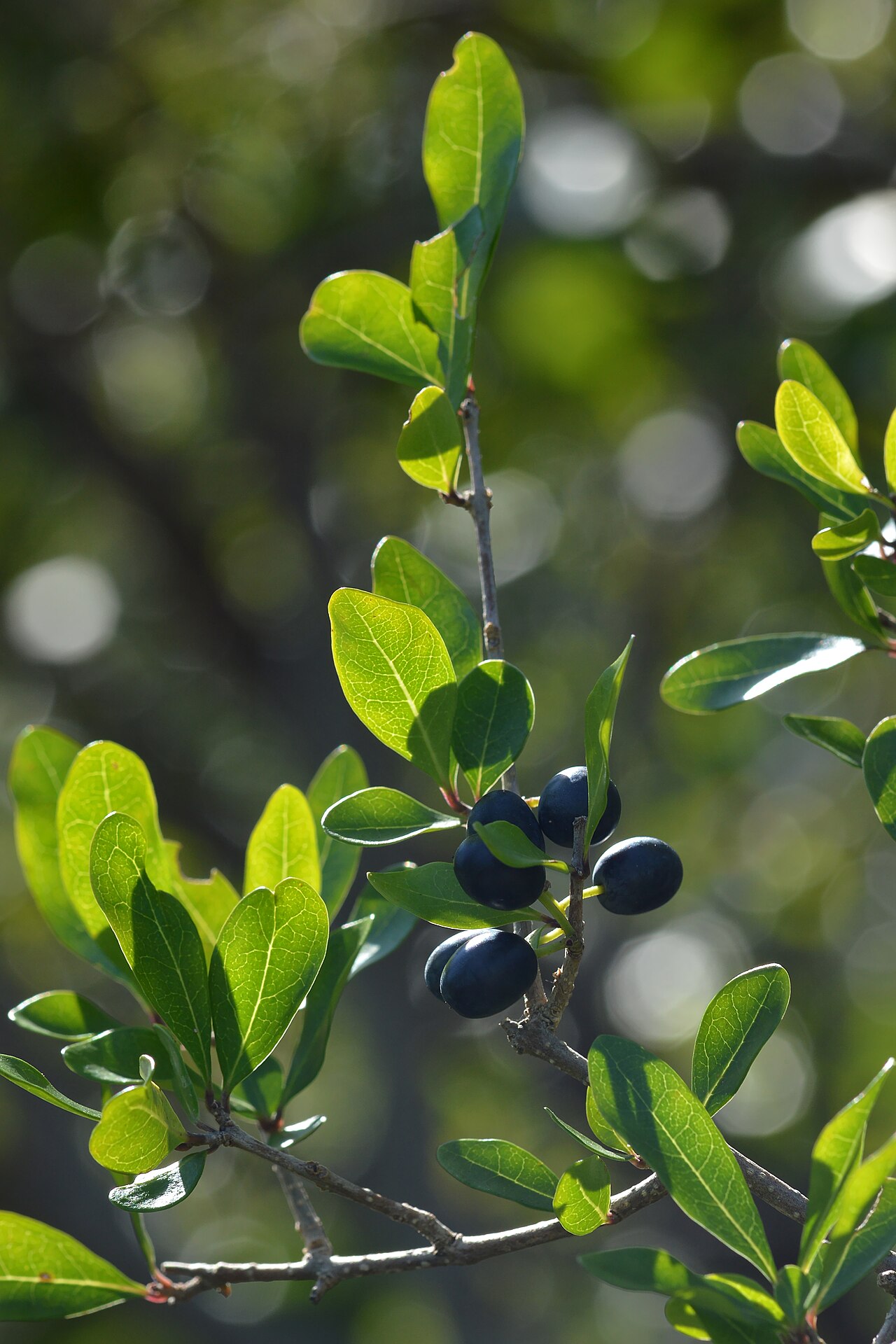
Female plants ripen crops of small drupes, about a quarter to a third of an inch long, egg-shaped, going from green through blue to deep purple-black with a slight bloom, typically from spring into summer. Each contains a single stone. Birds take them quickly, often clearing a shrub within a week or two of ripening. If you want fruit in your landscape you need at least one female plant, and a male somewhere nearby for pollination; nurseries do not always label the sex, so ask.
Quick Facts
| Scientific Name | Forestiera segregata (Jacq.) Krug & Urb. (USDA symbol FOSE) |
| Family | Oleaceae (olive family) |
| Plant Type | Evergreen to semi-evergreen shrub or small tree; dioecious |
| Mature Height | 6–15 ft (occasionally to about 25 ft as a tree) |
| Mature Spread | 6–12 ft |
| Growth Rate | Moderate to fast |
| Sun Exposure | Full sun to partial shade |
| Water Needs | Low to moderate; drought tolerant once established |
| Soil Type | Sand, shell, limestone or sandy loam; tolerates alkaline soil |
| Soil pH | About 6.0–8.5 |
| Bloom Time | Mainly February–March; sporadically at other seasons |
| Flower Color | Yellow-green to cream |
| Fall Color | None; evergreen to semi-evergreen |
| Fruit | Small blue to purple-black drupe on female plants, spring–summer |
| Deer Resistant | Moderately |
| USDA Hardiness Zones | 8b–11 |
Native Range
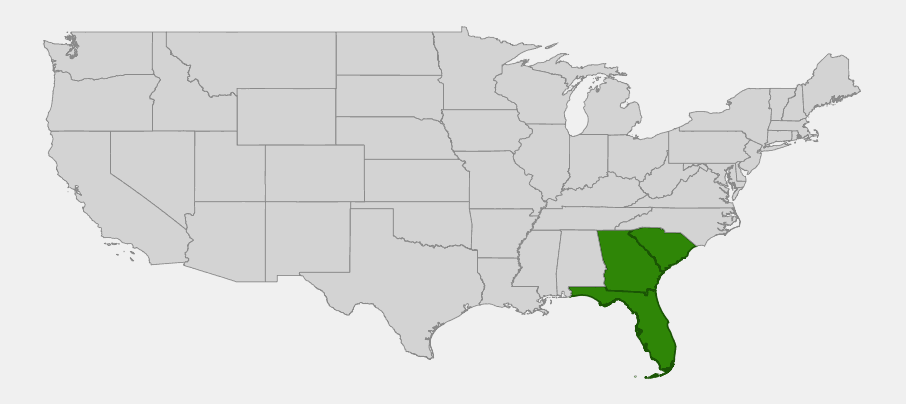
USDA PLANTS records Florida privet as native in the lower 48 states, Puerto Rico and the U.S. Virgin Islands. On the mainland it is a coastal plant of Florida, coastal Georgia and South Carolina, most abundant along and near the Florida coasts from the western Panhandle around the peninsula to the Keys. Beyond the United States it grows in Bermuda, the Bahamas and the Greater Antilles. The range map above shows the mainland states only, since Puerto Rico and the Virgin Islands are not drawn.
Its habitats are coastal and sub-coastal: maritime and tropical hammocks, coastal strand and the landward edge of dunes, shell middens, the upland margins of mangrove swamps and salt marshes, pine rockland and scrub edges, and the understory of coastal pine woods. It grows readily on limestone, shell and alkaline sand, which is one reason it succeeds in south Florida landscapes where many inland natives struggle. It takes salt spray well and tolerates brief soil salinity, though it is not a plant for standing salt water.
The common name invites confusion. Florida privet is unrelated to Chinese and Japanese privets (Ligustrum), which are invasive exotic shrubs in the Southeast, and planting Forestiera segregata is in fact one of the standard ways to replace them. It is also distinct from the deciduous Swamp Privet (Forestiera acuminata), a wetland shrub of river swamps across the interior Southeast.
📋 Regional plant lists featuring Florida Privet: North & South Florida · Alabama, Georgia & Mississippi · North & South Carolina
Growing & Care Guide
Florida privet is one of the easiest native shrubs to grow within its range. It establishes fast, tolerates poor alkaline soil, salt wind and drought, and responds to pruning better than almost any other Florida native. The main mistakes are planting it too far north, overwatering it in heavy soil, and expecting fruit from a male plant.
Light
Full sun gives the densest growth and the heaviest flowering and fruiting, and it is the right exposure for a hedge. The plant also grows well in partial shade, where it becomes more open and arching, which suits an informal understory planting under pines or oaks. Deep shade produces thin, leggy stems.
Soil & Water
Almost any well-drained soil works, including pure sand, shell, marl and limestone rubble, and the plant handles alkaline pH without chlorosis. It is not suited to soils that stay saturated. Water new plants regularly for the first few months; after that, established shrubs need irrigation only in extended drought. Fertilizer is rarely necessary, and heavy feeding simply produces growth you will have to prune.
Planting Tips
Plant any time of year in frost-free areas, though the start of the rainy season is ideal. For a sheared hedge, set plants about two and a half to three feet apart; for an informal screen, five to six feet. Buy at least one female plant if you want fruit, and plant a male within pollinating distance. In coastal plantings set it just behind the front line of sea oats and dune species, where it gets salt spray but not direct wave wash.
Pruning & Maintenance
This is the species’ great virtue. It takes repeated shearing, responds with dense twiggy growth, and resprouts readily from old wood, so a neglected plant can be cut back hard and rebuilt. Shear a formal hedge two or three times a year in the growing season. For a small tree, remove lower branches over a few seasons and let the pale trunks show. Pruning in late summer or fall removes the wood that would carry next spring’s flowers and fruit, so time your cuts according to whether you want berries or a crisp outline.
Propagation
Semi-hardwood cuttings taken in summer root well with standard rooting hormone and mist, and they are the usual nursery method because they let the grower control the sex of the plant. Seed also works: clean the pulp from ripe fruit, sow fresh in a well-drained mix, and expect irregular germination over several months. Seedlings cannot be sexed until they flower, which takes a few years.
Landscape Uses
- Native hedges and screens: the standard native replacement for clipped exotic privet and ficus hedges in Florida
- Coastal and seaside landscapes: tolerates salt spray, wind, alkaline sand and shell
- Bird gardens: female plants produce heavy crops of fruit that birds strip quickly
- Small multi-trunked specimen trees: attractive pale sinewy trunks when limbed up
- Buffer and understory plantings: grows well under pines and in hammock edges
- Hammock and coastal restoration: a fast-establishing native shrub layer on poor coastal soils
Wildlife & Ecological Value
An evergreen shrub that flowers in late winter and fruits in late spring fills two gaps in the coastal calendar: nectar when little else is open, and fruit before the main summer crop of berries arrives.
For Pollinators
The small, massed, lightly fragrant flowers draw honey bees, native bees, flies and small wasps in numbers. Because bloom comes in February and March, when most Florida shrubs are not flowering, a large male plant can be the busiest thing in a coastal garden on a warm late-winter afternoon. The foliage is reported as a larval host for the amethyst hairstreak butterfly in the Caribbean part of the range.
For Birds
This is the plant’s main wildlife value. The blue to purple-black drupes are heavily eaten by mockingbirds, catbirds, thrashers, cardinals, blue jays, woodpeckers and migrating thrushes and warblers, and a ripe shrub is often cleared within days. The dense twiggy interior also provides excellent nesting and roosting cover for small songbirds, which is one reason an unsheared plant has more wildlife value than a tightly clipped hedge.
For Mammals
Raccoons, opossums and other small mammals take the fruit. Deer browse the foliage lightly but do not usually damage established plants.
Ecosystem Role
Florida privet is a structural component of maritime hammocks, coastal strand and the shrub fringe between mangroves and uplands. Its salt and drought tolerance let it hold ground that few other broadleaf shrubs can occupy, and its dense growth stabilizes sandy and shelly soils against wind. Bird dispersal of the seed moves it readily into disturbed coastal sites, where it is among the first native woody plants to re-establish.
Cultural & Historical Uses
The genus Forestiera was named for Charles Le Forestier, a French physician and naturalist, and it contains about fifteen species of shrubs and small trees in the Americas, all in the olive family. Forestiera segregata was first described from the Caribbean by Nikolaus von Jacquin and later transferred to Forestiera by Krug and Urban. In Puerto Rico and the Virgin Islands it is known as ink-bush, a reference to the dark staining juice of the ripe fruit.
In the Bahamas and parts of the West Indies the plant has a modest record of folk medicinal use, and the hard close-grained wood has been used locally for small tools and fuel. These are minor uses; the species was never economically important, and its value today is ornamental and ecological.
Its rise in Florida horticulture is recent and deliberate. As Florida counties began discouraging and in some cases prohibiting invasive hedge plants, landscape architects and extension programs looked for a native that could be sheared into a formal hedge in alkaline coastal soil. Florida privet was the obvious answer, and it is now a staple of Florida Native Plant Society recommendations, Florida-Friendly Landscaping guides and coastal municipal plant lists.
Frequently Asked Questions
Is Florida privet related to the invasive privets?
No. Invasive Chinese and Japanese privets belong to the genus Ligustrum and come from Asia. Florida privet is Forestiera segregata, a native American shrub in the same family (Oleaceae) but a different genus. Planting it is one of the common ways Florida gardeners replace invasive privet hedges.
Why does my plant never produce berries?
Most likely it is male. The species is dioecious: male and female flowers grow on separate plants, and only females fruit. You need a female plant, with a male within range to pollinate it. Nursery stock is often unlabeled, so buy from a grower who propagates from known female cuttings if fruit matters to you.
How hard can I prune it?
Very hard. Florida privet tolerates repeated shearing and resprouts readily from old wood, so an overgrown shrub can be cut back severely and will rebuild. Keep in mind that it flowers on the previous season’s twigs, so heavy pruning in late summer or fall removes the following spring’s flowers and fruit.
Will it grow north of Florida?
In the coastal plain of Georgia and South Carolina, yes, and it is native there. It is reliably hardy to roughly zone 8b and is damaged by hard freezes, so it is not a choice for inland or northern gardens. Gardeners farther north who want a similar native shrub should look at other members of the olive and holly families suited to their zone.
How salt tolerant is it?
Quite tolerant of salt spray and wind, which is why it is used widely in coastal landscapes, on back dunes and along the upland edge of mangroves. It handles occasional brief soil salinity but is not a plant for sites that are regularly flooded with salt water.

Looking for a nursery that carries Florida Privet?
Browse our native plant nursery directory: Florida & Georgia · South Carolina